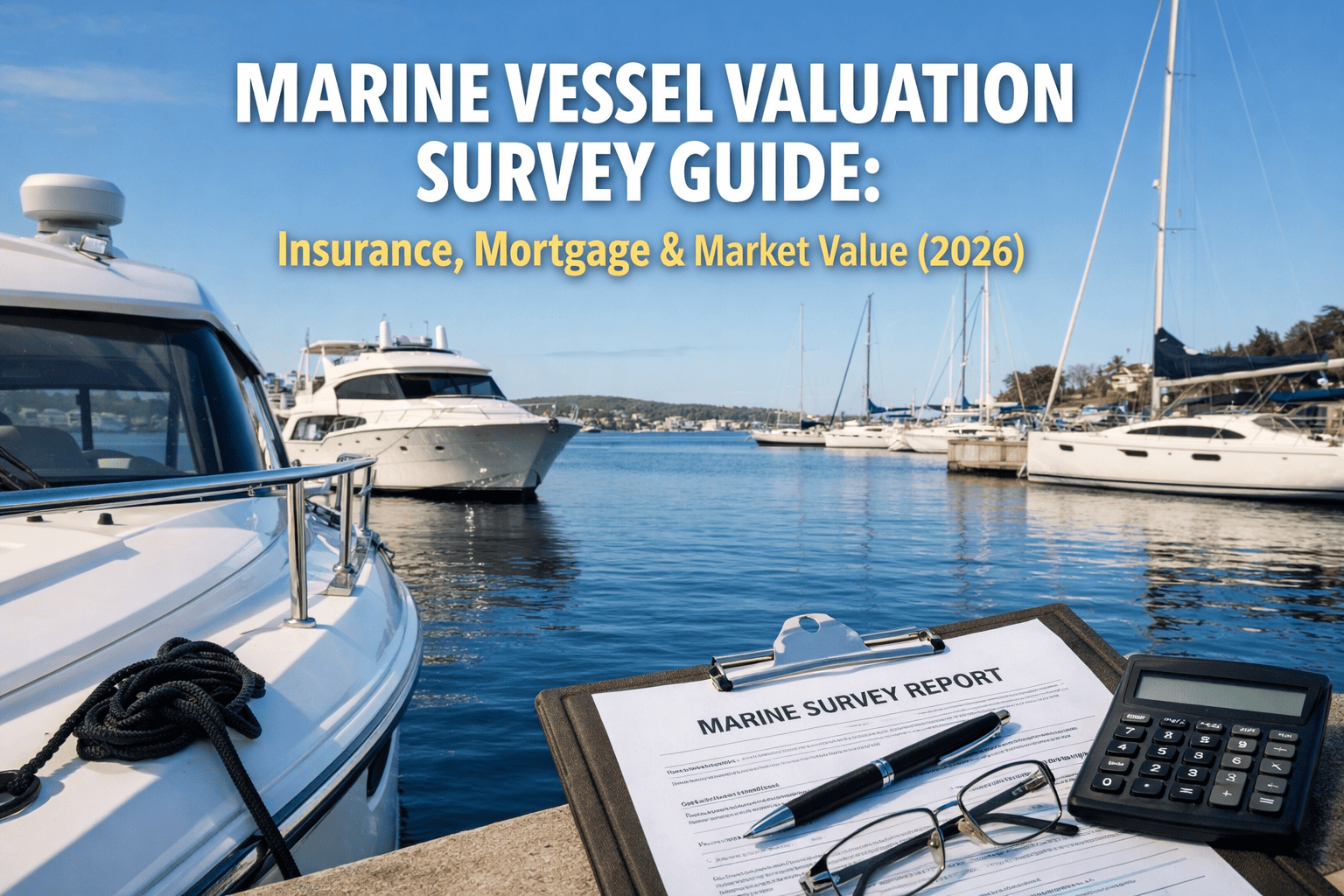
Whether you're insuring a yacht, financing a boat purchase, settling an estate, or preparing to sell, you need to know what your vessel is actually worth — and a professional marine valuation survey is how you get that number. Unlike cars, there is no universal "Blue Book" for boats. Online estimators give rough ballparks, but they can't account for the specific condition, equipment, maintenance history, and local market that determine your vessel's real value. A qualified marine surveyor or accredited appraiser examines the vessel firsthand and delivers a documented opinion of value that banks, insurers, and courts accept. This guide explains the types of valuation surveys, what drives a vessel's value, and how the process works. Boat owners looking to keep their vessel's condition — and value — documented over time can sign up for Marine Inspection's vessel management platform to maintain organized records from day one.
Marine Vessel Valuation Survey: Key Facts
3 Methods
Valuation Approaches
Market comparison · Cost · Income
2 Values
Typically Reported
Fair Market Value + Replacement Cost
SAMS / NAMS
Surveyor Credentials
Accredited by professional organizations
USPAP
Appraisal Standard
Uniform Standards of Professional Appraisal Practice
Types of Marine Valuation Surveys
Different situations call for different types of valuation surveys. The level of detail, purpose, and who accepts the report varies significantly. Understanding which type you need saves time and money.
Insurance Valuation
Required by Insurers to Set Coverage
Insurance companies need to know the vessel's value to determine coverage amounts and assess risk. Most insurers require a survey on older boats (typically 10+ years) or high-value vessels. The report covers structural integrity, seaworthiness, safety equipment, and fair market value. Insurers may require renewal surveys every 3–5 years.
Mortgage / Financing
Required by Lenders to Approve Loans
Banks and marine lenders require a valuation to confirm the vessel's worth matches or exceeds the loan amount — protecting their Loan-to-Value (LTV) ratio. The surveyor provides a Condition & Valuation (C&V) report with fair market value that the lender uses to approve or adjust financing terms.
Pre-Purchase Valuation
Confirms the Asking Price Is Fair
The most comprehensive survey type. Includes full condition assessment plus fair market and replacement values. Gives the buyer data to negotiate the purchase price, satisfy insurance requirements, and secure financing — often all from a single survey report.
Estate / Legal / Donation
Court-Accepted Value Documentation
Estate settlements, divorce proceedings, charitable donations, and tax filings all require a documented fair market value from an accredited appraiser. The IRS, courts, and legal counsel recognize professional marine surveyors as qualified vessel appraisers within their area of expertise.
Fair Market Value vs Replacement Cost: What's the Difference?
Most valuation survey reports include two distinct value figures. Understanding what each means — and when each applies — prevents confusion and ensures you're properly covered.
Fair Market Value vs Replacement Cost
Aspect
Fair Market Value (FMV)
Replacement Cost Value (RCV)
Definition
Price a willing buyer would pay a willing seller, neither under pressure
Cost to replace the vessel with one of similar type, age, and condition today
Based On
Comparable sales data, current market conditions, vessel condition
Current new-build cost minus depreciation, or cost of equivalent used vessel
Used For
Purchase negotiations, estate settlement, donations, tax filings, financing
Insurance coverage amounts, total loss claims, underwriting decisions
Typically
Lower — reflects actual resale market
Higher — reflects cost to make the owner whole after a loss
Why It Matters
Overpaying on purchase, undervaluing for estate, incorrect tax deductions
Underinsured = out-of-pocket loss; overinsured = paying unnecessary premiums
Review your insured value annually. If the marine market has shifted (as it did dramatically post-2020), your vessel could be significantly under- or over-insured relative to current replacement costs. A quick valuation update can save thousands in premiums or prevent a devastating shortfall on a total loss claim.
The 3 Valuation Approaches Appraisers Use
Professional appraisers — particularly those accredited by the American Society of Appraisers (ASA) — use three recognized approaches to estimate a vessel's value. Most marine valuations rely primarily on the first two, but all three may be applied depending on the vessel type and purpose.
The most common method for recreational vessels. The appraiser researches recent sales of comparable vessels — same make, model, year, condition, and equipment — and adjusts for differences. Sources include broker databases, auction results, NADA/J.D. Power guides, and industry sales records. Adjustments are made for location, engine hours, upgrades, and condition.
Most common for boats & yachts
Calculates the current cost to build or acquire a new equivalent vessel, then subtracts depreciation for age, wear, and obsolescence. Useful when comparable sales data is limited — such as custom-built vessels, one-off designs, or heavily modified boats where no true "comparable" exists in the marketplace.
Best for unique or custom vessels
Values the vessel based on the income it can generate — relevant for commercial vessels, charter boats, and working craft. The appraiser estimates future revenue, applies operating expenses and a capitalization rate, and calculates present value. Rarely used for private recreational vessels but essential for commercial marine appraisals, financing, and fleet valuations.
Commercial vessels, charter boats & working craft
What Factors Determine Your Vessel's Value?
Appraisers consider a wide range of factors — some obvious, some surprising. Here are the key variables that move the needle on your valuation.
Key Factors in Marine Vessel Valuation
1
Make, Model & Year — Brand reputation and model desirability drive baseline value. Some builders hold value far better than others.
2
Overall Condition — Hull integrity, gelcoat, topsides, interior, and cosmetic appearance. Well-maintained vessels command significant premiums.
3
Engine Hours & Type — Low-hour engines add value. Repower history, fuel type (diesel vs gas), and engine brand all matter.
4
Maintenance Records — Documented service history is proof of care. Gaps in records raise questions and reduce value.
5
Upgrades & Equipment — New electronics, canvas, rigging, or systems upgrades can increase value — but rarely at dollar-for-dollar return.
6
Location & Market — Regional demand, seasonal timing, and local inventory levels directly affect what buyers will pay.
7
Storage History — Freshwater vs saltwater, covered vs exposed, indoor vs outdoor storage. Each impacts long-term condition and value.
8
Damage & Repair History — Previous groundings, collisions, or insurance claims reduce value — especially if repairs were not professionally completed.
9
Regulatory Compliance — Current safety equipment, up-to-date certifications, and compliance with USCG/ABYC standards support higher valuations.
Protect Your Vessel's Value with Documented History
Marine Inspection helps owners maintain organized maintenance records, inspection reports, and photo documentation — the evidence appraisers and insurers look for when determining your vessel's worth.
Survey vs Appraisal: What's the Difference?
These terms are often used interchangeably, but they serve different purposes and may require different credentials.
Marine Survey vs Marine Appraisal
Aspect
Marine Survey
Marine Appraisal
Focus
Physical condition, safety, seaworthiness, systems functionality
Monetary value — what the vessel is worth in the market today
Performed By
Certified Marine Surveyor (SAMS-AMS, NAMS-CMS)
Accredited Appraiser (ASA) or surveyor with appraisal credentials
Output
Condition report with findings, defects, and recommendations
Value opinion supported by market data, methodology, and USPAP compliance
Best For
Buying, insuring, or assessing a vessel's physical state
Financing, legal proceedings, tax filings, estate settlement
Many marine surveyors provide both condition assessment and a fair market value estimate in a single Condition & Valuation (C&V) report. However, for high-value vessels, legal proceedings, or complex financing, a formal USPAP-compliant appraisal from an ASA-accredited appraiser may carry more weight with courts, the IRS, and institutional lenders.
How to Prepare for a Valuation Survey
A well-prepared vessel leads to a smoother, faster survey — and often a better valuation outcome.
Before the Surveyor Arrives
Gather all documentation — Registration, title, maintenance records, previous survey reports, receipts for upgrades and repairs, engine service logs, and warranty information.
Clean the vessel thoroughly — First impressions matter. A clean, well-presented boat signals care and maintenance. Clear access to all compartments, bilges, and engine spaces.
Ensure all systems are operational — Charge batteries, top off fluids, check that electronics power on, and verify bilge pumps and navigation lights work. Non-functional systems may be noted as deficiencies.
List recent upgrades with receipts — New electronics, canvas, engines, or systems upgrades should be documented with dates and costs. Upgrades without documentation may not be fully reflected in the valuation.
Arrange haul-out if needed — Many valuation surveys include a below-waterline inspection. Coordinate with the boatyard for a short haul. The surveyor needs the hull exposed and pressure-washed for proper assessment.
Online Estimators vs Professional Valuation
Online tools have their place — but understanding their limits prevents costly mistakes.
Online Tools (NADA / J.D. Power / BUCValu)
Useful Starting Point — Not a Final Answer
Online guides provide a general price range based on make, model, and year. They cannot account for actual condition, engine hours, specific equipment, maintenance history, regional market variations, or modifications. Banks and insurers rarely accept online estimates alone for significant transactions. Best used for initial research before hiring a professional.
Professional Surveyor / Appraiser
Accepted by Banks, Insurers & Courts
A professional inspects the vessel firsthand, applies recognized valuation methodologies, adjusts for vessel-specific factors, and delivers a documented report. This opinion of value is accepted by lenders for marine mortgages, insurers for coverage, the IRS for donations and estates, and courts for legal proceedings. It reflects what your specific vessel is actually worth — not what an average example might sell for.
Keep Your Vessel's Value Documented Year-Round
Maintenance records, inspection histories, and photo documentation all support higher valuations. Marine Inspection gives you one platform to track everything — so when the surveyor arrives, you're ready.
Frequently Asked Questions
What is the difference between fair market value and replacement cost?
Fair market value (FMV) is the price a willing buyer would pay a willing seller in an open market, with neither under pressure. Replacement cost value (RCV) is what it would cost to replace the vessel with one of similar type, age, and condition today. RCV is typically higher and is used for insurance coverage, while FMV is used for purchase negotiations, financing, estates, and tax purposes.
Do I need a valuation survey for boat insurance?
Most insurers require a survey on older vessels (typically 10+ years), high-value boats, or when establishing a new policy. The survey confirms the vessel is an acceptable risk and establishes the insured value. Some insurers require renewal surveys every 3–5 years. Even when not required, a current valuation ensures you're neither underinsured nor paying premiums on an inflated value.
How much does a valuation survey cost?
Insurance and valuation surveys typically cost $14–$25 per foot — less than a full pre-purchase survey ($25–$40/ft) because they're less comprehensive. A Condition & Valuation (C&V) survey that combines condition assessment with fair market value falls in between. Haul-out fees ($10–$15/ft) and travel fees may apply separately.
Can I use an online boat value calculator for insurance or financing?
Online tools like NADA (J.D. Power) and BUCValu provide general price ranges but cannot account for your vessel's specific condition, equipment, or maintenance history. Banks and insurers rarely accept online estimates alone for significant transactions. A professional survey or appraisal is typically required for marine mortgages, insurance policies on older or high-value vessels, estate settlement, and tax filings.
How often should I get my vessel revalued?
As a general rule, every 3–5 years or whenever a significant event occurs — major upgrades, engine repower, market shifts, damage and repair, or changes in intended use. Insurers may require more frequent surveys on older vessels. Keeping current ensures your coverage matches actual value and prevents surprises at claim time.