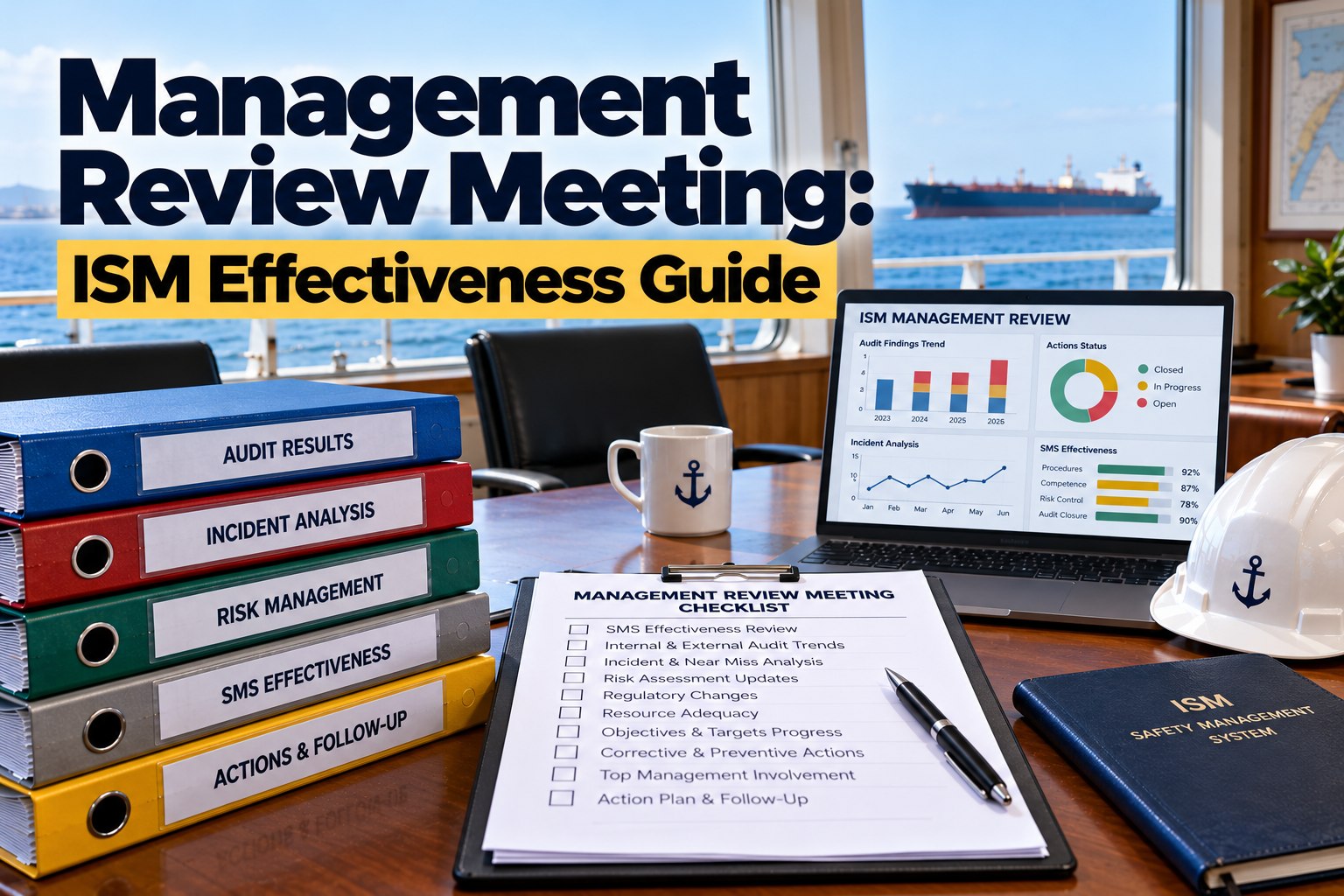
The annual management review is the one meeting where top management is expected to look at the whole safety management system and decide what changes. Too often it becomes a slide pack nobody acts on. This guide shows DPAs how to prepare a review that meets the ISM Code, uses audit trends and incident analysis properly, and produces decisions an auditor can follow, with every input collected automatically in Marine Inspection.
Management review meeting: prove the SMS works and decide what changes
A management review has two jobs: judge whether the safety management system is effective, and commit resources to fix what is not. If the minutes show no decisions, the review did not happen in any meaningful sense.
Minimum inputs (IMO company guidelines)
What the ISM Code requires from a management review
The ISM Code does not use the words “management review meeting”, but it requires the outcome. IMO’s guidelines for companies (MSC-MEPC.7/Circ.8) describe how the review should work in practice. Fleets that want to see these duties tracked can ask for a demo.
Evaluate effectiveness
The company periodically evaluates the effectiveness of the SMS and, when needed, reviews it, following its own procedures.
Master’s review
Each master periodically reviews the SMS and reports its deficiencies to shore-based management.
DPA monitors
The designated person, with direct access to the highest level of management, monitors the evaluation and review of SMS effectiveness.
Review and communicate
Reviews are periodic or triggered by events such as serious system failures; deficiencies get corrective action and results are formally communicated to the people involved.
Management review inputs: the minimum data set and what to add
The IMO guidelines list five minimum inputs. A useful review adds the measures that show direction over time, so the meeting can see whether last year’s decisions worked. Our ISM internal audit guide covers the audit side; collect every input automatically, free.
- Internal audit results, ship and shore
- Non-conformities reported by personnel
- Masters’ reviews from every ship
- Analysis of non-conformities, accidents and hazardous occurrences
- External evidence: PSC reports, flag and class audits
- Status of actions from the last review
- Safety and environmental objectives against targets
- Vetting results and SIRE 2.0 observation trends for tankers
- Near-miss reporting rates and themes
- Management of change: what changed and how it went
- Coming regulatory changes and resource needs
Audit trends for the management review: seeing direction, not snapshots
A list of this year’s findings tells management very little. Trends over several years show whether the system is getting better, and where it is not. Present a few measures the same way every year so the meeting can compare. The tiles below are illustrative.
Illustrative figures. Repeat findings rising while total findings fall usually means corrective actions are not removing root causes.
Incident analysis for the management review: what the data should answer
Incident analysis is where the review earns its value. The question is not how many incidents happened but what they have in common, and whether the system would stop the next one. Treat PSC findings as signals too: DNV notes that ISM-related detentions often build up from several deficiencies that are not detainable on their own. Our PSC deficiency codes guide explains how those findings are coded.
For context, ISM Code items made up 4.6% of all Paris MoU deficiencies in 2024.
Walk into the review with the data already prepared
Audit trends, incident themes, masters’ reviews and last year’s actions gathered into one review pack, ready for top management.
Top management involvement in the ISM management review
The ISM Code expects the designated person to have direct access to the highest level of management, and the review is where that access is used. Auditors look at who attended and whether the minutes show decisions only top management can make. See attendance and decisions recorded.
Who should attend
Decisions only they can make
- Approve resources: people, budget, training, equipment
- Set or revise safety and environmental objectives
- Approve significant SMS changes
- Accept or reject risks that cannot be removed
- Assign owners for system-level actions
Management review meeting agenda
A fixed agenda keeps the review focused and makes year-on-year comparison easy. Send the pack at least a week before, so the meeting discusses decisions rather than reading data. Use this agenda as a free template.
Management review outputs auditors look for
External auditors judge the review by its outputs. They look for decisions, owners and dates, evidence that results reached the fleet, and proof the actions were followed up. If findings did become a formal non-conformity, our major non-conformity recovery guide covers what follows.
Management review preparation checklist
Tick these items before and after the meeting. The DPA usually owns this list.
How Marine Inspection makes management review actions stick
The weakest part of most reviews is what happens after the meeting. Marine Inspection builds the review pack from live fleet data and carries every decision forward as a tracked action, so the next review opens with an honest account of what was done. The ledger below is an illustrative example.
ISM management review FAQs
Does the ISM Code require a management review?
The Code requires the company to periodically evaluate the effectiveness of the SMS and review it when needed (12.2). IMO’s guidelines for companies describe this as a management review and list its minimum inputs.
How often should the management review be held?
Most companies hold it at least once a year, and the IMO guidelines also call for a review when needed, for example after a serious system failure.
What are the minimum inputs?
Internal audit results, non-conformities reported by personnel, masters’ reviews, analysis of non-conformities, accidents and hazardous occurrences, and external evidence such as PSC inspection reports.
What is the master’s review?
The master’s periodic review of the SMS on board, with deficiencies reported to shore management, as ISM 5.1.5 requires. It is a required input to the management review.
What role does the DPA play?
The DPA monitors the evaluation and review of SMS effectiveness and has direct access to top management. In practice the DPA usually prepares the review pack and tracks the actions.
What do auditors check in management review records?
That the required inputs were reviewed, top management took part, decisions were made with owners and dates, results were communicated, and actions were followed up. Marine Inspection can keep that trail for every review.
One review a year, twelve months of follow-through
Give top management a review built on live fleet data, and give the DPA a way to make every decision stick.