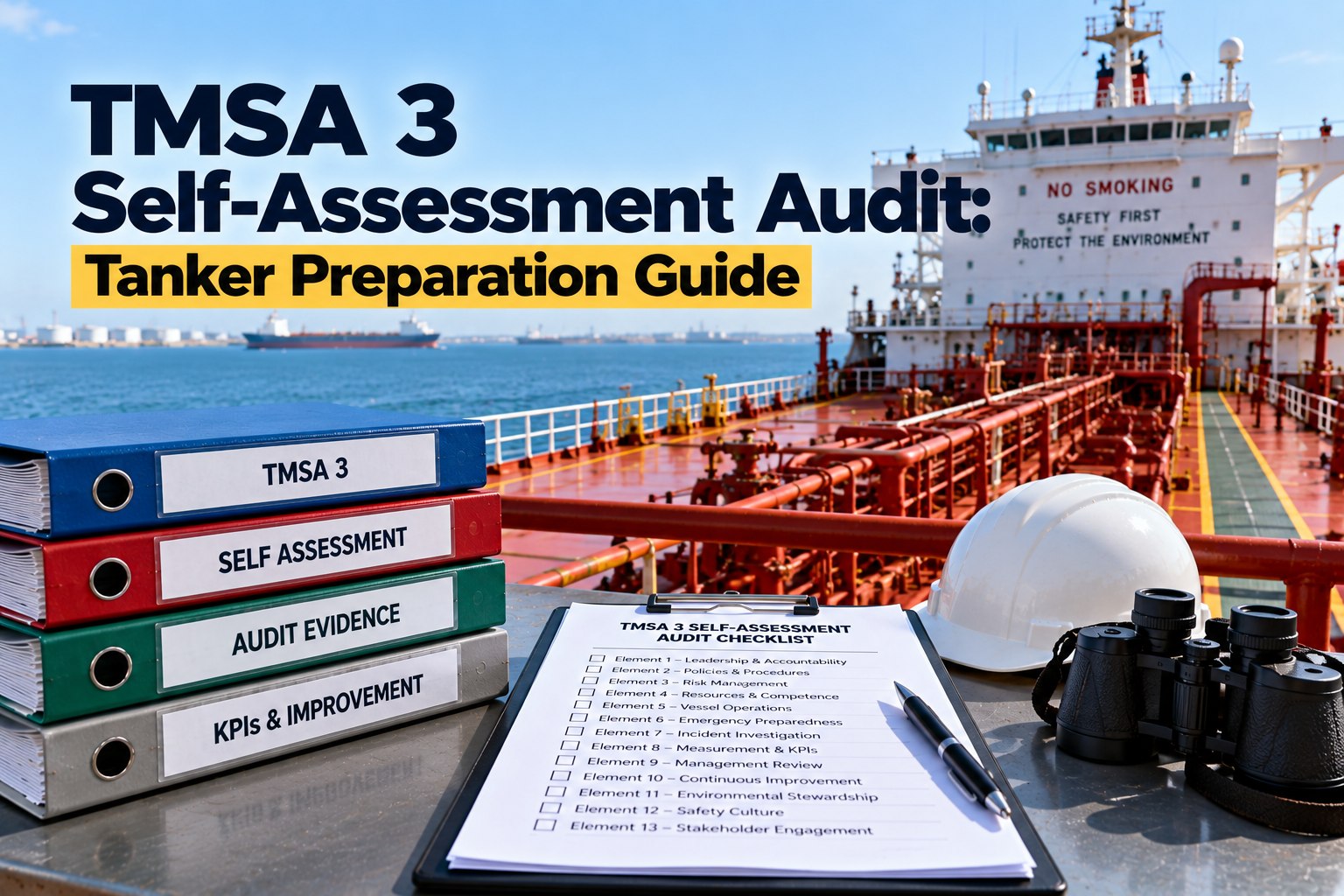
A TMSA 3 self-assessment is only as good as the evidence behind each stage claimed. Oil major vetting teams read it alongside SIRE 2.0 reports, and a stage that the fleet’s inspection record contradicts does more harm than a modest score. This guide walks QHSE managers through the 13 elements, the stages, the KPIs and the evidence each one needs, and shows how to keep TMSA evidence live in Marine Inspection.
TMSA 3 self-assessment audit: claim the stage you can prove on every ship
TMSA measures the company ashore against four stages of management practice. Stage 1 is the minimum; each stage above it needs more evidence, more measurement and more improvement shown over time.
General pattern only; the exact KPIs for each stage are in the TMSA 3 guide.
TMSA 3 elements: the 13 areas of tanker management
TMSA 3, published by OCIMF in April 2017, groups shore management into 13 elements, six of them with an “A” sub-element. Element 13, maritime security, was new in this edition. Each element carries its own KPIs and best practice guidance for every stage. See evidence organised by element.
Sub-elements: 1A developing and maintaining the SMS; 3A wellbeing of vessel personnel; 4A critical equipment; 6A mooring and anchoring; 9A fleet monitoring; 12A audits.
TMSA stages: what changes between stage 1 and stage 4
Each stage builds on the one below, so a company cannot sit at stage 3 in an element without meeting stages 1 and 2 first. In practice the step up is less about new procedures and more about evidence: measurement, trend analysis and proof that results drive change. Track stage evidence per element free.
| Stage | What it looks like | Typical evidence an assessor asks for |
|---|---|---|
| Stage 1 | Procedures exist and meet the ISM Code and basic industry expectations | Approved procedures, responsibilities defined, records kept |
| Stage 2 | Procedures are applied consistently and results are measured | KPIs collected for every vessel, internal audit results, training records |
| Stage 3 | Results are analysed and acted on before problems occur | Trend analysis, management review minutes, actions closed with effect shown |
| Stage 4 | The company leads practice and improves continuously | Several years of improving trends, benchmarking, shared lessons, innovation |
TMSA evidence: what proves a stage is met
A TMSA claim is a statement about the whole fleet, not the best-run ship. Before marking a stage achieved, check that the evidence exists in all five forms below and covers every vessel in scope. If one ship cannot show it, the stage is not met. See evidence coverage per vessel.
Written process
The procedure exists, is current and says who does what.
Records from every vessel
The process leaves records on each ship, not just the flagship.
Measured results
KPIs calculated the same way across the fleet, over time.
Review and action
Management review shows the results were discussed and acted on.
People who can explain it
Shore staff and officers can describe how the process works in practice.
Running the TMSA 3 self-assessment: six steps
OCIMF recommends re-taking the self-assessment every 12 months. Treat it as an internal audit with owners and deadlines, not a form filled in once a year by the QHSE office. Assign element owners and deadlines free.
Assign element owners
A shore manager owns each element and its evidence, not QHSE alone.
Gather evidence first
Collect records and KPIs before scoring, so the score follows the evidence.
Score with a challenger
Someone outside the element tests each claim, as a vetting assessor would.
Compare with vessel results
Check the claims against SIRE 2.0 observations, PSC findings and incidents.
Plan the next stage
Turn each gap into an action with an owner and a date.
Publish and repeat
Submit through the OCIMF tool and review progress at the next management review.
Keep every TMSA claim in balance with its proof
Link each element’s stage to live fleet records and KPIs, so the self-assessment reflects what the ships are actually doing.
TMSA KPIs: measuring shore management the same way across the fleet
KPIs are what move an element from stage 1 to stage 2 and beyond. The official KPIs are set out per element in the TMSA 3 guide; the examples below are the kind of fleet measures companies use to support them. What matters is that each is defined once and calculated the same way for every ship.
Examples for illustration, not the official TMSA KPI list.
Aligning the TMSA self-assessment with SIRE 2.0 vessel inspections
SIRE 2.0 looks at the ship; TMSA looks at the office that runs it. Vetting departments read both, so they must tell the same story. If the self-assessment claims a high stage in navigational safety while SIRE 2.0 reports keep finding bridge team issues, the claim loses credibility. Our SIRE 2.0 fleet readiness guide covers the vessel side; see both linked in one view.
Open SIRE 2.0 observations that repeat across ships point to a shore management gap. The open defect list guide shows how to keep them from recurring.
TMSA 3 self-assessment checklist
Run through these items before publishing the self-assessment. They are the questions a vetting assessor will ask during an office visit.
How Marine Inspection keeps the TMSA self-assessment honest
The most common TMSA weakness is a stage claimed on confidence rather than evidence. Marine Inspection compares the stage claimed for each element with the stage the fleet’s live records support, so gaps show up in the office before they show up in a vetting review. The chart below is an illustrative example for six elements.
Element 5: stage 4 claimed, but four of nine ships had bridge team observations in their last SIRE 2.0 inspection. Element 12A: evidence supports a higher stage than claimed.
TMSA 3 self-assessment FAQs
What is TMSA 3?
The third edition of OCIMF’s Tanker Management and Self-Assessment guide, published in 2017. It helps tanker operators measure their management systems against 13 elements and four stages of best practice.
How often should the TMSA self-assessment be done?
OCIMF recommends re-taking the self-assessment every 12 months, and many companies also review progress at each management review.
What are the four TMSA stages?
Stage 1 is the minimum expected standard. Stages 2 to 4 are increasing levels of best practice, moving from consistent measurement to proactive analysis and finally continuous improvement and leadership.
Which element was added in TMSA 3?
Element 13, maritime security. TMSA 3 also expanded the best practice guidance and reflected newer rules such as the Polar Code and the Ballast Water Management Convention.
How does TMSA relate to SIRE 2.0?
SIRE 2.0 inspects the vessel; TMSA assesses the company ashore. Vetting departments consider both, so the stages claimed in TMSA should be consistent with what SIRE 2.0 inspections find on the fleet.
What is the biggest TMSA mistake?
Claiming a stage that the evidence cannot support across every ship. An honest lower stage with a clear improvement plan carries more weight. Marine Inspection can show where evidence falls short.
Thirteen elements, one honest picture of the fleet
Build the TMSA self-assessment on live fleet evidence and keep it consistent with what SIRE 2.0 sees on board.