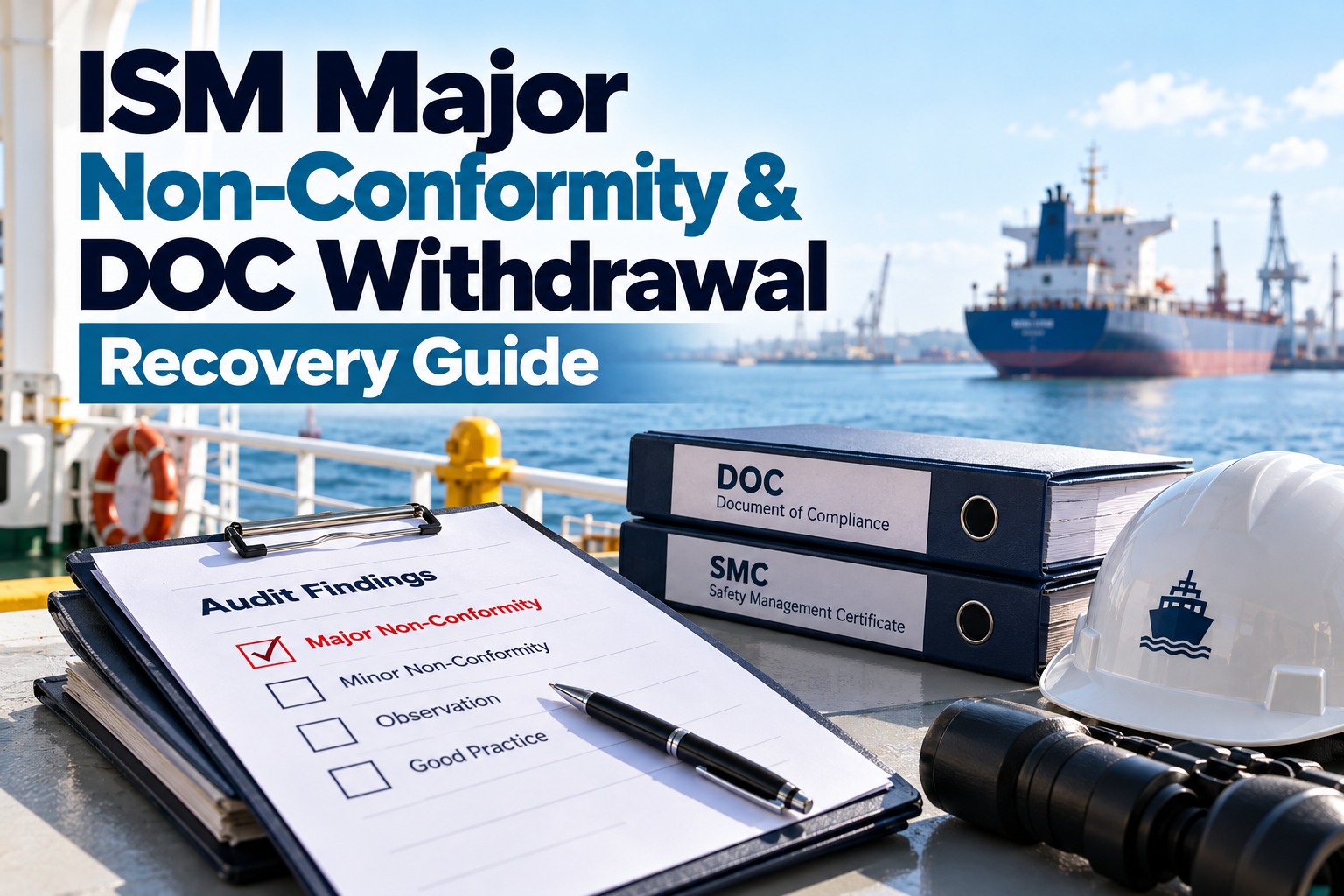
A major non-conformity is the ISM finding that can stop a ship trading. Under the IACS procedure, a DOC or SMC cannot be issued, endorsed or renewed while one exists, a ship with a withdrawn SMC or DOC must not sail until the certificate is reissued, and port state control can detain a ship that sails without a valid one. For the Designated Person Ashore (DPA) the days after a major are the real audit: top management wants a date, the auditor wants evidence and the ship wants to know if it can leave. This guide explains what triggers a major, how it escalates to certificate withdrawal, a response plan for the first days and the recovery path back to valid certification. Build your non-conformity recovery plan in Marine Inspection to keep every finding, action and verification in one traceable record. Rules differ by flag and recognized organization, so confirm the exact path with yours.
Major Non-Conformity: The Clock Starts at the Closing Meeting
3 months
Normal Fix Limit
Corrective actions should not normally exceed this
0
Interim DOC
None issued after a DOC withdrawal
1+
Extra Shipboard Audit
To verify the corrective action worked
Before sailing
Downgrade Deadline
A ship major must be downgraded before it departs
Free trial available. Or book a walkthrough built around your own findings.
How a Finding Escalates Toward Certificate Withdrawal
LEVEL 1
Non-conformity
Corrective action within the agreed time.
LEVEL 2
Major non-conformity
Immediate action. Downgrade before the ship sails. Fix plan under 3 months.
LEVEL 3
SMC withdrawn
The ship must not operate until the SMC is reissued.
LEVEL 4
DOC withdrawn
No interim DOC. Full initial verification. SMCs follow.
What Triggers a Major Non-Conformity
A
A serious threat
An identifiable deviation that poses a serious threat to the safety of personnel or the ship, or a serious risk to the environment, requiring immediate corrective action.
B
A systemic failure
A lack of effective and systematic implementation of an ISM Code requirement, even when no single event looks serious.
C
A weak response
Failing to take adequate corrective action, including measures to prevent recurrence, may itself be treated as a major non-conformity.
Wording follows the IACS ISM procedure (PR 9) and IMO Resolution A.1118(30). Situations that could meet these tests, such as drills not carried out, safety-critical maintenance skipped without a recorded reason or corrective actions left open with no owner, are our own illustrations, not a published list.
The third trigger is the one a DPA controls most. Track corrective actions free so no finding goes quiet between audits.
The Ripple Effect When a DOC Is Withdrawn
1
Company DOC withdrawn
The finding sits in the company's SMS, not one ship.
→
2
SMCs withdrawn
Ship certificates tied to that DOC follow it.
→
3
Ships must not operate
Until the DOC is reissued, even if an SMC looks valid.
→
4
PSC can detain
Port states may detain or revoke permits to stop operation.
First-Days Response Plan: Who Does What
Timings are our suggested working model. The only fixed point in the sources is that the corrective-action schedule should not normally exceed three months. Agree dates with your flag or RO.
Two Recovery Tracks to Valid Certification
Track A: Downgrade and Close Out
1Take verifiable action that removes the serious threat
2Auditor downgrades the major so the ship may sail
3Complete corrective actions, normally within 3 months
4At least one additional shipboard audit verifies the fix
5Certificates stay valid, or are issued or endorsed
Track B: Withdrawal and Reinstatement
1DOC or SMC withdrawn. Ships stop operating
2Close all outstanding non-conformities
3Initial-scope verification. No interim DOC is issued
4DOC reissued first, then SMCs after ship verification
5New certificates keep the original expiry date
Track B follows the IACS procedure: SMC verification covers at least one ship of each type the company operates. Some flags add their own steps, for example written notice to the master and Administration and closure confirmed by additional audit.
Close Out Findings Before They Escalate
Assign owners, set dates, attach evidence and show an auditor the full close-out trail for every non-conformity.
Free trial available. Or book a walkthrough built around your own findings.
The Close-Out File an Auditor Wants to See
01
Immediate correction
What was done to remove the threat, with dated proof.
02
Root cause
Why the SMS allowed it, not just who made the mistake.
03
Systemic fix
Revised procedure, training or resources that prevent recurrence.
04
Fleet check
Proof that sister ships were checked for the same gap.
05
Effectiveness check
A later verification showing the fix is working.
Response Mistakes That Stretch the Recovery
Fixing the instance only
Show the system change as well, since the Code expects measures to prevent recurrence.
Blaming the individual
Root cause should reach resources, procedures, training or supervision.
Leaving other ships unchecked
Run the same check across the fleet and record the result.
Missing the agreed date
Ask for a documented extension early, before the deadline passes.
These four points are practical advice from our reading of the guidance, not an official list.
Can a ship sail with a major non-conformity?
Under the IACS procedure a major non-conformity on a ship must be downgraded before the ship departs, and downgrading requires verifiable action that removes the serious threat. The ship cannot simply sail with an open major.
How long do we have to fix it?
The corrective-action schedule should not normally exceed three months from the audit, with at least one additional audit within the agreed time. Your flag or RO sets the exact dates.
Can we get an interim DOC after a withdrawal?
No. After a DOC is withdrawn for a major non-conformity, a new DOC needs initial verification and no interim DOC is issued. Interim SMCs are not issued to the affected ships either.
Does a withdrawn DOC affect every ship?
What is the port state control role?
Port states may ask the Administration about certificate validity. If a certificate has been withdrawn, IMO's procedure says the port state should ensure the ship does not operate, using detention or permit revocation where needed.
Be Ready Before the Next Closing Meeting
One system for non-conformities, root-cause records, corrective actions and verification evidence across the whole fleet.
Free trial available. Or book a walkthrough built around your own findings.