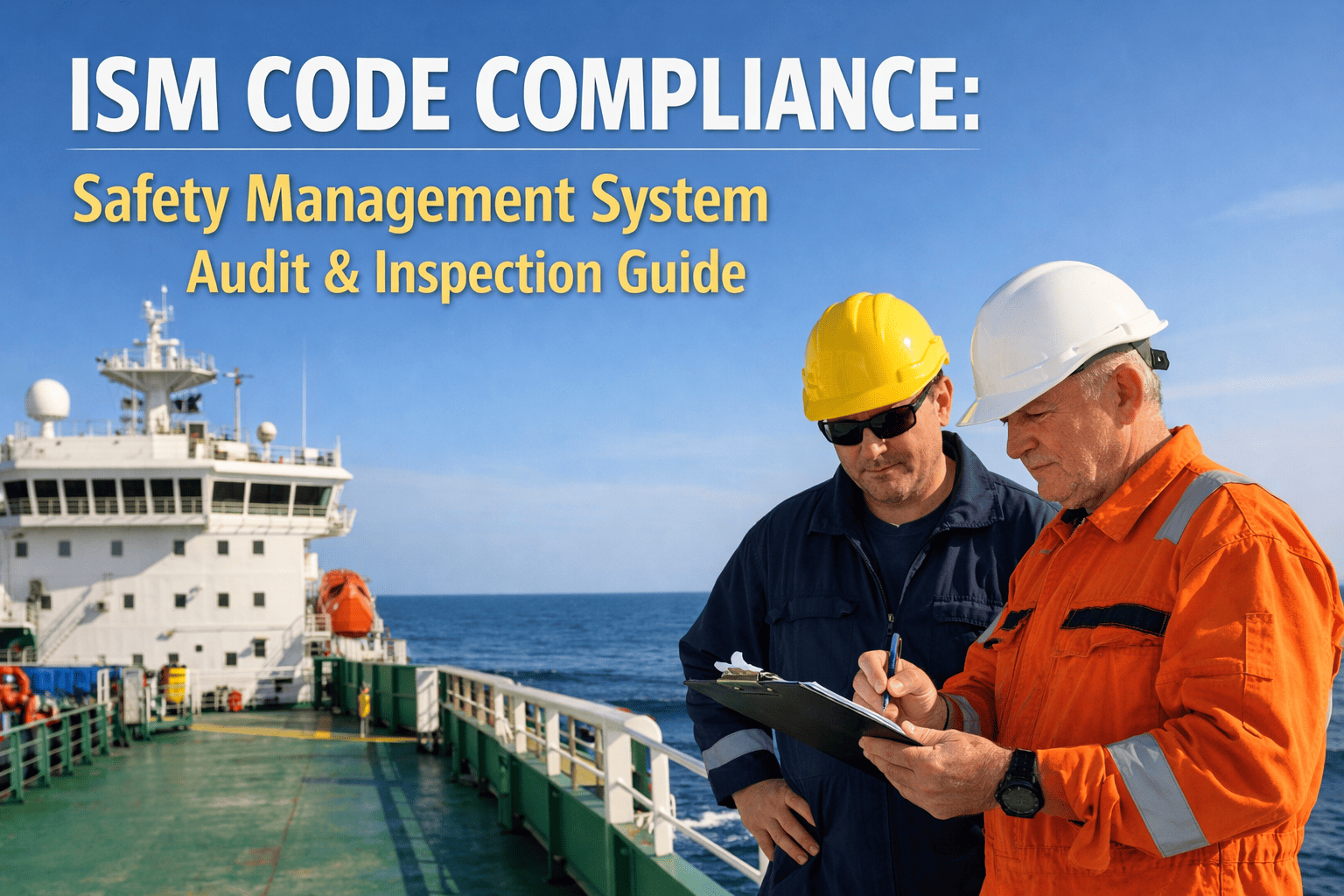
The ISM Code is the backbone of every vessel's safety and environmental compliance — and it's also the mechanism that turns multiple minor deficiencies into a detention. During PSC inspections, a pattern of individually non-detainable findings across fire safety, navigation, MARPOL, and crew competency can collectively demonstrate "a failure, or lack of effectiveness, of the implementation of the ISM Code" — triggering an ISM deficiency (code 15150) that is detainable. ISM-related deficiencies consistently rank among the top causes of PSC detentions globally. The good news: PSCOs do not perform safety management audits — they assess ISM implementation through the vessel's actual condition and crew competence. If your SMS is genuinely implemented (not just documented), the ISM component of any inspection takes care of itself. This guide covers the ISM Code structure, what PSCOs and auditors actually check, the DOC/SMC certification cycle, and how to prepare for both external audits and PSC inspections. Operators building a stronger safety management system can sign up for Marine Inspection or schedule a demo to see how non-conformities, corrective actions, and audit readiness connect in one platform.
ISM Code Compliance: Key Reference Numbers
SOLAS IX
Legal Basis
Mandatory under SOLAS Chapter IX, Regulation 3
DOC + SMC
Two Certificates
Document of Compliance (company) + Safety Management Certificate (ship)
≤12 months
Internal Audit Interval
Company must audit onboard & ashore annually
15150
PSC Deficiency Code
ISM Code deficiency — can be ground for detention
The 13 Elements of the ISM Code
Every Safety Management System must address these 13 functional areas. Auditors and inspectors assess compliance against each element — and weaknesses in any one can cascade into findings across others. Book a demo to see how Marine Inspection maps your SMS against every element.
ISM Code: 13 Functional Elements
1
General — Definitions, objectives, application. The SMS must provide safe practices and a safe working environment.
2
Safety & Environmental Policy — Company policy documented, implemented at all levels, understood by crew.
3
Company Responsibility & Authority — Clear definition of who is responsible for what. Documented organizational structure.
4
Designated Person (DPA) — Shore-based person with direct access to highest management. Monitors safety and pollution prevention.
5
Master's Responsibility — Master reviews SMS, reports deficiencies to shore. Overriding authority preserved in all circumstances.
6
Resources & Personnel — Crew qualifications, training, familiarization. Manning compliance. Language requirements for safety communication.
7
Shipboard Operations — Procedures for key operations, checklists, and standing orders. Covers navigation, cargo, machinery, and pollution prevention.
8
Emergency Preparedness — Emergency procedures, drills, response plans (SOPEP, fire, abandon ship, pollution). Tested regularly.
9
Non-Conformity Reporting — System for reporting, investigating, and correcting NCRs, accidents, and hazardous occurrences.
10
Maintenance of Ship & Equipment — Planned maintenance system. Inspections at appropriate intervals. Critical equipment identified and tested.
11
Documentation — SMS documents controlled, available, and reviewed. Obsolete documents removed. Accessible to all relevant personnel.
12
Company Verification, Review & Audit — Internal audits ≤12 months. Management reviews. Results communicated to personnel.
13
Certification & Verification — DOC for company, SMC for ship. Interim certificates for new companies/ships. External verification by flag/RO.
DOC & SMC: The Certification Cycle
The Document of Compliance (DOC) and Safety Management Certificate (SMC) are the two ISM certificates inspectors verify first. Understanding the certification cycle prevents the administrative failures that lead to immediate deficiencies.
DOC vs SMC: Side-by-Side
Feature
DOC (Document of Compliance)
SMC (Safety Management Certificate)
Issued To
The Company (ISM operator)
The Ship
Validity
5 years (annual verification required)
5 years (intermediate verification between 2nd–3rd anniversary)
Interim Period
Up to 12 months (new company or new ship type)
Up to 6 months (extendable by 6 months max in special cases)
Onboard?
Copy required onboard (not original)
Original required onboard
Key Link
Must cover the ship type of every vessel operated
Not valid unless the company holds a valid DOC for that ship type
If Invalid
All SMCs linked to that DOC become invalid
Vessel subject to detention until valid SMC obtained
What PSCOs Check: ISM During Port State Control
PSCOs do not perform safety management audits — that is the flag state's responsibility. But they assess ISM implementation through what they observe. Here's the critical distinction and what triggers an ISM deficiency. Schedule a demo to see how Marine Inspection helps you stay ISM-ready for PSC.
Immediate Detention
Missing or Invalid DOC/SMC
No SMC, no Interim SMC, and/or no copy of the DOC or Interim DOC onboard = detention. The SMC is not valid if the company's DOC doesn't cover that ship type, or if the company details on the SMC don't match the DOC. Overdue intermediate verification also invalidates the SMC. Minor typing errors in certificates are recorded as technical deficiencies — not ISM findings.
Detention Risk
The "Cumulative Effect" — Multiple Deficiencies = ISM Failure
This is the mechanism that catches operators off guard. Multiple individually non-detainable deficiencies across different areas — fire safety, navigation, MARPOL, crew competency — can collectively demonstrate ISM system failure. The PSCO records each deficiency normally, marks relevant ones as "ISM-related," and then records an additional ISM deficiency (code 15150) that is ground for detention. This requires a safety management audit by the flag state or RO before release.
ISM-Related Finding
Deficiencies Showing Non-Effective Implementation
A single deficiency considered a "failure of effectiveness" of the ISM Code triggers an ISM deficiency with action code requiring corrective action within 3 months. At a subsequent inspection (at least 3 months later), the PSCO verifies corrective actions were effective. If the same issues persist — particularly non-rectified or repeated deficiencies — escalation to detention becomes likely.
No ISM Issue
Clean Initial Inspection = No ISM Assessment
If no technical or operational deficiencies are found during the initial inspection, there is no need to consider the ISM aspect at all. The ISM assessment is only triggered when deficiencies exist. This is why continuous readiness is the best ISM strategy — a well-maintained vessel with competent crew simply doesn't generate the findings that open the door to ISM scrutiny.
Close Every NCR Before It Becomes an ISM Finding
Marine Inspection tracks non-conformities from identification through corrective action to close-out — ensuring the pattern of open findings that triggers ISM deficiencies never develops.
Preparing for ISM Audits: Internal & External
Your SMS faces two types of verification: internal audits (conducted by the company at least annually) and external audits (conducted by the flag state or Recognized Organization for DOC/SMC certification). Both assess the same 13 elements — but with different focus.
Frequency: At intervals not exceeding 12 months (may be extended by max 3 months in exceptional, documented circumstances). Conducted both onboard and ashore. Auditors: Must have completed relevant auditor training. Should be independent of the area being audited. Scope: Verify safety and pollution-prevention activities comply with the SMS. Review corrective actions from previous audits, PSC inspections, and flag state surveys.
Your own quality check — catch problems before external auditors do
Types: Initial audit (first certification), annual/intermediate verification, renewal audit (every 5 years), and additional audits (triggered by adverse PSC/incidents). Auditors: Flag state administration or authorized Recognized Organization (class society). Non-conformities: Minor NCR (corrective action required within agreed timeframe) or Major NCR (serious threat — immediate corrective action or DOC/SMC suspension).
DOC annual · SMC intermediate (2nd–3rd anniversary) · Renewal every 5 years
The Areas That Generate the Most ISM Findings
These are the SMS implementation areas where auditors and PSCOs most frequently identify weaknesses — each directly linked to an ISM Code element. See how Marine Inspection covers each area.
Non-Conformity & Corrective Action Management (Element 9)
Most common ISM finding: NCRs from previous inspections, audits, or surveys not closed out — or closed without effective corrective action. Root cause analysis missing. Recurrence of the same deficiency proves the SMS corrective action process isn't working. Auditors check: Is there a system for reporting, investigating, evaluating, and resolving non-conformities? Is it actually used?
Maintenance of Ship & Equipment (Element 10)
Second most common: Planned Maintenance System (PMS) not followed — overdue maintenance tasks, critical equipment not tested at required intervals, no evidence of inspections being carried out. The PMS exists on paper but the engine room tells a different story. Fire safety, LSA, and emergency equipment maintenance gaps are the most visible.
Emergency Preparedness (Element 8)
Drill quality matters, not just frequency: Drills conducted but not debriefed, lessons not recorded, scenarios not varied, crew unable to demonstrate their emergency roles when asked. The SMS requires emergency procedures to be tested regularly — but auditors assess whether the crew actually learned from the drills, not just whether they happened.
Resources & Personnel (Element 6)
Familiarization and competency gaps: New crew joining without documented familiarization with the vessel's specific SMS procedures, equipment, and layout. Crew unable to explain their duties in emergency situations. Safety communication hampered by language barriers. Auditors interview crew at various levels — and the answers must demonstrate genuine understanding, not memorized responses.
Master's Review (Element 5)
Master's review not conducted or not meaningful: The Master is required to review the SMS and report deficiencies to shore management. Auditors look for documented Master's reviews that identify real issues and demonstrate genuine engagement — not templated forms with "no deficiencies noted" when the vessel clearly has outstanding maintenance items.
The most effective ISM strategy is simple: implement the SMS genuinely, not just on paper. When your planned maintenance is actually performed, your NCRs are actually closed with effective root cause analysis, your drills actually teach the crew something, and your Master's reviews actually identify real issues — the ISM component of any inspection takes care of itself. The vessels that get ISM detention findings are overwhelmingly those where the documentation says one thing and the vessel condition says another. Book a demo to see how Marine Inspection bridges the gap between SMS documentation and actual vessel condition.
ISM Audit Preparation Checklist
Use this before any external audit (DOC annual, SMC intermediate, renewal) or internal audit. Schedule a demo or sign up to run this digitally across your fleet.
Certificates & Documentation
DOC copy and SMC valid with endorsements current — Company details match on both certificates. Ship type covered by DOC. Intermediate/annual verifications not overdue.
SMS documentation accessible and current — Latest revision onboard. Obsolete versions removed. All crew know how to access the SMS. Document control log maintained.
Non-Conformity Management
All open NCRs closed with corrective actions documented — Root cause analysis for each. Evidence that corrective action was effective. Measures to prevent recurrence implemented. Previous audit findings resolved.
PMS up to date with no overdue critical maintenance — Fire safety, LSA, navigation, and emergency equipment maintenance current. Critical equipment identified and tested per schedule.
Drill records complete with meaningful debrief notes — Recent fire, abandon ship, pollution, and security drills documented. Lessons learned recorded. Scenarios varied. Crew can explain their emergency roles.
Master's review and internal audit completed within 12 months — Documented, with identified issues and corrective actions. DPA notified of findings. Management review conducted.
ISM Compliance That Works in Practice — Not Just on Paper
Marine Inspection connects your SMS documentation, NCR tracking, PMS records, drill logs, audit findings, and corrective actions into one platform — so the gap between what's documented and what's happening onboard never develops.
Frequently Asked Questions
Do PSCOs perform ISM audits during port state control?
No. PSCOs do not perform safety management audits — that is the responsibility of the flag state and the company. However, PSCOs assess ISM implementation by examining the vessel's actual condition and crew competence. If technical or operational deficiencies found during the inspection provide objective evidence of "a failure, or lack of effectiveness, of the implementation of the ISM Code," the PSCO records an ISM deficiency (code 15150). If no deficiencies are found during the initial inspection, there is no need to consider the ISM aspect at all.
How can minor deficiencies lead to an ISM detention?
Multiple individually non-detainable deficiencies across different areas can collectively demonstrate that the safety management system is not being effectively implemented. For example: an expired fire extinguisher, an incomplete drill record, a missing chart correction, and a crew member unfamiliar with emergency procedures — each alone might be a simple deficiency, but together they show a pattern of poor safety management. The PSCO marks each deficiency as "ISM-related" and records an additional ISM deficiency that is ground for detention, requiring a safety management audit before the vessel can be released.
How often must internal safety audits be conducted?
The ISM Code (Section 12) requires internal safety audits both onboard and ashore at intervals not exceeding 12 months. In exceptional, documented circumstances, this period may be extended by a maximum of 3 months. Internal auditors must have completed relevant auditor training and should be independent of the area being audited. Internal audits are in addition to — not a replacement for — external audits conducted by the flag state or Recognized Organization.
What is the difference between a Major and Minor non-conformity?
A Major Non-Conformity (MNC) is an identifiable deviation that poses a serious threat to the safety of personnel or the ship, or a serious risk to the environment, and requires immediate corrective action. A Major NCR can lead to DOC or SMC suspension. A Minor Non-Conformity (or Deficiency Non-Conformity/DNC) is a deviation that does not pose an immediate serious threat but still requires corrective action within an agreed timeframe (typically within 3 months). If a Major NCR is not resolved within the agreed period (maximum 3 months), the DOC/SMC must be withdrawn.
What is the role of the Designated Person Ashore (DPA)?
The DPA is a shore-based person with direct access to the highest level of management, responsible for monitoring the safety and pollution-prevention aspects of each ship's operation and ensuring adequate resources and shore-based support. The DPA must have the qualifications, training, and experience necessary for this role (as outlined in IMO Circular MSC-MEPC.7/Circ.6). Auditors verify that the DPA is identified, contactable, and actively fulfilling their monitoring role — not just a name on a document.