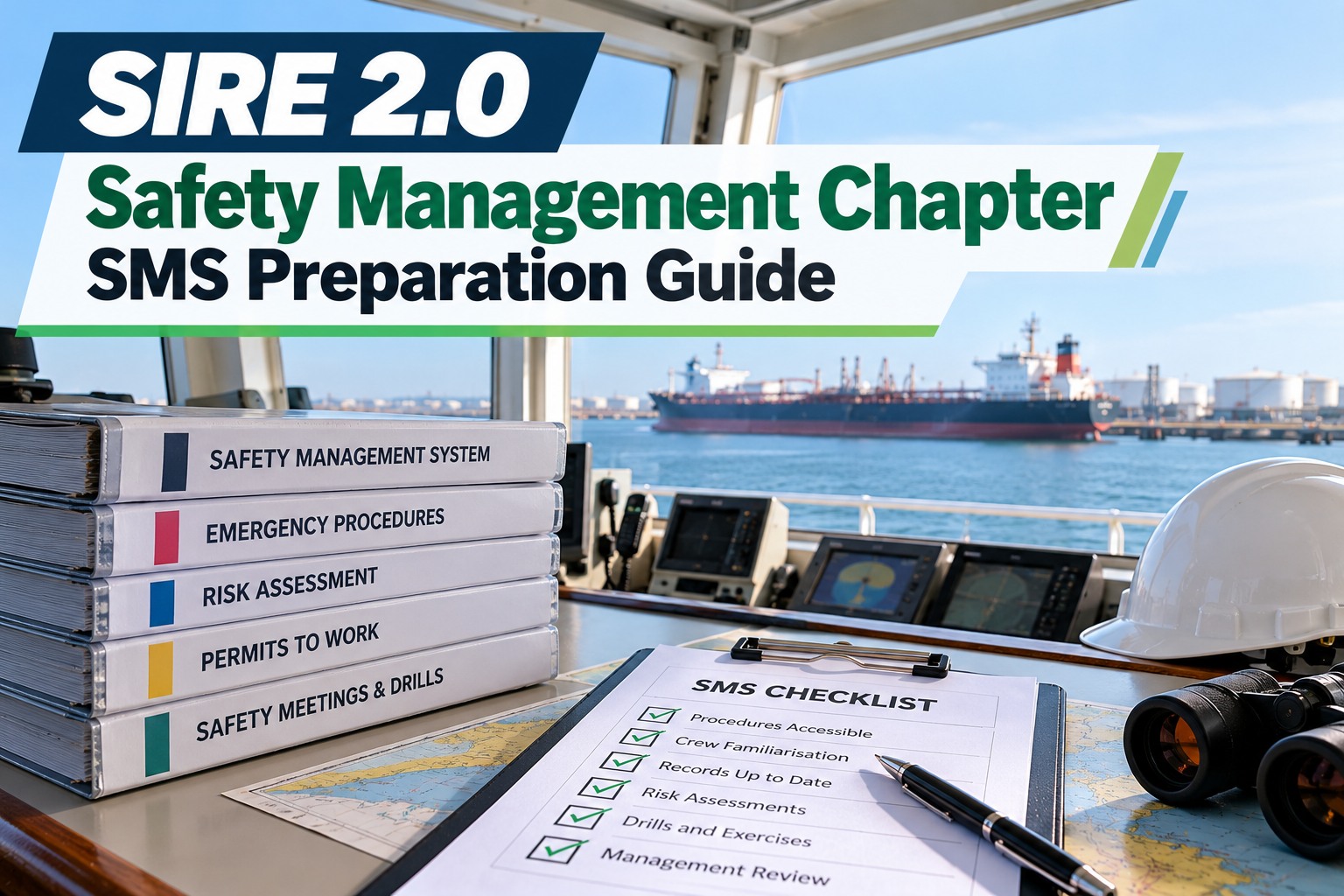
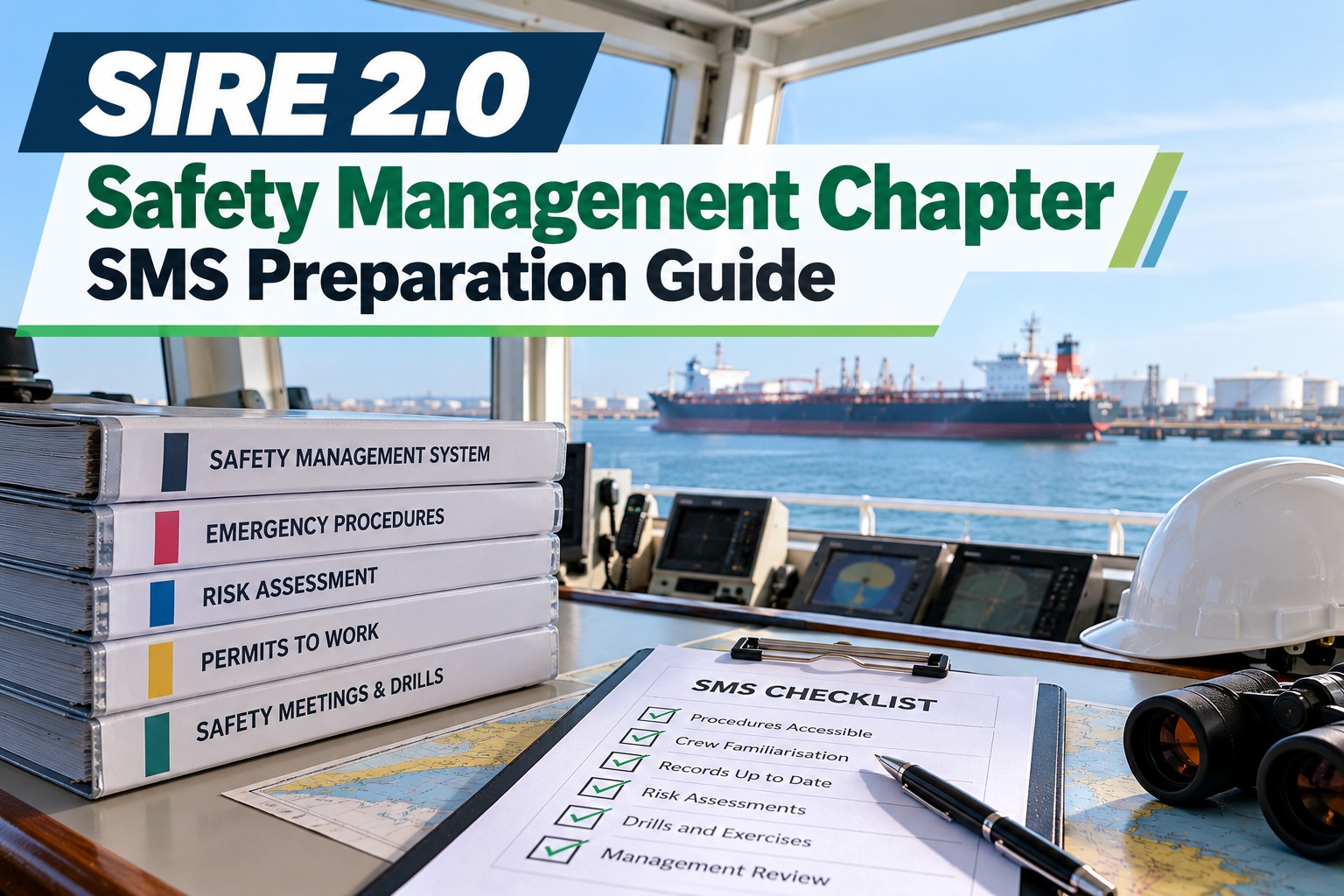
Chapter 5 of the question set is titled Safety Management, and preparing only that chapter prepares roughly a third of what is actually examined. The safety management system is assessed twice over in its own right — once as a document set under certification and documentation, once operationally under chapter 5 — and then again, procedure by procedure, in almost every other chapter. The recurring construction is the same wherever it appears: were the officers familiar with the company procedure for this.
SIRE 2.0 · Safety management
The system is not examined in one chapter. It is examined one procedure at a time.
Certification, defect reporting, ballast management, cargo operations, security — each chapter asks whether the people on board knew the company procedure governing it. That makes safety management the most distributed subject in the inspection, and the one least well served by preparing a chapter.
Where the system is actually assessed
Three places, each asking a different kind of question. A QHSE manager who maps preparation onto all three stops being surprised by where observations land.
Chapter 2
The system as a document set
Whether the master is fully conversant with the company system and whether master’s reviews have taken place as the Code and the company procedures require. Whether recent internal audit reports are on board, whether non-conformities were closed out, and whether shore management verified the corrective action.
Chapter 5
The system in operation
How safety is managed in practice on this vessel — the arrangements, the meetings, the risk work and the behaviour an inspector sees rather than reads about. This is the chapter most people mean when they talk about preparing the safety management chapter.
Everywhere else
The system, procedure by procedure
Statutory certification, defect reporting, ballast water management, cargo operations, hardening — each asked as whether the relevant officers were familiar with the company procedure. This is the largest share and it cannot be prepared chapter by chapter.
The ladder an answer is judged on
Familiarity is not a yes or no. An answer sits somewhere on a scale, and because every question carries a human-factors dimension alongside hardware and process, where it sits is part of the record. The difference between the third rung and the fourth is what separates a competent vessel from a strong one.
1
Recites
Repeats the wording, usually because it was read recently. Sounds prepared and collapses on the first follow-up, because recall has no structure behind it to answer a question that was not anticipated.
2
Locates
Knows where the procedure lives and can produce it quickly. A real and underrated capability — an officer who finds the right document in thirty seconds has demonstrated something about the system as well as about themselves.
3
Applies
Describes what they do, in their own words, matching what the procedure says. The answer and the document agree without the document being open, which is where most well-run vessels sit.
4
Explains why it exists
Can say what the procedure is protecting against and therefore what would be lost by shortcutting it. This is the answer that satisfies the human-factors side of the question, and it is the only rung that survives an unfamiliar scenario.
Briefings and toolbox talks move people from the first rung to the second. Only doing the work, discussed afterwards, moves them to the third and fourth — which is why a fleet that prepares by circulating documents before an inspection sees so little return on it.
The questions that carry the system
| Area |
What is asked |
The rung it needs |
| The system itself | Whether the master is fully conversant with the company safety management system, and whether master’s reviews have taken place as required | Explains — including what the reviews changed |
|---|
| Internal audits | Whether recent audit reports are on board, non-conformities closed out, and corrective action verified by shore management | Locates, then explains the close-out |
|---|
| Statutory certification | Whether the master and senior officers know the company procedure for keeping certification current | Applies — describes the routine, not the rule |
|---|
| Defect reporting | Whether senior officers are familiar with the company defect reporting procedure | Applies, with a recent example to hand |
|---|
| Ballast water management | Whether the master, deck officers and engineer officers are familiar with the management plan | Applies — and the plan matches the equipment fitted |
|---|
| Operational procedures | Whether the officers responsible know the company procedure for the operation in question, chapter by chapter | Explains, for anything with a hazard behind it |
|---|
Question numbering belongs to the published library and is revised over time, so confirm against the current issue. The programme mechanics sit in our SIRE 2.0 inspection guide.
Accessibility, measured in seconds
Whether the system is accessible is treated as a philosophical question in a great many fleets and as a practical one in an inspection. The test is simple: can the person who needs a procedure find it, in the time they would have in the situation it covers.
The right person, not the master
A system only the master can navigate has failed the test. The rating who needs the enclosed space procedure is the person whose access matters, and they are rarely the one shown the system during an audit.
At the place of work
Available where the job happens rather than in the ship’s office. A procedure three decks away from the task it governs is a procedure that will be worked from memory.
In a usable language
The working language of the vessel, for the people who have to act on it. A system in a language the crew read slowly is accessible on paper and not in fact.
One current version
No competing copies, no superseded revision still in a folder, and no sister vessel running a different version of the same procedure. Two answers to the same question is itself an observation.
Procedure quality, judged by use
Inspectors do not grade prose. They read a procedure for signs of whether it is used, and four tells do most of the work.
01It describes this vessel
Equipment that is actually fitted, spaces that exist, ranks the ship carries. A fleet-generic procedure listing equipment this ship does not have tells an inspector it was never read on board.
02It is written to be followed
Steps in the order they happen, with the decision points visible. A procedure that restates a regulation rather than telling somebody what to do has not been converted into work.
03It has changed at some point
A revision history showing the procedure responded to an incident, an audit finding or a crew suggestion. A document unchanged since issue in a system that has run for years is a document nobody has questioned.
04The records it generates exist
If the procedure says a checklist is completed, the completed checklists are there and show variation. A procedure whose outputs cannot be found is a procedure that is not operating.
A system people can reach, in the place they need it
Marine Inspection keeps procedures at their current revision at the point of use, tracks who has been taken through which one, and holds the records each procedure generates against the vessel — so accessibility and familiarity are demonstrable rather than asserted.
Familiarisation that survives a crew change
Every familiarity question is really a question about the last crew change, because that is when knowledge leaves the vessel. The arrangements that hold up are the ones built around positions rather than around people.
Dated against joining, not against the voyage
A familiarisation record that cannot be compared with a joining date proves nothing. An inspector checking one against the other is the most common way this fails.
Specific to the position held
The procedures this person will actually work from, rather than a general induction signed by everyone. Generic sign-off across a whole crew reads as administrative.
Delivered before it is needed
Not retrospectively completed once somebody noticed the gap. Timing is visible in the dates and is part of what is being judged.
Revisited when a procedure changes
A revision issued mid-voyage opens a familiarisation gap for everyone already on board, and almost no fleet closes that loop deliberately.
The master’s review and the audit trail
Two documentary items carry disproportionate weight because they are the evidence that the system is being managed rather than merely maintained.
Master’s review of the system
Carried out as the Code and the company procedures require, and — the part that matters — saying something. A review that raises nothing, repeatedly, is a review that was signed. The strongest version names a procedure that did not work on this vessel and what was proposed about it.
Internal audit reports on board
Recent reports available, with non-conformities closed out and the corrective action verified by shore management rather than closed on the ship’s own say-so. The verification step is the one most often missing.
Findings that travelled
Evidence that something found on one vessel was looked for on the others. This is the difference between a system that learns and a set of ships that each solve the same problem separately.
The loop closed back to the procedure
Where a finding led to a procedure being revised, the revision visible and the crew familiarised with it. That chain, shown end to end, answers several questions at once.
The audit side of this is covered in depth in our guide to ISM compliance and SMS audits, and you can book a demo to see findings tracked from one vessel across a fleet.
Preparing the distributed half
Because most of the safety management content is asked inside other chapters, the useful preparation is not a review of the system but a pass across the procedures the other chapters will reach for. That list is short and does not change much.
List the procedures each chapter will touch
Certification, defect reporting, ballast management, cargo operations, security, mooring. One procedure per subject, named, with the officer who would be asked about it identified alongside it.
Ask the officer, not the document
Put the question as an inspector would and listen for which rung the answer lands on. Ten minutes per procedure with the person who owns it tells you more than a week of document review.
Fix the gap by doing, not by reading
Where the answer is recall, the remedy is carrying out the task and discussing it afterwards. Reissuing the procedure moves nobody up the ladder.
Repeat it after every crew change
The list does not change; the people do. Running the same short pass each time a significant relief joins keeps the distributed half of the chapter permanently ready.
Done as a routine rather than as preparation, this takes an hour a month and removes a category of observation that is otherwise found for you. The wider question set is covered in our SIRE inspection checklist, and you can book a demo to see familiarity tracked per procedure and per position.
SYThe system
One current version of every procedure, with superseded copies withdrawn
Procedures describe this vessel’s equipment, spaces and ranks
Each procedure is reachable at the place the work happens
Revision histories show the system has responded to something
Sister vessels are running the same revision
POThe people
Familiarisation records are dated against joining dates
Records are specific to the position, not a general induction
Officers can describe procedures in their own words, not recite them
At least the key procedures can be explained in terms of what they prevent
Anyone who joined after the last revision has been taken through it
Marine Inspection modules for safety management
Document ControlProcedures · Revisions · Point-of-Use Access
Holds every procedure at its current revision, withdraws superseded copies automatically, and makes the governing document reachable where the work happens rather than in the ship’s office — which is the accessibility test as an inspector applies it.
Crew & CompetenceFamiliarisation · Position Matrix · Training Records
Links familiarisation to the position rather than the person and dates it against joining, then reopens the requirement for everyone aboard when a procedure is revised — closing the loop almost no fleet closes by hand.
InspectionInternal Audits · Finding Register · Verification
Runs internal audits, carries each non-conformity through correction, corrective action and shore verification as separate steps, and shows whether a finding from one vessel was looked for on the rest.
MaintenanceDefect Register · Planned Routines · Work Orders
Gives the defect reporting procedure somewhere to land, so an officer asked about it can produce a recent example rather than describing the process in the abstract.
Risk & PermitsAssessment Library · Permit to Work · Toolbox Records
Produces the records a procedure is supposed to generate as the work is done, which is the evidence that a procedure is operating rather than filed.
Reporting & AnalyticsFleet Dashboard · Familiarisation Gaps
Shows which vessels carry familiarisation gaps after a crew change and where the same finding keeps appearing, which is where a procedure revision does more than another visit.
Safety management chapter: frequently asked questions
Which chapter covers safety management?
Chapter 5 is titled Safety Management in the published question library. The safety management system also appears as a section under chapter 2, certification and documentation, and familiarity with company procedures is asked throughout the other chapters, so preparing chapter 5 alone prepares only part of what is examined.
What is asked about the system itself?
Whether the master is fully conversant with the company system and whether master’s reviews have taken place as the ISM Code and the company procedures require; and whether recent internal audit reports are on board, non-conformities closed out, and corrective action verified by shore management.
Is reciting a procedure a good answer?
It is the weakest of four levels. Reciting collapses on the first follow-up; locating the document quickly is better; describing what you actually do, in your own words, matching the procedure, is better still; and being able to say what the procedure protects against is the answer that holds up when the scenario is unfamiliar.
How is accessibility judged?
Practically. Can the person who needs a procedure find it, at the place the work happens, in a language they read comfortably, in one current version, in the time the situation would allow. A system only the master can navigate has not passed that test.
What makes a procedure look unused?
Describing equipment the vessel does not have, restating regulations instead of telling somebody what to do, a revision history unchanged since issue, and records the procedure says should exist that cannot be produced. Any one of those invites a closer look at the rest.
Where do familiarisation records usually fail?
On dates and specificity. Records that cannot be compared against joining dates, general inductions signed by a whole crew rather than records tied to the position held, completion filled in retrospectively, and procedures revised mid-voyage with nobody already on board taken through the change.
Chapter 5 and everywhere else
Prepare the procedures people use, not the chapter they sit in
Marine Inspection keeps procedures current and reachable at the point of use, ties familiarisation to the position and reopens it when a revision lands, and carries findings from correction through to shore verification — so familiarity is a record rather than a hope.