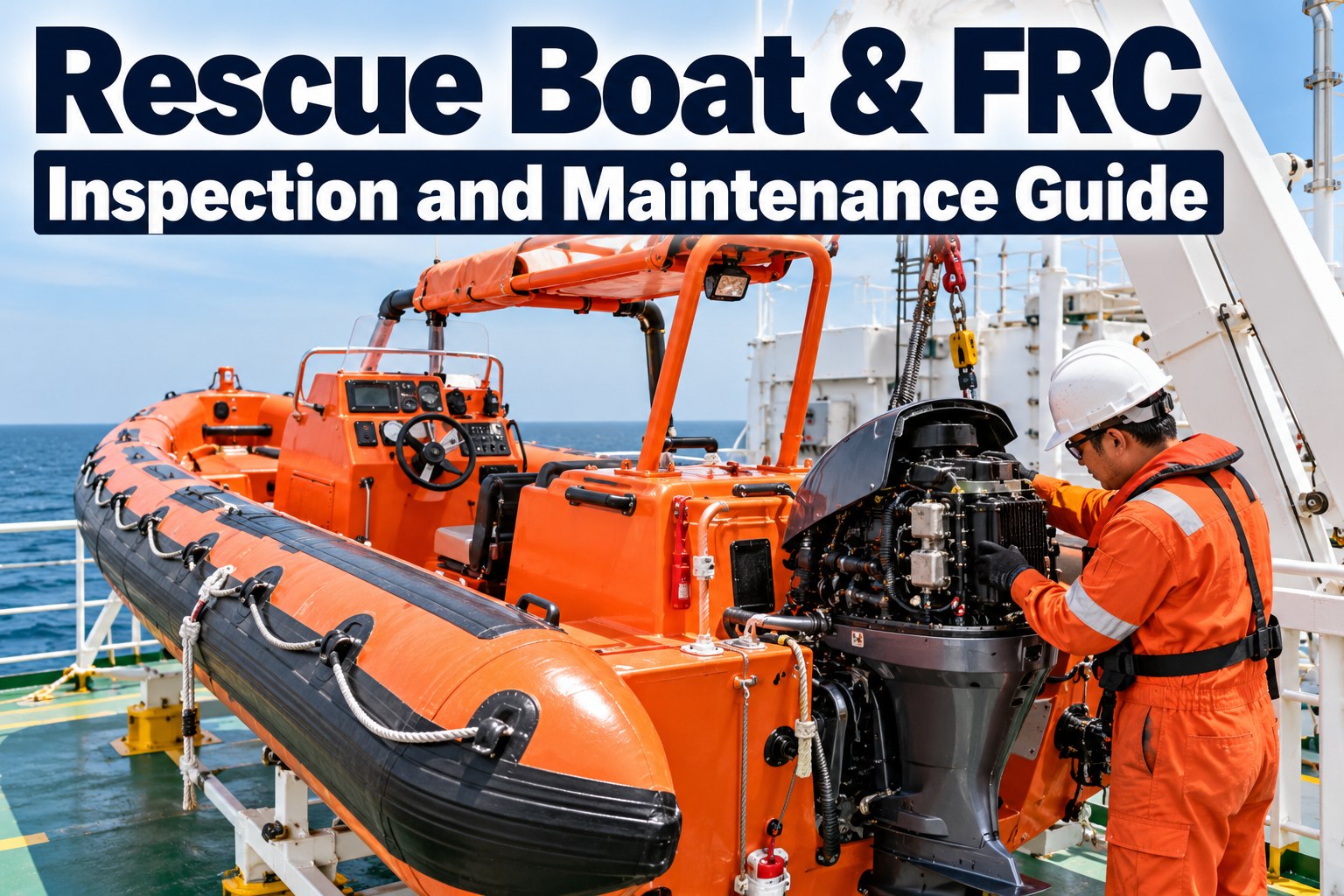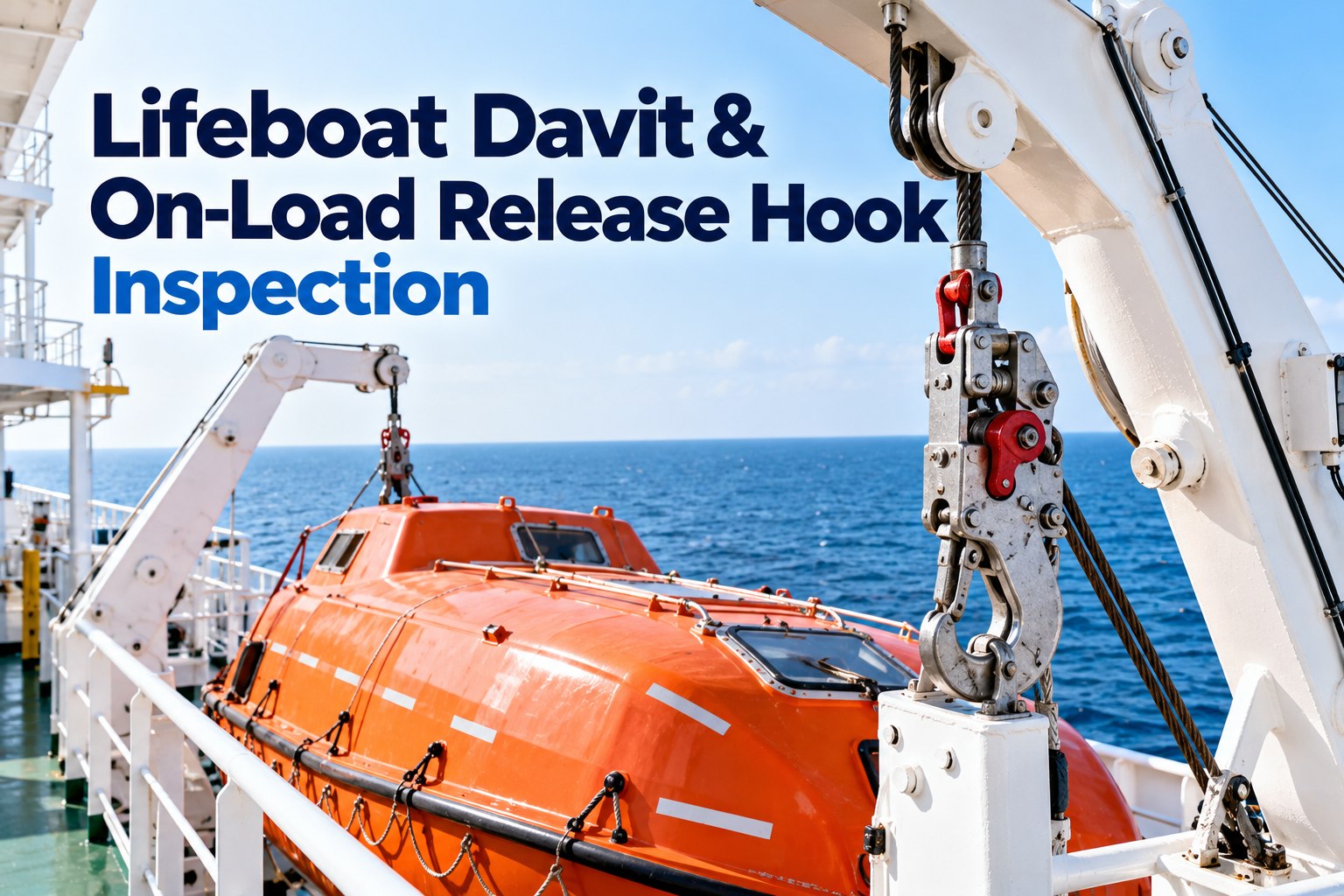
Lifeboat davit inspection covers the davits, winches, falls and on-load release hooks that put a lifeboat or rescue boat in the water, from weekly crew checks to the annual thorough examination and the five-yearly overhaul and overload test required under SOLAS III/20 and IMO Resolution MSC.402(96). It matters because lifeboat launching systems have injured and killed seafarers during drills and maintenance, often through unexpected hook release or a failure no one spotted. Get it wrong and the cost is a boat that cannot be launched in an emergency, a boat falling during a drill, an expired servicing certificate at survey or a port state control detention.
Davits, winches and hooks you can trust on the day: the lifeboat inspection cycle from weekly checks to the five-yearly test
Free sign-up · Offline checklists on deck · Signed PDF reports
Since 1 January 2020, MSC.402(96) has set how lifeboats, rescue boats, fast rescue boats, their launching appliances and on-load or off-load release gear are maintained, examined, tested and repaired, through amendments to SOLAS regulations III/3 and III/20. It splits the work in two: weekly and monthly checks the crew can do under a senior officer, and annual and five-yearly work that only certified personnel of the manufacturer or an authorised service provider may carry out.
This guide is for the officers who run the weekly and monthly routine and the superintendents who book and check the annual and five-yearly service. It covers who does what, the weekly and monthly checks, falls, hooks and fall preventer devices, annual and five-yearly work, records, PSC findings and how to keep it all ready. To put the weekly and monthly checks on the crew’s phones, you can start logging lifeboat inspections free.
Lifeboat davit inspection under MSC.402(96): who does what
The biggest change MSC.402(96) brought was clarity on who is allowed to do each level of work. Gard and DNV summarise it the same way.
| Interval | Work | Who may do it | Record |
|---|---|---|---|
| Weekly | Inspection and routine maintenance to the maintenance manual | Shipboard personnel under a senior ship’s officer, or a service provider | PMS or LSA log |
| Monthly | Inspection and routine maintenance to the maintenance manual | Shipboard personnel under a senior ship’s officer, or a service provider | PMS or LSA log |
| Annual | Thorough examination and operational tests | Certified personnel of the maker or an authorised service provider | Service provider report |
| Five-yearly | Thorough examination, overhaul, overload operational tests and repairs | Certified personnel of the maker or an authorised service provider | Service provider report; RO involvement as flag requires |
Based on Gard’s and Luxembourg’s summaries of MSC.402(96). Service providers are authorised by the flag or its Recognised Organisation for each make and type of equipment; Luxembourg, for example, requires the five-yearly work in the presence of an RO surveyor. A ship operator can do annual work only if it is itself authorised.
Weekly and monthly lifeboat checks by the crew
The crew routine follows the maker’s maintenance manual and the ship’s on-board maintenance instructions under SOLAS III/36. Typical items, each with a checkpoint type so the record shows what was actually done:
Typical items only; your maker’s manual and SMS set the actual list. For the wider life-saving appliance routine see our lifeboat inspection checklist.
On-load release hook inspection and fall preventer devices
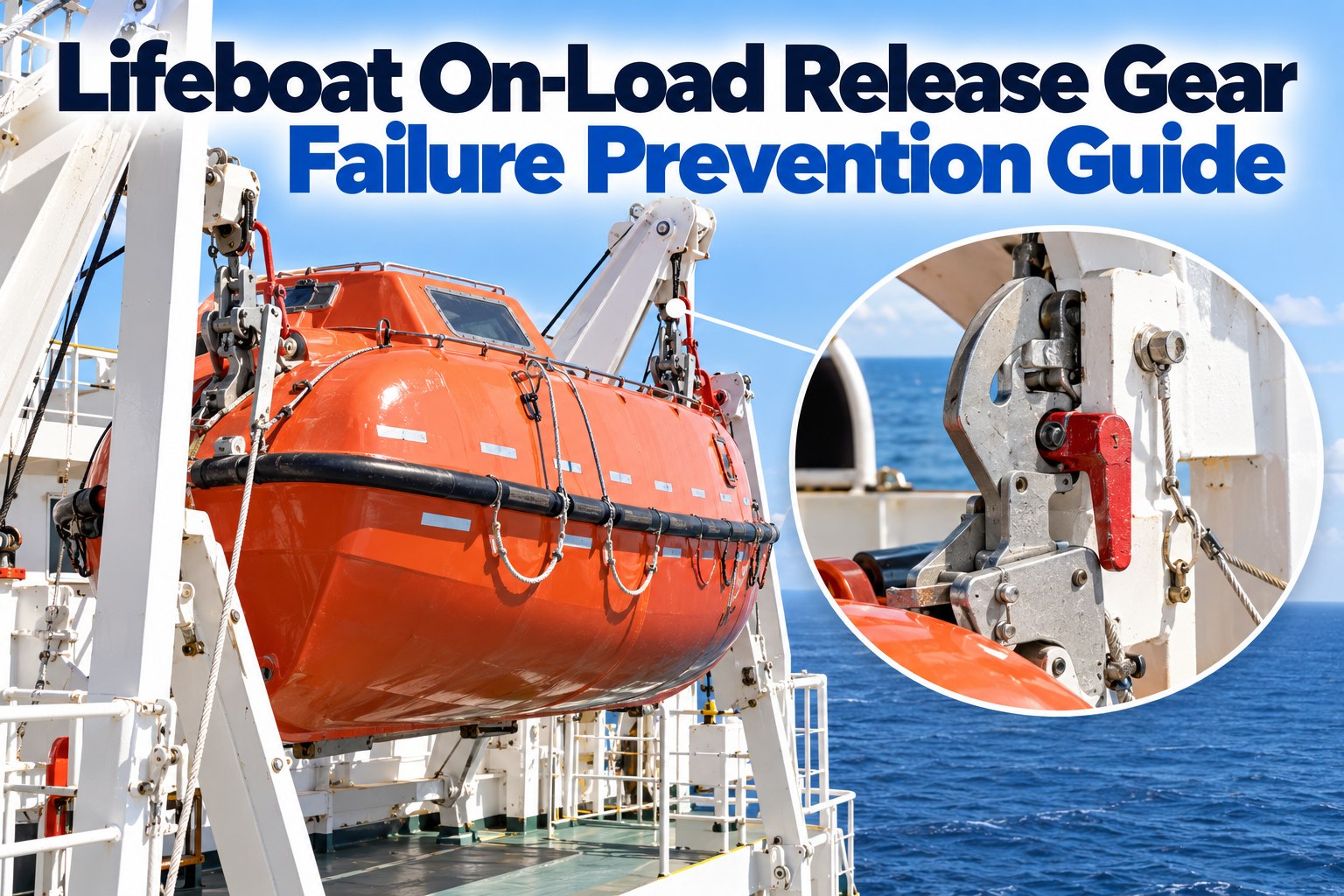
On-load release hooks let the crew release the boat while its weight is still on the falls. That makes them essential in an emergency and dangerous if they release when they should not. Maritime Mutual’s risk bulletin notes that up to 88 different on-load hook designs were approved, and that investigators, including the MAIB, have found human error made worse by complex release systems and poor training, as well as design, installation and maintenance problems.
What to check on the hooks
- Hook fully reset after every drill, with indicators showing the reset position
- Release handle secured with its safety pin, and the cable or linkage free and undamaged
- No corrosion, cracks or wear on the hook, cam and hydrostatic interlock
- Release gear operated only by people trained on that design
- Maker’s resetting instructions posted inside the boat
Fall preventer devices (FPDs)
The Bahamas Maritime Authority’s lifeboat safety notice sets out how FPDs may be used:
Every weekly check, hook reset and service report, ready before the surveyor asks
Crew checks done on deck, offline, with service dates and provider reports held against each boat and davit.
Free to start · Works offline on deck · Export to signed PDF
Lifeboat winch maintenance and falls
The winch and falls are where wear accumulates quietly. SOLAS III/20.4, as the Bahamas Maritime Authority summarises it, requires falls to be inspected periodically, with particular attention to the sections that pass through sheaves, and renewed when they have deteriorated or after five years, whichever is earlier.
Renewal limit
Falls renewed at deterioration or five years, whichever comes first.
End-for-ending
The old 30-month end-for-ending rule no longer applies, but end-for-ending is still allowed using a correct joining method.
Inspection timing
A competent person inspects the falls before or at the Safety Equipment Survey.
Rotation resistant
Single falls must be rotation resistant; twin falls need not be if they meet the maker’s specification.
Lower the boat or pay out the wire so the fall carries no weight.
Clean the wire and check for corrosion, broken wires and deformation.
Confirm grease penetration and re-grease to the maker’s instructions.
Replace any wire whose strength is in doubt; record the result.
Inspection steps from the Bahamas Maritime Authority’s Marine Notice 82. Winch brakes, limit switches and the gravity lowering function are part of the annual and five-yearly service by the authorised provider.
Annual servicing and the five-yearly lifeboat inspection
The annual and five-yearly work is done by the authorised service provider, but the ship has to prepare for it and check the result. The scope is set in Section 6 of MSC.402(96).
Thorough examination and operational test
- Lifeboat, davit, winch and release gear examined
- Operational tests of launching appliance and release gear
- Defects reported and repaired before the boat returns to service
- Report issued by the certified technician
Overhaul and overload operational test
- Everything in the annual examination
- Overhaul of the release gear and launching appliance
- Overload operational tests of release gear and winch brakes
- Report attached to the survey records, with RO involvement where the flag requires
A five-year lifeboat cycle at a glance (illustrative)
LSA servicing records and lifeboat PSC findings
Surveyors, auditors and PSC officers all ask for the same evidence. The Bahamas notice is explicit that missing documents are an ISM non-conformity.
Weekly and monthly records
Who checked, what was found, defects raised, following the on-board maintenance instructions.
Annual and five-yearly reports
Service provider reports, provider authorisation and technician certificates.
Falls records
Annual inspection results, any end-for-ending and renewal dates, verified at survey.
Drill records
Launching and manoeuvring drills logged, including drills not carried out and why.
Manuals on board
Maker’s instructions for boat, davit, winch and release gear, accessible to the crew.
Defect close-out
Defects found at any level, with repairs and dates, so nothing stays open.
For how life-saving appliance findings feed into detention, see our PSC detention deficiencies guide. Lifeboat drills themselves are covered in our SOLAS emergency drill guide.
How Marine Inspection supports lifeboat davit and hook inspections
Marine Inspection keeps one record for each lifeboat, rescue boat and davit: the crew’s weekly and monthly checks, the service provider’s annual and five-yearly reports and the falls history.
For the wider LSA picture see SOLAS compliance; for plans by fleet size see Marine Inspection pricing.
Lifeboat davit inspection: the cycle that keeps the boat launchable
Lifeboat davit inspection works when every level of the cycle is done by the right people and recorded: weekly and monthly checks by a crew who understand their hooks, annual examinations and five-yearly overhauls by an authorised provider, falls inspected and renewed on time, and every defect closed. Do that and the boat goes in the water when it is needed, and the records stand up at survey. Keep the crew checks in a digital logbook so the evidence builds every week.
Know the next annual, five-yearly and falls date for every boat on every ship
Free sign-up · Offline on deck · Signed PDF reports