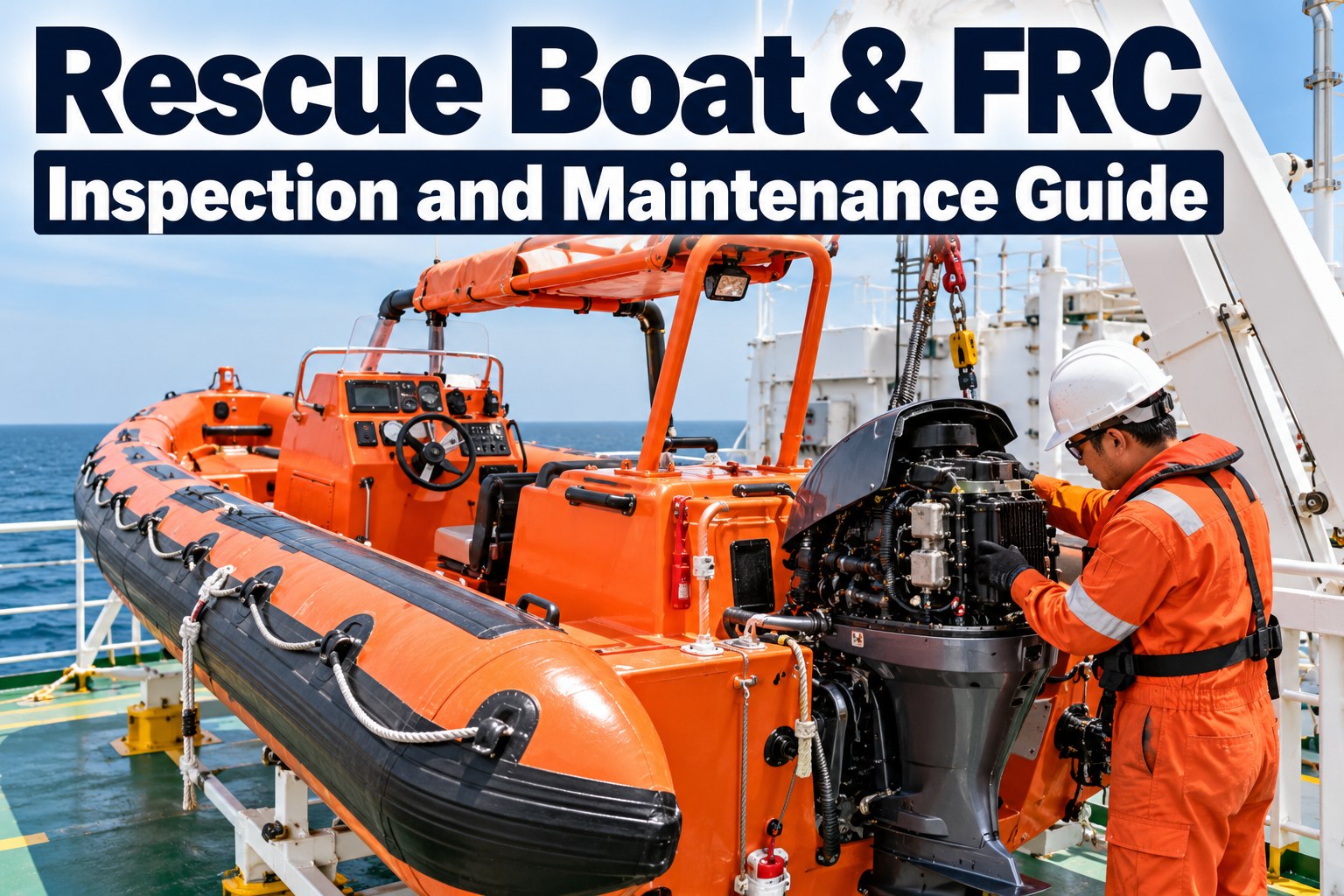
A rescue boat is the one piece of life-saving equipment that is launched in earnest more often than anything else, and it is also where launching accidents are most likely during drills and maintenance. What do SOLAS and the IMO circulars require for rescue boat inspection, how should a fast rescue craft outboard be tested and what records should a Chief Officer hold? This guide covers rescue boat and fast rescue craft inspection and maintenance: outboard engine care, launching drills, inflatable collar and valve checks, davit tests and records. It draws on SOLAS extracts, the IMO guidelines MSC.1/Circ.1206/Rev.1, a Gard summary of MSC.402(96), an AMSA notice on outboards and an MAIB case, and it flags what we could only read through secondary summaries. For the wider requirements, see our SOLAS life-saving appliances Chapter III requirements and inspection guide.
Ready to Launch: Rescue Boat Checks, Drills and Records That Stand Up
Engine, collar, release gear, davit and drill evidence for rescue boats and fast rescue craft.
Free trial available. Or book a walkthrough built around your own rescue boat inspection and drill records.
Read this first. Launching and recovering rescue boats and fast rescue craft is one of the most hazardous routine jobs on a ship, and accidents have happened during drills and maintenance. This guide supports planning and record keeping. It does not replace SOLAS chapter III and the LSA Code, MSC.402(96), the maker's manuals, your flag State's requirements, the ship's SMS or the Master's decisions. Follow your own launching procedures, risk assessment and permit-to-work for every launch, never work on release gear while the hooks are under load and never carry out an untested change to a launching arrangement.
SOLAS Requirements for Rescue Boats and Fast Rescue Craft: Four Rules in Plain Terms
Drills, maintenance, the LSA Code and the ISM Code, each with what inspectors look at
III/19
Drills and training
Requires: rescue boats that are not lifeboats to be launched each month with their assigned crew and manoeuvred in the water as far as reasonable and practicable, and in all cases at least every three months (as compiled in a Nautical Institute extract).
Inspectors look at: drill records and crew familiarity.
III/20
Maintenance and inspection
Requires: since 1 January 2020, maintenance, thorough examination, operational testing, overhaul and repair under MSC.402(96), with weekly and monthly inspections under a senior officer and annual and five-yearly work by certified personnel (Gard summary).
Inspectors look at: service certificates and records.
LSA Code V
Rescue boat requirements
Requires: engine and equipment standards, and for inflated boats a non-return valve for manual inflation, a means of deflation and a safety relief valve (para. 5.1.3.7 as reproduced in a German flag extract).
We did not obtain: the speed and start-up figures from the LSA Code text itself.
ISM 10.3
Critical equipment
Requires: the company to identify equipment whose sudden failure could create a hazard, and AMSA says rescue boats are included and their maintenance procedures should sit in the planned maintenance system.
Inspectors look at: the planned maintenance record.
The regulation numbers matter because inspectors ask for evidence against them. Two points deserve care. The SOLAS drill paragraphs have been renumbered since the extract we read, which is a compiled web version and not the official text, so check the current wording. And we could not obtain the LSA Code speed and start-up figures. A trade blog says fast rescue boats must reach 20 knots lightly loaded and about 7 to 8 knots fully loaded, but it is secondary, so we use no speed as a requirement.
Rescue Boat Launch Frequency in the SOLAS Extract: Months Between Launches (Rescue Boats That Are Not Lifeboats; as Compiled by the Nautical Institute; Bars Out of 3 Months)
Target for rescue boats, where reasonable and practicable
1 month
Hard limit for rescue boats in all cases
3 months
Lifeboats launched and manoeuvred at least
3 months
The extract is a web compilation, not the official IMO text, and the SOLAS drill paragraphs have been renumbered since (a Cayman notice cites 19.3.4.3 and 19.3.4.6). Check the current text and your flag State. Port State control and vetting deficiencies are possible if the interval is missed, as the Cayman notice states.
Rescue Boat Launching Drill: A Six-Step Safety Sequence for the Chief Officer
What the IMO circular says about preparing, lowering and recovering
MSC.1/Circ.1206/Rev.1, dated 11 June 2009, mainly addresses lifeboats but says its principles may also be applied to rescue boats and fast rescue boats. Its drill guidance is the most useful published safety sequence we reached. The six steps below are our summary, with each drawn from the circular or from AMSA, and they sit under your own risk assessment and procedures.
1Check the maintenance firstCircular 1206 asks for maintenance to be checked before a drill. Confirm the last weekly and monthly inspection records are complete
2Brief the crew and agree the rolesDrills should be conducted with an emphasis on learning, according to the same circular. Name the coxswain, the winch operator and the person on the painter
3Lower and recover empty firstThe circular advises lowering and recovering without persons on board before any manned launch
4Treat a full complement as a higher riskThe circular says lowering a boat with its full complement carries risk and needs special precautions. Apply your own risk assessment
5Keep hanging-off pennants for maintenance onlyThe circular says they should only be used for maintenance and not during training exercises. Never leave them connected in normal stowage
6Run the engine and recoverStart the engine in the water with the cooling water proven, run the boat, recover it and flush the engine with fresh water as the maker advises
Show the Launch Interval, the Service Certificate and the Last Inspection in One Place
Schedule weekly, monthly and annual rescue boat tasks, attach dated photos and keep the drill record ready for the inspector.
Free trial available. Or book a walkthrough built around your own rescue boat inspection and drill records.
Rescue Boat Outboard Engine Maintenance: Cooling Water, Fuel and Start-Up Faults
A fault tree built from the AMSA notice
AMSA Marine Notice 12/2017 on the operation and maintenance of rescue boat outboard motors is the most practical source we found. It says outboards are not designed to run without cooling water even for short periods, that the effective test is to submerge the motor leg so the inlet ports are covered and that fuel problems are the most common cause of an engine failing to start. It also says that, unlike the five-minute cold run the LSA Code allows for inboard engines out of the water, outboards have no such allowance. The ISM Code, element 10.3, makes the maintenance procedures part of the planned maintenance system.
Outboard will not start or will not run
1. Fuel. The most common cause of starting failure, according to AMSA. Old or contaminated fuel, the wrong mixture, or the wrong fuel for the engine
2. Spark. Fouled spark plugs are named in the same AMSA notice
3. Cooling water. Run only with the leg submerged to cover the inlet ports, and confirm water at the tell-tale and exhaust
Blocked inlet mesh or ports, blocked tell-tale (salt, rubber fragments, paint), worn impeller or salt in the passages can all cause overheating damage
4. Maker's manual. Know whether the engine is two-stroke or four-stroke and how oil is supplied, then use the maker's fault chart for anything else
A UK MCA recommendation on rescue boat outboards says an engine of the same power rating may have different towing performance, so replacing an approved outboard with a different one needs further testing, and replacing a part with a different specification counts as a modification. Do not substitute engines without checking the approval documentation.
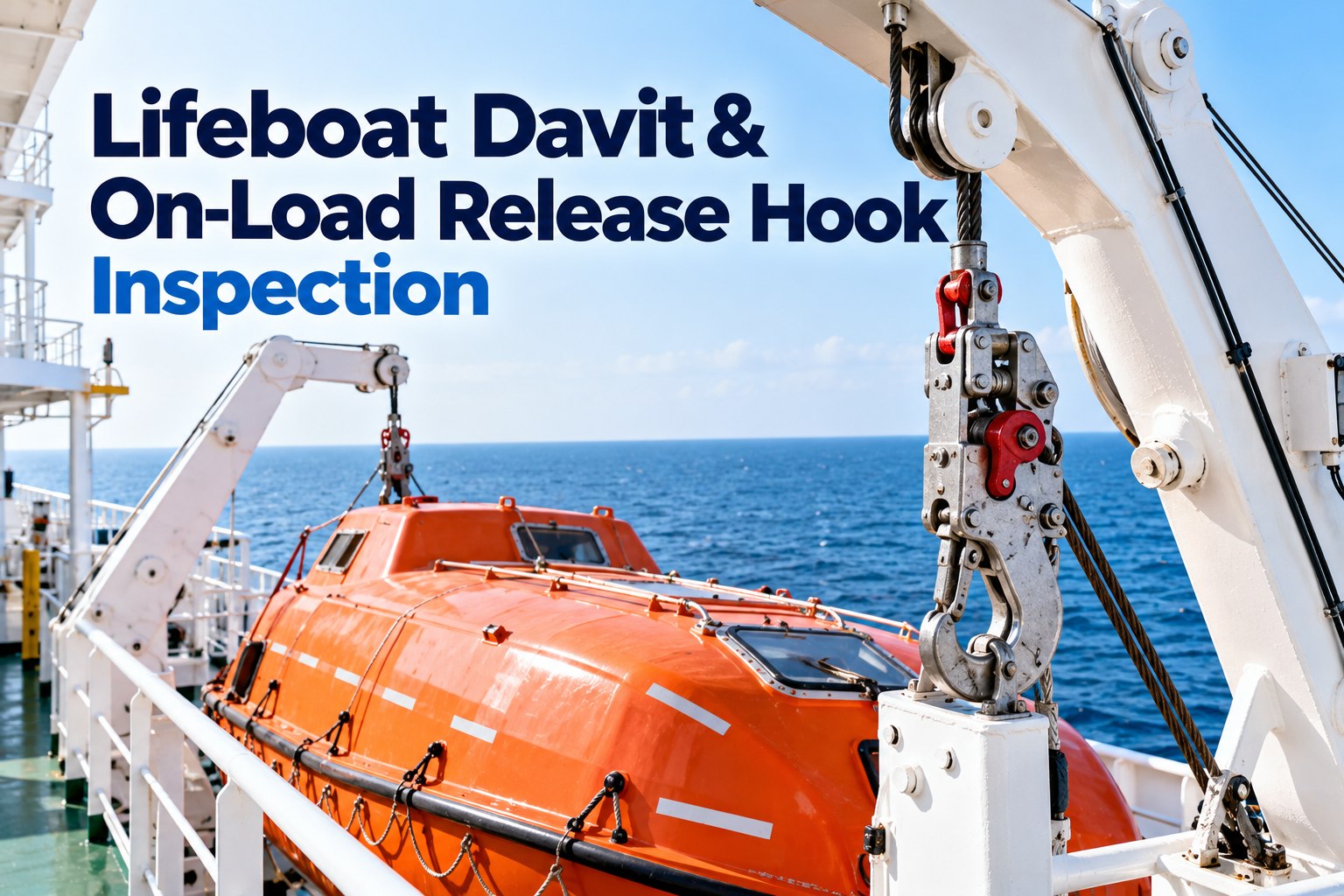
Davit, Release Gear and Winch Servicing: Who Does What and How Often
The MSC.402(96) intervals, from weekly checks to the five-year overhaul
Weekly and monthly
Inspections and routine maintenance, by authorized service providers or by shipboard personnel under the direction of a senior ship's officer, following the maintenance manual (Gard summary of MSC.402(96)).
Annual
Thorough examination and operational test of launching appliances by certified personnel of the manufacturer or an authorized service provider. Circular 1206 adds a winch brake test with the empty boat.
Five-yearly
Thorough examination, any overhaul, overload operational tests and repairs of on-load release gear, by certified personnel. Circular 1206 mentions a winch test at 1.1 times the proof load every five years.
Always
No maintenance or adjustment of release gear while the hooks are under load, and documentation of maintenance and adjustment kept on board (MSC.1/Circ.1206/Rev.1).
Circular 1206's appendix lists the davit checks: structure for corrosion, misalignment, deformation and excessive free play, then wires, sheaves, lubrication, limit switches, stored power and hydraulics. It says vital release gear parts should be examined for defects and cracks, with non-destructive examination such as dye penetrant where suitable. The Gard summary and the circular agree on the service structure, but we read them as secondary summaries, so confirm the interval and certification rules with your flag State and the manufacturer.
Case note: RFA Mounts Bay, davit failure during a fast rescue craft launch (MAIB, published 2015)
During a man-overboard drill at Faslane, the fast rescue craft was lowered to about 1 m above the water. When lowering resumed, the winch paid out at full speed and was stopped at once, the davit assembly visibly juddered and the boat detached from the release hook and fell about 1 m into the water. No one was hurt and there was no damage. The summary names no failed part and no root cause, notes that the ship was new and in commissioning tests, and records that the Chief Inspector pointed the project team to IMO MSC/Circ.1094, which says all parts of the stowage, launch and recovery system should be proven compatible well before installation. The occurrence date is given as 1 July 2006 in the metadata but 7 January 2006 in the summary table, and the page does not resolve it. It is a naval auxiliary vessel, so it is not a merchant ship precedent.
Rescue Boat and FRC Inspection Checklist for the Chief Officer
A checklist with a checkpoint type on each item
Use the checklist for the weekly and monthly inspection and again before arrival. For servicing detail, see our lifeboat and life raft maintenance, annual servicing and inspection guide, and for a readiness view of the whole LSA set, our SOLAS LSA inspection guide for lifeboat and liferaft readiness. It is our template and does not replace the maker's manual or your flag State's rules.
Rescue boat and fast rescue craft inspection checklist with a checkpoint type on each item (our template built from MSC.1/Circ.1206/Rev.1, MSC.402(96), the AMSA notice and the SOLAS extracts)| Item | What to check | Checkpoint type |
|---|
| Engine start | Starts promptly, runs in the water with cooling water proven at the tell-tale and exhaust | Test |
| Fuel | Correct fuel and oil, fresh, in approved containers, enough to run at 6 knots for at least 4 hours (AMSA, citing LSA Code 5.1.1.8) | Record |
| Outboard cooling | Inlet ports and mesh clear, tell-tale open, impeller sound, passages flushed after use | Visual |
| Hull and fittings | No damage, cracks or loose fittings, lifting points and painter secure | Visual |
| Inflated collar and valves | Collar sound with no abrasion or leaks, non-return and safety relief valves present and working, per the maker | Visual |
| Release hook | Hook and fastening checked and reset, interlocks correct, no maintenance under load | Visual |
| Davit and winch | Structure free of corrosion, misalignment, deformation and free play. Wires, sheaves, limit switches and hydraulics sound | Test |
| Lowering and recovery | Launch and recover empty, then manned, with brake and speed behaving normally | Test |
| Painter and equipment | Painter, bailers, steering, lights and radio equipment present and in date | Visual |
| Drill record | Rescue boat launched and manoeuvred in the water within the required interval with assigned crew | Record |
| Service record | Annual and five-year examinations, certificates and spares inventory on board | Record |
Our suggested template. Checkpoint types: Visual, Test and Record.
Six Rescue Boat Habits Inspectors Pick Up
What AMSA and the IMO circular warn about
⚑Running an outboard without cooling waterAMSA says it has seen crews do this and that port State control officers stop it when they see it. Outboards are not designed to run without cooling water, even briefly.
⚑Testing the engine with an external hose onlyAMSA says even testing with an external pressurised water supply has limitations, because it does not prove the pump can draw suction.
⚑Treating old fuel as fuelFuel problems are the most common cause of an engine failing to start, according to the same notice.
⚑Leaving hanging-off pennants on after maintenanceThe circular says they should not remain connected during normal stowage or training.
⚑Working on release gear under loadThe circular says no maintenance or adjustment of the release gear should be done while the hooks are under load.
⚑Missing the launch intervalA Cayman notice says missing the SOLAS interval risks port State control or vetting deficiencies.
Keeping Rescue Boat Drills, Service Certificates and Findings in One System
How a dated photo repository, task ownership and deadlines support rescue boat readiness
Rescue boat findings recur when the drill dates and service dates sit in different places. Marine Inspection supports a dated photo repository, observations turned into tasks with owners, deadlines and evidence, and certificate and equipment tracking. A dated photo of a reset hook, a task for a blocked tell-tale with a named owner and due date, and tracked annual and five-year service dates give a Chief Officer a record to show an inspector. It does not replace SOLAS, MSC.402(96) or the maker's instructions. Raise follow-up jobs through maintenance work orders, see our lifesaving appliance inspection software for commercial ships and see Marine Inspection pricing for plans.
Frequently Asked Questions About Rescue Boat and Fast Rescue Craft Inspection
How often must rescue boats be launched under SOLAS?
A Nautical Institute extract of regulation III/19 says rescue boats that are not lifeboats are launched each month with their assigned crew and manoeuvred in the water as far as reasonable and practicable, and in all cases at least every three months. Check the current SOLAS text and your flag State, since paragraph numbers have changed.
Who can service a rescue boat and its davit?
Under MSC.402(96), applying since 1 January 2020, weekly and monthly work can be done by authorized service providers or by shipboard personnel under a senior officer. Annual thorough examination and operational tests and five-year release gear overhaul must be done by certified personnel of the manufacturer or an authorized service provider.
How do I test a rescue boat outboard properly?
AMSA recommends submerging the motor leg so the inlet ports are covered, starting the motor and confirming water at the tell-tale hole and exhaust. It says an external pressurised supply has limitations, outboards must not run dry and the passages should be flushed with fresh water after use.
What fuel must a rescue boat carry?
AMSA states the boat must carry sufficient fuel to run at 6 knots for at least 4 hours in approved containers, citing LSA Code paragraph 5.1.1.8. We read this in the AMSA notice, not the LSA Code text, so confirm against the Code.
What should I check on an inflatable rescue boat?
Check the collar for abrasion and leaks, and the valves. The LSA Code extract we reached requires each buoyancy compartment on an inflated rescue boat to have a non-return valve for manual inflation and a means of deflation, with a safety relief valve. Inflation pressure limits come from the maker.
Can I use hanging-off pennants during a drill?
MSC.1/Circ.1206/Rev.1 says hanging-off pennants should only be used for maintenance purposes and not during training exercises, and that they should not stay connected during normal stowage. Follow the circular and your own procedures.
What records do inspectors expect for rescue boats?
Expect drill records showing launches within the required interval, weekly and monthly inspection records, annual and five-year service certificates, maintenance manuals, a spares inventory and planned maintenance entries. The circular says records should be kept on board, and AMSA says manuals and a spares list must be available.
Arrive With Every Rescue Boat Drill, Service and Inspection Already on Record
Rescue boat checks, dated photos, service tracking and follow-up tasks for every vessel, in one system.
Free trial available. Or book a walkthrough built around your own rescue boat inspection and drill records.