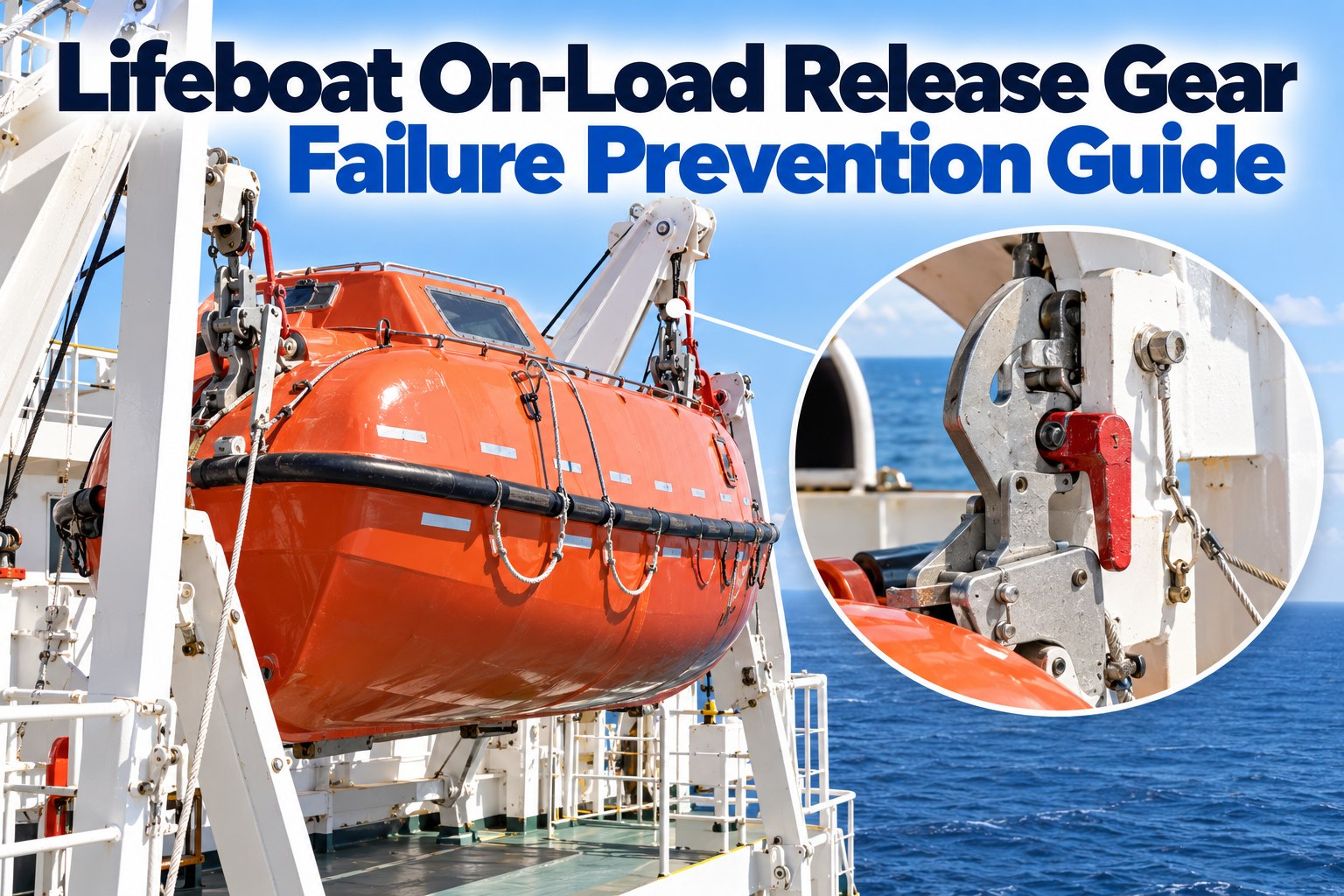
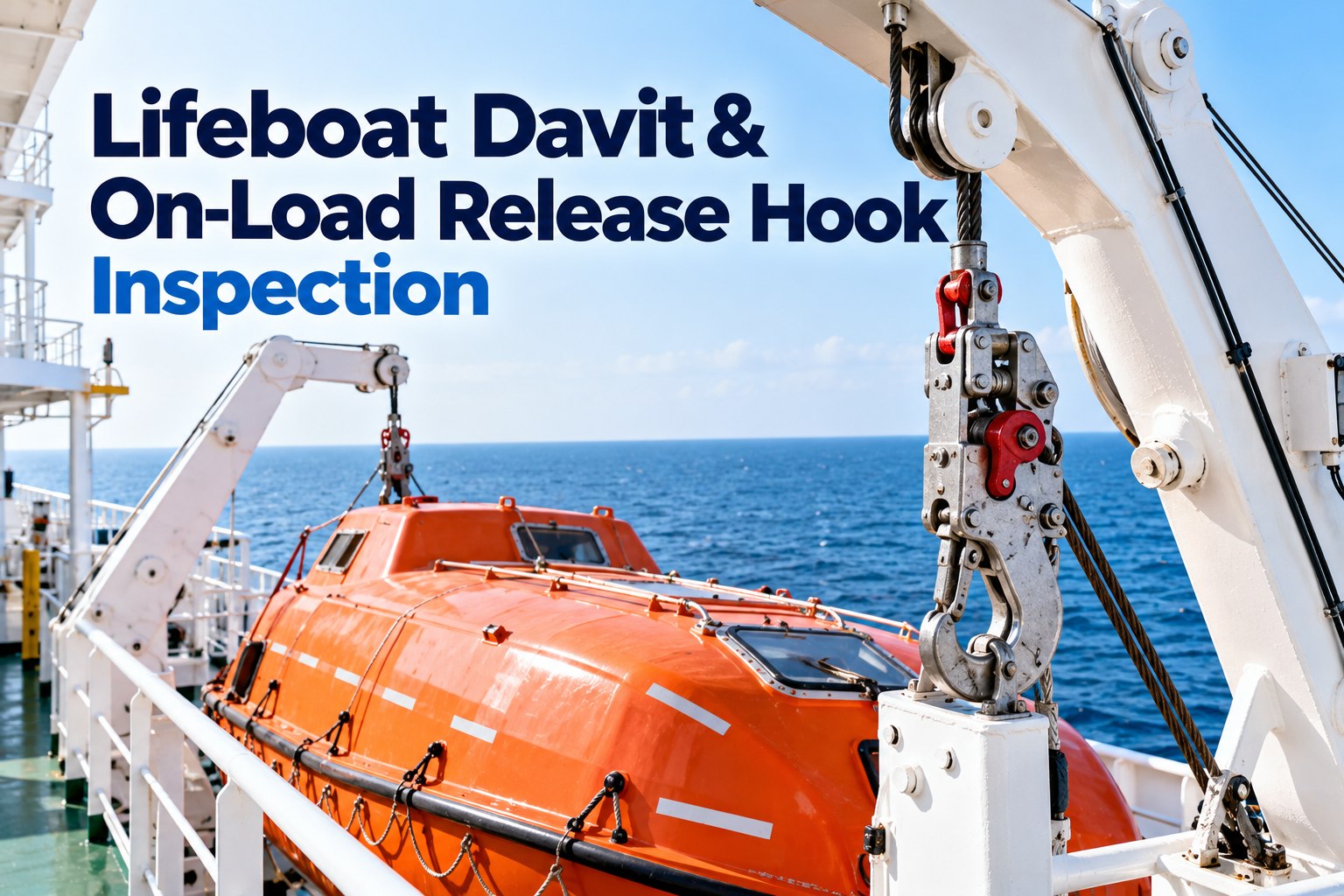
A lifeboat drill is the safest time to find a problem with the release gear, and one of the riskiest times to discover it. A hook that opens when it should not drops a boat with people in it. That risk is why IMO required release gear to be evaluated and replaced, and why accident investigators keep finding the same weak points: resets that were missed, crews who were never trained and maintenance that left the gear out. This guide, written for the Safety Officer, explains how on-load release works, what the rules require and what the published accidents show about prevention. For the wider LSA picture, see our SOLAS life-saving appliances Chapter III requirements and inspection guide.
On-Load Release Gear: Why Hooks Fail and How to Stop It
How the mechanism works, what the failures behind real accidents had in common and the maintenance and drill controls that prevent them.
Read this first. This guide supports training and planning. Lifeboat release gear must be operated, tested and maintained strictly to the manufacturer's instructions, the ship's approved procedures and the certificates on board. Nothing here replaces them.
1 Jul 2019
Latest replacement date
MSC.1/Circ.1392 required non-compliant systems to be replaced or modified by then.
50 cycles
Performance test
50 load-and-release cycles at 100% safe working load, in the evaluation of existing systems.
1.1 x load
After installing new gear
Post-installation testing includes a 1.1 times load and simultaneous release test.
Human error
MAIB's main cause
Worsened by system complexity and inadequate training, per Maritime Mutual's summary.
How On-Load Release Works and Why It Raised the Stakes
The difference between an off-load hook and an on-load release system
A Maritime Mutual risk bulletin explains that the older off-load hook permitted release only when the lifeboat was fully waterborne, which made it hazardous in a real emergency. The on-load design lets crew release both davit hooks at once, before the boat is fully waterborne, even in heavy seas or with the ship still moving. That capability is the point of the design, and it is also why a mistake with the reset or the mechanism can drop a boat.
Off-Load Hook Versus On-Load Release: What Changed and Why It Is Riskier to Get Wrong (Maritime Mutual Summary)
OFF-LOAD HOOK
Release only when fully waterborne
The weight is off the hooks before they open. The safeguard is the water. In a real emergency, this was hazardous, because the boat could not release until waterborne.
ON-LOAD RELEASE
Can release before fully waterborne
Both davit hooks release at once, even in heavy seas or with the ship still moving. The safeguard is the mechanism, the reset and the crew's procedure.
Source: Maritime Mutual Risk Bulletin No. 17 (appears to date from about mid-2019). The bulletin's "Mark 1" and "Mark 2" labels are the club's terms, not IMO terms. IMO's term is lifeboat release and retrieval system.
Why the IMO now calls it a release and retrieval system
MSC.1/Circ.1392 defines the system as the hook assembly and operating mechanism that connect a lifeboat to its falls, and uses the term lifeboat release and retrieval system instead of on-load release mechanism. The bulletin's Mark 1 and Mark 2 labels are the club's own shorthand, so check your documents for the manufacturer's model name, not the label.
The Rules: MSC.1/Circ.1392, SOLAS III/1.5 and the LSA Code
What the circular required and the dates that applied
MSC.1/Circ.1392, dated 27 May 2011, gives guidelines for evaluating and replacing release and retrieval systems, supporting SOLAS regulation III/1.5 and the LSA Code. Systems must comply with LSA Code paragraphs 4.4.7.6.4 to 4.4.7.6.6. The circular set evaluation by 1 July 2013 and replacement or modification of non-compliant systems no later than 1 July 2019, with replacement at the next scheduled dry-docking after 1 July 2014. These dates are historical, so your task is to confirm your own ship's status.
The Release Gear Rules Timeline From MSC.1/Circ.1392 (27 May 2011)
1 JAN 2013
SOLAS III/1.5 expected in force
Requires release and retrieval systems to meet the LSA Code (the circular's expected date).
1 JULY 2013
Evaluation by this date
The circular says the evaluation of existing systems should be completed.
AFTER 1 JULY 2014
Next dry-docking
Non-compliant systems replaced or modified at the next scheduled dry-docking after this date.
1 JULY 2019
Final deadline
No later than this date, whatever the dry-docking schedule.
Source: IMO MSC.1/Circ.1392 as reproduced in a Hong Kong Marine Department annex. Governments were also urged to ensure ships with on-load systems had fall preventer devices (MSC.1/Circ.1327) in the meantime. Confirm the current position and your certificates with your flag and class.
What the circular's tests and documents mean for what should be on board
For existing systems, the circular describes a design review and a performance test including 50 load-and-release cycles at 100% safe working load. Replacement equipment needs prior approval, and post-installation testing includes a 1.1 times load and simultaneous release test, followed by a Statement of Acceptance. Maritime Mutual adds that compliance certificates must be carried on board. For how the broader LSA inspection fits together, see our {L2}.
What MSC.1/Circ.1392 sets out for release and retrieval systems (summary of the circular as reproduced)| Topic | What the circular says | What to verify on board | Checkpoint type |
|---|
| Compliance basis | Systems must comply with LSA Code paragraphs 4.4.7.6.4 to 4.4.7.6.6 | Certificate or statement of acceptance for the installed system on board | Record |
| Evaluation of existing systems | Design review and a performance test, including 50 load-and-release cycles at 100% safe working load | Evaluation or approval documents from the manufacturer or class | Record |
| Replacement | Replacement equipment needs prior approval from the Administration or recognised organisation | Approval and installation records | Record |
| Post-installation test | 1.1 times load and simultaneous release test, then a Statement of Acceptance | Test report and the statement kept on board | Record |
| Interim protection | Fall preventer devices recommended until upgrades were complete (MSC.1/Circ.1327) | Whether fall preventers remain fitted and are used per the maker | Visual |
Source: MSC.1/Circ.1392 as reproduced in a Hong Kong Marine Department annex, and Maritime Mutual on certificates. Check your flag and class for current requirements.
Keep Release Gear Tests, Drills and Certificates in One Record
Track hook inspections, resets, crew competence and certificates with dated photos and owners for every lifeboat on every vessel.
Free trial available. Or book a walkthrough built around your own lifeboat release gear.
What Two Published Accidents Show About Release Gear Failures
Nagato Reefer and Blue Bosporus: a missed reset and a maintenance gap
MAIB's report on the Nagato Reefer found that a lifeboat fell from its davit while being secured after an abandon ship drill, because the forward lifting hook had not been correctly reset when lifted from the water. The report cites low crew competence, inadequate maintenance of safety equipment, an inadequate safety culture and falsified drill records. The TSB's Blue Bosporus findings concern a free-fall boat, but the same themes appear: maintenance that skipped a component and a drill practice that nobody had risk-assessed.
Two Published Accidents and What Each Shows About Release Gear and the Drill Around It
NAGATO REEFER, APRIL 2014 (MAIB 9/2015)
Forward hook opened while the boat was being secured
A lifeboat fell from its davit after an abandon ship drill during a Port State Control inspection. The forward lifting hook had not been correctly reset when lifted from the water. MAIB found low crew competence, inadequate maintenance, an inadequate safety culture and falsified drill records. One crewman was injured.
BLUE BOSPORUS, DECEMBER 2020 (TSB, FREE-FALL BOAT)
Slings failed when the hook was released
A free-fall boat fell about 45 feet during a test launch. Stress corrosion cracking had weakened sling crimp sleeves, one sling was shorter than the rest, crew stood unsecured in the boat and the maintenance schedule did not cover the slings. Two crew were seriously injured.
Sources: MAIB report page for Nagato Reefer, and Maritime Executive's summary of the TSB report on Blue Bosporus. The second case is a free-fall lifeboat, a different system from a davit-launched on-load hook, but the lessons about maintenance and drill practice carry over. We read summaries, not the full reports.
The failure patterns and the control each one points to
Maritime Mutual reports that MAIB found human error was the main cause in the cases it reviewed, worsened by system complexity and inadequate training, with design, installation and maintenance problems contributing. Put together with the two cases above, the pattern is consistent. The grouping below pairs each pattern with a control that a Safety Officer can own. The controls on the right are our suggestions.
Failure Patterns Seen in the Sources, and the Control Each Points To (Our Grouping)
Hook not reset after a launch
A step in the drill procedure with a named person who confirms it, and training on how to do it
Crew never trained on the system
Competence records and practical drills for everyone assigned to the boat
Complex mechanism, unclear instructions
Maker's instructions on board and specific to the installed system, with the training manual amended where needed
Maintenance gaps
Release gear and slings explicitly in the maintenance system, with dated evidence
Records that do not reflect reality
Drill and test records that can be checked against photos and inspection evidence
Left column from the Maritime Mutual bulletin, MAIB's Nagato Reefer findings and the TSB Blue Bosporus findings. Right column is our suggested control.
Prevention in Practice: Maker's Instructions, Competence and Evidence
Who should operate and maintain the gear and to what standard
Maritime Mutual urges operators to run and maintain on-load systems with the utmost caution and strictly in accordance with the manufacturer's instructions, with senior shipboard personnel or those under their close supervision doing the work. It also recommends inspecting all davit-fitted on-load systems, treating ISM non-conformities on equipment, maintenance and operation as a top priority and amending LSA training manuals as necessary. It recommends reporting near misses internally under the ISM Code.
How to make the reset and the inspection verifiable
The simplest control is a named person confirming the reset, in the way the maker specifies, before the boat is lifted or secured, and a record that can be matched to evidence. A dated photo of the hook in the correct position, if the maker's procedure allows one to be taken safely, gives that record weight. The MAIB's finding of falsified drill records is a reminder that a signature alone proves little.
The On-Load Release Gear Safety Checklist for the Safety Officer
A checklist with a checkpoint type on each item for drills, inspections and audits
Use the table before each drill, after each launch and before inspections. It covers the certificate, the maker's instructions, the reset, the condition of the gear and slings, testing, competence and drill records.
On-load release gear safety checklist, with a checkpoint type on every item (our suggested template)| Item | What to check | Checkpoint type |
|---|
| Type and certificate | Installed release and retrieval system identified and its certificate on board | Record |
| Maker's instructions | Current, specific to the installed system and in the crew's language | Record |
| Hook reset | Hooks confirmed reset after every launch or lift, by a named person | Visual |
| Condition | Hooks, operating mechanism and linkage inspected for wear, corrosion and damage | Visual |
| Function test | Release gear tested as the maker requires, by authorised personnel | Test |
| Slings and attachments | Included in inspection, with age and condition recorded | Visual |
| Crew competence | Everyone assigned trained on operation, reset and emergency release, with records | Record |
| Drill records | Accurate, signed and consistent with the evidence on board | Record |
Our suggested template. Checkpoint types: Visual, Test and Record. Follow the maker's instructions for the actual inspection and test method.
Mistakes That Have Dropped Lifeboats
Six habits drawn from the published cases
1
Not resetting the hooks after a drill
In the Nagato Reefer case the forward hook had not been correctly reset when lifted from the water, and the hook opened while the boat was being secured.
2
Assuming the crew know the reset
Maritime Mutual reports crews in an MAIB case had never been trained to reset the hooks.
3
Treating drills as paperwork
MAIB found drill records falsified on Nagato Reefer. A record is not evidence unless it matches the equipment.
4
Leaving slings and fittings out of the schedule
The Blue Bosporus maintenance schedule did not cover the slings, and stress corrosion had weakened them.
5
Standing unsecured in the boat
The TSB said there had been no assessment of the risk of crew standing unsecured. Assess and control the risk.
6
Operating without the maker's instructions
Maritime Mutual urges operation and maintenance strictly in accordance with the manufacturer's instructions by senior personnel or close supervision.
Systems That Keep Lifeboat Evidence, Training and Corrections Together
How a dated photo repository, task ownership and deadlines support release gear safety
Lifeboat safety is a chain of small, dated checks. Marine Inspection supports a dated photo repository, observations turned into tasks with owners, deadlines and evidence, and certificate and equipment tracking. A dated photo of a reset hook, a task for each finding with a named owner and a tracked certificate give a Safety Officer a record that matches the equipment. It does not replace the maker's instructions or your approved procedures.
Frequently Asked Questions About On-Load Release Gear
What is an on-load release hook?
A release mechanism that lets crew release both davit hooks at once before the lifeboat is fully waterborne, according to Maritime Mutual. An off-load hook permits release only when the boat is fully waterborne.
Why did IMO require evaluation and replacement of release gear?
MSC.1/Circ.1392 required evaluation of existing release and retrieval systems and replacement or modification of non-compliant ones, no later than 1 July 2019. It supports SOLAS III/1.5 and the LSA Code.
What tests does the circular describe?
For existing systems, a design review and a performance test including 50 load-and-release cycles at 100% safe working load. For replacements, a 1.1 times load and simultaneous release test after installation, then a Statement of Acceptance.
What caused the Nagato Reefer accident?
MAIB found the forward lifting hook had not been correctly reset when lifted from the water, so it opened while the boat was being secured. It also found low crew competence, inadequate maintenance and falsified drill records.
Who should operate and maintain the release gear?
Maritime Mutual urges that it be done in strict accordance with the manufacturer's instructions by senior shipboard personnel or those under their close supervision.
Does the Blue Bosporus accident involve an on-load hook?
No. It involved a free-fall lifeboat on a bulk carrier. It is included because the TSB's findings on slings, maintenance and unsecured crew relate to release practice and drill risk.
Where do I confirm my ship's release gear status?
In the certificates and approval documents on board, and with your flag and class. The circular's dates are historical, so confirm the current position for your ship.
Make Sure the Hook Does Only What the Crew Intended
Release gear inspections, resets, competence records and certificates for every lifeboat, in one system your Safety Officers and superintendents can use.
Free trial available. Or book a walkthrough built around your own lifeboat release gear.