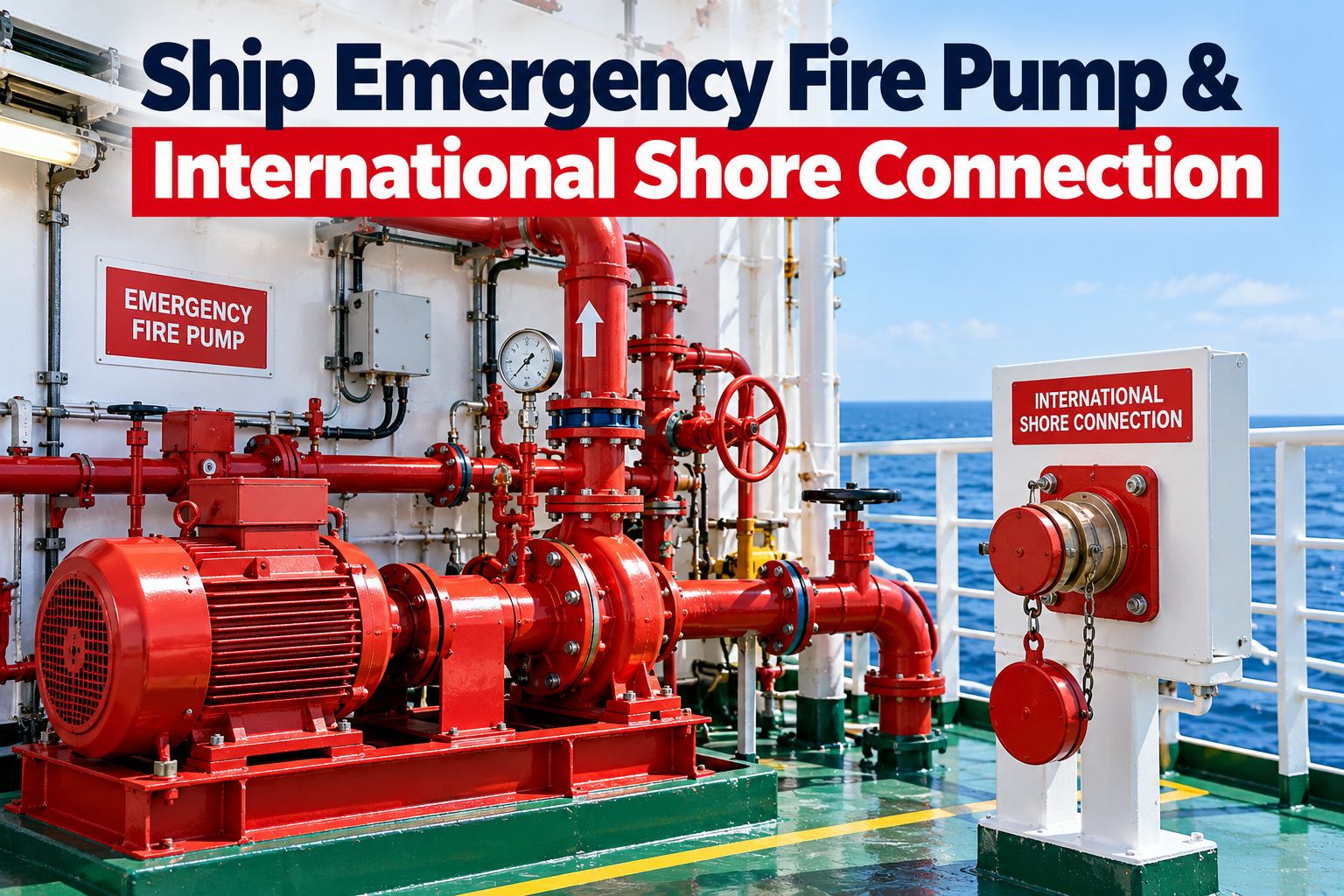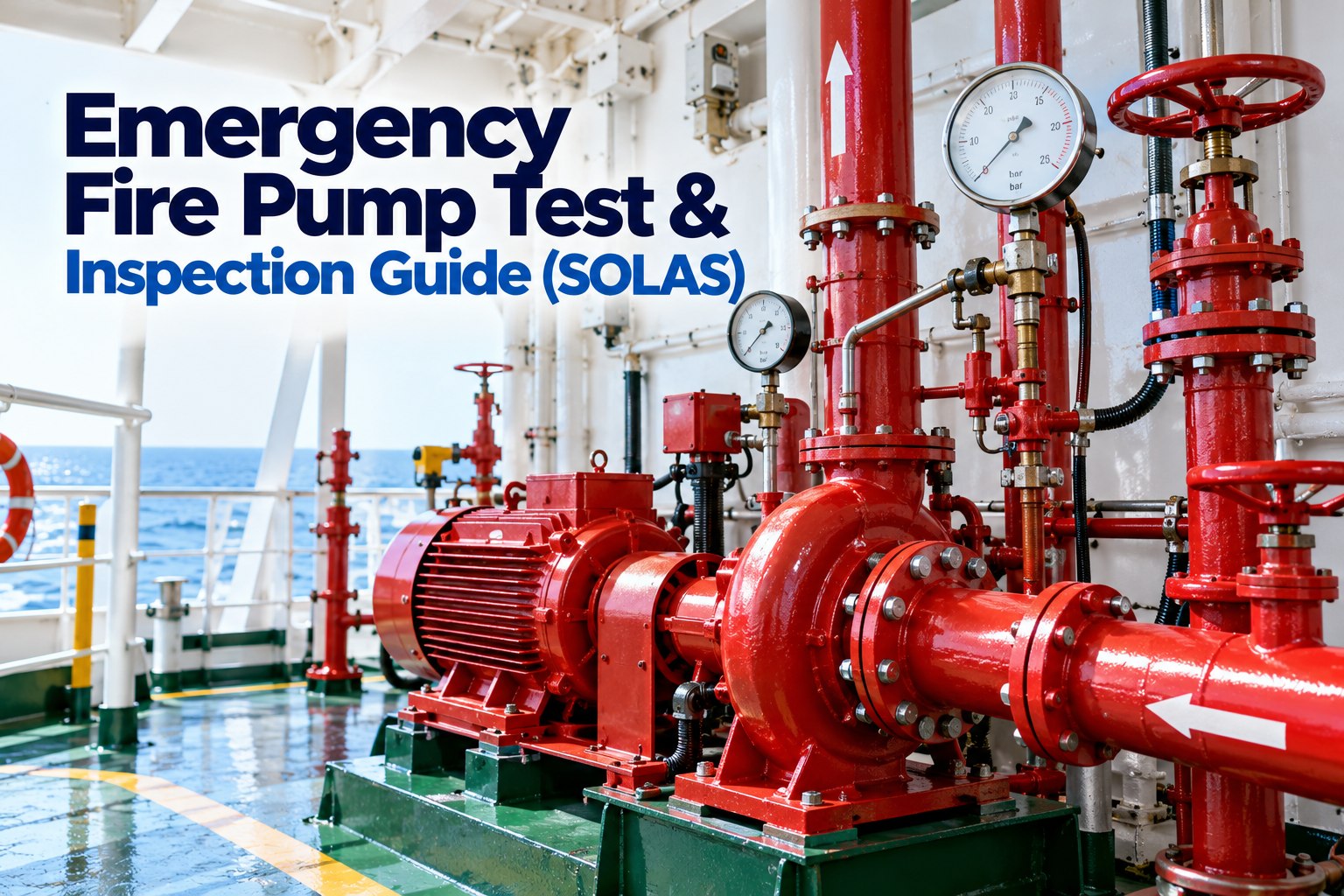
An emergency fire pump test proves that the pump outside the machinery space can start, prime, lift water and deliver enough pressure to the fire main when the main fire pumps are lost. SOLAS Chapter II-2 and the FSS Code set the requirements, IMO’s maintenance guidelines in MSC.1/Circ.1432 expect it to be run monthly and flow tested annually, and port state control officers regularly ask to see it working. Get it wrong and the cost is a ship with no fire main when the engine room is on fire, a PSC deficiency or detention, and logbook entries that do not match what the pump can actually do.
Start it, prime it, prove the pressure: running an emergency fire pump test the PSC officer will accept
A step-by-step test from the pump room to the highest hydrant, with the logbook record that proves it.
Free sign-up · Offline checklists on board · Signed PDF reports
The emergency fire pump exists for one scenario: a fire or flooding that knocks out the main fire pumps in the machinery space. That is why it sits in a separate compartment, has its own power and its own sea suction, and must be able to supply the fire main with the engine room isolated. It is also why a quick weekly run with the discharge valve shut proves very little.
This guide is about the test itself and the evidence it leaves: the requirements the test has to prove, a step-by-step procedure, starting and priming checks, pressure at the highest hydrant, intervals, common PSC findings and what to record. For the wider engine room routine, see engine room maintenance. To log each test on the crew’s phones, you can start recording fire pump tests free.
SOLAS fire pump requirements an emergency fire pump test must prove
The test is only meaningful if it checks the things the rules require. Marine Insight’s summary of the requirements gives the core points:
Who needs one
Cargo ships of 2,000 GT and above and passenger ships of 1,000 GT and above.
Capacity
At least 25 m³/h, enough to supply two jets from the fire main.
Suction head
Total suction head not more than 4.5 m in all conditions of list and trim.
Location
Outside the machinery space, with its own suction and independent power.
Starting
Manual, battery or hydraulic start that one person can operate.
Pressure
Enough at the hydrants to meet SOLAS II-2/10.2.1.6 for your ship type and size, with the machinery space isolated.
Summary from Marine Insight’s guide to fire pumps on ships. Check SOLAS II-2/10 and FSS Code Chapter 12 for the exact figures for your ship, including the minimum hydrant pressure and fuel endurance.
Emergency fire pump test: step-by-step procedure
Run the test as if the engine room were lost. The ADOMS summary of MSC.1/Circ.1432 calls for the annual flow test to be done with the isolation valves closed, and the Bahamas Maritime Authority’s pre-arrival checklist asks for a two-hose test to the extremities of the ship.
Plan and brief
Tell the bridge and engine room, agree hydrant positions and who reads each gauge. Check the ship can accept water on deck.
Isolate the machinery space
Close the fire main isolating valves between the engine room and the rest of the main, so only the emergency pump supplies the deck.
Check before starting
Sea suction valve open, fuel level, battery or hydraulic charge, priming system ready, ventilation open.
Start and prime
Start as you would in an emergency, by one person, and time how long it takes to prime and build pressure.
Run two jets at the extremities
Open two hydrants, including the highest and most remote, with hoses and nozzles attached, and read the pressure.
Restore and record
Stop the pump, reopen isolating valves, drain the main where required and record every reading.
Every fire pump test logged with start time, pressures and hydrants used
Readings captured on deck, offline, and stored with the pump’s maintenance history.
Free to start · Works offline on board · Export to signed PDF
Fire pump starting test and priming checks
Most failed emergency fire pump tests fail before any water moves: the engine will not start, or the pump will not prime. The Bahamas checklist asks whether the starting system works and whether the crew understand the instructions.
Test at the ship’s lightest draught when you can, because that is when the suction lift is greatest and priming is hardest.
Hydrant pressure test: proving pressure at the highest hydrant
The pressure that matters is the one at the hydrant, with water flowing, not the figure on the pump discharge gauge with the valve shut. The test should show the pump can hold pressure with two jets running at the most demanding outlets.
Pressure falls along the fire main (illustrative readings during a two-jet test)
Illustrative only; actual losses depend on height, pipe length and condition. Compare the lowest reading with the SOLAS minimum for your ship, and trend it year on year.
Fire pump maintenance intervals under MSC.1/Circ.1432
The ADOMS summary of MSC.1/Circ.1432 groups fire mains, pumps, hydrants, hoses and nozzles together. The intervals that apply to the emergency fire pump:
- All fire pumps run to confirm they supply adequate pressure
- Emergency fire pump fuel supply adequate; heating checked where fitted
- Hydrants, hoses and nozzles in place and serviceable
- International shore connection serviceable
- Flow test of all fire pumps for pressure and capacity
- Emergency fire pump tested with isolation valves closed
- All hydrant valves tested; relief valves set; strainers examined
- Sample of hoses pressure tested; all within five years
Many operators also run the emergency fire pump weekly and at fire drills; follow your SMS and planned maintenance system. Plan the routine in the preventive maintenance schedule.
Emergency fire pump PSC deficiencies and how to avoid them
The Bahamas Maritime Authority lists “fire pump and its pipes” among recurring PSC deficiencies, specifically insufficient pressure or a pump that will not work, and flags the emergency fire pump as critical equipment that is not always tested as required.
Pump will not start
Flat batteries, no fuel, failed starter, crew unsure of the procedure.
Insufficient pressure
Worn pump, passing isolating valves, leaking main, choked strainer.
Will not prime
Priming pump fault, air leaks on suction, sea valve seized.
Fire main leaks
Pinholes, excessive corrosion, temporary repairs not reported.
Records missing
Tests not in the PMS, or logbook entries that do not match the pump’s condition.
Defects not reported
SOLAS requires defects affecting safety to be reported to the flag and RO.
For how fire-safety findings build into detentions, see our PSC detention deficiencies guide.
Fire main inspection and the logbook record
The record is what turns a test into evidence. A good entry lets anyone see the pump started, primed, isolated the engine room and held pressure at the hydrants.
Fire main condition is part of the same record: note leaks, pinholes and valve problems found during the test, and raise jobs for them. For the full fire-safety picture, see SOLAS compliance.
How Marine Inspection supports emergency fire pump testing
Marine Inspection turns each test into a structured record and keeps the pump’s history, so the trend is visible before PSC sees it. The trend below is illustrative.
Plans scale from one ship to a fleet; see Marine Inspection pricing.
Emergency fire pump test: prove it as if the engine room were gone
An emergency fire pump test only proves something if it is run the way the pump would be used for real: started by one person, primed from its own suction, with the engine room isolated and two jets running at the most demanding hydrants, and every reading recorded. Do that monthly and flow test it annually, and the pump will be there when it is needed and ready for any inspector. Keep each test in a digital logbook so the pressure trend is never a surprise.
Walk into the next PSC inspection with every fire pump test, pressure and fix on file
Free sign-up · Offline on board · Signed PDF reports