Drills are the only part of a ship’s safety system that is tested on a schedule whether or not anything is wrong, and they are the part most often reduced to a signature. The regulation is not vague about this: SOLAS sets specific intervals for specific drills, specifies what several of them must contain, and requires that each one is conducted “as if there were an actual emergency”. A muster on the boat deck where nobody lowers anything, starts anything or wears anything satisfies none of that, and it is exactly what a port state control officer is trained to spot.
This guide sets out every drill interval a safety officer is responsible for, what each drill has to include, how the twenty-four hour rule works when the crew changes, what the log entry must actually say, and where the 2026 change sits — because there is one, and it is not where most people expect.
Every drill on board sits on one of six clocks. Miss a clock and the record is the finding, not the drill.
Six intervals, plus the four-month clock for davit-launched liferaft training and the two-week clock for a newly joined crew member’s on-board training. Passenger ships run fire and abandon ship weekly rather than monthly.
SOLAS emergency drill requirements: what regulation III/19 sets
The base rule is short. Every crew member must take part in at least one abandon ship drill and one fire drill every month. On passenger ships those drills run weekly, and the crew musters weekly as well. Everything else in the drill regime is a longer clock hanging off that monthly spine.
Abandon ship drill
Fire drill
Enclosed space entry and rescue
Lifeboat launched and manoeuvred
Free-fall lifeboat
Rescue boat
Two further clocks are easy to lose because they are not attached to a named drill. On-board training in the use of the ship’s life-saving appliances has to be given as soon as possible and no later than two weeks after a crew member joins — which for a ship with rolling crew changes means it is effectively continuous. And training in the use of davit-launched liferafts must take place at intervals of not more than four months. Both belong in the same schedule as the drills, and both are recorded.
The 24-hour rule: when a drill must happen before you sail
This is the provision that catches ships after a crew change, and it is the one an inspector can test from the crew list alone. If more than 25 per cent of the crew have not taken part in abandon ship and fire drills on board that particular ship in the previous month, the drills must take place within 24 hours of the ship leaving port.
Count against this ship, not the fleet
Count against the previous month
The clock starts at departure
Security has its own version
The practical control is simply knowing the number. A crew list that shows, per person, the date they last took part in a fire drill and an abandon ship drill on this ship turns the 24-hour rule from a judgement call into arithmetic — and it is the same list that answers the inspector when they ask who has and has not drilled. Keeping that participation record per crew member rather than per drill is the difference between an answer and a search.
Abandon ship drill requirements and lifeboat launching intervals
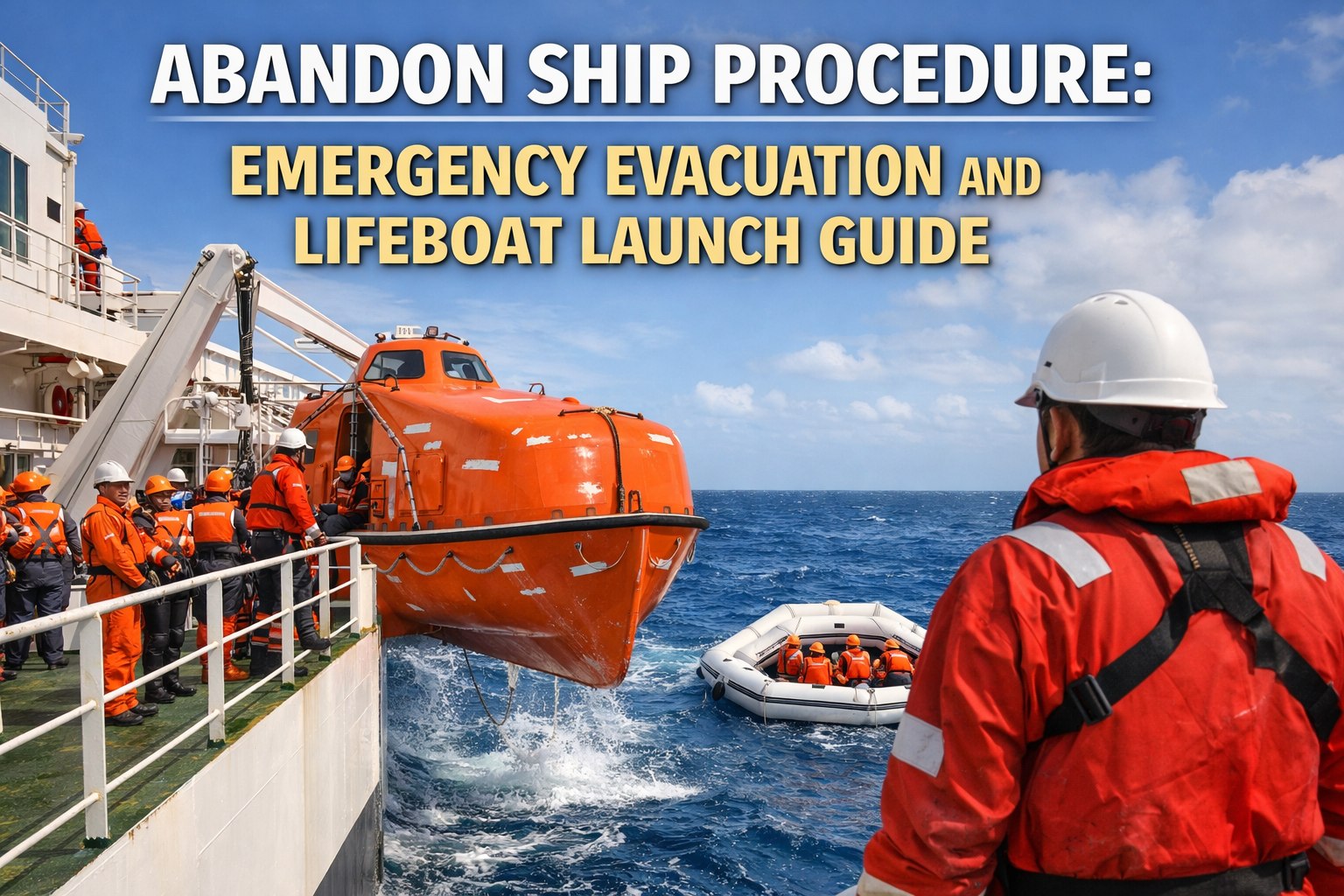
An abandon ship drill is a sequence, not a gathering. It calls the crew to muster stations with the alarm, has them report and be accounted for against the muster list, sends them to their stations in the correct dress with lifejackets properly donned, and then exercises the equipment itself — lowering, starting engines, checking the lighting and the launching arrangements.
The launching intervals are where the paperwork and the practice most often separate. Each lifeboat must be launched and manoeuvred in the water by its assigned operating crew at least once every three months during an abandon ship drill. Free-fall boats have their own arrangement: the crew boards and secures itself in the seats and the launch procedure is taken to the point before release at the quarterly drill, and at intervals of not more than six months the boat is either launched by free fall with only the operating crew on board, or a simulated launching is carried out instead.
Where launching drills go wrong
Fire drill requirements: what a fire drill must include
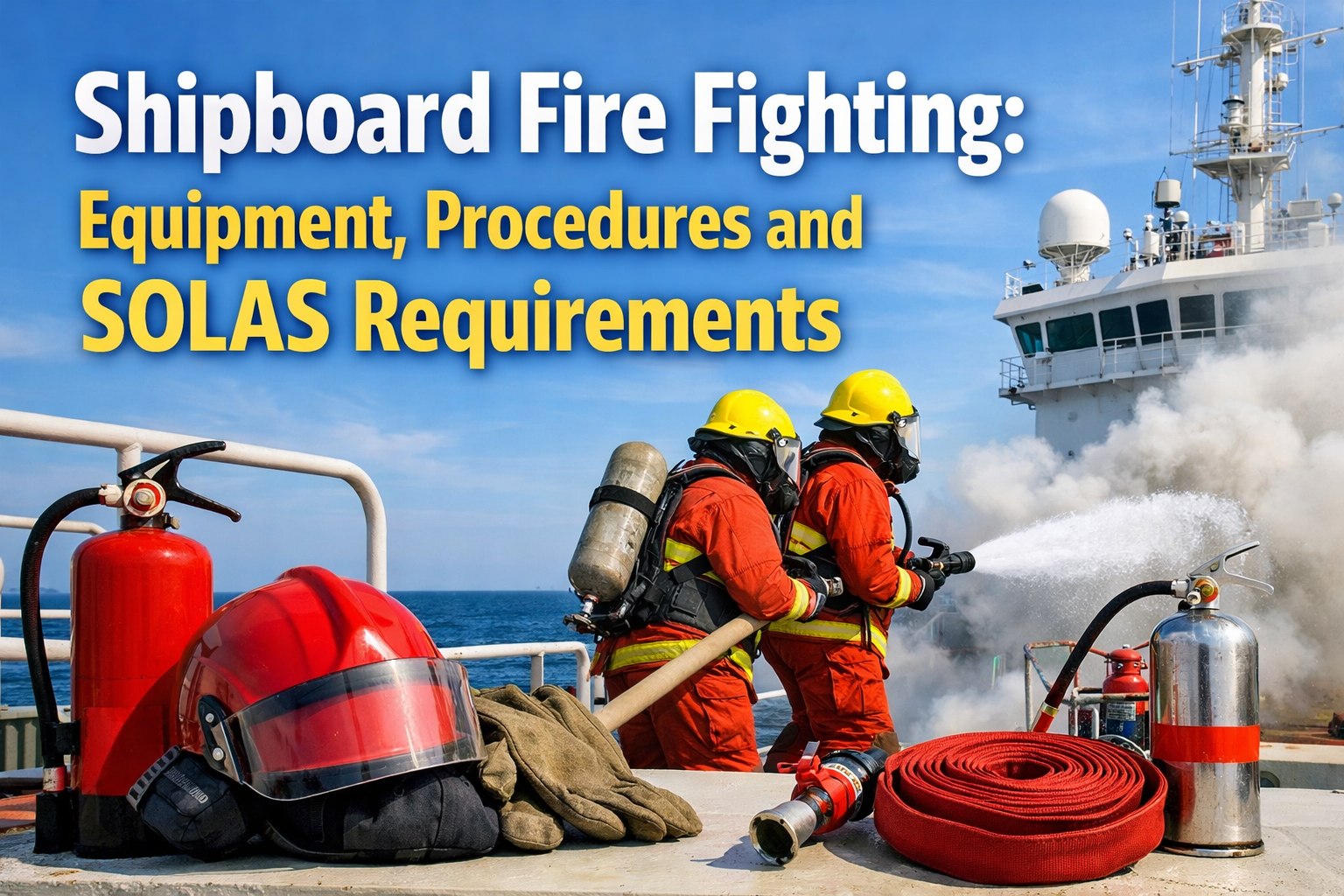
SOLAS lists the content of a fire drill rather than leaving it to the ship, which makes it straightforward to audit against — and straightforward for an inspector to find the gap.
Report to stations
Start the fire pumps
Check fireman’s outfits
Check communications
Operate doors and dampers
Check for abandonment
Scenarios have to vary. A fire drill that is always a galley fire trains the crew for a galley fire; the machinery space, the accommodation, the cargo area and the paint store all behave differently and need different parties and equipment. Varying the location, the time of day and which key person is declared unavailable is what turns a drill into training, and it is also what the fire safety inspection regime assumes has been happening when it tests the hardware.
Enclosed space entry and rescue drill: every two months
Every crew member with enclosed space entry or rescue responsibilities must take part in an enclosed space entry and rescue drill at least once every two months. The drill is specified in some detail, and the detail is the point — it is designed to stop the exercise becoming a talk-through.
Check the equipment
Check communications
Use the instruments
Rescue equipment and procedures
First aid and resuscitation
The recommendations behind this drill were rewritten at the end of 2025. IMO resolution MSC.581(110), effective 3 December 2025, supersedes the long-standing A.1050(27) and asks for a ship-specific enclosed space register, an enclosed space emergency response plan, entry permits with a maximum validity of eight hours, and personal gas detection covering oxygen, carbon dioxide, flammable gases and toxic substances. The pre-entry atmosphere criteria it sets are oxygen at 20.9 per cent or above, carbon dioxide below 0.5 per cent, flammable gas below 1 per cent of the lower flammable limit and toxic gases below half the occupational exposure limit.
SOLAS drill frequency calendar: a twelve-month plan
Intervals are easier to defend when they are laid out as a year rather than tracked as a set of countdowns. The plan below is one workable arrangement for a cargo ship — the monthly drills run every month, and the longer clocks are spread so that no single month carries three launchings.
| Drill or training | Jan | Feb | Mar | Apr | May | Jun | Jul | Aug | Sep | Oct | Nov | Dec |
|---|---|---|---|---|---|---|---|---|---|---|---|---|
| Abandon ship drill | • | • | • | • | • | • | • | • | • | • | • | • |
| Fire drill | • | • | • | • | • | • | • | • | • | • | • | • |
| Rescue boat launched | • | • | • | • | • | • | • | • | • | • | • | • |
| Lifeboat launched and manoeuvred | • | • | • | • | ||||||||
| Free-fall launch or simulated launch | • | • | ||||||||||
| Enclosed space entry and rescue | • | • | • | • | • | • | ||||||
| Davit-launched liferaft training | • | • | • | |||||||||
| Emergency steering drill | • | • | • | • | ||||||||
| Ship security drill | • | • | • | • | ||||||||
| Ship security exercise | • |
A plan, not a specification. Passenger ships run fire and abandon ship weekly. The two-week on-board training clock for newly joined crew sits outside any calendar and has to be handled per person.
Drills beyond SOLAS chapter III: steering, security and pollution
Three regimes add drills that safety officers own but that do not appear in chapter III, and all three are asked about.
Emergency steering drill
Ship security drills and exercises
Pollution and emergency response
What makes a drill realistic enough to count
SOLAS asks that drills be conducted, as far as practicable, as if there were an actual emergency. That wording gives an inspector a great deal of room, and the drills that fail are usually failing on the same handful of points.
The debrief is the part that most often goes missing and is the cheapest to add. Five minutes at the end, recording what took longer than it should have and what did not work, produces a drill record that reads as training rather than attendance — and gives you the evidence trail when the same problem shows up twice.
SOLAS drill records: what must be written and what inspectors read
The record-keeping requirement is explicit. The date when musters are held — alongside the ship’s planned maintenance system records rather than in a separate book — details of abandon ship drills and fire drills, enclosed space entry and rescue drills, drills of other life-saving appliances and on-board training must all be recorded in the log book. And there is a second sentence that carries most of the weight in practice: if a full muster, drill or training session is not held at the appointed time, an entry must be made stating the circumstances and the extent of the session that was held.
Date and type
Who took part
What was exercised
What was not done, and why
That last one is worth saying plainly, because crews avoid it: writing down that a lifeboat could not be launched in that port, and what was done instead, is compliance. Leaving the month blank, or recording a drill that did not take place, is not — and the second is the one that turns a deficiency into a question about the log book as a whole.
Drill deficiencies port state control actually writes up
When the MoUs ran a concentrated inspection campaign on emergency systems and procedures, the single most common finding was not a failed launching or a slow muster. It was the muster list. Tokyo MoU recorded 178 muster list deficiencies over the campaign and Paris MoU recorded 201, and inspectors in the Indian Ocean and Abuja regions reported crews unfamiliar with the operation of their own emergency equipment.
Muster list out of date
Crew cannot operate their equipment
Log entries with no substance
Intervals quietly slipped
Drills are also a common trigger for an expanded inspection: a port state control officer who is unconvinced by the muster list or the drill record will usually ask for a drill to be demonstrated, and what happens next is judged against the record you just handed over. The LSA readiness regime and the drill regime are read together for exactly this reason.
Did SOLAS drill requirements change in 2026?
The drill intervals in SOLAS chapter III did not change. Abandon ship and fire remain monthly, enclosed space entry and rescue remains two-monthly, lifeboat launching remains quarterly and the free-fall interval remains six months. If you have been told the frequencies moved for 2026, they did not.
What did change sits alongside them. IMO resolution MSC.581(110) took effect on 3 December 2025 and replaced the previous recommendations for entering enclosed spaces, adding the ship-specific enclosed space register, the emergency response plan, the eight-hour entry permit and revised atmosphere criteria. It reaches ships through the safety management system rather than as a new SOLAS regulation, which is precisely why it is easy to miss. The substantive 2026 work sits elsewhere in the package — principally in the new lifting appliance requirements, which do carry real deadlines.