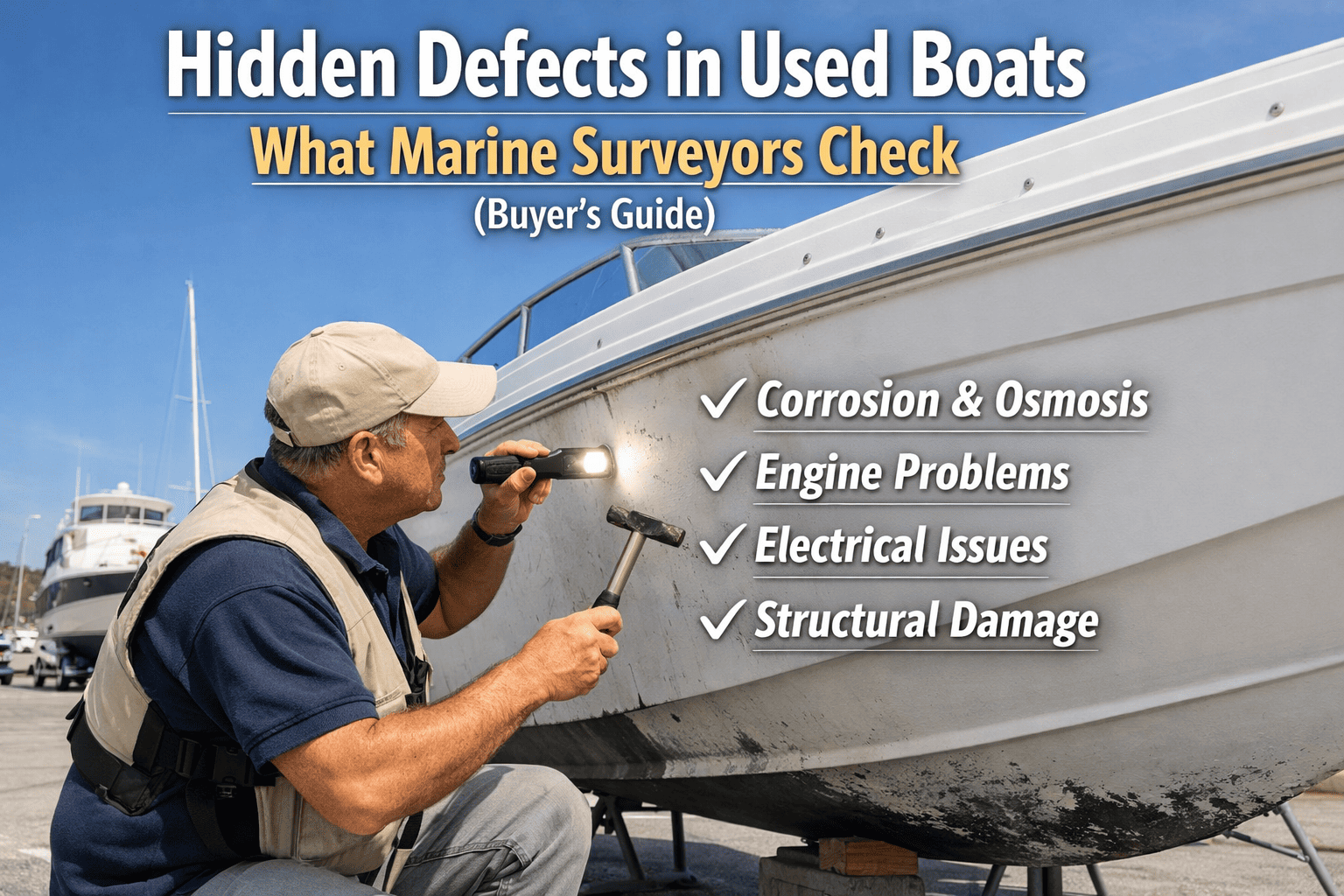
Every used boat has a story — and the most expensive chapters are the ones the seller doesn't mention. Hidden defects lurk below waterlines, behind engine covers, inside wire runs, and under layers of cosmetic touch-ups. Some are harmless. Others can cost tens of thousands to repair — or make a vessel genuinely unsafe. A qualified marine surveyor knows where to look, what to tap, and which stains on a bilge wall mean trouble. This guide walks you through the most common hidden defects surveyors find in used boats, how serious each one is, and what to look for yourself before you spend a dollar on a professional inspection. Boat buyers who want a structured way to track defects and repairs from day one can sign up for Marine Inspection's vessel management platform to keep every finding organized.
Hidden Defects in Used Boats: What the Numbers Say
80%+
Surveys Find Issues
Even well-maintained boats have findings
#1 Risk
Electrical Systems
Greatest fire hazard on used boats
$500–$50K+
Repair Cost Range
From minor fixes to deal-breaking failures
Below Waterline
Most Hidden Area
Invisible without a haul-out inspection
Hull & Structural Defects
The hull is everything. If the structure is compromised, nothing else matters. These are the defects surveyors look for with moisture meters, tap hammers, and trained eyes — and the ones that sink deals (sometimes literally).
High Severity
Osmotic Blistering (Boat Pox)
Water penetrates the gelcoat and reacts with the resin, forming fluid-filled blisters on the hull bottom. Minor surface blisters may be cosmetic, but widespread "boat pox" — hundreds of blisters across the hull — can require stripping the entire gelcoat and outer laminate. Repair cost: $5,000–$20,000+ depending on severity and hull size. Surveyors detect this with moisture meters and visual inspection during haul-out.
High Severity
Delamination & Core Rot
In cored hulls and decks (balsa or foam core between fiberglass skins), water intrusion causes the core to rot or separate from the skins. The deck feels spongy underfoot. Tap testing reveals dull, dead sounds versus the sharp ring of solid laminate. Repair cost: $3,000–$15,000+ per affected area. Often invisible from the surface until advanced.
Medium Severity
Stress Cracks & Impact Damage
Hairline cracks in the gelcoat can be cosmetic (spider cracks from UV/age) or structural (stress cracks indicating underlying flex or impact). Surveyors distinguish between the two by location, pattern, and depth. Cracks radiating from hardware mounting points, along hull-to-deck joints, or at stringer attachments suggest structural stress. Impact damage from grounding may be hidden beneath fresh bottom paint.
Medium Severity
Stringer & Transom Deterioration
Stringers are the internal structural members that support the hull. When water enters through hardware holes, cracks, or poor drainage, the wood core inside fiberglass stringers rots from within — invisible until the surveyor taps or probes them. Transom rot (especially on outboard boats) compromises engine mounting. Transom replacement: $3,000–$10,000+.
Engine & Propulsion Problems
The engine is the most expensive single component on most boats. Hidden engine defects don't always announce themselves with smoke or noise — some only show up in oil analysis, compression tests, or under load during a sea trial.
High Severity
Internal Corrosion & Overheating History
Saltwater engines that have overheated — even once — may have warped heads, blown gaskets, or corroded internal passages. Sellers repaint engine blocks to hide corrosion. Surveyors look for white salt deposits around exhaust risers, discolored coolant, and signs of water in oil (milky residue on the dipstick). Oil analysis ($30–$75) reveals metal particles that indicate internal wear invisible to the eye.
High Severity
Exhaust System Failures
Corroded exhaust risers and manifolds on inboard engines allow water to flow back into cylinders — a condition called hydro-lock that can destroy an engine in seconds. Risers have a finite lifespan (5–8 years in saltwater) and are often overlooked in maintenance. Surveyors check for rust weeping, scale, and water staining around exhaust connections. Riser/manifold replacement: $2,000–$6,000 per engine.
Medium Severity
Outdrive & Lower Unit Wear
Sterndrive lower units and outboard gearcases suffer from seal failures, water intrusion, and gear wear. Milky or gray lower unit oil indicates water contamination. Metal shavings on the drain plug magnet signal gear damage. Bellows (on sterndrives) crack with age and allow water into the bilge — a sinking hazard. Check service records for bellows replacement history.
Medium Severity
Propeller & Shaft Issues
Bent props, pitted blades, and worn cutlass bearings cause vibration, reduced performance, and accelerated wear on transmission seals. Shaft misalignment may not be visible but causes excessive vibration under load during sea trial. Surveyors inspect prop, shaft, strut, and bearings during haul-out. Prop replacement: $500–$3,000; shaft work: $1,500–$5,000+.
Electrical System Hazards
After years of additions, modifications, and amateur repairs, the electrical system is often the greatest fire hazard on a used boat. Surveyors consider this area one of the most critical — and most commonly deficient — in pre-purchase inspections.
Common Electrical Defects Found in Used Boats
Equipment wired directly to battery without fuses — A fire waiting to happen. Previous owners often hard-wire accessories (radios, pumps, lights) directly to battery posts, bypassing the breaker panel entirely. One short circuit = one fire with no overcurrent protection.
Residential-grade (solid) wire used instead of marine-grade — Solid-strand household wire (Romex) is not rated for the vibration environment on a boat. It fatigues and breaks, creating open circuits or arcing faults. Marine-grade wire is multi-strand, tinned copper — look for the difference in exposed wire runs.
Corroded terminals and connections — Green, crusty terminals increase resistance, generate heat, and can ignite surrounding materials. Battery posts with more than four wires connected ("crowded post syndrome") are a common finding that indicates ad-hoc wiring additions over the years.
Missing GFCI protection on AC outlets — AC outlets in the galley, head, machinery spaces, and on weather decks must be GFCI-protected. Many older boats lack this, creating a shock hazard — particularly dangerous near water. Surveyors test every outlet.
Batteries not properly secured or contained — Batteries must be in liquid-tight, acid-proof containers and secured against movement (no more than one inch in any direction). Loose batteries shift in rough seas, short-circuit against metal, and spill acid.
If the electrical system is maxed out or riddled with problems, get an estimate from a certified marine electrician before negotiating with the seller. A full rewire on a 35-foot boat can cost $8,000–$15,000+. Knowing that number changes the negotiation entirely.
Below-Waterline Defects (Invisible Without Haul-Out)
These defects are literally invisible while the boat is floating. This is exactly why surveyors insist on a haul-out — and why skipping it to save $250–$500 is a false economy.
Through-hulls are the fittings that penetrate the hull below the waterline for water intake, discharge, and sensors. Corroded, frozen, or failed seacocks can't be closed in an emergency — meaning a broken hose connection becomes an uncontrollable flood. Surveyors operate every seacock and check for dezincification (pink discoloration on bronze fittings).
Sinking hazard · Replace corroded fittings immediately
Sacrificial zinc anodes protect underwater metals from galvanic corrosion. When zincs are consumed and not replaced, the corrosion attacks propellers, shafts, through-hulls, and rudder fittings instead. Surveyors check zinc condition during haul-out — severely depleted or missing zincs suggest the boat's underwater metals have been unprotected for months or years.
Cheap to prevent · Expensive to repair once damage occurs
A boat that has run aground may show no exterior damage but have cracked fiberglass, misaligned shafting, bent struts, or internal structural stress. Sellers don't always disclose groundings. Surveyors look for fresh bottom paint over localized areas, prop blade damage patterns, and keel bolt weeping as indicators of unreported bottom contact.
Often undisclosed · Ask for incident history
Rudder bearings wear over time, creating play that worsens handling. On sailboats, keel bolts can corrode internally — invisible from outside but potentially catastrophic if they fail. Surveyors check rudder play by hand, inspect keel-to-hull joints for weeping or cracking, and may recommend ultrasonic testing on keel bolts for older vessels.
Structural safety · Ultrasonic testing may be recommended
Track Every Defect from Survey to Resolution
Marine Inspection turns survey findings into tracked maintenance tasks — with deadlines, photo evidence, and a complete repair history for your vessel.
Plumbing, Fuel & Gas System Defects
Less dramatic than structural or engine problems, but plumbing and fuel defects create safety hazards, environmental violations, and expensive repairs that buyers often don't anticipate.
Plumbing, Fuel & Gas System Red Flags
⚠
Fuel tank corrosion — Aluminum tanks develop pinholes from ethanol fuel or water contamination. Replacement requires cutting open deck or hull sections. Cost: $3,000–$10,000+.
⚠
Aged fuel hoses — Rubber fuel lines degrade over time, becoming brittle or swelling. Failed fuel lines in the engine compartment are an explosion and fire risk.
⚠
Non-compliant LPG/CNG systems — Propane systems must have leak detection, solenoid shutoffs, and proper ventilation. Older installations often fail current safety standards.
⚠
Head and holding tank issues — Permeable hoses absorb odor permanently. Old sanitation hoses smell even when clean. Holding tank condition and discharge fittings must meet USCG requirements.
⚠
Freshwater system contamination — Cracked or aging water tanks harbor bacteria. Surveyors check tank condition, pump operation, and hot water heater for leaks and proper pressure relief.
⚠
Bilge pump failures — Non-functional automatic bilge pumps can't respond to water intrusion when no one is aboard. Surveyors test float switches and pump operation — both primary and backup.
Red Flags You Can Spot Before Hiring a Surveyor
You don't need professional tools to catch early warning signs. Before spending $1,000+ on a full survey, a quick personal walkthrough can reveal obvious problems — and save you from surveying a boat that's clearly not worth pursuing.
Quick Visual Checks Anyone Can Do
Check the bilge — Excessive water, oil sheen, or staining suggests chronic leaks or poor maintenance. A dry, clean bilge is a good sign.
Walk the deck — feel for soft spots — Step firmly on every area of the deck, especially around hardware, hatches, and chainplates. Spongy or flexing areas indicate core rot beneath the surface.
Smell the engine oil — Pull the dipstick. Milky, frothy oil = water contamination. Burnt smell = overheating. Dark but smooth and clean = normal. No oil on the dipstick = run away.
Look for mismatched paint or repairs — Fresh gelcoat patches, newly painted sections, or mismatched colors can indicate hidden damage that's been cosmetically covered rather than properly repaired.
Open every locker and hatch — Look for water stains, mold, musty odors, and signs of past flooding. Check under settee cushions, behind panels, and in anchor lockers. Sellers clean what's visible — hidden compartments tell the real story.
Ask for maintenance records — No records = no proof of care. Gaps in service history are a red flag that the previous owner deferred maintenance. Documented history directly supports the vessel's value and your confidence in the purchase.
How Severity Impacts Your Decision
Not every survey finding is a deal breaker. Understanding which defects are cosmetic, which are negotiable, and which should make you walk away prevents both overpaying and walking away from a good boat over minor issues.
Defect Severity Guide: Walk, Negotiate, or Accept
Walk Away
Severe structural damage, transom rot, active hull delamination, evidence of fire, unfixable engine failures, massive hidden electrical rewiring needed
Unless repair cost is fully reflected in a dramatically reduced price and you're prepared for a project boat
Negotiate
Corroded exhaust risers, worn rigging, outdated electronics, aging canvas, deferred maintenance items, seacock replacement needed, propeller damage
Get repair estimates, reduce purchase price accordingly, or require seller to complete repairs before closing
Accept
Expired flares, worn cushions, minor gelcoat scratches, faded canvas, cosmetic scuffs, small zinc depletion, outdated safety equipment
Normal wear on any used boat. Budget for these as part of ownership. Don't use minor items to hammer the seller.
From Survey Findings to Maintenance Plan
Marine Inspection helps boat owners convert every defect into a tracked task — with priorities, deadlines, photo documentation, and a complete service history that protects your vessel's value.
Frequently Asked Questions
What are the most expensive hidden defects in used boats?
The costliest defects are typically structural: osmotic blistering requiring full gelcoat stripping ($5,000–$20,000+), transom rot and replacement ($3,000–$10,000+), core rot in decks or hulls ($3,000–$15,000+ per area), and engine replacement if internal corrosion or overheating has caused irreversible damage ($10,000–$50,000+). Fuel tank replacement hidden behind structural components is another major expense that surprises buyers.
Can I spot hidden defects without a surveyor?
You can catch obvious red flags — soft decks, oily bilges, milky engine oil, corroded wiring, water stains, and cosmetic cover-ups. However, a qualified surveyor has specialized tools (moisture meters, ultrasonic thickness gauges, tap hammers) and trained experience to find defects invisible to untrained eyes. A personal walkthrough narrows your shortlist; a professional survey protects your investment.
Should I walk away from a boat with survey findings?
Not necessarily. Virtually every used boat has findings — even well-maintained ones. The question is severity: structural or safety issues that cost more to fix than the price reduction justifies may be walk-away items. Deferred maintenance and worn components are negotiation points. Minor cosmetic issues are part of buying used. Use the survey report to make an informed decision — that's exactly what it's for.
Why is the electrical system the biggest risk on used boats?
After years of owner modifications, amateur installations, and marine environment corrosion, electrical systems accumulate hazards: unfused circuits, residential-grade wire, corroded connections, overloaded battery posts, and missing GFCI protection. These create fire and shock risks that aren't visible without inspecting wire runs, panels, and connections. Electrical defects are the most common category of serious findings in pre-purchase surveys.
Is it worth doing a haul-out inspection?
Yes — strongly recommended. Through-hulls, seacocks, propeller, shaft, rudder, keel, bottom paint, blisters, and grounding damage are all invisible while the boat is in the water. The haul-out fee ($250–$500 typically) is minor compared to missing a corroded seacock that could sink the vessel or osmotic blistering that costs thousands to repair.