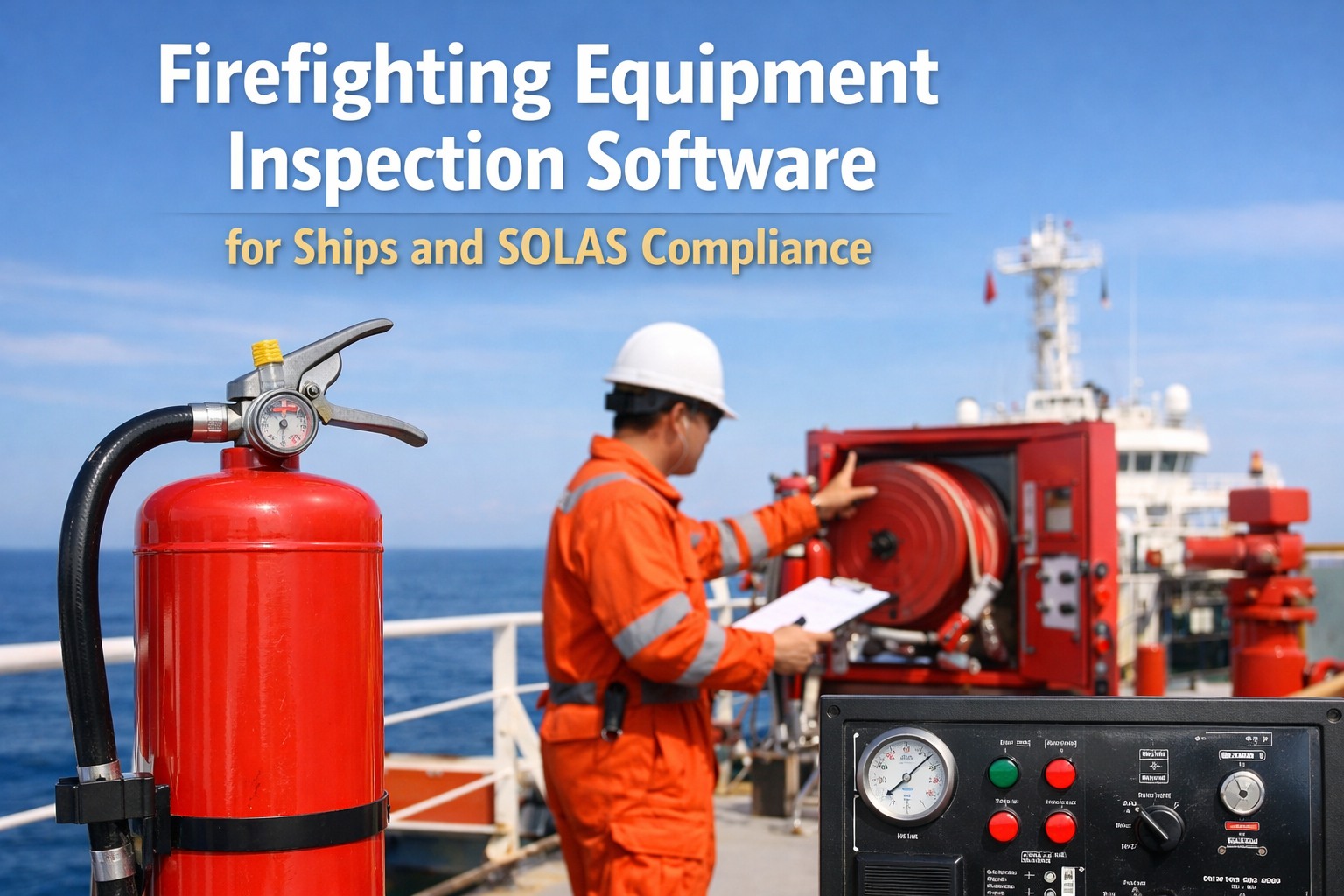
Fire safety is the single largest category of port state control deficiencies worldwide—the Paris MOU 2024 Annual Report confirms SOLAS Chapter II-2 accounts for 17.2% of all recorded deficiencies. The Tokyo MOU's 2023 Fire Safety CIC found 2,860 deficiencies across 8,273 inspected vessels. A single detainable deficiency can halt your vessel at $15,000-$50,000 per day. The problem isn't knowing what's required—it's inspecting dozens of fire protection systems on different schedules, recording every test result, and maintaining equipment before deadlines pass. Marine Inspection's software helps vessel teams inspect fire safety equipment faster, record every finding digitally, and maintain compliance continuously—sign up free to start building your vessel's fire equipment register and stay PSC-ready at every port.
Inspect, Record, and Maintain: What SOLAS Requires for Fire Equipment
SOLAS Chapter II-2 Regulation 14 requires every fire protection system to be maintained in good working order and readily available. "Maintained" means monthly testing for some equipment, annual servicing for others, and 5- or 10-year overhauls for fixed systems. Missing a single interval creates a detainable deficiency. Marine Inspection's software automates these overlapping schedules—crew members inspect equipment using digital checklists, record results with timestamps and photos, and the platform tracks maintenance due dates so nothing expires unnoticed. Schedule a demo to see how inspection intervals are tracked and alerted across your fleet.
| Equipment / System | Monthly | Annual | 2-Year | 5-Year | 10-Year |
|---|---|---|---|---|---|
| Portable Fire Extinguishers | Service | Hydro test | |||
| Fire Detection / Alarm System | Sample test | Full check | All devices tested | ||
| Fire Pumps and Hydrants | Test + inspect | ||||
| Fixed CO2 System | Visual inspect | Pilot cylinders | 10% hydro test | ||
| Foam Systems (Fixed) | Visual + flow test | Tank quantity check | |||
| SCBA / Breathing Apparatus | Full service | Hydro test bottles | |||
| Fire Doors | Condition check |
Top PSC Fire Deficiencies: What to Inspect and How to Record It
Paris and Tokyo MOU inspection campaigns reveal which fire safety areas generate the most deficiencies. Marine Inspection helps vessel teams inspect each area systematically, record findings with evidence, and maintain equipment before deficiencies become detentions.
Fleet operators managing fire safety across multiple vessels can sign up today to configure vessel-specific fire equipment inventories—each ship gets its own inspection schedule and maintenance tracker, so nothing falls through the cracks between PSC visits.
Expert Review: Fire Safety Compliance After the 2023 CIC
The 2023 joint Paris MOU and Tokyo MOU CIC on Fire Safety confirmed what detention data has shown consistently: fire safety remains the most common deficiency category, with fire doors, extinguisher maintenance, and detection testing generating the most findings. The regulatory framework—SOLAS II-2 Regulation 14, MSC.1/Circ.1432, and IMO Resolution A.951(23)—establishes clear requirements, but managing overlapping intervals across dozens of equipment types per vessel is where compliance breaks down. The Marshall Islands (August 2025) and Bahamas Marine Notice 79 (November 2025) both reinforce that ships' officers handle routine inspections while periodic servicing requires approved companies. Marine Inspection bridges this gap—helping crews inspect equipment systematically, record results digitally, and maintain schedules that keep every system within compliance. Schedule a 15-minute demo to see how the platform works for your fleet.
Conclusion
Fire safety deficiencies lead PSC detention causes worldwide because managing inspection intervals, service records, and drill documentation across a fleet is too complex for spreadsheets and paper logs. Marine Inspection's software gives vessel teams the tools to inspect fire equipment faster using guided digital checklists, record every finding with evidence and timestamps, and maintain compliance through automated scheduling and alerts. Schedule a demo to walk through the fire safety module with our team, or sign up now and start building your fleet's fire equipment register in minutes.