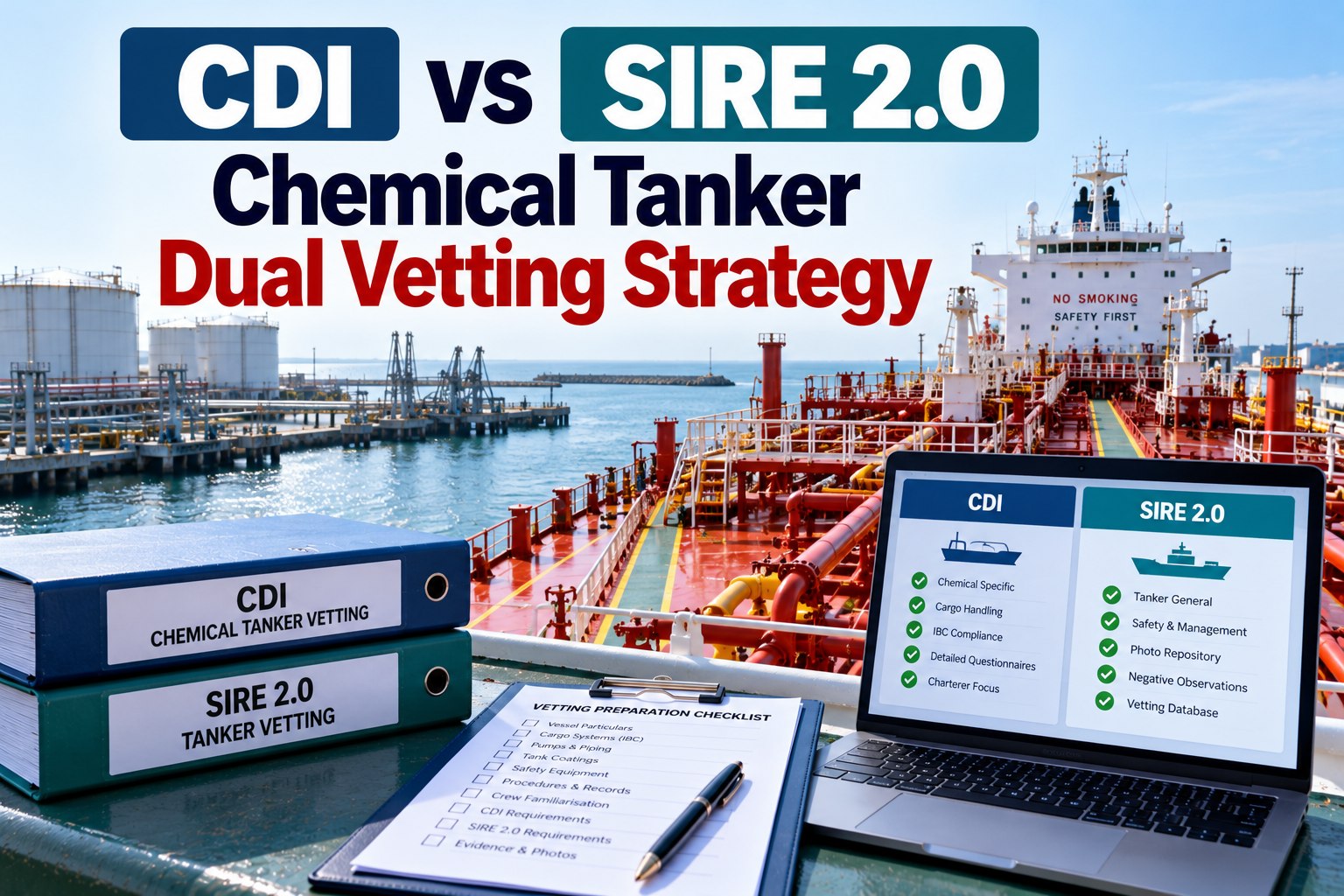
Many chemical tankers face two vetting regimes. Chemical companies look for a current CDI report, and oil majors and many traders look for SIRE 2.0. The two cover much of the same ground but ask in different ways, so preparing for each separately doubles the work and still leaves gaps. This guide compares CDI and SIRE 2.0, shows where they overlap, and sets out one preparation workflow that serves both. Book a demo to see a dual vetting workflow.
CDI vs SIRE 2.0: one ship, two inspections, one preparation workflow
CDI vs SIRE 2.0 comparison at a glance
Both are commercial inspections, not statutory ones. Charterers use the reports to decide whether to accept a ship. For background on each, see our CDI inspection guide and SIRE 2.0 inspection guide.
| Aspect | CDI (CDI-Marine) | SIRE 2.0 (OCIMF) |
|---|---|---|
| Main users | Chemical companies | Oil majors, traders, terminals |
| Questionnaire | 10th Edition SIR: core chapters plus a type-specific Chapter 5 | CVIQ compiled for each inspection from the Question Library |
| Question coding | Each question categorised S, R or D | Core, rotational, conditional and campaign questions |
| Pre-inspection input | Online Self Inspection Document (SID) | HVPQ, PIQ and photograph repository |
| Self-inspection | Inspector samples 15% of SI questions; wrong answers trigger a full inspection | No equivalent; PIQ and HVPQ shape the questions |
| Human element | Crew knowledge and proficiency interviews | Human response tool with nine PIFs |
| Findings | Negative answers with inspector remarks | Negative observations coded SOC and NOC |
| Report active | 12 months on the CDI database | 12 months on the SIRE database |
From CDI’s 10th Edition announcement and v10.5 amendments, and OCIMF guidance. Check current CDI and OCIMF documents before each inspection.
Where CDI and SIRE 2.0 overlap on a chemical tanker
Most of the evidence a chemical tanker needs is the same for both. The difference is how it is tested. Use one evidence base and note the extra layer each regime adds.
CDI references from the 10th Edition v10.5 amendments. The rows are examples, not a full crosswalk.
How the two regimes test the same ship differently
Records and statutory items first
- Fixed questions you can prepare against line by line
- Statutory questions carry the most weight
- An accurate SID shortens the inspection; a missing one means a full inspection
- Combination ships get a separate report per inspection type
Crew performance and data accuracy
- Questions vary by inspection, so cramming one list fails
- Crew explain and show tasks; shortfalls are tagged with PIFs
- PIQ and HVPQ data decide conditional questions
- Photos must be current and match the ship
One evidence base, two reports
Tag each record once to the CDI chapter and the SIRE 2.0 area it supports, and stop preparing twice.
Chemical tanker inspection focus areas for both
These cargo and safety items are commonly checked on chemical tankers under either regime. Getting them right once covers a large share of both inspections.
Building one dual vetting preparation workflow
Run one continuous process and tag each step to the regime it feeds. For multi-ship planning, see our fleet-wide SIRE 2.0 readiness guide.
CDISIRE
CDISIRE
CDISIRE
CDISIRE
CDISIRE
CDI and SIRE 2.0 scheduling: keep both reports current
Both reports stay active for 12 months, and many charterers prefer a recent one. Spacing the two inspections apart avoids two big preparation peaks and gives time to fix findings from one before the other. The plan below is illustrative.
Dual inspection traps to avoid
Chemical tanker dual vetting checklist
Run this before each CDI or SIRE 2.0 inspection.
How Marine Inspection runs CDI and SIRE 2.0 preparation together
Marine Inspection keeps one record per item and maps it to both regimes, so a single self-inspection, photo round or corrective action counts for CDI and SIRE 2.0 at once. The view below is illustrative. Our CDI inspection management guide covers the CDI side in more depth.
CDI vs SIRE 2.0 FAQs
Do chemical tankers need both CDI and SIRE 2.0?
It depends on trade. Chemical companies usually look for CDI, while oil majors and many traders look for SIRE 2.0, so ships trading for both often keep both current.
What is the main difference between CDI and SIRE 2.0?
CDI uses a fixed questionnaire with self-inspection sampling. SIRE 2.0 builds a questionnaire for each inspection and grades crew performance with PIFs.
How long are CDI and SIRE 2.0 reports active?
Both are active for 12 months on their databases, though many charterers prefer a more recent inspection.
What is the CDI Self Inspection Document?
The operator completes SI questions before the inspection. The inspector samples 15%, and wrong answers lead to a full inspection.
Can one preparation cover both?
Largely, yes. Most evidence is shared; add the SID for CDI, and the PIQ, HVPQ, photos and crew coaching for SIRE 2.0.
Can Marine Inspection track both regimes?
Yes. Book a demo to see CDI and SIRE 2.0 preparation tracked together.
Bridge CDI and SIRE 2.0 with one workflow
Shared evidence, mapped once, kept current for both inspections and every charterer who reads them.