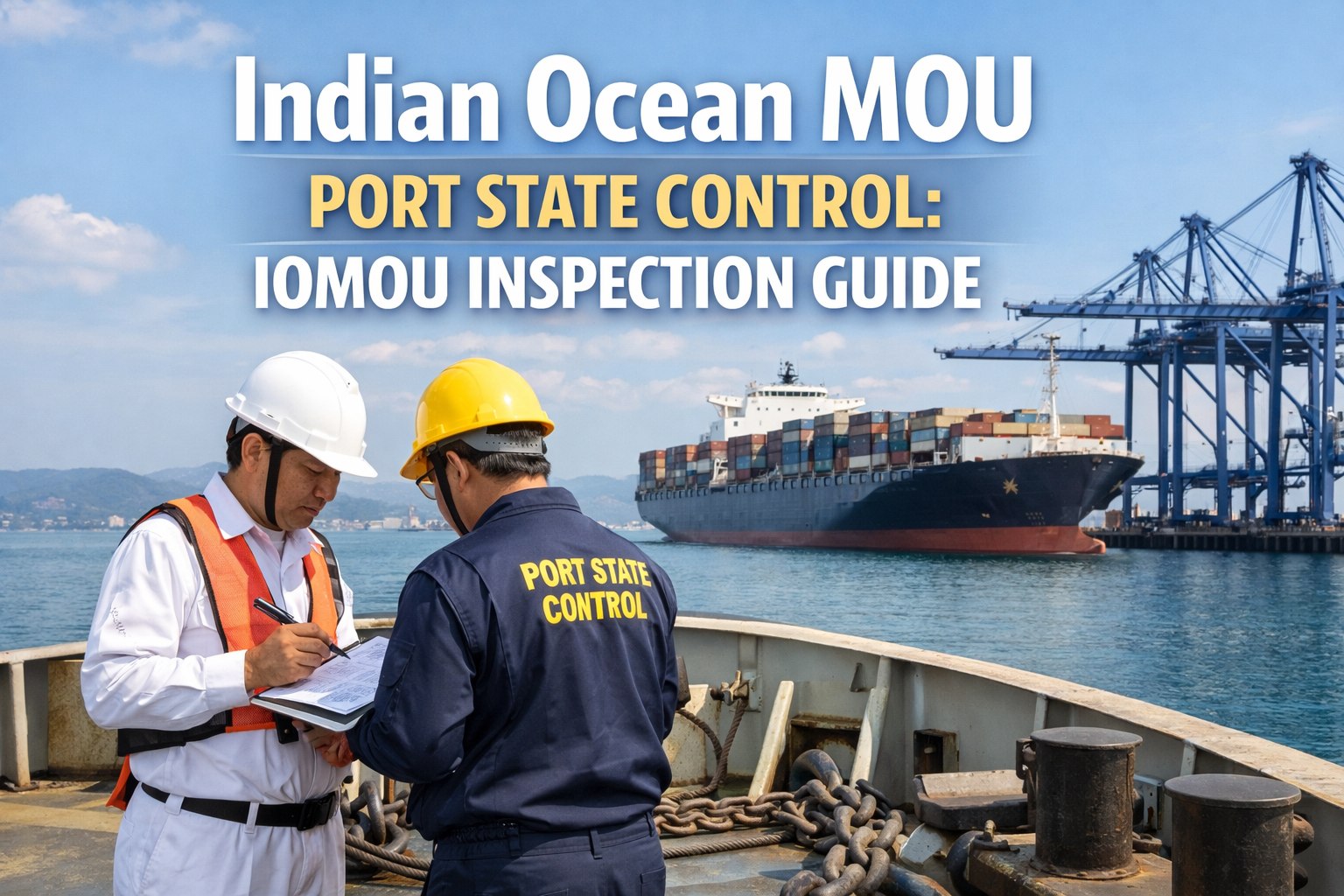
The Indian Ocean is one of the world's busiest maritime corridors — connecting the oil-rich Gulf states to the manufacturing powerhouses of South and Southeast Asia, the raw material exports of East Africa, and the containerised trade flowing through the Suez Canal. Every foreign-flagged vessel transiting this corridor faces port state control inspections governed by the Indian Ocean Memorandum of Understanding, a 20-member intergovernmental agreement that conducted 5,334 inspections and detained 225 ships in 2024 alone. With fire safety deficiencies accounting for 15.26% of all findings, bulk carriers drawing the highest detention numbers, and the IOMOU's New Inspection Regime now assigning risk profiles to every vessel in the IOCIS database, ship masters and Indian fleet operators who lack systematic compliance documentation are the ones filling the detention lists. Operators ready to get ahead of inspections can start a free trial of Marine Inspection's compliance platform to centralise deficiency tracking, maintenance records, and crew documentation before the next PSCO boards.
What Is the Indian Ocean MOU?
The Indian Ocean Memorandum of Understanding on Port State Control is an intergovernmental organisation recognised by the International Maritime Organization as the regional PSC regime covering the Indian Ocean. Established in 1998 and operational since the first Committee meeting in Goa in January 1999, the IOMOU exists for one purpose: to eliminate substandard shipping from the Indian Ocean region through coordinated inspections, shared data, and harmonised enforcement. The founding signatories — Australia, Eritrea, India, Sudan, South Africa, and Tanzania — have since been joined by Mauritius, Sri Lanka, Iran, Kenya, Maldives, Oman, Yemen, France (Reunion), Bangladesh, Comoros, Mozambique, Seychelles, Myanmar, and Madagascar. By 2024, the IOMOU has conducted over 130,000 inspections and recorded more than 342,000 deficiencies across its 25-year history. Ship masters who book a Marine Inspection demo can see how the platform maps directly to IOMOU inspection requirements.
IOMOU Member States: The 20-Nation Network
Understanding which countries enforce the IOMOU is essential for voyage planning and compliance preparation. Each member authority conducts PSC inspections at its ports, and results are shared across the entire network through the Indian Ocean Computerized Information System (IOCIS). A detention in Colombo is visible to inspectors in Mumbai, Durban, and Muscat before your vessel arrives.
| Sub-Region | Member State | Key Ports | Year Joined | Dual MOU Membership |
|---|---|---|---|---|
| South Asia | India | Mumbai, Chennai, Kandla, Visakhapatnam, Kochi | 1999 | — |
| Bangladesh | Chittagong, Mongla | 2004 | — | |
| Sri Lanka | Colombo, Hambantota | 2001 | — | |
| Middle East / Gulf | Oman | Sohar, Salalah, Muscat | 2002 | Riyadh MOU |
| Iran | Bandar Abbas, Bushehr | 2002 | — | |
| Arabian Sea / Bay of Bengal | Maldives | Malé | 2002 | — |
| Myanmar | Yangon, Thilawa | 2006 | — | |
| Southern Africa | South Africa | Durban, Cape Town, Richards Bay | 1999 | Abuja MOU |
| Mozambique | Maputo, Beira | 2005 | — | |
| East Africa | Tanzania | Dar es Salaam, Zanzibar | 1999 | — |
| Kenya | Mombasa | 2001 | — | |
| Eritrea | Massawa, Assab | 1999 | — | |
| Sudan | Port Sudan | 1999 | — | |
| Island States | Mauritius | Port Louis | 2000 | — |
| Seychelles | Victoria | 2005 | — | |
| Comoros | Moroni | 2005 | — | |
| Madagascar | Toamasina, Mahajanga | 2007 | — | |
| Other | France (Réunion) | Port Réunion (Le Port) | 2003 | Paris MOU |
| Australia | Sydney, Melbourne, Fremantle | 1999 | Tokyo MOU | |
| Conflict Zone | Yemen | Aden, Hodeidah | 2002 | — |
How the IOMOU New Inspection Regime (NIR) Targets Your Vessel
The IOMOU operates a New Inspection Regime that assigns a Ship Risk Profile to every vessel in the IOCIS database. This is not a static label — it is recalculated using rolling 36-month PSC inspection data, and it determines how frequently your vessel will be inspected, at what priority level, and with what scope. Understanding the NIR is the single most important step for any ship master or fleet operator trading in the Indian Ocean region.
2024 Deficiency Breakdown: Where Vessels Fail in the Indian Ocean
The IOMOU's 2024 annual report reveals exactly which deficiency categories drive the most findings — and the most detentions — across the region. Fire safety has overtaken all other categories as the most frequently recorded deficiency type. Operators who sign up for Marine Inspection get pre-built checklists targeting each of these high-risk categories.
| Rank | Deficiency Category | Total Deficiencies | Share of All Deficiencies | Key Inspection Focus |
|---|---|---|---|---|
| 1 | Fire Safety | 1,831 | 15.26% | Fire doors, extinguishers, detection systems, crew drill records |
| 2 | Life-Saving Appliances | 1,019 | 8.49% | Lifeboat davits, liferaft servicing, LSA maintenance logs |
| 3 | Certificates & Documentation | 964 | 8.03% | Validity, endorsements, continuous synopsis records |
| 4 | Safety of Navigation | 912 | 7.60% | Charts, ECDIS, voyage planning, bridge equipment |
| 5 | ISM Code / Safety Management | 847 | 7.06% | SMS implementation, DPA access, maintenance records |
| 6 | Working & Living Conditions (MLC) | 786 | 6.55% | SEAs, wages, rest hours, accommodation, food & catering |
Detention by Ship Type: Which Vessels Are Most at Risk?
Not all vessel types face equal scrutiny in the Indian Ocean region. Bulk carriers dominate both inspection volume and detention numbers — driven by the sheer volume of bulk trade through the region and the age profile of the fleet. Understanding where your vessel type sits in the detention statistics helps you calibrate your compliance investment.
IOMOU Concentrated Inspection Campaigns (CICs)
Each year, the IOMOU conducts Concentrated Inspection Campaigns — targeted enforcement blitzes on specific safety areas, often coordinated with the Paris MOU and Tokyo MOU for global impact. During a CIC, inspectors use a supplementary questionnaire in addition to the standard inspection, and results are reported to the IMO. The 2025 CIC focuses on Ballast Water Management — conducted jointly with the Paris MOU and Tokyo MOU. Ship masters transiting the Indian Ocean region should ensure Ballast Water Management Plans, treatment system records, and ballast water record books are current and accessible. Schedule a demo to see how Marine Inspection tracks CIC readiness alongside standard compliance.
India's Role: The IOMOU's Anchor Authority
India hosts the IOMOU Secretariat and operates the IOCIS database through the National Informatics Centre under the Ministry of Electronics and Information Technology. India's Directorate General of Shipping oversees PSC inspections at major ports including Mumbai, Chennai, Kandla, Visakhapatnam, Kochi, Kolkata (Haldia), Paradip, Mangalore, Goa, and Tuticorin — with Port State Control Officers (PSCOs) operating under Merchant Shipping Notice No. 02 of 2024. Vessels calling at Indian ports face inspections governed by both the IOMOU framework and Section 334/342 of the Indian Merchant Shipping Act 1958, giving inspectors the power to issue detention orders that prevent sailing until all deficiencies are rectified. Flag state authorities may appeal detentions through the IOMOU's Detention Review Panel. Sign up for Marine Inspection to keep your vessels compliant across all Indian ports.
IOMOU Year-on-Year: Inspection Trends
Expert Review: Navigating IOMOU Compliance in 2026
The Indian Ocean MOU's 2024 data tells a nuanced story. While the headline detention rate decreased slightly to 4.22% from 4.27%, the underlying enforcement intensity is increasing — the shift toward risk-based targeting through the NIR means inspections are becoming more concentrated on vessels most likely to fail, and the deficiencies being found are more serious. The 8.45% decrease in total inspections alongside a marginal decrease in detentions confirms that IOMOU authorities are inspecting smarter, not less.
For Indian fleet operators specifically, the convergence of IOMOU requirements with India's DG Shipping PSC framework creates a dual compliance obligation. Vessels calling at Indian ports face both the international IOMOU inspection standard and the domestic enforcement provisions of the Merchant Shipping Act 1958. The same maintenance records, drill logs, and crew documentation that satisfy an IOMOU PSCO also support DG Shipping's requirements — but only if that documentation is current, organised, and instantly accessible when the inspector arrives.
The 2025 Ballast Water Management CIC — running jointly with the Paris MOU and Tokyo MOU — signals the direction of IOMOU enforcement: increasingly coordinated with global PSC regimes, increasingly data-driven, and increasingly focused on environmental compliance alongside traditional safety areas. Operators who build integrated digital compliance systems now — connecting maintenance records, crew documentation, certificate tracking, and deficiency management — position themselves for the regulatory trajectory that is clearly heading toward real-time data sharing and cross-MOU enforcement harmonisation. Schedule a walkthrough to see how Marine Inspection connects these requirements.
Conclusion
The Indian Ocean MOU's 20-member network covers some of the world's most critical shipping lanes — from the Strait of Hormuz to the Mozambique Channel, from the approach to the Suez Canal to the ports of the Indian subcontinent. With 5,334 inspections and 225 detentions in 2024, fire safety topping the deficiency charts at 15.26%, and the NIR's Ship Risk Profile system targeting vessels based on rolling 36-month performance data, operators trading in this region cannot afford reactive compliance. Every deficiency recorded in the IOCIS database follows your vessel to its next port call. Every detention elevates your risk profile for years. And every CIC campaign adds targeted scrutiny on top of standard inspections. Marine Inspection provides the digital platform that keeps your fleet ahead of IOMOU enforcement — sign up today to bring your Indian Ocean compliance into one system.