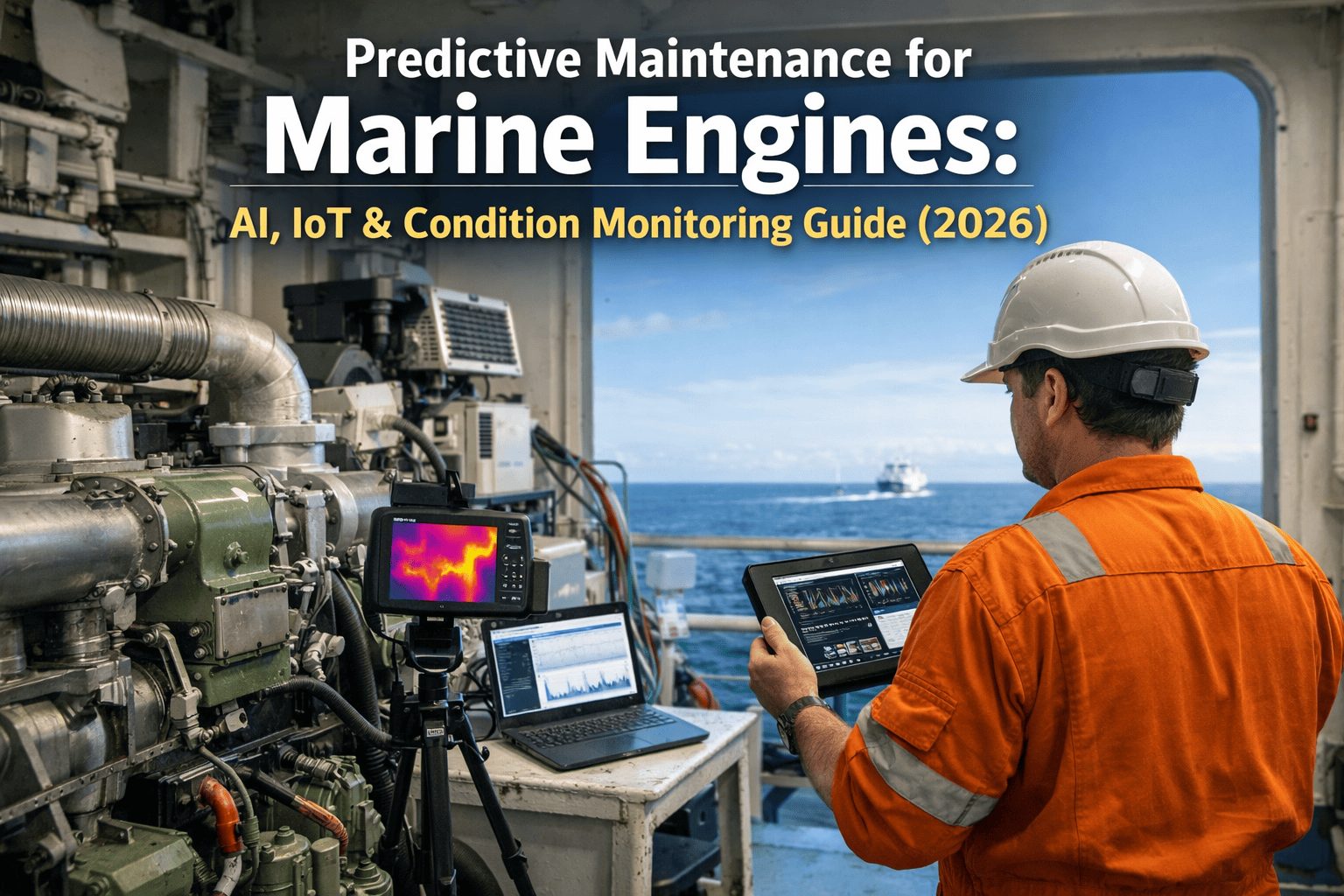
The maritime AI market is forecast to grow by nearly $19 billion at a CAGR of 38.9% between 2025 and 2029, and predictive maintenance is the single largest application driving that growth. Where traditional planned maintenance systems replace components on fixed running-hour intervals — often servicing equipment that does not yet need it, or missing failures that develop between intervals — predictive maintenance uses real-time sensor data, machine learning algorithms, and historical failure patterns to forecast exactly when a component will fail, weeks or months before any human could detect the problem. Maersk has reduced engine-related downtime by over 20% through AI-driven maintenance alerts. MOL monitors 5,000+ components on select vessels using predictive analytics. Lloyd's Register forecasts that 70% of new ships delivered by 2030 will feature AI-based maintenance platforms. For technical directors and engineers managing commercial fleets, the question is no longer whether predictive maintenance works — it is how fast you can implement it before your competitors gain the operational advantage. Fleet operators building predictive maintenance capability can start a free trial of Marine Inspection to establish the digital CMMS foundation that predictive systems require.

20-30%
Maintenance Cost Reduction
Within first year of implementation
40-50%
Less Unplanned Downtime
Documented across early adopter fleets
30-90 days
Advance Failure Warning
AI models predict with 80-97% accuracy
$7 Return
Per $1 Invested
ROI documented across industrial deployments

Maintenance Evolution: From Reactive to Predictive

Understanding where predictive maintenance sits in the maintenance evolution helps technical directors assess what infrastructure they need and what returns to expect. Each maintenance strategy has its place — but the operators who combine all four, with predictive analytics guiding the overall programme, achieve the lowest total lifecycle cost.

The Four Maintenance Strategies
Reactive
Breakdown Maintenance
Fix it when it breaks. Lowest upfront investment, highest total cost. Equipment used to failure — often causing collateral damage to adjacent components. No planning possible.
Highest Risk & Cost
Preventive
Planned Maintenance (PMS)
Service at fixed intervals regardless of condition. Industry standard under ISM Code. Prevents most failures but often replaces components that still have useful life remaining.
ISM Baseline
Condition-Based
CBM
Monitor actual equipment condition through sensors and analysis. Maintain when data indicates need. Eliminates unnecessary maintenance while catching developing problems.
Optimised Intervals
Predictive
AI-Powered PdM
AI algorithms analyse sensor data against historical failure patterns to forecast when components will fail — 30 to 90 days in advance. Enables planned intervention before failure with optimal parts procurement and scheduling.
Lowest Lifecycle Cost

The Five Predictive Maintenance Technologies for Ships

Predictive maintenance is not a single technology — it is an integrated ecosystem of sensing, analysis, and action technologies. Each technology monitors different failure indicators, and the most effective implementations combine multiple techniques to provide comprehensive equipment health visibility. Operators who book a Marine Inspection demo can see how the platform serves as the CMMS action layer that turns sensor predictions into executed work orders.

Predictive Maintenance Technologies: Comparison
Technology What It Monitors Equipment Covered Detection Window Maritime Application
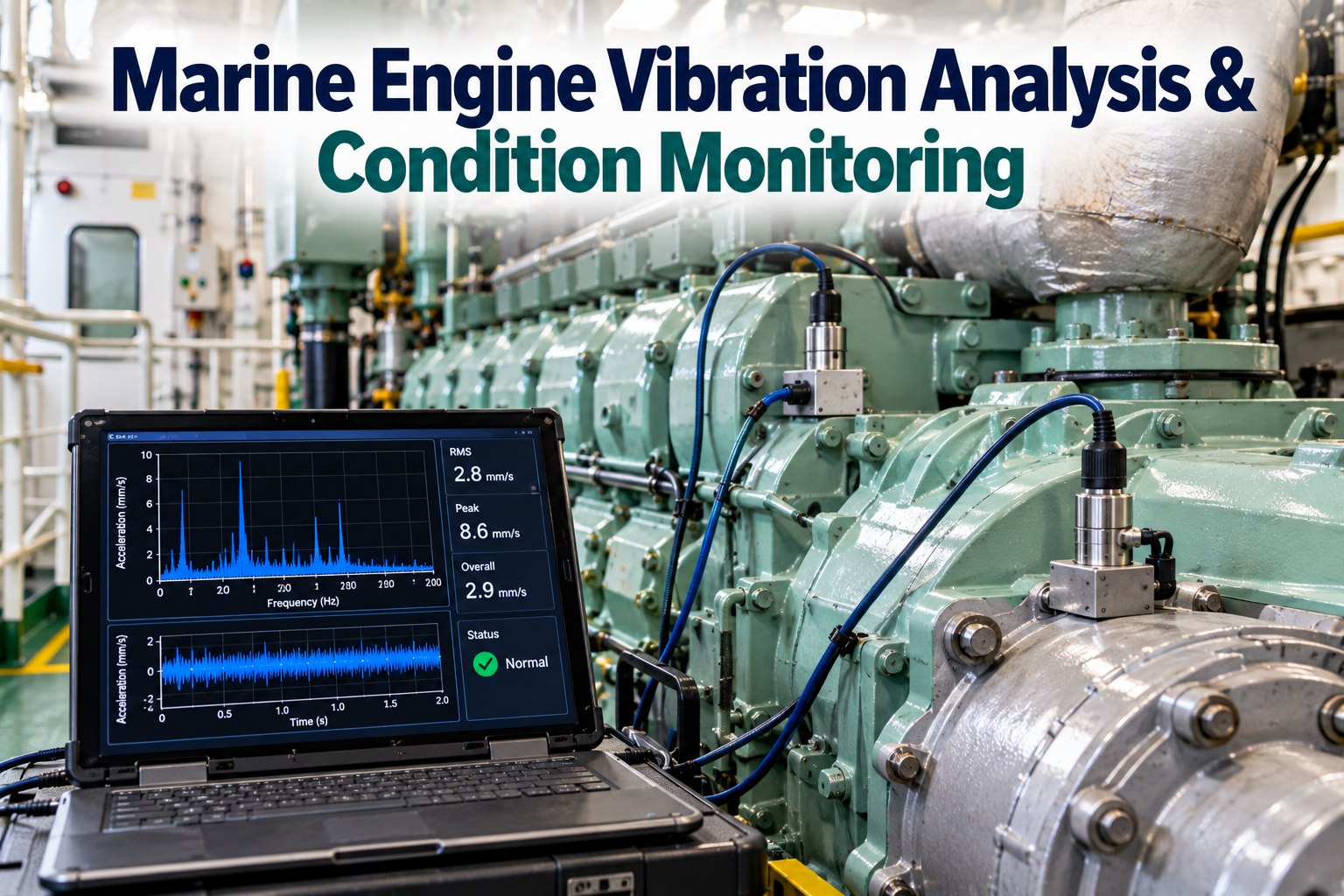
Vibration AnalysisVibration patterns, frequencies, amplitudesBearings, shafts, gearboxes, turbochargers, pumps, motorsWeeks to months before failureMain engine crankshaft, auxiliary generator bearings, propeller shaft alignment, turbocharger imbalance
Oil AnalysisWear metals, viscosity, TBN, water content, particle count, flash pointEngines, gearboxes, hydraulic systems, compressorsTrend-based: weeks to monthsMain/aux engine lube oil, cylinder oil feed rate optimisation, hydraulic steering gear, crane systems
ThermographyInfrared heat signatures, thermal patterns, temperature anomaliesElectrical systems, switchboards, motors, bearings, boilers, exhaust systemsDays to weeksMain switchboard hot spots, exhaust manifold leaks, turbocharger casing temps, boiler refractory condition
Acoustic / Ultrasonic AnalysisHigh-frequency sounds from friction, impact, turbulence, electrical dischargeSteam traps, valves, pressure systems, electrical arcing, bearing wearDays to weeksSteam system leak detection, bearing pre-failure detection, compressed air leak identification
IoT Sensor Networks + AITemperature, pressure, RPM, fuel flow, exhaust gas composition — continuous multi-parameterAll critical systems simultaneously30-90 days with AI predictionIntegrated engine health monitoring, digital twin creation, fleet-wide anomaly detection, automated work order generation
The most effective implementations combine multiple techniques. IoT + AI provides the integration layer that correlates data across all monitoring technologies.

How AI Predictive Maintenance Works: The Four-Layer Loop

A working predictive maintenance system is not a single tool — it is four layers working together in a continuous loop that gets smarter with every data point. The CMMS platform is what ties the prediction into an operational workflow that maintenance teams actually execute.

1
Data Acquisition (IoT Backbone)
IoT sensors capture vibration, temperature, pressure, current, acoustic, and oil analysis data continuously from every critical asset. Modern sensors are wireless, battery-powered, and retrofit-friendly — connecting to existing systems via MQTT/OPC-UA protocols. Sensor costs have dropped below $1/unit, making fleet-wide deployment economically viable.

2
Predictive Analytics (ML Engine)
Machine learning algorithms process data at edge or cloud — detecting anomalies, identifying degradation patterns, and scoring failure probability. Hybrid approaches using convolutional neural networks for feature extraction from vibration/acoustic signals and LSTM networks for time series analysis demonstrate the highest accuracy in predicting remaining useful life of critical equipment.

3
Failure Forecast Generated
Failure forecast generated 30-90 days in advance with 80-97% confidence — identifying which component, when, and why. The system distinguishes between normal operational variations (engine performance under different loads, sea states, weather) and genuine developing faults that require intervention.

4
CMMS Action Layer
CMMS auto-generates work order with parts lists, procedures, and technician assignment — scheduled during planned downtime. This is where most implementations fail: sensor data without an operational system to act on predictions produces alerts that get ignored. The CMMS closes the loop between prediction and action. Sign up for Marine Inspection to build the CMMS action layer your predictive system needs.
The Action Layer That Makes Predictions Operational
Most predictive maintenance implementations fail not because the sensors or AI don't work — but because there's no system to act on predictions. Marine Inspection closes that gap: sensor data feeds in, work orders are generated, execution is tracked, and results feed back to improve the model.

Implementation Roadmap: From Pilot to Fleet-Wide Deployment

Phase 1
Foundation (Months 1-3)
Deploy digital CMMS across fleet. Establish data quality standards. Retrofit pilot vessel with IoT sensor packages on critical assets (main engine, generators, steering gear). Begin collecting baseline operational data.
Phase 2
Pilot & Validate (Months 3-9)
AI models train on 3-6 months of baseline data. First predictions generated and validated against actual equipment condition. Crew training on human-AI collaboration workflows. Measure ROI against unplanned downtime and maintenance costs.
Phase 3
Scale Fleet-Wide (Months 9-18)
Proven pilot blueprint applied across fleet. Standardised sensor packages deployed. CMMS integration with procurement for automated spare parts ordering. Classification society engagement for condition-based survey extensions.
Phase 4
Optimise & Evolve (Ongoing)
Continuous model refinement as more data accumulates. Digital twin development for comprehensive asset lifecycle management. Integration with class society remote survey programmes. Fleet-wide anomaly detection and benchmarking.

Expert Review: The Predictive Maintenance Inflection Point

Industry Analysis

The maritime industry is at a predictive maintenance inflection point. IoT sensors now cost under $1 per unit. AI models predict failures 30-90 days in advance with up to 97% accuracy. Classification societies — DNV, Lloyd's Register, Bureau Veritas — are actively building remote survey programmes that accept condition monitoring data as a basis for extending survey intervals. And the ROI data from early adopters (Maersk's 20%+ downtime reduction, MOL's 5,000+ component monitoring programme) is compelling enough to shift predictive maintenance from innovation initiative to operational standard.

The primary barrier to adoption is not the technology — it is data quality and the absence of a CMMS action layer. Sensor data without a system to act on predictions produces alerts that accumulate unanswered. The operators who succeed with predictive maintenance are those who first establish the digital CMMS foundation — systematic maintenance records, work order workflows, parts management, corrective action tracking — and then layer sensor data and AI analytics on top of that operational infrastructure. This is why the sequence matters: CMMS first, sensors second, AI third.

For technical directors evaluating the investment, the math is straightforward: a $2,000 bearing replacement becomes a $25,000 emergency when the bearing seizes and damages the shaft, housing, and coupling. Multiply that across every critical asset on every vessel in your fleet, and the case for predictive maintenance becomes self-evident. Schedule a walkthrough to see how Marine Inspection provides the CMMS foundation for your predictive maintenance programme.

Conclusion

Predictive maintenance represents the most significant shift in maritime maintenance strategy since planned maintenance systems were mandated under the ISM Code. By combining IoT sensors, machine learning algorithms, and digital CMMS platforms, predictive maintenance replaces time-based guesswork with data-driven precision — forecasting equipment failures 30-90 days in advance, reducing maintenance costs by 20-30%, cutting unplanned downtime by 40-50%, and delivering $7 return for every $1 invested. But the technology only works when there is an operational system to act on predictions. Marine Inspection provides that CMMS action layer — turning sensor data into auto-generated work orders, tracked execution, and documented evidence that satisfies both operational requirements and ISM compliance standards — sign up today to build the digital foundation your predictive maintenance programme needs.

Frequently Asked Questions

What is predictive maintenance and how does it differ from preventive maintenance?
Preventive maintenance (PMS) follows fixed running-hour or calendar intervals — components are serviced at predetermined schedules regardless of actual condition, often replacing parts with remaining useful life. Predictive maintenance (PdM) uses real-time sensor data, machine learning algorithms, and historical failure patterns to forecast when specific components will actually fail, enabling maintenance to be performed only when data indicates it is needed. PdM typically predicts failures 30-90 days in advance with 80-97% accuracy, reducing maintenance costs by 20-30% and unplanned downtime by 40-50%.
What sensors are used for predictive maintenance on ships?
Five primary sensor types are used: vibration sensors (for bearings, shafts, turbochargers, pumps), temperature/pressure sensors (for engines, cooling systems, exhaust), oil analysis sensors (for wear metals, viscosity, water content in lube and hydraulic systems), acoustic/ultrasonic sensors (for steam traps, valve leaks, bearing pre-failure), and infrared thermal cameras (for electrical switchboards, motor insulation, exhaust systems). Modern IoT sensors are wireless, battery-powered, retrofit-friendly, and cost under $1 per unit — making fleet-wide deployment economically viable even on older vessels.
Can predictive maintenance be retrofitted to existing vessels?
Yes. While new builds increasingly come with pre-installed sensor systems, existing vessels can be retrofitted with cost-effective IoT sensor packages. The key requirements are: sensor placement on critical monitoring points (engine block, bearings, cooling circuits, exhaust systems), connectivity infrastructure (typically wireless sensors communicating to a shipboard data collection unit), and a CMMS platform to receive and act on the data. The ROI on retrofitting critical assets is typically very fast — often within 6-12 months — because the first prevented emergency repair usually exceeds the total sensor investment cost.
What is the ROI of predictive maintenance for shipping?
Documented returns include: 20-30% reduction in maintenance costs within the first year, 40-50% reduction in unplanned downtime, $7 return for every $1 invested, and Maersk's reported 20%+ reduction in engine-related downtime. The cost calculus is driven by the difference between planned and unplanned repair costs — a $2,000 bearing replacement becomes a $25,000 emergency when failure causes collateral damage. The predictive maintenance market reached $14.29 billion in 2025 and is growing at 28% annually, reflecting the proven ROI across maritime and industrial deployments.
How does a CMMS support predictive maintenance?
The CMMS is the critical action layer that turns predictions into executed maintenance. Without a CMMS, sensor alerts accumulate unanswered — the most common reason PdM implementations fail. A properly integrated CMMS auto-generates work orders when AI detects developing faults, includes parts lists and procedures, assigns technicians, tracks execution with completion evidence, and feeds results back to improve the AI model. This closed-loop system ensures every prediction results in a documented action — satisfying both operational efficiency goals and ISM Code compliance requirements for planned maintenance evidence.
Build Your Predictive Maintenance Foundation
The CMMS comes first. Then sensors. Then AI. Marine Inspection provides the operational foundation that makes predictive maintenance work — turning data into work orders, work orders into completed tasks, and completed tasks into the documented evidence that proves your maintenance culture.