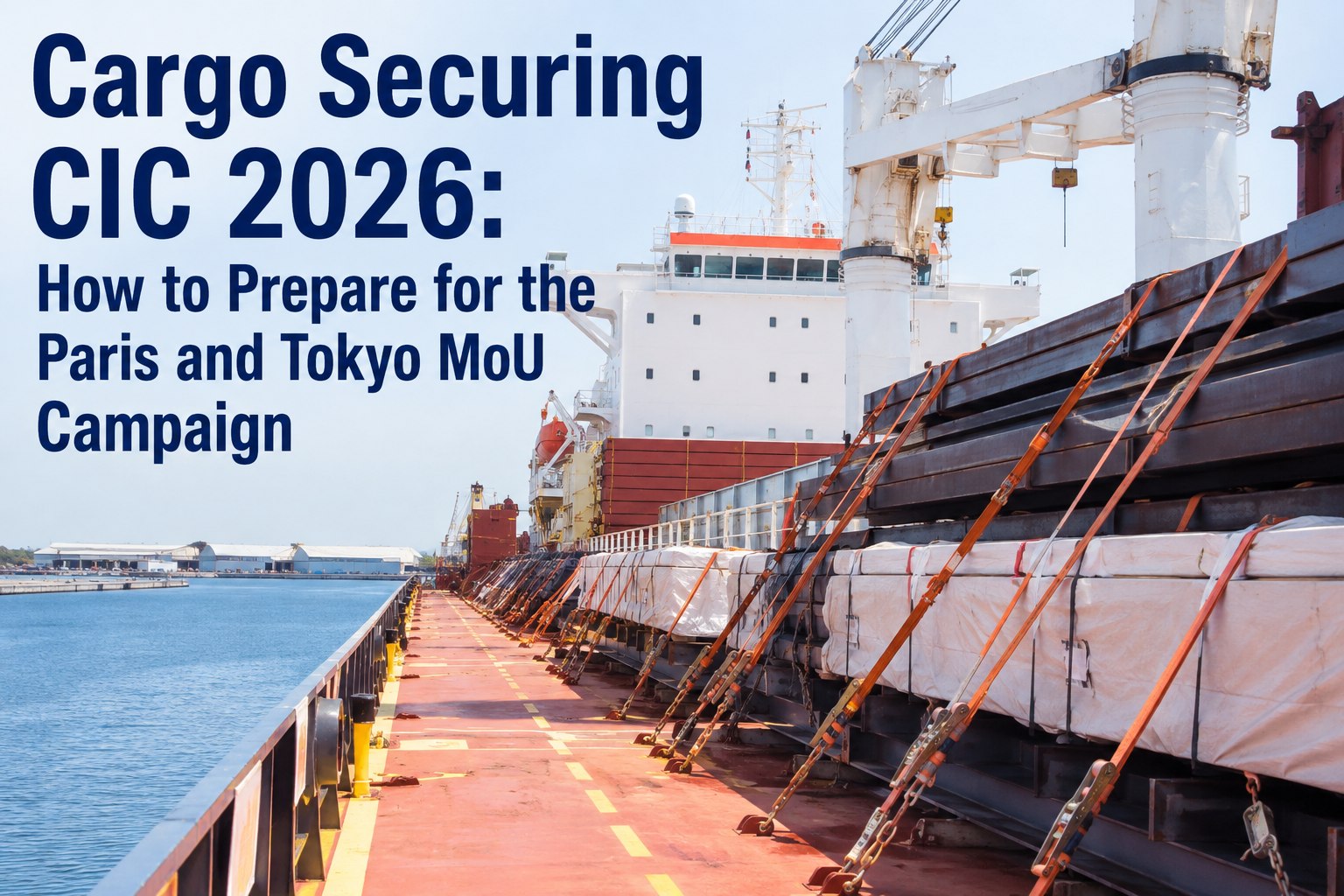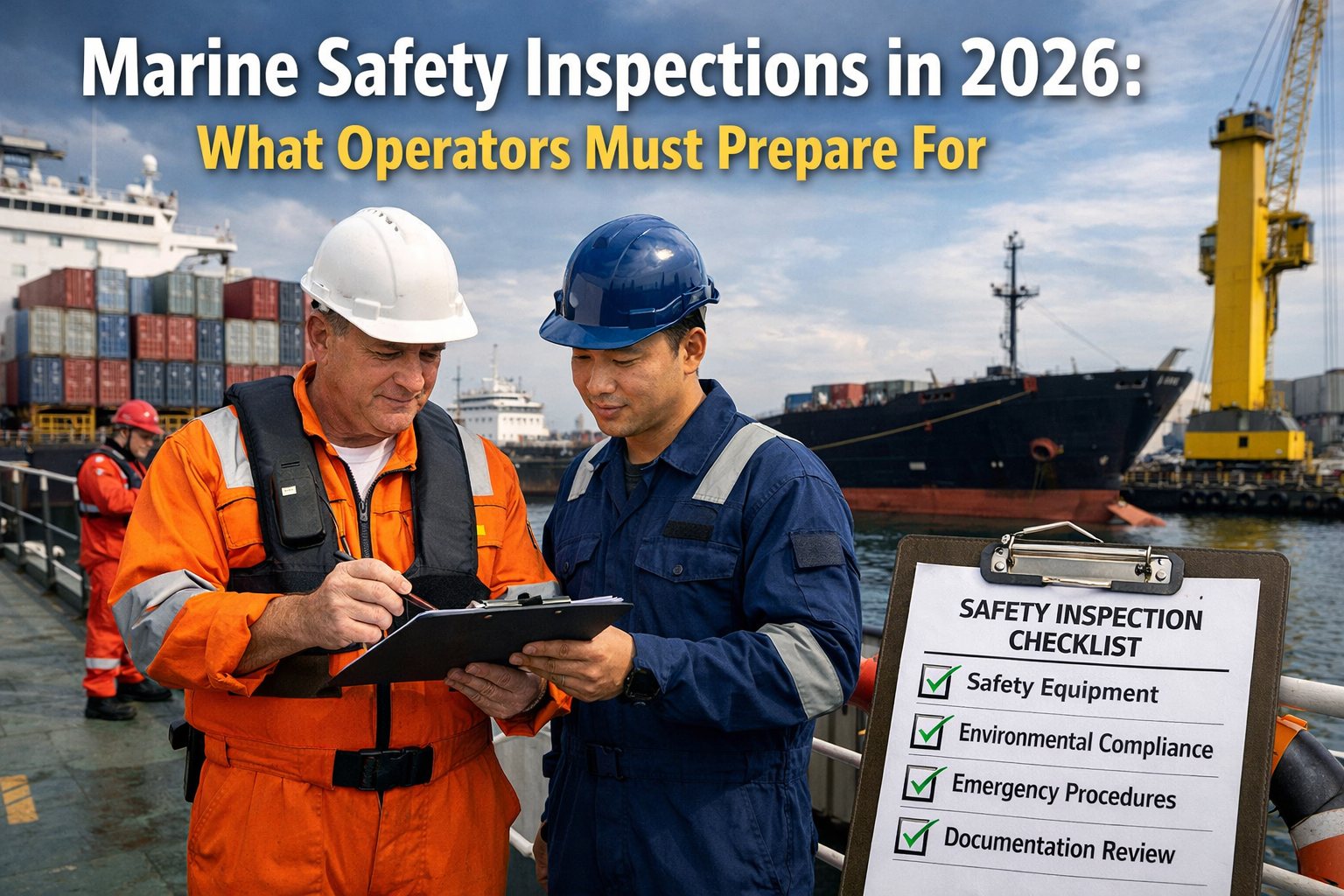
Every year between September and November, port state control authorities across the Paris MOU and Tokyo MOU regions conduct a Concentrated Inspection Campaign — a coordinated three-month enforcement blitz that adds a targeted questionnaire on top of every standard PSC inspection. For 2026, the confirmed CIC topic is Cargo Securing, and it applies to every vessel inspected at any port across the combined 50+ member states of both MOUs during the campaign window. This is not a random audit of flagged vessels — every ship that receives a PSC inspection between September 1 and November 30, 2026, will face the cargo securing questionnaire regardless of its risk profile. Past CIC campaigns have shown that even vessels with clean inspection records pick up deficiencies when the campaign questionnaire exposes gaps in documentation, equipment condition, or crew familiarity. Ship masters and safety officers who start a free trial of Marine Inspection can begin building cargo securing compliance evidence now — months before the first PSCO opens the questionnaire.
What Is a Concentrated Inspection Campaign?
A Concentrated Inspection Campaign is a coordinated period during which PSC authorities across one or more MOU regions focus their inspection effort on a specific safety topic. During a CIC, every vessel that receives a standard PSC inspection is also assessed against a supplementary campaign questionnaire — a predefined checklist of questions targeting the specific CIC topic. The results are compiled across all participating member states and submitted to the International Maritime Organization, creating a global snapshot of fleet compliance in that area. CIC campaigns typically run for three months, from September 1 to November 30, and each vessel is subject to the CIC questionnaire only once during the campaign period. Operators who book a Marine Inspection demo can see how the platform tracks CIC-specific readiness alongside standard compliance.
CIC History: 20+ Years of Targeted Enforcement
Understanding what has been inspected in the past reveals the regulatory enforcement cycle — and helps predict where future campaigns will focus. Topics tend to rotate on a multi-year cycle, returning to high-deficiency areas as new regulations enter force or when global compliance data shows persistent problems.
| Year | CIC Topic | Regulatory Basis | Joint With | Key Outcome |
|---|---|---|---|---|
| 2027 | Enclosed Space Entry | SOLAS III/19, MSC.1/Circ.1401 | Tokyo MOU | Planned |
| 2026 | Cargo Securing | SOLAS VI & VII, CSS Code | Tokyo MOU | Sep–Nov 2026 |
| 2025 | Ballast Water Management | BWM Convention 2004 | Tokyo MOU | 10-question checklist; 8 questions detainable |
| 2023 | Fire Safety Systems | SOLAS II-2 | Tokyo MOU, IOMOU | Fire doors (9.3% non-compliance) and drills (9.2%) flagged |
| 2022 | STCW / Polar Code | STCW Convention, Polar Code | Tokyo MOU | Crew certification and watchkeeping focus |
| 2021 | Stability in General | SOLAS II-1, Load Lines | Tokyo MOU | Delayed from 2020 (COVID) |
| 2019 | Emergency Systems & Procedures | SOLAS II-1, III, V | Tokyo MOU | Steering gear, emergency power, damage control |
| 2018 | MARPOL Annex VI | MARPOL 73/78 Annex VI | Tokyo MOU | Emissions compliance, sulphur cap preparation |
| 2017 | Safety of Navigation | SOLAS V | Tokyo MOU | ECDIS, charts, voyage planning |
| 2016 | Maritime Labour Convention | MLC 2006 | Tokyo MOU, IOMOU | SEAs, wages, rest hours, accommodation |
| 2015 | Enclosed Space Entry | SOLAS XI-1/7 | Tokyo MOU | Atmosphere testing, permits, rescue equipment |
| 2014 | Hours of Rest (STCW) | STCW Convention | Tokyo MOU | Watchkeeping hours, fatigue management |
| 2013 | Propulsion & Auxiliary Machinery | SOLAS II-1 | Tokyo MOU | Engine maintenance, redundancy systems |
| 2012 | Fire Safety Systems | SOLAS II-2, FSS Code | Tokyo MOU | Fire detection, suppression, crew drills |
| 2011 | Structural Safety & Load Lines | SOLAS II-1, Load Lines Conv. | Tokyo MOU | Hull integrity, freeboard, watertight doors |
CIC 2026 Cargo Securing: What PSCOs Will Check
The 2026 CIC questionnaire will be published by Paris MOU and Tokyo MOU ahead of the September start date — expected during summer 2026. Based on the confirmed topic, the regulatory framework (SOLAS Chapter VI, SOLAS Chapter VII, and the CSS Code), and the questionnaire structure from the previous cargo securing CIC, the following areas will form the core of what PSCOs assess. Preparation needs to start now — not in August.
CIC Preparation Timeline: Month-by-Month Action Plan
Successful CIC preparation is not a last-minute exercise — it is a structured, months-long process that builds genuine operational readiness. The operators who pass CIC inspections cleanly are the ones who started early and documented everything. Here is a month-by-month action plan for CIC 2026.
What Past CIC Results Tell Us About Enforcement
CIC campaigns produce real consequences. The 2023 Fire Safety CIC found 9.3% non-compliance on fire door maintenance and 9.2% non-compliance on fire drill execution — leading member states to commit to enhanced fire drill enforcement going forward. The 2025 BWM CIC questionnaire contained 10 questions, of which 8 could lead directly to detention. The 2016 IOMOU cargo securing CIC found deficiencies in CSM availability, crew knowledge, and lashing equipment condition across the Indian Ocean region. Each CIC generates enforcement intelligence that shapes subsequent inspection priorities — meaning poor fleet performance during a CIC increases your inspection frequency in subsequent years. Sign up for Marine Inspection to track CIC readiness across your entire fleet.
| MOU Region | Member States | Typical CIC Participation | Coordinates With | Database |
|---|---|---|---|---|
| Paris MOU | 27 (Europe + Canada) | Joint lead with Tokyo MOU | Tokyo, IOMOU, others | THETIS |
| Tokyo MOU | 21 (Asia-Pacific) | Joint lead with Paris MOU | Paris, IOMOU, others | APCIS |
| Indian Ocean MOU | 20 | Often runs parallel CIC | Paris, Tokyo MOUs | IOCIS |
| Black Sea MOU | 6 | Frequently participates | Paris MOU | BS-MIS |
| Mediterranean MOU | 11 | Participates selectively | Paris MOU | MARIS |
| Caribbean MOU | 14 | Runs own or joins | Paris, Tokyo MOUs | CARIS |
| US Coast Guard | 1 | EEP programme (quarterly) | Independent | MISLE |
Expert Review: Why CIC 2026 Matters More Than Usual
The 2026 cargo securing CIC arrives at a significant moment for the container and general cargo sectors. New SOLAS amendments effective January 1, 2026, mandate container loss reporting — meaning the regulatory spotlight on cargo integrity has never been brighter. The confluence of mandatory container loss reporting under SOLAS V/31 and V/32, the CIC's focus on securing manual compliance and equipment condition, and AMSA's parallel emphasis on cargo securing under its National Compliance Plan creates a triple enforcement layer that no operator trading internationally can avoid.
The CIC questionnaire, while typically containing only 8-10 questions, has an outsized impact because it converts a documentation and equipment gap into a formal PSC deficiency with a single negative answer. Vessels that have never received cargo-related deficiencies during standard inspections may find themselves with findings during the CIC simply because a PSCO has never previously checked whether the crew can articulate the CSM's discard criteria for lashing rods, or whether the pre-departure securing checklist is actually completed and filed for each voyage rather than treated as a formality.
For ship masters and safety officers, the preparation strategy is straightforward but requires lead time: verify the CSM is current and vessel-specific, physically inspect every securing device, train the crew on content they can explain under questioning, and establish a documented pre-departure verification routine that produces evidence. Schedule a walkthrough to see how Marine Inspection connects cargo securing compliance with your broader PSC readiness.
Conclusion
Concentrated Inspection Campaigns are the sharpest tool in the PSC enforcement toolkit — a coordinated, time-bound, topic-specific blitz that exposes compliance gaps standard inspections often miss. The 2026 CIC on Cargo Securing will run from September 1 to November 30 across the Paris MOU, Tokyo MOU, and likely most other MOU regions. Every vessel inspected during this window faces the campaign questionnaire, and every negative answer becomes a formal deficiency that follows your vessel's record for years. The Cargo Securing Manual, crew familiarisation, equipment condition, and pre-departure verification routines are not areas where last-minute preparation works — they require months of systematic documentation and genuine operational readiness. Marine Inspection provides the digital platform that builds this readiness into your daily operations — sign up today to start your CIC 2026 preparation now.