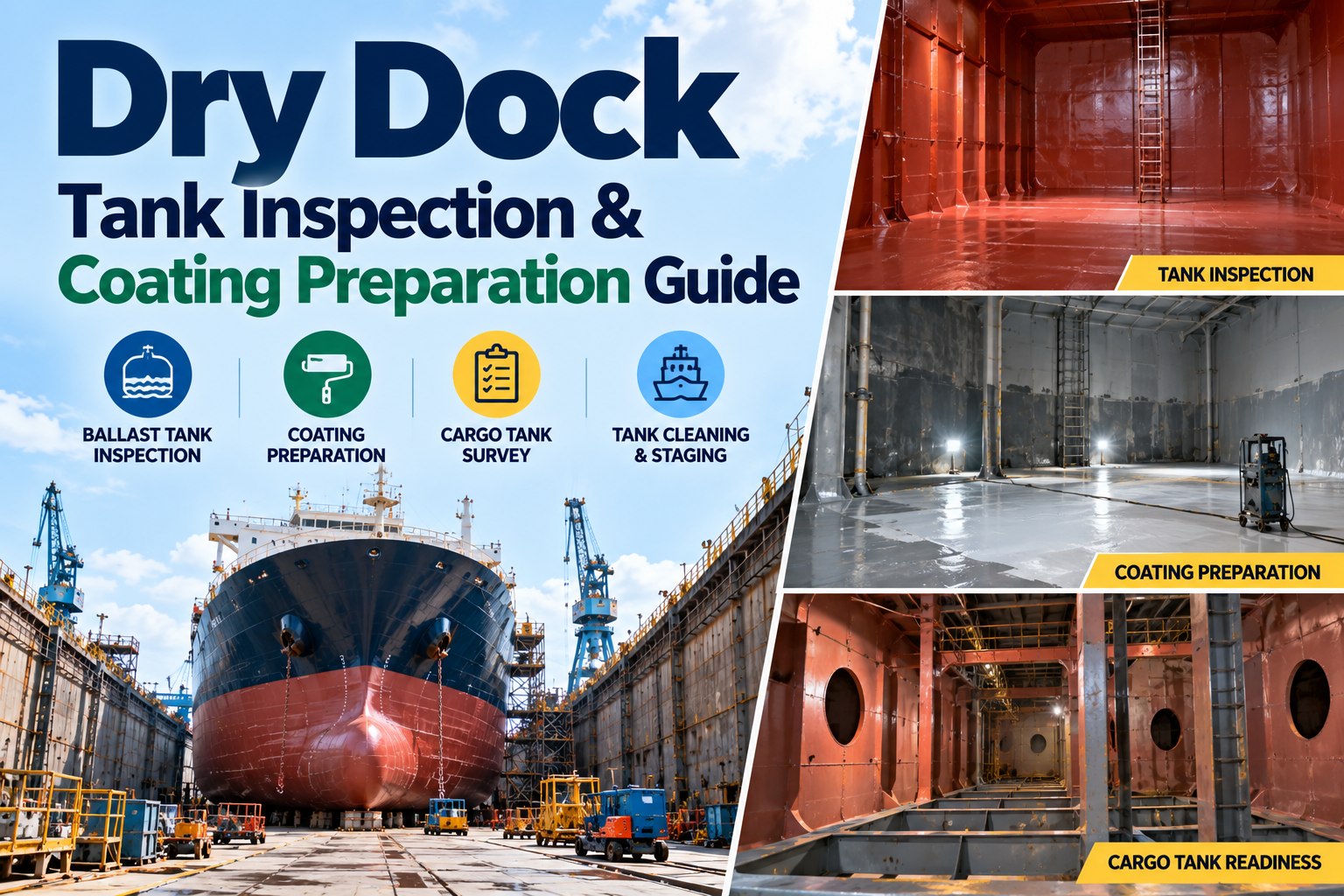
Dry Dock Tank Inspection & Coating Preparation Guide
The close-up survey of a ballast tank takes a surveyor about half a day. Getting that tank into a condition where the survey can happen at all takes most of a week, and putting right what the survey finds takes several more. That ratio is the whole reason tank work governs a dry dock programme, and why a superintendent who treats the survey as the event rather than the preparation will lose the schedule somewhere around day six.This guide covers the coating condition ratings and the exact thresholds behind them, what a POOR rating costs over the following years, the breakdown types worth telling apart, how the repair decision follows the service life you are buying, and the preparation sequence that keeps survey day free of surprises.
Dry dock · tank inspection and coating
The survey is half a day. The tank is ten.
Durations are indicative and vary with tank size, cargo history and yard resources. The proportions do not vary much at all.
Keep every tank’s condition history in one place
Coating ratings, breakdown photographs and repair decisions held against the tank, docking after docking.
Tanks behave differently from every other work item in a docking, for four reasons that compound.
A tank holds one trade at a time
Cleaning, staging, blasting, coating and inspection cannot overlap in the same space. Everything is sequential, so every delay is additive rather than absorbed.
The sequence is gated by permits
Entry depends on gas-free certification and ventilation, hot work depends on both again. The constraint is rarely labour; it is what can be permitted on the day.
Coating brings its own clock
Conditions, overcoating intervals and cure time are fixed by the product rather than the programme. Lost hours here cannot be recovered with more people.
It is where the unknowns live
The outside of the hull is visible all year. The inside of a ballast tank is seen properly once in five years, which makes it the most likely source of scope you did not plan for.
Tank coating condition: GOOD, FAIR and POOR
These are not impressions. Each rating has defined thresholds, and knowing them changes how a superintendent walks a tank — because the difference between FAIR and POOR is a number you can estimate on the spot, and it carries years of consequence.
Thresholds as set out in the IACS recommendation on coating maintenance and repairs for ballast tanks. Note that any one of the three POOR conditions is enough on its own — a tank with light general breakdown can still be POOR on edges and welds alone.
That last point is the one most often missed in a walk-through. Breakdown concentrates at edges, bracket toes and weld lines long before it becomes general, so a tank that looks broadly sound from the middle of a staging platform can already be over the fifty per cent line on its edges. Judge the edges separately from the plating.
What a POOR tank coating actually costs
The expense of a POOR rating is not the recoating. It is the regime that follows.
01
Annual internal examination
A ballast tank where the coating is found POOR and not renewed moves to internal examination at annual intervals, rather than being opened on the five-year cycle. One rating converts a periodic item into a yearly commitment, with the access cost attached each time.
02
Thickness measurement follows it
Where there was previously substantial corrosion, measurements are taken at annual surveys, and the extent is increased if more is found. The gauging bill arrives with the examination rather than instead of it.
03
It follows the ship, not the docking
The rating is recorded and carries forward. Deferring the recoat saves money in this dock and spends it every year until the next one, which is the arithmetic worth doing before the decision rather than after.
Coating breakdown types and what each one is telling you
Breakdown is not one phenomenon. Telling the types apart matters because they point at different causes and need different answers — and because two of them mean the problem is under the coating rather than on it.
Type
What you see
What causes it
What it means for this docking
Edge and weld breakdown
Rust lines following bracket toes, stiffener edges and weld seams while plating looks sound
Coating thins over sharp edges and weld profiles; it is where film thickness was always lowest
The commonest route to a POOR rating. Treat edges as a separate assessment and a separate repair scope
Blistering
Bubbles in the coating film, which may hold liquid, vapour or gas
Normally osmosis — moisture or contamination drawn through or trapped beneath the film
A substrate problem, not a surface one. Spot touching-up over blisters buys months, not years
Flaking
Paint lifting from the surface beneath in flakes or scales
Loss of adhesion, usually from preparation or contamination at the time of application
Expect the surrounding area to be suspect too; the boundary of the repair is rarely where the flaking stops
Cracking
Cracks running through at least one layer of the system
Film stress, movement or over-thick application
Water has a path to steel. Assess as breakdown rather than as cosmetic damage
Hard rust scale
Layered oxide that does not brush away
Prolonged exposure of bare steel, often behind failed coating
Must come off before anything goes on. Ten per cent of the area is the line between FAIR and POOR
Mechanical damage
Local scrapes and gouges, often near access and working areas
Staging, tools, hoses and feet rather than corrosion
Cheap to fix now and expensive to find next cycle. Repair before the staging comes down
Spot repair or full recoat: choosing by service life
The repair decision is not really about how bad the tank is. It is about how many years you are buying, and the recommendation is explicit that the two answers differ.
Buying about five years
Small damaged areas in an otherwise GOOD tank can be spot repaired without disturbing sound coating. Preparation can be power tool cleaning or wire brushing with fresh water hosing. FAIR and POOR areas still need broader treatment — blast cleaning to Sa 2 for short-term work on FAIR areas.
Buying ten to fifteen years
FAIR and POOR conditions need blast cleaning to Sa 2½ across larger zones, and a POOR tank means full blast cleaning to Sa 2½ over all the area under consideration. This is a different job with a different dock duration, and it has to be decided before the tender rather than during the dock.
The number that settles most of these arguments is the one below. Preparation method, not paint choice, is what determines how long the repair lasts.
A tank repaired by hand chipping comes back as a scope item at the next intermediate survey. The same tank blasted properly is usually not seen again until the following special survey, by which point the access cost has been avoided twice. That is the real comparison, and it rarely appears on the quotation.
%
Rate the tank once, and have the rating still there in five years
Marine Inspection records coating condition by tank and by area, with the photographs, the breakdown type and what was done about it — so the next superintendent inherits a trend instead of starting another first impression.
Tank preparation: making the space ready to survey
Nothing in the survey plan happens until the tank is clean, dry, ventilated, lit and certified for entry. Each of those is a predecessor, and each is routinely under-planned.
Empty and de-mudResidues and mud in the bottom hide exactly the structure that matters — bottom plating, bracket toes, drain holes. A tank surveyed over sediment is a tank surveyed twice.
Wash and dryFresh water washing removes salt and loose scale so the coating can actually be assessed, and drying matters because a wet surface hides breakdown and prevents any repair starting.
Ventilate and certifyContinuous ventilation and a gas-free certificate for entry, re-tested as required. This is the gate everything else queues behind, so it belongs at the front of the plan rather than the morning of the survey.
Light it properlyBreakdown at edges and weld lines is invisible under a hand torch. Fixed lighting through the space is the cheapest single improvement to the quality of the survey.
Confirm access is completeStaging that reaches most of the structure produces a survey of most of the tank, and the remainder becomes a return visit with the staging already struck.
Have the last report in the tankThe previous ratings, suspect areas and photographs, available to the people in the space. A survey conducted without the last one is an opinion rather than a comparison.
Choosing tank access for the close-up survey
Access is usually the largest single cost in tank work and it is chosen too late. The four routes trade cost, coverage and what can be done once you are there.
Staging
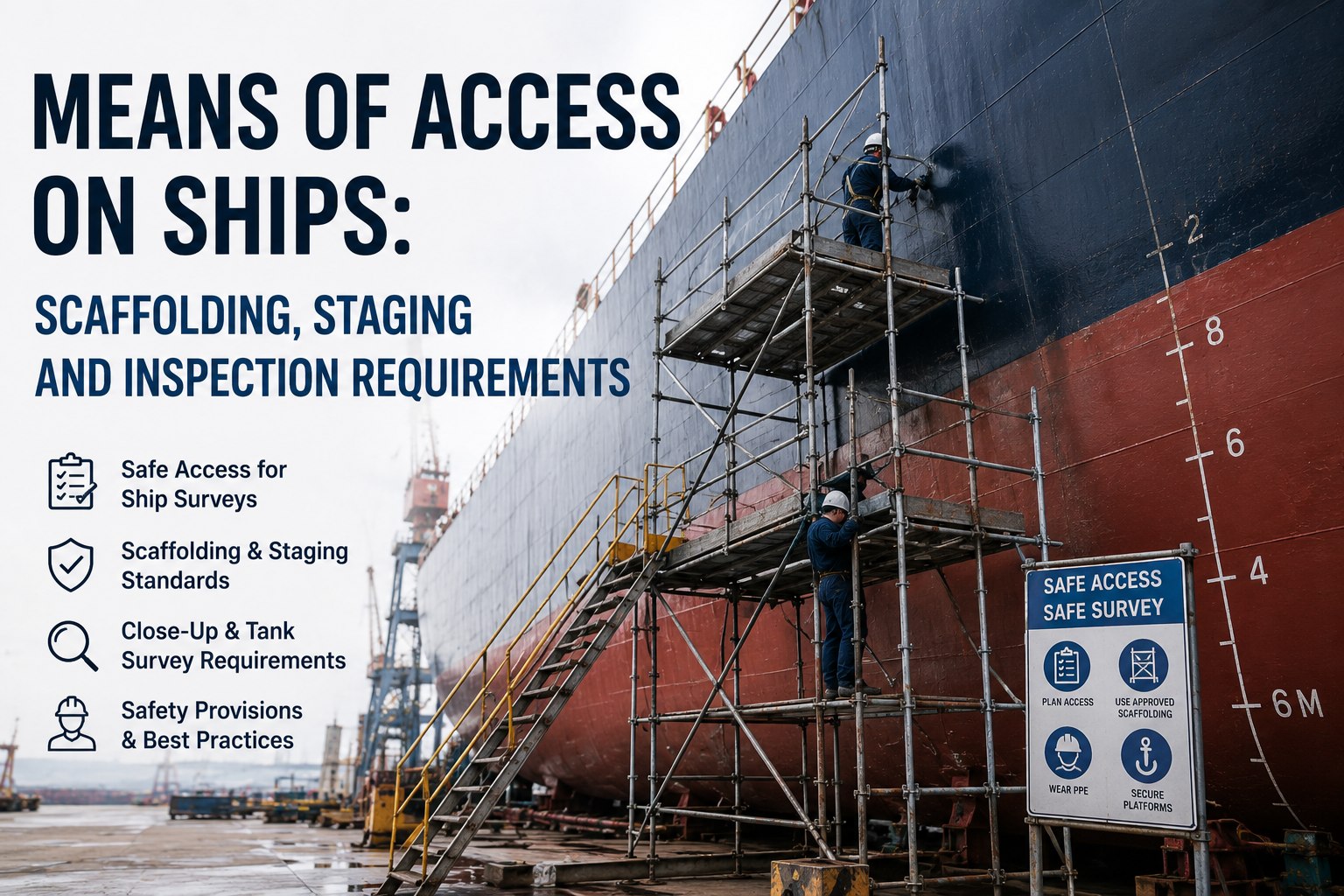
The workhorse for full close-up, and the only option that lets repair follow inspection immediately. Also the most time-consuming and costly to erect and dismantle, which is why it should be planned around repair, not just survey.
Rafting
Only where the structural capacity of the space is sufficient for the static loads at all water levels. Quick for upper structure, useless for anything you then want to blast and coat.
Remote techniques
Drones and similar methods are now recognised for close-up work and reduce the need to put people at height. Good for assessment and for deciding scope; they do not carry a blasting hose.
Permanent means of access
Fixed platforms and walkways designed into the ship, giving repeated access at every survey. Where they exist, use them to plan what staging is genuinely still needed.
The planning mistake is choosing access for the survey alone. If the tank is likely to need coating repair — and a FAIR or POOR rating makes that near-certain — then staging erected once for both jobs is far cheaper than a remote assessment followed by staging anyway. The requirements and recognised methods are set out in our guide to means of access on ships.
Where tank breakdown starts: what to look at first
Structure fails in the same places on every ship. A superintendent with two hours in a tank should spend them here.
Edges and bracket toes
Where film thickness was always lowest and breakdown starts first.
Weld seams
Profile and spatter make these the second place coating thins and lifts.
Under the deck head
Condensation and heat; often the worst area in the tank and the hardest to reach.
Drain and air holes
Cut edges, water movement and debris concentrate attack at the openings.
The internal waterline band
Wetting and drying with every ballast cycle, in the same horizontal band.
Bottom and suction area
Standing water, sediment and mechanical wear around bellmouths and wells.
Behind and around anodes
Fixing points, wastage of the anode itself, and whether any remain effective.
Previously repaired areas
The honest test of the last docking, and the best single predictor of this one.
Every one of those deserves a photograph with its location recorded, because the comparison between cycles is worth more than any single assessment. Holding that record against the vessel rather than in a survey folder is what the workflows in our guide to hull inspection software are for, and the wider relationship between coatings, corrosion and hull condition is covered in our guide to hull maintenance and inspection.
Anodes and cathodic protection in the tank
Coating and cathodic protection work together, and the limits of the second are worth being clear about.
It only works immersed
Cathodic protection is effective only while the metal surface is in the water. In a ballast tank that cycles empty, the protection cycles with it — which is why coating remains the primary defence and anodes the secondary one.
Record consumption, not just presence
Anodes supplied by sacrificial zinc or aluminium are consumed by design. What matters at the docking is how much is left and how evenly they have gone, which says more about the tank than a count of fittings does.
Check the fixings as well
An anode with a wasted or detached fixing is doing nothing while still appearing on the inspection list. The attachment is part of the item.
Specific attack needs specific answers
Pitting associated with sulphate reducing bacteria is addressed with purpose-made anodes for that duty. Design and maintenance of the system is a question for the classification society rather than a general rule.
The tank preparation sequence that prevents survey-day surprises
Working backwards from the survey date is what turns all of the above into a plan.
Before arrival
Agree the tank list and the survey programme, confirm which tanks carry FAIR or POOR ratings from last time, and price staging and coating repair for those tanks in the tender rather than discovering the need in the dock.
On passage
Begin de-ballasting and cleaning where it can be done safely at sea. Hours taken out of the dock here are the cheapest hours in the whole project.
First days alongside
Finish cleaning and de-mudding, start ventilation, and get the first tanks gas-free. The order tanks become available decides the order everything else happens in.
Before the surveyor
Staging complete to the structure that needs close-up, lighting in, the previous report in the space, and somebody who knows the tank present throughout.
Immediately after
Ratings and scope agreed the same day, with repair starting while the staging is still up. A decision deferred overnight often costs a full erect and dismantle.
Before striking staging
Final walk-through against the repair list, photographs taken, and mechanical damage from the work itself made good. The last chance at this price is before the scaffolding comes down.
Dry dock tank inspection: frequently asked questions
What are the GOOD, FAIR and POOR coating definitions?
GOOD is spot rusting on less than 3 per cent of the area under consideration without visible coating failure, with rusting at edges or welds on less than 20 per cent of those edges or weld lines. FAIR is breakdown or rust penetration under 20 per cent, hard rust scale under 10 per cent, and edge or weld rusting under 50 per cent. POOR is breakdown or rust penetration over 20 per cent, or hard rust scale over 10 per cent, or edge and weld breakdown over 50 per cent.
What happens if a ballast tank coating is rated POOR?
If it is not renewed, the tank moves to internal examination at annual intervals rather than being opened on the five-year cycle, and thickness measurements are taken at annual surveys where there was previously substantial corrosion, with the extent increased if more is found. The rating carries forward with the ship.
Can a tank be POOR without looking generally bad?
Yes. Any one of the three conditions is enough on its own, and edge and weld breakdown over 50 per cent of edges or weld lines qualifies by itself. Breakdown concentrates at edges and bracket toes long before it becomes general, so edges should be judged separately from plating.
When is spot repair enough and when is a full recoat needed?
It depends on the service life being bought. For around five years, small damaged areas in a GOOD tank can be spot repaired without disturbing sound coating, prepared by power tool cleaning or wire brushing with fresh water hosing. For ten to fifteen years, FAIR and POOR conditions need blast cleaning to Sa 2½ over larger zones, and a POOR tank means full blast cleaning to Sa 2½ over the whole area under consideration.
Does the preparation method really change how long the repair lasts?
Substantially. Hand chipping has been associated with service life of about two years, while proper blast cleaning delivers in excess of ten. The paint cost is similar either way, so preparation is where the durability is bought or lost.
What does blistering indicate?
Bubbles in the coating film, normally caused by osmosis, which may contain liquid, vapour or gas. It points at moisture or contamination beneath the film rather than damage on the surface, which is why touching up over blisters is a short-term measure at best.
How much dock time should be allowed per tank?
Far more than the survey. A realistic sequence is cleaning and de-ballasting, gas-freeing and ventilation, staging, lighting and final preparation, the close-up survey itself, then repair and coating and striking the staging. The inspection is a small fraction of the total, and the preparation and repair either side are what consume the programme.
Should access be chosen for the survey or for the repair?
For both, decided together. Staging is the only method that lets repair follow inspection immediately. Where a FAIR or POOR rating makes repair likely, erecting staging once is cheaper than a remote assessment followed by staging anyway.
How effective are anodes in a ballast tank?
Cathodic protection works only while the surface is immersed, so in a tank that cycles empty the protection cycles too. Coating remains the primary defence. At the docking, record how much of each anode is left and how evenly it has been consumed, and check that fixings are intact.
Dry dock & planned maintenance
Walk into the tank already knowing what you are looking for
Marine Inspection holds coating ratings by tank and area, breakdown photographs with their locations, repair scope and the access that was built for it — so each docking starts from the last assessment rather than from a fresh pair of eyes and a torch.