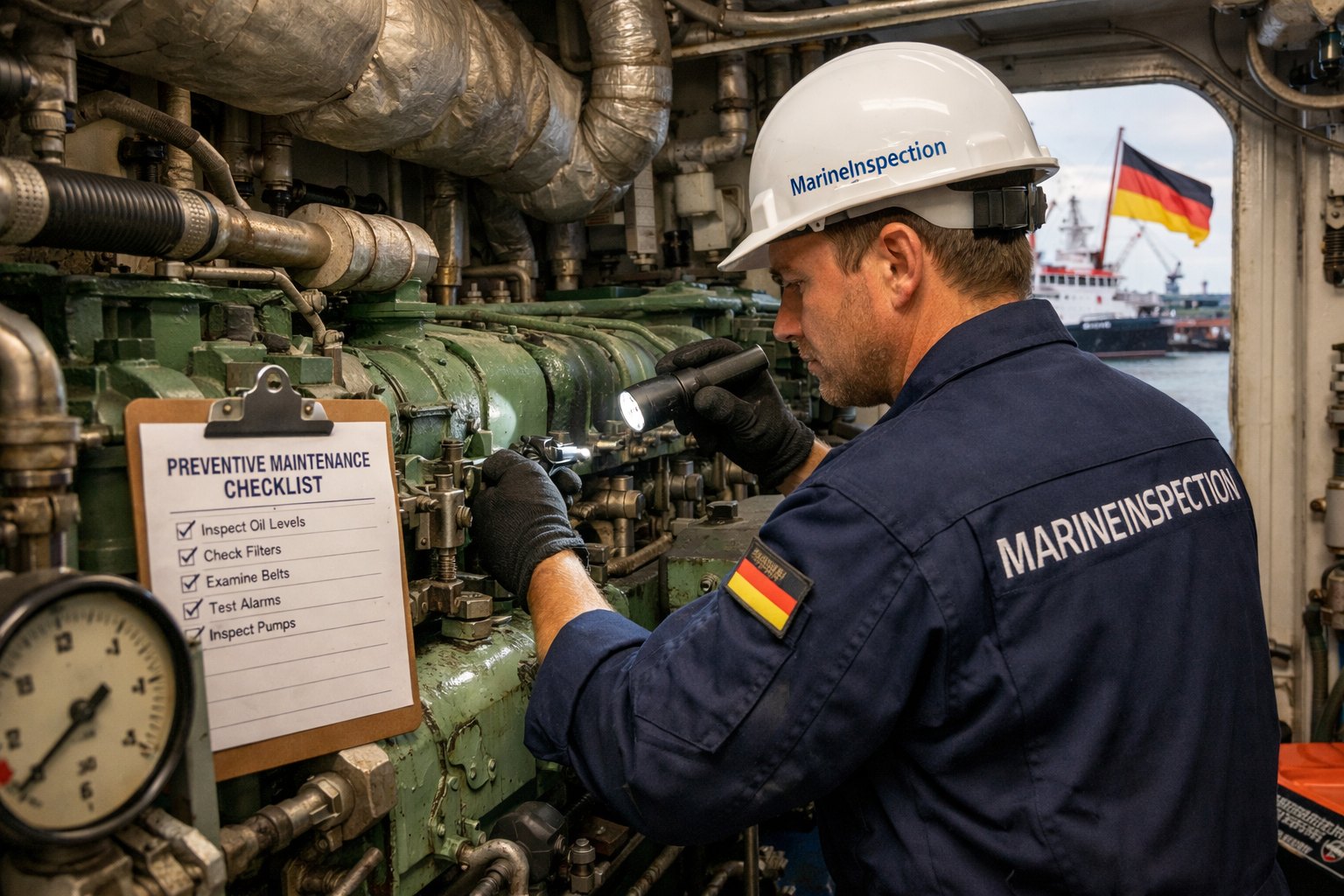
A container vessel operating between Hamburg and Bremerhaven faced $275,000 in unplanned repairs when a main engine bearing failed catastrophically—a failure that ultrasonic monitoring would have detected 4-6 weeks earlier at 1/20th the cost. German maritime authorities detained the vessel for 9 days while emergency repairs were completed, adding $180,000 in port fees, charter party penalties, and crew costs. The Berufsgenossenschaft investigation revealed the operator had skipped three consecutive condition monitoring intervals to "save costs"—resulting in losses 47 times greater than the prevented maintenance expenses. Germany's maritime sector has embraced predictive maintenance technology faster than any EU nation, with 78% of German-flagged commercial vessels now implementing condition-based maintenance systems that prevent 89% of catastrophic equipment failures.
78%
adoption rate
German vessels using predictive maintenance
89%
failure prevention
Catastrophic breakdowns avoided through monitoring
$450K
average savings
Annual cost reduction per vessel (100+ crew)
40%
downtime reduction
Compared to reactive maintenance approaches
German maritime regulations combine EU directives with strict domestic standards enforced by the Federal Maritime and Hydrographic Agency (BSH) and Berufsgenossenschaft Verkehrswirtschaft Post-Logistik Telekommunikation (BG Verkehr). Germany's technical inspection regime requires documented preventive maintenance following manufacturer specifications, class society requirements, and DIN standards specific to maritime applications. Digital maintenance management systems help operators meet German compliance requirements while reducing unplanned maintenance costs by 67%.
Understanding Preventive Maintenance Compliance in Germany
German maritime law mandates systematic maintenance for all commercial vessels through the Schiffssicherheitsverordnung (Ship Safety Ordinance). Unlike reactive approaches that fix equipment after failure, preventive maintenance operates on three principles: time-based servicing per manufacturer schedules, condition-based monitoring using diagnostic data, and predictive analytics identifying failure patterns before they occur. German authorities verify maintenance compliance during flag state inspections and Berufsgenossenschaft safety audits.
Time-Based Maintenance (Mandatory)
Main Engine Service
Per running hours (typically 8,000-12,000h)
Auxiliary Systems
Quarterly inspections, annual overhauls
Safety Equipment
Monthly testing per DIN EN standards
Documentation
Maintenance logs retained 10 years minimum
Condition-Based Monitoring (Recommended)
Oil Analysis
Quarterly for main engines, semi-annual for auxiliaries
Vibration Monitoring
Continuous or monthly for rotating equipment
Thermal Imaging
Annual electrical systems inspection
Performance Trending
Fuel consumption, temperature, pressure baselines
Predictive Analytics (Industry Standard)
Equipment Health Scoring
AI-driven failure probability assessment
Spare Parts Optimization
Predictive inventory based on failure forecasts
Maintenance Scheduling
Work order automation based on condition data
Critical Equipment & Inspection Intervals
German maritime standards prioritize critical systems where failure impacts safety, environmental compliance, or operational capability. Main propulsion systems, steering gear, fire suppression, and pollution prevention equipment receive intensive monitoring. Automated maintenance tracking ensures no interval is missed—critical when German inspectors audit maintenance records dating back years.
| Equipment System |
Inspection Frequency |
Service Interval |
| Main Engine |
Daily (running checks) |
8,000-12,000 hours |
| Auxiliary Engines |
Weekly |
6,000 hours or annual |
| Steering Gear |
Weekly test |
Quarterly overhaul |
| Fire Suppression Systems |
Monthly |
Annual service |
| Bilge & Ballast Pumps |
Bi-weekly |
6-month overhaul |
| HVAC Systems |
Monthly filters |
Annual cleaning/service |
Critical - Must Be Available
✓ Planned Maintenance System (PMS) schedule and completion records
✓ Engine room logbook with running hours and service entries
✓ Oil analysis reports with trending data (past 24 months)
✓ Spare parts inventory with critical stock levels
Important - Subject to Review
✓ Manufacturer's service manuals and maintenance instructions
✓ Class society survey reports and recommendations
✓ Work order histories showing corrective actions
✓ Condition monitoring reports (vibration, thermal, performance)
Automate Your German Maritime Compliance
Digital CMMS platforms track maintenance intervals, generate German-compliant documentation, and prevent missed services that trigger inspections.
Best Practices and Digital Tools for Preventive Maintenance
German shipping companies achieving 95%+ equipment reliability implement four core practices: centralized CMMS with automated work order generation, IoT sensor integration for real-time condition data, predictive analytics identifying optimal service timing, and mobile access enabling crew to document maintenance instantly. Modern maintenance platforms consolidate these capabilities—reducing administrative burden by 73% while improving maintenance effectiveness scores from 68% to 94%.
Digital Preventive Maintenance Strategies
Running Hour Automation
CMMS auto-calculates service due dates based on engine running hours, eliminating manual tracking and preventing overrun intervals that void warranties.
Condition Monitoring Integration
Oil analysis results, vibration data, and thermal readings feed directly into maintenance planning—triggering work orders when thresholds are exceeded.
Mobile Maintenance Execution
Engineers complete work orders on tablets with photo documentation, inventory usage tracking, and immediate logbook updates—all synced to shore offices.
Predictive Parts Management
System forecasts component lifecycles, auto-ordering critical spares with sufficient lead time to prevent expensive air freight or operational delays.
Cost Analysis: Reactive vs. Preventive Maintenance
German operators transitioning from reactive to preventive maintenance see dramatic cost reductions. Reactive approaches—fixing equipment only after failure—cost 3-4x more than planned maintenance when emergency repairs, expedited parts, downtime, and secondary damage are factored. Digital maintenance platforms demonstrate ROI within 4-7 months through reduced emergency repairs and optimized spare parts inventory.
Reactive Maintenance
$1,847,000
Emergency repairs: $680,000
Downtime costs: $540,000
Expedited parts: $387,000
Secondary damage: $240,000
Preventive + Digital CMMS
$597,000
Planned maintenance: $420,000
Monitoring systems: $87,000
CMMS platform: $45,000/year
Minor emergencies: $45,000
Annual Savings: $1,250,000 | ROI on CMMS: 4-7 months | Equipment uptime: 95%+ vs 78%
Implementing Condition-Based Maintenance
Oil Analysis
Detects metal wear particles, contamination, and oil degradation before component failure occurs.
Applications: Main engines, gearboxes, hydraulic systems, auxiliary machinery
Frequency: Quarterly for critical equipment, semi-annual for auxiliaries
Vibration Analysis
Identifies bearing wear, misalignment, imbalance, and resonance issues 4-8 weeks before failure.
Applications: Pumps, compressors, generators, propulsion motors, fans
Frequency: Continuous monitoring or monthly manual readings
Thermal Imaging
Reveals electrical connection hot spots, insulation breakdown, and mechanical friction anomalies.
Applications: Electrical panels, motor connections, bearings, piping systems
Frequency: Annual comprehensive scans, quarterly for critical systems
Performance Trending
Tracks fuel consumption, temperatures, pressures against baselines to detect gradual degradation.
Applications: Main propulsion, generators, heat exchangers, compressors
Frequency: Continuous automated data logging with monthly reviews
Common Preventive Maintenance Challenges
Overdue Maintenance from Schedule Drift
Solution: Automated alerts 30 days before due dates with escalation to shore management if intervals exceed tolerance
Incomplete Work Order Documentation
Solution: Mobile CMMS requiring photo uploads and parts usage entry before work orders can be closed
Critical Spare Parts Stockouts
Solution: Predictive inventory management with automatic reorder points based on equipment lifecycles and usage rates
Lost Historical Maintenance Data
Solution: Cloud-based CMMS with 10+ year data retention, searchable by equipment ID, date, or work type
Crew Turnover Knowledge Loss
Solution: Digital work instructions with step-by-step procedures, safety notes, and historical issue documentation
Transform Your Maintenance from Reactive to Predictive
Join German operators achieving 95%+ reliability through automated maintenance scheduling, condition monitoring integration, and mobile work order execution.
Frequently Asked Questions
What preventive maintenance documentation do German maritime authorities require?
BSH and BG Verkehr inspectors verify Planned Maintenance System schedules, engine logbooks with running hours, maintenance completion records, oil analysis reports, and spare parts inventories. All documentation must be retained minimum 10 years.
Digital CMMS platforms automatically maintain compliant records with unlimited retention and instant retrieval during audits.
How often should oil analysis be conducted on main engines?
German maritime best practice recommends quarterly oil analysis for main propulsion engines and semi-annual for auxiliary engines. Analysis should track wear metals (iron, copper, aluminum), contamination (fuel, water, dirt), and oil condition (viscosity, TBN, oxidation). Trending data over 24+ months identifies developing issues before they cause failures.
What ROI can vessel operators expect from preventive maintenance systems?
German operators report 3-4x cost reduction versus reactive maintenance—annual savings of $450,000-1,250,000 per vessel through eliminated emergency repairs, reduced downtime, optimized parts inventory, and extended equipment lifecycles.
CMMS platforms show ROI within 4-7 months through immediate reduction in unplanned maintenance costs.
How does condition-based maintenance differ from time-based schedules?
Time-based maintenance services equipment at fixed intervals (hours, calendar dates) regardless of actual condition. Condition-based monitoring uses oil analysis, vibration data, thermal imaging, and performance trending to service equipment based on actual wear patterns—preventing both premature maintenance and late failures. German vessels increasingly combine both approaches: time-based for safety-critical items, condition-based for optimizing service timing.
Can preventive maintenance eliminate all equipment failures?
Preventive maintenance reduces catastrophic failures by 89% but cannot eliminate all breakdowns—random failures still occur. However, systematic monitoring ensures failures are detected early when repairs are smaller, parts are available, and scheduling is controlled versus emergency situations. Best operators achieve 95%+ planned maintenance ratios where only 5% of work is unscheduled emergency response.
Conclusion: German Maritime Maintenance Excellence
Germany's maritime industry leadership stems from systematic preventive maintenance—not as compliance burden but as operational advantage. Vessels operating with planned maintenance achieve 95%+ reliability, 40% less downtime, and $1.25M annual savings versus reactive approaches. German authorities increasingly expect digital maintenance management during inspections, recognizing that CMMS platforms deliver better compliance outcomes than paper logbooks.
The transition pathway is clear: start with automated scheduling for time-based maintenance, add condition monitoring for critical equipment, then implement predictive analytics as data accumulates. Modern CMMS platforms guide this progression—delivering immediate benefits through missed maintenance prevention while building the foundation for advanced predictive capabilities. Within 12 months, operators achieve German maritime compliance excellence while dramatically reducing maintenance costs and improving operational reliability.