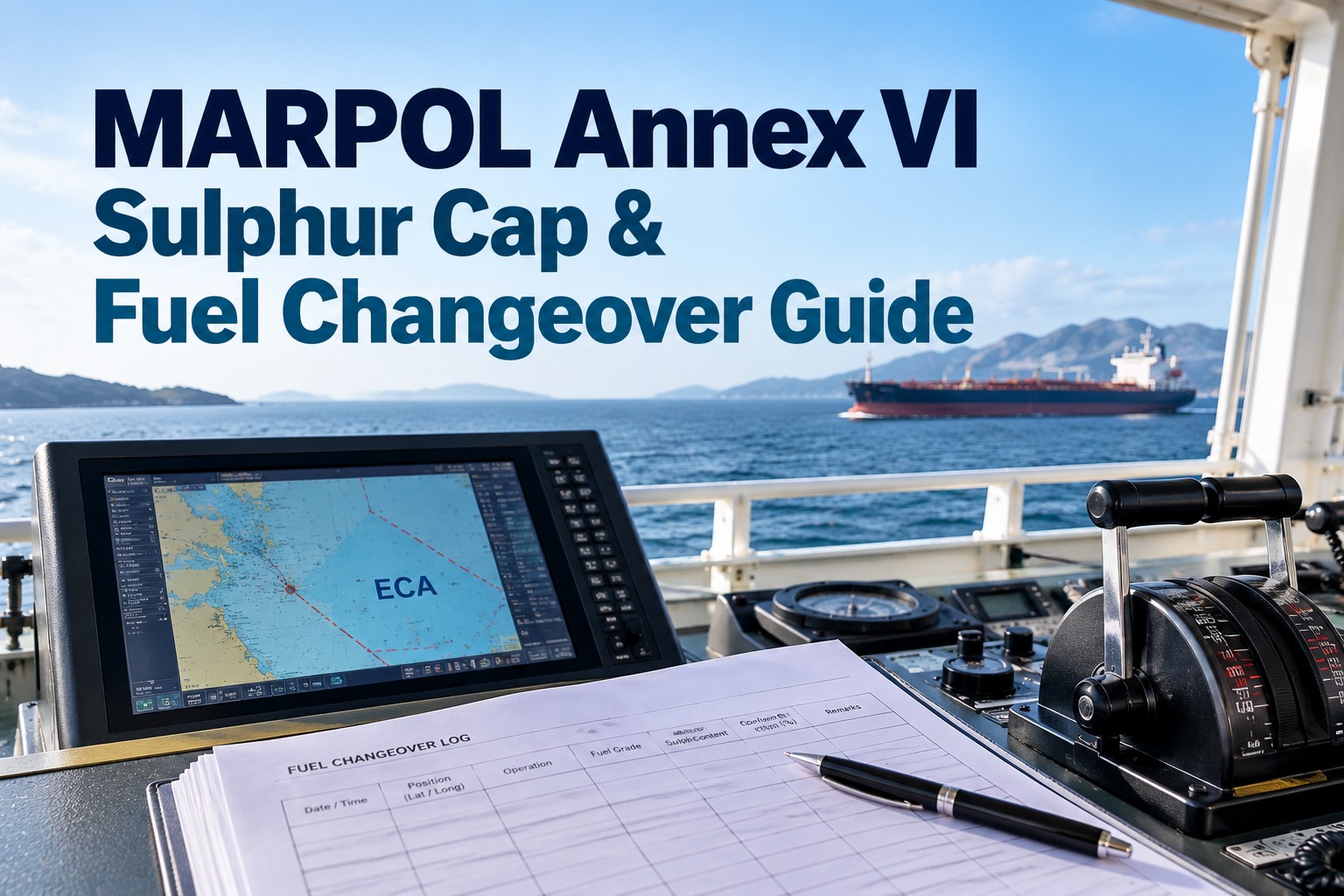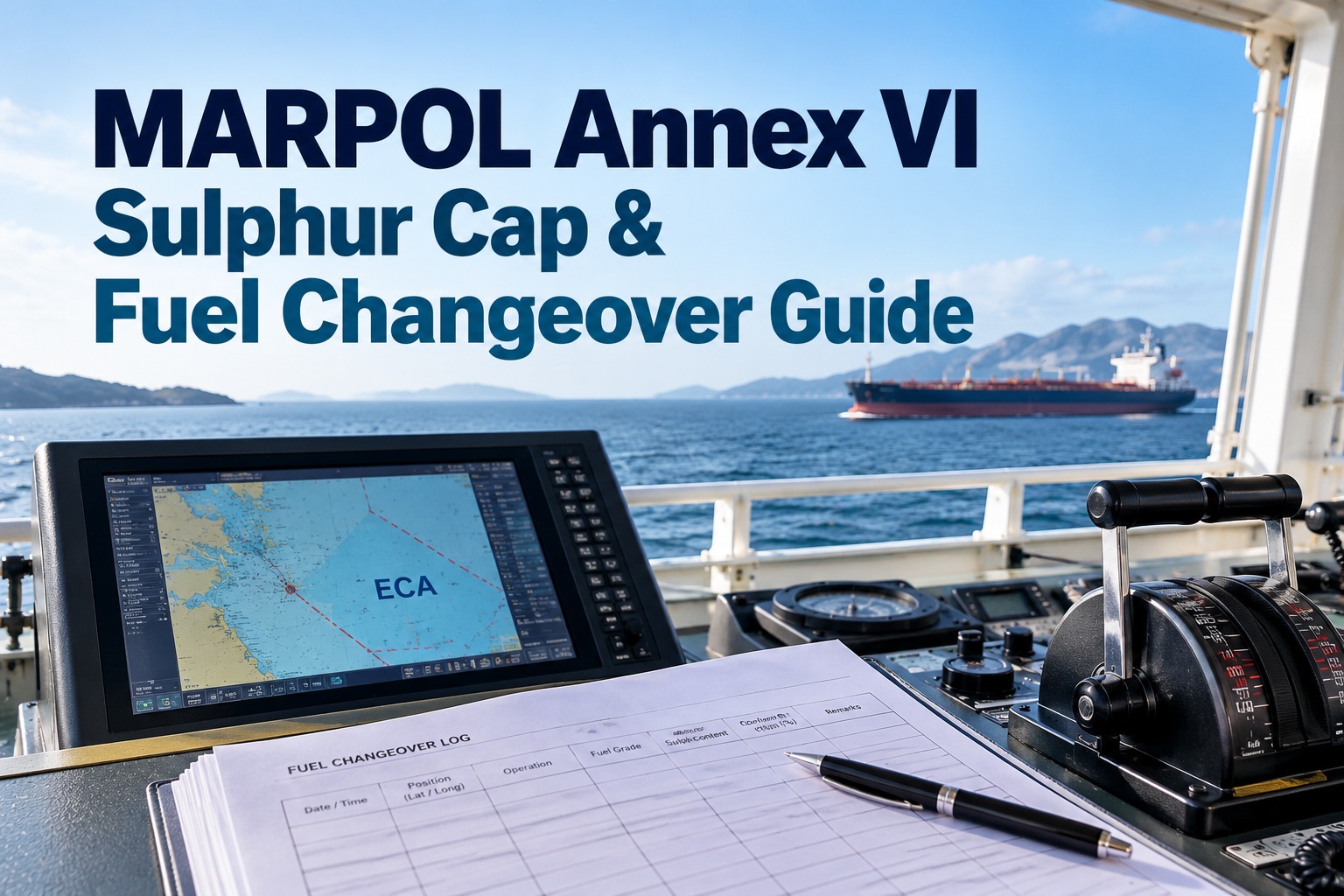
Switching to 0.10% fuel at an ECA boundary is a timed engine-room job, and compliance is proven on paper. When a PSC officer takes a fuel sample, the changeover log, bunker delivery notes and samples decide how that conversation goes. This guide covers the limits in force, how to time the switch, and the records that prove it. Book a demo to see digital fuel logs.
MARPOL Annex VI sulphur cap and fuel changeover: switch on time, and prove it
Three limits, one fuel system, and a log that has to match the voyage track to the minute.
Sulphur cap limits in 2026: where 0.10% applies
The map of 0.10% waters keeps growing. The Mediterranean became a SOx ECA on 1 May 2025, and three more northern areas are on the way. For a full guide to the new boundaries, see our 2026 ECA fuel switching guide. Try the platform free.
| SOx ECA | 0.10% applies from | Status in Oct 2026 |
|---|---|---|
| Baltic Sea | In force since 2015 at 0.10% | In force |
| North Sea (incl. English Channel) | In force since 2015 at 0.10% | In force |
| North American | In force since 2015 at 0.10% | In force |
| United States Caribbean Sea | In force since 2015 at 0.10% | In force |
| Mediterranean Sea | 1 May 2025 | In force |
| Canadian Arctic | 1 March 2027 | Coming |
| Norwegian Sea | 1 March 2027 | Coming |
| North-East Atlantic | 1 September 2028 (adopted May 2026) | Coming |
Ships with an approved exhaust gas cleaning system may use higher-sulphur fuel where the system gives an equivalent result and local rules allow it. Our scrubber maintenance guide covers that route.
Fuel changeover timing: how long the switch really takes
The changeover must be complete before the ship crosses the boundary, so the start time is worked back from the entry point. The fuel already in the service tank, mixing column and pipework has to burn off before the engine sees 0.10%. A simple dilution model gives a first estimate; your own ship’s data and the manufacturer’s guidance should set the final time.
Sulphur at the engine after changeover starts (illustrative)
Worked example
Estimate: time ≈ (volume ÷ consumption) × ln[(start − new) ÷ (0.10 − new)]
Illustrative figures only. Lower engine load means lower consumption and a longer changeover. Many fuel suppliers also advise limiting temperature change to about 2°C per minute to protect fuel pumps.
ECA fuel switching countdown: what to do and record
Treat the switch as a planned operation with a written procedure, which MARPOL requires for ships using separate fuels to comply in an ECA. The records at each step matter as much as the actions. See a changeover checklist in action.
Keep every changeover log PSC-ready
Capture start, completion and tank volumes on the device, with position and time, and let the office see every switch across the fleet.
The fuel changeover log: what MARPOL requires you to record
When a changeover is completed before entering an ECA, or starts after leaving one, MARPOL Annex VI requires the volume of low-sulphur fuel in each tank, and the date, time and position, to be recorded in the logbook the flag prescribes. The card below shows a complete entry.
Illustrative entry. Use the logbook and format your flag state prescribes, and make sure the times match the deck log and the ship’s track.
BDN, samples and fuel records behind sulphur compliance
The changeover log shows when you switched; the bunker paperwork shows what you switched to. Keep these together. Our MARPOL record book checklist covers the related books.
| Record or sample | What it proves | Keep for |
|---|---|---|
| Bunker delivery note (BDN) | Sulphur content and quantity as supplied, signed by the supplier | 3 years on board |
| MARPOL delivered sample | The fuel as delivered, sealed and linked to the BDN | Until the fuel is substantially used, and at least 12 months |
| In-use sampling point | Where PSC can draw fuel actually going to the engine | Designated and marked on the piping diagram |
| Changeover log | When the switch was completed or started, where, and with how much fuel | As the flag requires |
| Oil record book H entries | Each grade bunkered and the tanks it went into | 3 years from last entry |
| FONAR, if needed | Compliant fuel could not be bought despite best efforts | With the voyage records |
During a PSC fuel sample: how sulphur compliance is judged
An inspector may take a sample at the designated in-use point, or from a tank on board. Laboratory tests carry a margin of error, so IMO guidance sets a verification limit for these samples a little above the regulatory limit.
For the 0.50% limit: suppliers aim for about 0.47% to be 95% confident of compliance. A MARPOL delivered sample is judged against 0.50% with no margin. An in-use or on board sample passes up to 0.53%. Margins for 0.10% fuel are smaller.
Common sulphur compliance failures on board
Most failures are not about the fuel bought, but about timing and records.
Fuel changeover log and ECA compliance checklist
Use this before every ECA entry and exit. Our article on how oil records are audited explains how inspectors link fuel and oil records.
How Marine Inspection supports sulphur and fuel changeover compliance
Marine Inspection keeps the evidence for each switch together, from bunkering to the ECA exit. Engineers complete the changeover checklist on the device, attach photos of BDNs and sample seals, and the office sees every vessel’s changeovers in one place. The voyage below is an illustrative example.
Sulphur cap and fuel changeover FAQs
What is the MARPOL Annex VI sulphur cap?
Since 1 January 2020, fuel used outside ECAs must not exceed 0.50% sulphur. Inside SOx ECAs the limit is 0.10%, unless an approved equivalent such as a scrubber is used.
When must the fuel changeover be completed?
Before the ship enters the ECA. The change back to higher-sulphur fuel may only start after the ship has left it.
What must the changeover log show?
The volume of low-sulphur fuel in each tank, and the date, time and position when the changeover was completed before entry, or started after exit.
How long do we keep BDNs and fuel samples?
BDNs for three years on board. The MARPOL delivered sample until the fuel is substantially used, and for at least 12 months from delivery.
What result fails a PSC in-use sample?
For the 0.50% limit, IMO verification guidance treats an in-use or on board sample above 0.53% as non-compliant, allowing for test reproducibility.
Can Marine Inspection hold our changeover records?
Yes. Book a demo to see a changeover checklist with photo evidence and a fleet view.
Switch on time, log it right, pass the sample
A planned changeover and a complete evidence trail turn a PSC fuel sample into a routine check.