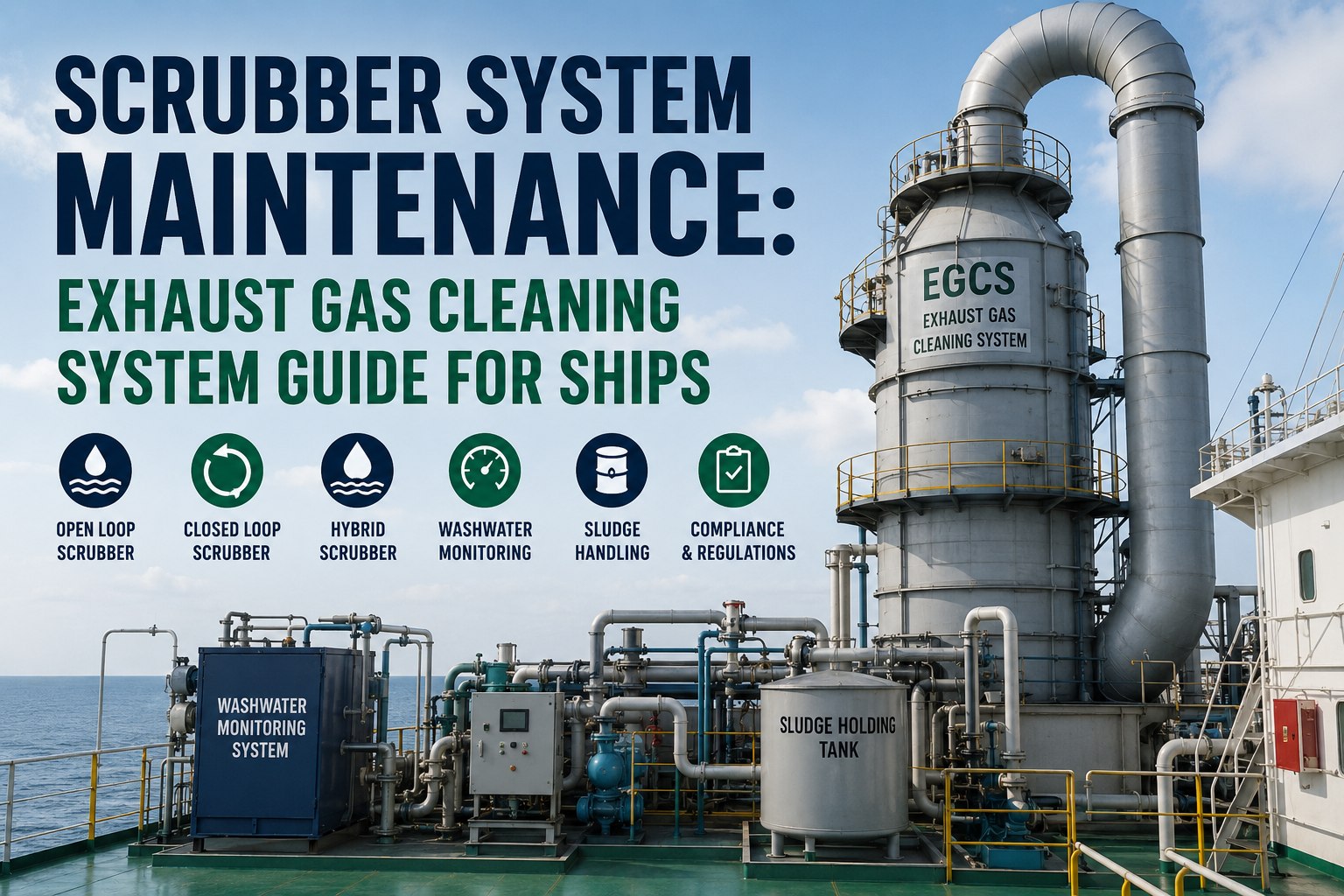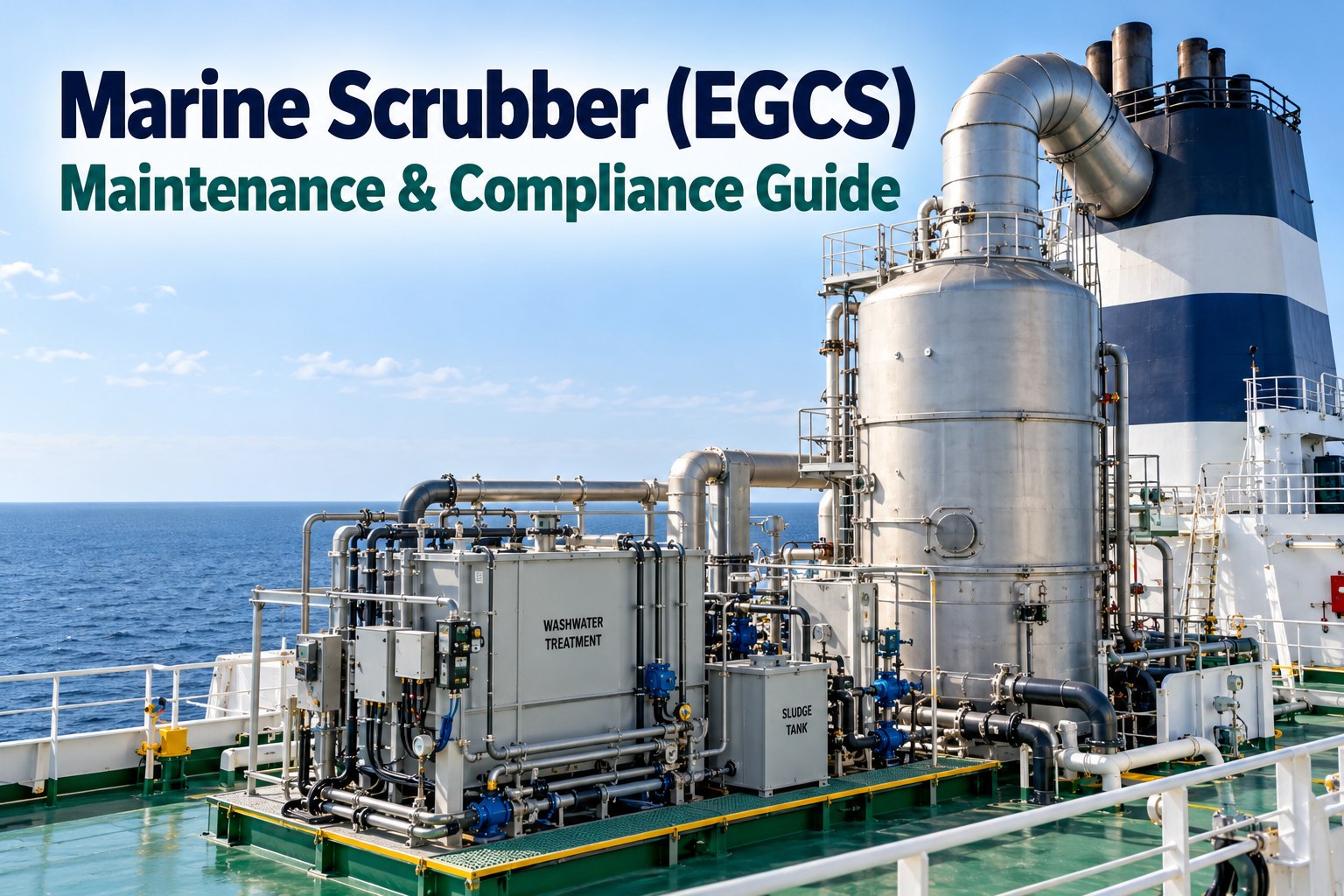
A scrubber is judged twice: by what leaves the funnel and by what goes over the side. Both judgments rest on sensor readings someone had to clean and calibrate, and on pipework that acidic washwater attacks every hour the system runs. This guide covers the limits, the maintenance and the Annex VI records that keep an EGCS compliant. Log scrubber readings and calibrations free.
Marine scrubber maintenance that keeps the numbers honest and the sea connection sound
An EGCS is only an equivalent to compliant fuel while it holds its limits and can prove it. Four figures from the 2021 EGCS Guidelines decide most of that proof.
Scrubber compliance limits under the 2021 EGCS Guidelines
The 2021 Guidelines (resolution MEPC.340(77)) apply to systems on ships keel-laid or delivered on or after 1 June 2022, and to changes made to older systems after that date. Earlier installations are usually certified to the 2015 Guidelines, so the ETM on board is the document that tells you which numbers bind your ship. For how the tower, pumps and dosing work, see our scrubber system maintenance overview.
| Parameter | Limit | How it is judged | Sensor tolerance |
|---|---|---|---|
| Emission ratio | SO2 (ppm) / CO2 (%) of 21.7 for 0.50% S, 4.3 for 0.10% S | Petroleum fuels; continuous (Scheme B) or daily spot check (Scheme A) | Per the NOx Technical Code test methods |
| Washwater pH | At least 6.5 at overboard; up to 2 units below inlet during manoeuvring and transit | Or an overboard limit set in the ETM that gives pH 6.5 at 4 m from the discharge | ±0.2 pH units |
| PAH (phenanthrene equivalent) | 50 µg/L above inlet, normalised to 45 t/MWh | After treatment, before any dilution; may exceed by 100% for 15 min in 12 h | ±5% |
| Turbidity | No more than 25 FNU/NTU above inlet | 15-minute rolling average; may exceed by 20% for 15 min in 12 h | ±2 FNU/NTU |
| Nitrate | Equal to 12% NOx removal, or 60 mg/L at 45 t/MWh, whichever is greater | Sample within 3 months of installation and before each renewal survey | Laboratory analysis |
The PAH limit falls as washwater flow rises
Limit in µg/L above inlet, by discharge flow (t/MWh)
Source: 2021 EGCS Guidelines, MEPC.340(77). The 45 t/MWh column is the reference flow. Above 2.5 t/MWh, PAH is measured by fluorescence.
Washwater monitoring and scrubber sensor calibration
Most "exceedances" found on review are not chemistry at all. They are a fouled optical window, a pH probe past its calibration date or a gap in the data file. The Guidelines set how often readings are recorded and how far a sensor may drift. See calibration tracking in a demo.
Washwater recording
pH, PAH and turbidity recorded at least every 90 seconds (0.0111 Hz), continuously in ports, harbours and estuaries.
Scheme B emissions
SO2, CO2 and the ratio recorded at least once every 4.8 minutes (0.0035 Hz) whenever the EGCS runs.
Scheme A spot check
An emission ratio check of at least 5 minutes, logged every 10 seconds, on top of continuous operating parameters.
Data retention
Recorded data kept for at least 18 months. The EGCS Record Book is kept for 3 years after its last entry.
Calibration drift
Hold pH within ±0.2, PAH within ±5% and turbidity within ±2 FNU. Calibrate to the OMM and keep the certificates.
Optical windows
PAH and turbidity cells read through glass that soot and salt film over. Clean on the maker's interval and after any spike you cannot explain.
Open loop vs closed loop scrubber maintenance
Around 85% of scrubbers are open loop and about 15% hybrid, according to Germany's Environment Agency (UBA). The loop decides where the maintenance load sits. Set up loop-specific tasks free.
Seawater in, washwater straight over the side
- Washwater limits apply every hour of operation, so sensor uptime is everything
- High seawater flow and acidic discharge concentrate wear on the overboard pipe and sea chest
- Most exposed to port bans: mode changes and fuel switching must be planned by route
Recirculated water dosed with alkali
- Caustic soda dosing, storage and handling: PPE, eye-wash and spill kits ready
- Bleed-off treatment unit separates sludge that must be stored and landed
- Holding tank capacity sets how long the ship can run with zero discharge
Scrubber sea connection corrosion: the biggest claims risk
Gard's review of six years of hull and machinery claims (2020 to 2025) puts nearly 7,000 vessels on scrubbers, with claims at about 4 per 1,000 vessels a year. Water ingress through corroded overboard piping is the headline risk, and about three quarters of all failures happened at sea, where a plug is hardest to fit.
Share of scrubber claims
Source: Gard, "Scrubber risks: lessons from six years of claims", March 2026.
IACS UR MR81, as cited by Gard. Steamship Mutual's risk alert suggests thickness gauging at least annually, six-monthly where possible, plus diver checks of the diffuser and shell attachment.
Overboard distance piece
Hot, acidic, variable flow attacks coating breaks and unshielded flange joints. Gauge it, test the bilge alarm beside it, renew before it thins out.
Washwater backflow
A failed high-level tower alarm that does not trip the seawater pumps can send water back to the engine. Put the trip on the critical list.
Fire in the tower
Cooling pumps stopped with the bypass damper not sealing lets hot gas into dry internals. Test that interlock and inspect inlet valves.
Hot work in the yard
Scrubber internals can burn. Cover openings, keep fire watch and brief the yard before any cutting or welding nearby.
Tank and tower pitting
Soot abrades coatings, then acid finishes the job. Look for spray dead zones and inspect coatings to the maker's spec.
Every limit, every calibration, every thickness reading in one EGCS record
Washwater checks, sensor calibrations, pipe gauging and sludge landings logged on board, offline, and ready when PSC or class asks to see the EGCS Record Book.
Scrubber malfunction: the one-hour rule for EGCS compliance
IMO guidance (MEPC.1/Circ.883/Rev.1) separates a failed sensor from a failed system. The clock that matters is one hour. If the ship has to change fuel, our ECA fuel switching guide covers the changeover records.
Act at once
Troubleshoot to the checklist in the approved technical manual or the maker's documents.
Record it
Start time, duration, cause, action and follow-up go in the EGCS Record Book.
Switch fuel
Not compliant again within one hour: change over to compliant fuel oil.
Tell flag and port State
Any malfunction over an hour, or repeated ones, with the corrective steps taken.
Scrubber washwater discharge restrictions by region
About 45 countries now restrict washwater discharge somewhere, mostly open loop in ports, according to UBA. North-west Europe is moving fastest. Lists change, so check before every call. See route-based compliance alerts in a demo.
OSPAR ports and internal waters
Open loop discharge banned in ports and internal waters of the OSPAR states; closed loop from 2029. Parties may delay by up to three years.
Denmark, Sweden, Finland
Open loop discharge banned in territorial waters; closed loop discharge to follow from 2029.
Baltic Sea (HELCOM)
A roadmap adopted in December 2025 aims for a harmonised ban in territorial seas, internal waters and ports.
Singapore
Open loop use banned in port waters; ships transiting the traffic separation scheme without calling are exempt.
China
Open loop discharge banned in domestic emission control areas, and burning scrubber residue on board is prohibited.
Ports worldwide
Examples include Hong Kong, Vancouver at anchor or berth, the Panama Canal, Fujairah and California waters.
Sources: DNV, North Standard (April 2026) and UBA (March 2026). Port rules vary in scope and date; confirm with the agent before arrival.
Scrubber sludge and residue handling under Annex VI
The Guidelines are blunt: EGCS residues should not be discharged to sea or incinerated on board. They go ashore, and every step is recorded.
Annex VI scrubber records PSC inspectors ask for
A PSC officer cannot see washwater chemistry. They can see whether the paperwork joins up. Pair this list with our MARPOL record book checklist and the wider MARPOL Annex I to VI guide.
Marine scrubber maintenance schedule
Some intervals come from the Guidelines; the rest come from the maker, class or the P&I clubs' claims experience. The schedule keeps the sources apart.
| Task | Interval | Basis |
|---|---|---|
| Review washwater and emission readings against limits | Continuous, signed daily | Guidelines |
| Scheme A emission ratio spot check, 5 minutes minimum | Daily | Guidelines |
| Clean optical cells of PAH and turbidity sensors | Per maker | Maker |
| Calibrate pH, PAH, turbidity and gas analyser | Per OMM | Guidelines |
| Test high-level tower alarm trips seawater pumps | Per SMS, critical list | P&I advice |
| Test bypass damper interlock on cooling pump stop | Per SMS | P&I advice |
| Gauge overboard distance piece, diver check of diffuser | Annual minimum, six-monthly preferred | P&I advice |
| Test bilge alarms near the overboard pipe | Per SMS | P&I advice |
| Nitrate sample | Within 3 months before renewal survey | Guidelines |
| Residue tank level and landing receipts | Each port call | Guidelines |
| EGCS survey | Annual, intermediate, renewal | Guidelines |
How Marine Inspection keeps scrubber compliance traceable
The weak point in most EGCS files is the join: a calibration nobody linked to the reading that followed it, a thickness result in an email, a malfunction that never reached the record book. Marine Inspection keeps each step on one trail. Start your EGCS trail free.
Calibrations on the calendar
Each sensor gets its own recurring task, so an expired pH probe shows up as due work, not as a surprise in the data review.
Pipe thickness that trends
Distance piece readings stored as numbers against the same points, so the wastage rate is visible long before the 12 or 15 mm floor.
Works offline at sea
Engineers log in the scrubber room with no signal; records sync to the office when the link returns.
Marine scrubber (EGCS) maintenance and compliance: FAQs
What washwater pH must a scrubber meet?
At least 6.5 at the overboard discharge, with up to 2 pH units below the inlet allowed during manoeuvring and transit. Or the ETM can set an overboard limit that gives pH 6.5 at 4 m from the discharge point.
What is the SO2/CO2 emission ratio for a scrubber?
21.7 to match 0.50% sulphur fuel and 4.3 to match 0.10% sulphur fuel in an ECA, for petroleum-derived fuels.
What happens if the scrubber fails at sea?
Troubleshoot to the technical manual and log it. If compliance is not restored within one hour, change over to compliant fuel, and report malfunctions over an hour, or repeated ones, to the flag and port State.
Can scrubber sludge be burned in the incinerator?
No. The 2021 Guidelines say residues should not be discharged to sea or incinerated on board; they are landed ashore and recorded in the EGCS Record Book.
How long must scrubber monitoring data be kept?
At least 18 months for recorded monitoring data, and 3 years after the last entry for the EGCS Record Book.
How often should the scrubber overboard pipe be inspected?
Class checks sea connections at docking, but P&I advice is to gauge the distance piece at least annually, ideally every six months, with diver checks of the diffuser. See thickness trending in a demo.
Keep the scrubber an equivalent, not a liability
Limits, calibrations, malfunctions, sludge landings and pipe gauging on one record, so the answer to "prove it" is always one report away.