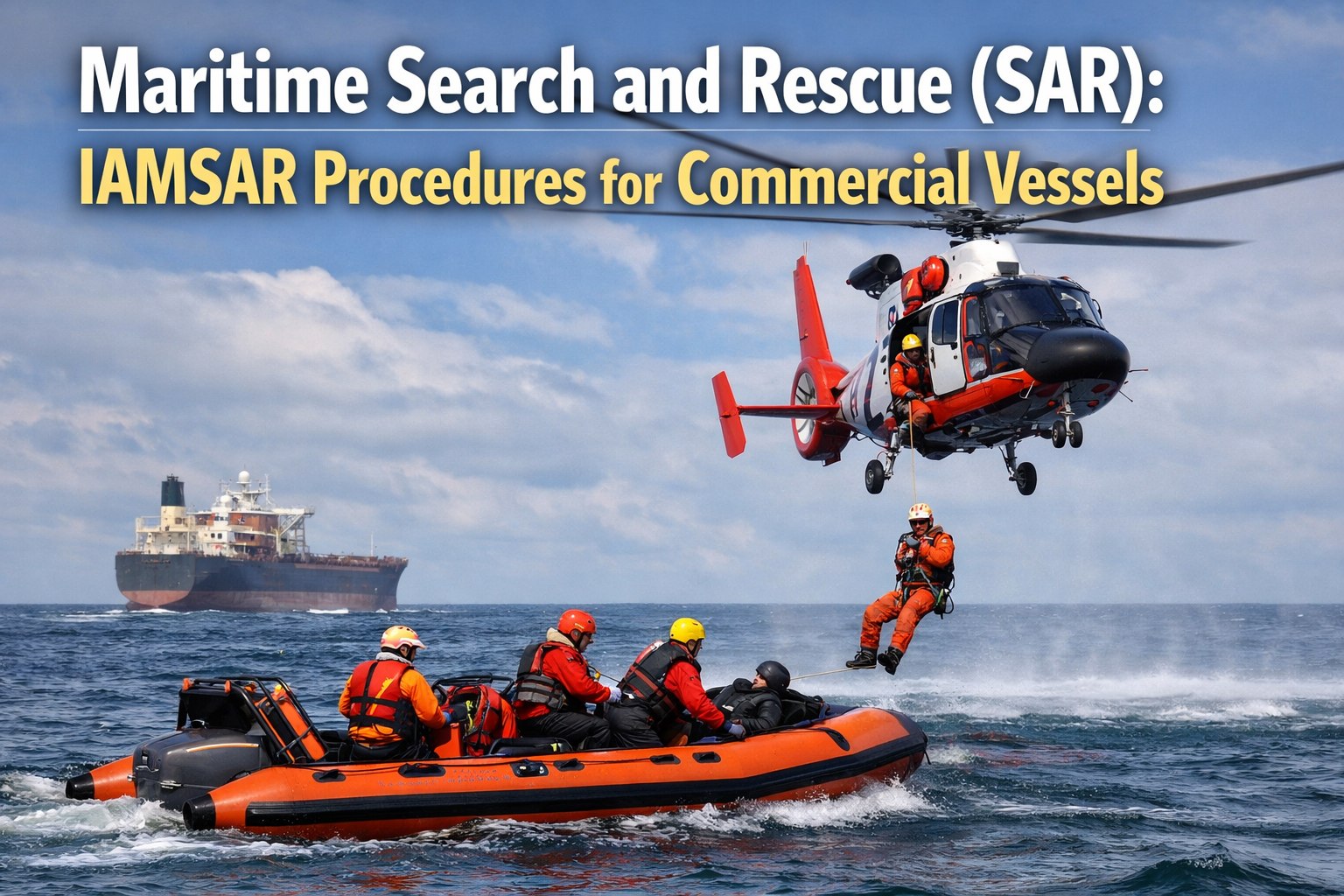
When a vessel receives a distress signal at sea, it triggers a legal obligation that supersedes commercial schedules, charter party instructions, and company directives: SOLAS Regulation V/33 requires the Master of every ship to proceed with all speed to the assistance of persons in distress at sea. This is not discretionary — refusal to render assistance when able to do so can result in criminal prosecution under maritime law. The International Aeronautical and Maritime Search and Rescue (IAMSAR) Manual, jointly published by the IMO and ICAO, provides the operational framework that transforms this legal obligation into structured action: how to communicate with Rescue Coordination Centres (RCCs), how to execute search patterns, how to coordinate with other vessels and aircraft, and how to perform the On-Scene Coordinator (OSC) function when designated by the RCC. SOLAS Regulation V/21 requires every ship to carry an up-to-date hard copy of IAMSAR Volume III (Mobile Facilities) — and the 2025 edition with amendments effective 1 January 2026 introduces significant updates: GMDSS modernisation aligned with 2024 SOLAS updates, new guidance for SAR operations near offshore wind farms (Section 6.15), night search capabilities using Electro-Optic/Infrared equipment (Appendix W), and international cooperation templates for cross-border SAR coordination (Appendices P and Q). For deck officers on commercial vessels, SAR competency means knowing the search patterns (expanding square, sector, parallel track), understanding communications protocols (Mayday relay, GMDSS DSC, COSPAS-SARSAT), managing the transition from normal operations to emergency response, and executing rescue techniques that recover people alive from the water. To see how Marine Inspection tracks SAR drill records, GMDSS equipment maintenance, and IAMSAR manual compliance across your fleet, book a Marine Inspection demo.
SOLAS V/33
Legal obligation: Master must proceed with all speed to assist persons in distress at sea. Cannot be overridden by charter party or commercial considerations.
SOLAS V/21
All ships must carry up-to-date hard copy of IAMSAR Volume III. 2025 edition with 2026 amendments mandatory from 1 January 2026.
SAR Convention 1979
International framework requiring states to establish SAR regions, provide SAR services, and cooperate with neighbouring states for coordinated rescue.
IAMSAR Manual
3 volumes: I (Organisation), II (Mission Coordination for RCCs), III (Mobile Facilities — mandatory carriage for ships). Jointly published by IMO and ICAO.
The Distress Communication Chain
SAR begins with the distress alert — and every commercial vessel is part of the communication chain that detects, relays, and responds to these alerts through the Global Maritime Distress and Safety System (GMDSS).
DETECT
Distress Alert Received
DSC distress alert on VHF Ch.70 or MF/HF. EPIRB detection via COSPAS-SARSAT satellite system relayed to nearest RCC. Mayday voice call on VHF Ch.16. INMARSAT distress message.
ACKNOWLEDGE
Confirm Receipt
Acknowledge the distress alert. If no RCC acknowledgement heard within 5 minutes, relay the distress alert (Mayday Relay). Record time, position, identity of distressed vessel, nature of distress.
COORDINATE
RCC Assumes Control
Rescue Coordination Centre assumes SAR mission coordination. Identifies available SAR units and merchant vessels. May designate an On-Scene Coordinator (OSC) from responding vessels. Issues search area and pattern assignments.
EXECUTE
Search and Rescue
Vessels proceed to search area. Execute assigned search pattern. Maintain communications with RCC and OSC. Report findings. Recover survivors. Provide medical care and safe passage.
Search Patterns: Which Pattern for Which Situation
IAMSAR Search Patterns for Commercial Vessels
Search Pattern
How It Works
Best Used When
Number of Vessels
Key Considerations
Expanding Square
Start at datum point. Sail increasing leg lengths in a square spiral outward, covering area systematically from centre.
Position of casualty well known. Small search area. Single vessel search. Good for initial search around datum.
1 vessel (primary)
Concentrated coverage near datum. Legs increase by track spacing (S) each two turns. Most effective when datum is reliable.
Sector Search
Vessel crosses through datum on different headings, rotating pattern to cover a circle around datum point.
Datum very reliable. Small search area. Object difficult to detect (requires close approach). Single vessel.
1 vessel
All tracks pass through datum. High coverage near centre. Useful when target is small (person in water, small raft).
Parallel Track
Vessel(s) sail parallel legs back and forth across the search area, covering a rectangular zone systematically.
Large search area. Multiple vessels available. Datum less certain. Uniform probability of detection across area.
1 or multiple vessels
Track spacing based on visibility and detection capability. Can be divided among multiple vessels for coordinated search.
Creeping Line Ahead
Similar to parallel track but legs are oriented along the direction of drift, advancing progressively downwind.
Known drift direction. Target expected to be moving with wind/current. Single or multiple vessels.
1 or multiple
Accounts for drift — searches ahead of where target is moving. More efficient than parallel track when drift direction is known.
Trackline Search
Search along the planned route of the casualty vessel. Expand outward from the planned track in parallel legs.
Casualty vessel overdue. Last known position on a planned route. Time of casualty unknown.
1 vessel initially
Covers the most likely area along the planned route. Expand search area if initial trackline search yields no results.
Track spacing (S) depends on visibility, target size, sea state, and detection equipment. IAMSAR Volume III contains tables for calculating optimal track spacing.
On-Scene Coordinator (OSC): When Your Vessel Leads the Search
The RCC may designate the Master of a commercial vessel as On-Scene Coordinator when the vessel is first on scene, closest to the datum, or best equipped. The OSC function is a significant responsibility — coordinating all SAR units at the scene until relieved by the RCC or a dedicated SAR unit. Book a Marine Inspection demo to see how the platform documents OSC assignments and SAR participation records.
Assume Coordination: Accept OSC designation from RCC. Establish communications with all SAR units on scene. Determine search area and assign patterns based on IAMSAR guidance and RCC instructions.
Modify Search Plan: Adjust search area based on updated datum calculations (drift, leeway, current). Reassign sectors as units arrive or depart. Account for changing visibility and weather conditions.
Coordinate Communications: Maintain communication with RCC, all SAR units, and any aircraft involved. Use designated SAR frequency. Provide situation reports (SITREPs) to RCC at regular intervals.
Direct Rescue Operations: When survivors located, coordinate rescue. Assign rescue vessel. Direct other units to standby or continue search for additional survivors. Manage medical priorities.
Record Keeping: Document all communications, search patterns executed, areas covered, weather conditions, sighting reports, and rescue actions. This record is critical for investigation and debriefing.
Release of Units: Release participating vessels from SAR duties when search is concluded, suspended, or when relieved by RCC. Ensure all units are clear before departing scene.
2026 IAMSAR Amendments: What Changed
The IAMSAR Manual 2025 edition with amendments effective 1 January 2026 (MSC.1/Circ.1686) introduces updates that reflect the modern maritime operating environment. All vessels must carry the updated hard copy of Volume III. Sign up for Marine Inspection to track IAMSAR manual version compliance across your fleet.
NEW
Offshore Wind Farm SAR
New Section 6.15 addresses SAR operations near and within offshore renewable energy installations. Wind farms create unique challenges: restricted manoeuvring, radar clutter, helicopter approach limitations.
NEW
Night Search Capabilities
Appendix W covers Electro-Optic/Infrared (EO/IR) equipment and Night Vision Devices for SAR operations. Recognition that night searches require different techniques and equipment than daylight operations.
UPDATED
GMDSS Modernisation
Aligned with 2024 SOLAS GMDSS updates. Multiple communication pathways — INMARSAT satellite, COSPAS-SARSAT, AIS, digital messaging alongside traditional radio. Ensures SAR protocols match modernised architecture.
NEW
Cross-Border SAR Cooperation
Appendices P and Q provide templates for cross-border SAR coordination — MOU between SAR services and process for expeditious approval to allow SAR units from assisting states to enter another state's territory.
How Marine Inspection Supports SAR Readiness
SAR Drill Records
SAR drill scheduling, scenario documentation, crew roles, search pattern execution records, communications practice, and debrief outcomes — demonstrating SOLAS compliance.
GMDSS Equipment Maintenance
VHF DSC, MF/HF radio, INMARSAT, EPIRB, SART, NAVTEX, AIS — all tracked with test records, battery replacement dates, annual surveys, and calibration.
IAMSAR Manual Compliance
Track IAMSAR Volume III version on board per vessel. Alert when new editions or amendments are published. Ensure 2025 edition with 2026 amendments is on board before 1 January 2026.
Crew Training Records
GMDSS operator certificates (GOC/ROC), SAR coordination training, STCW personal survival competencies, and radar/ARPA proficiency — tracked per crew member.
SAR Readiness Is a SOLAS Obligation — Not Optional Preparation
GMDSS equipment that fails during a distress response, crew unfamiliar with search patterns, outdated IAMSAR manuals — these are the gaps that cost lives and create legal liability. Marine Inspection ensures every element of SAR readiness is systematically maintained and documented.
Rescue Techniques: Recovering People From the Water
Approach from Downwind: Vessel creates a lee for the person in the water. Wind pushes vessel toward survivor rather than away. Reduces sea state on the recovery side. Stop engines with survivor well forward of propellers.
Rescue Boat Deployment: Launch rescue boat with trained crew, VHF, searchlight, first aid, thermal blankets, and recovery equipment. Approach survivor from downwind. Stop engine before reaching person to avoid propeller injury.
Horizontal Recovery: Recover hypothermic casualties horizontally — vertical lifting can cause circum-rescue cardiac arrest. Use Jason's Cradle, rescue net, or horizontal-lift sling. Handle gently.
Multiple Survivors: Triage: rescue conscious and responsive survivors first (they can assist in their own rescue). Then unconscious survivors. Liferaft survivors may be in better condition than those in water.
Night Recovery: Use searchlights, SART radar response, AIS MOB beacons, and flare sightings to locate survivors. EO/IR equipment per new IAMSAR Appendix W guidance. Night recovery requires additional crew and slower approach.
Post-Rescue Care: Remove wet clothing. Apply thermal protection (dry blankets, thermal bags). Warm sweet drinks if conscious. Do not give alcohol. Monitor for hypothermia symptoms. Seek medical advice via radio. Document condition and treatment.
Conclusion
Maritime search and rescue is the operational discipline where legal obligation (SOLAS V/33 — duty to assist), international coordination (SAR Convention 1979, RCC network), procedural framework (IAMSAR Manual Volumes I-III), and communication infrastructure (GMDSS) converge on a single objective: recovering people alive from the sea. The 2026 IAMSAR amendments (MSC.1/Circ.1686) modernise this framework with offshore wind farm SAR guidance, night search EO/IR capabilities, updated GMDSS alignment, and cross-border cooperation templates — all ships must carry the updated Volume III in hard copy from 1 January 2026. Five search patterns (expanding square, sector, parallel track, creeping line ahead, trackline) each serve specific situations based on datum reliability, search area size, number of vessels, and drift conditions. The OSC function, which any commercial vessel Master may be asked to perform, requires coordination of all units on scene, communications management, search plan adjustment, and record keeping. Rescue techniques prioritise downwind approach, horizontal recovery for hypothermic casualties, and systematic post-rescue medical care. Marine Inspection ensures your fleet's SAR readiness is documented and maintained — GMDSS equipment, IAMSAR manual compliance, drill records, and crew training — book a live demo today.
Frequently Asked Questions
FAQ 01
Is a commercial vessel legally required to respond to distress signals?
Yes. SOLAS Regulation V/33 establishes an absolute legal obligation: the Master of a ship at sea which is in a position to be able to provide assistance, on receiving information that persons are in distress at sea, is bound to proceed with all speed to their assistance. This obligation cannot be overridden by charter party terms, commercial schedules, or company instructions. The Master may be released from this obligation only if informed that other vessels have been requisitioned and are complying, or if the Master's ship has been released by the persons in distress or by the SAR authorities. Refusal to render assistance when able to do so can result in criminal prosecution under flag state law and international maritime law.
FAQ 02
What is the IAMSAR Manual and must ships carry it?
The International Aeronautical and Maritime Search and Rescue (IAMSAR) Manual is jointly published by IMO and ICAO in three volumes: Volume I (Organisation and Management) for SAR administrators, Volume II (Mission Coordination) for RCC staff, and Volume III (Mobile Facilities) for personnel aboard ships and aircraft. SOLAS Regulation V/21 mandates that all ships carry an up-to-date hard copy of Volume III. The 2025 edition with amendments effective 1 January 2026 must be on board — digital copies alone do not satisfy the requirement, as hard copy is stipulated for use during emergencies when electronic systems may be unavailable. Volume III provides practical guidance on search patterns, communications procedures, OSC functions, and rescue techniques.
FAQ 03
What are the main search patterns used in maritime SAR?
Five primary search patterns: (1) Expanding Square — start at datum, spiral outward in increasing squares. Best for reliable datum, single vessel, small area. (2) Sector Search — cross through datum on different headings. Best for very reliable datum, difficult-to-detect target. (3) Parallel Track — sail parallel legs across a rectangular area. Best for large search area, multiple vessels, less certain datum. (4) Creeping Line Ahead — parallel legs oriented along drift direction. Best when drift is known, searches ahead of moving target. (5) Trackline Search — search along casualty's planned route. Best for overdue vessels with known planned track. Track spacing depends on visibility, target size, sea state, and detection equipment — IAMSAR Volume III contains calculation tables.
FAQ 04
What does an On-Scene Coordinator (OSC) do?
The OSC is designated by the RCC to coordinate all SAR units at the scene of a maritime emergency. Any commercial vessel Master may be designated as OSC — typically the first vessel on scene, the closest to datum, or the best equipped. OSC responsibilities include: establishing communications with all SAR units, assigning search areas and patterns, adjusting the search plan based on updated drift calculations and weather, directing rescue operations when survivors are found, providing situation reports (SITREPs) to the RCC, managing medical priorities for recovered survivors, documenting all actions and communications, and releasing participating vessels when the search is concluded or suspended. The OSC function continues until the RCC relieves the OSC or designates a replacement.
FAQ 05
What changed in the 2026 IAMSAR amendments?
The 2026 IAMSAR amendments (MSC.1/Circ.1686, effective 1 January 2026) introduce: (1) Offshore Wind Farm SAR — new Section 6.15 addressing search and rescue operations near and within offshore renewable energy installations, which create restricted manoeuvring areas, radar clutter, and helicopter approach limitations. (2) Night Search Capabilities — new Appendix W covering Electro-Optic/Infrared (EO/IR) equipment and Night Vision Devices. (3) GMDSS Modernisation — alignment with 2024 SOLAS GMDSS updates, ensuring SAR communication protocols work with modernised systems including satellite, AIS, and digital messaging alongside traditional radio. (4) Cross-Border SAR Cooperation — Appendices P and Q providing templates for inter-state SAR agreements and expeditious approval for SAR units to enter another state's territory.
Book Your Live Demo
SAR Readiness Saves Lives — Make Sure Your Fleet Is Prepared
Marine Inspection tracks GMDSS equipment maintenance, IAMSAR manual compliance, SAR drill records, and crew GMDSS certifications — the systematic platform that ensures your fleet can respond when the distress signal comes.