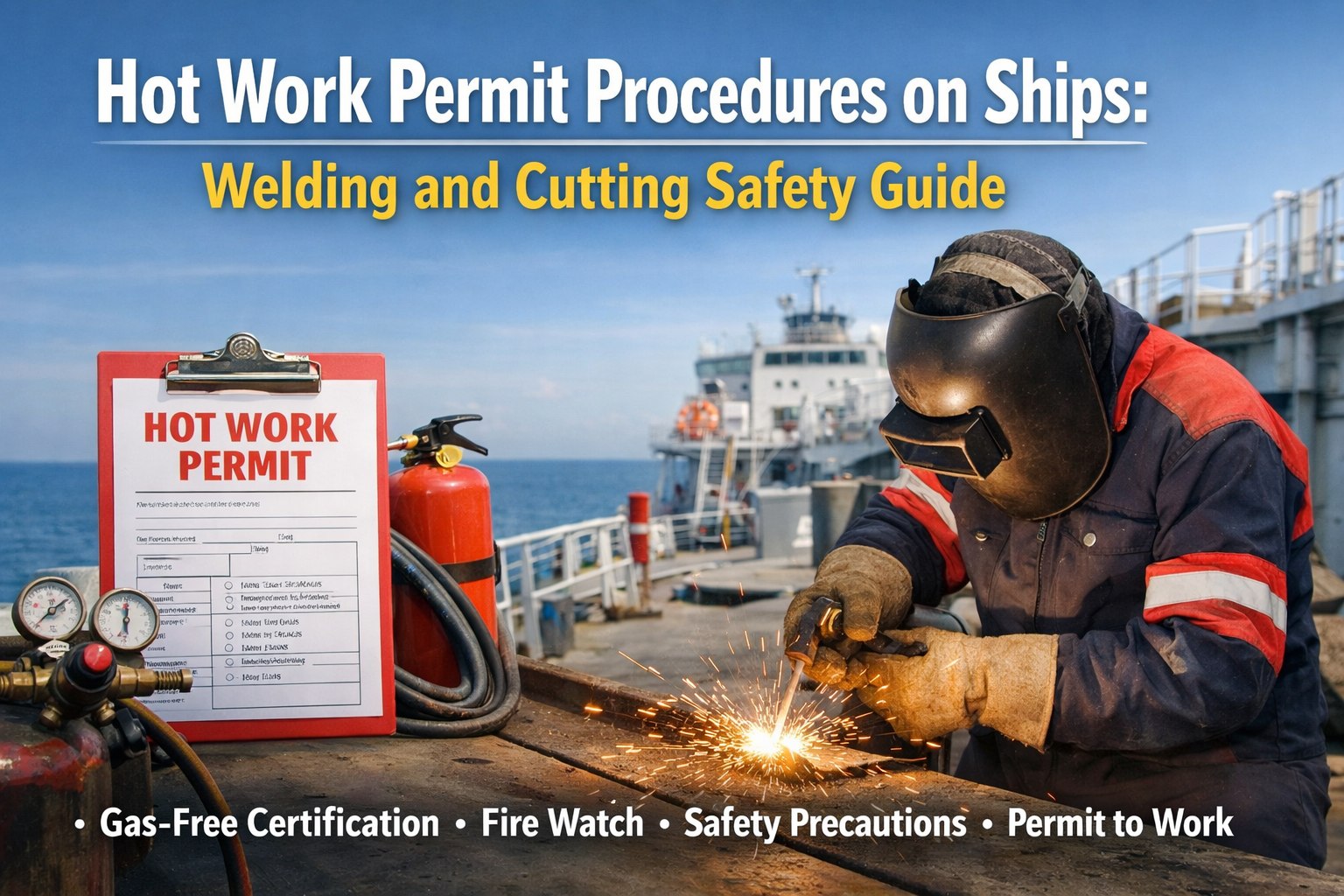
Hot Work Permit Procedures on Ships: Welding and Cutting Safety Guide
Hot work — welding, cutting, grinding, brazing, and any other operation that generates heat, sparks, or open flame — is among the activities most likely to produce fire on board a ship. According to marine insurer Gard's 2014-2024 claims data, hot work-related fires frequently occur in pump rooms, cargo tanks, holds, and machinery spaces, with nearly 60% of related insurance claims falling under Hull and Machinery insurance and 40% under P&I insurance covering cargo loss, personnel injuries, and third-party liabilities. The mechanism is consistently the same: sparks or heat from welding or cutting operations ignite flammable vapours, combustible residues, paint coatings, or materials on the opposite side of bulkheads and decks that nobody checked. The US Chemical Safety Board has found that a common feature of virtually all hot work accidents is the failure to recognise all the locations where a flammable atmosphere could be present — the absence of flammables needs to be verified before and during any hot work. The regulatory framework is established: the ISM Code requires Safety Management Systems with robust hot work controls; ISGOTT (International Safety Guide for Oil Tankers and Terminals) Chapter 9 addresses hot work procedures specifically; SOLAS Chapter II-2 covers fire protection; and NFPA 306 (Standard for the Control of Gas Hazards on Vessels) defines gas-free certification requirements. On tankers and chemical carriers, hot work within the cargo area is prohibited unless the process is strictly controlled under the ship's hot work procedures with gas-free certification. For safety officers and all crew, the hot work permit is not paperwork — it is the systematic barrier between a controlled repair and a catastrophic fire or explosion. To see how Marine Inspection digitalises hot work permits, gas testing records, and fire watch documentation across your fleet, book a Marine Inspection demo.
Why Hot Work Kills
Sparks travel up to 10 metres. Heat conducts through steel bulkheads and decks to ignite materials on the other side. Flammable vapours can accumulate in spaces that appear clean. A single unverified compartment becomes the ignition source.
60%H&M insurance claims from hot work fires (Gard 2014-2024)
No hot work outside the designated workshop is permitted without a written permit authorised by the Master. The permit is not a formality — it is the documented verification that every safety condition has been checked and confirmed. A permit must be issued immediately before work commences, has a limited time validity, and must be cancelled and reissued if conditions change.
Work Description: Exact location, type of hot work (welding, cutting, grinding), equipment to be used, estimated duration.
Authorisation: Master's signature confirming personal inspection of work area or delegation to Chief Engineer/Chief Officer with documented competency.
Atmosphere Test Results: O2, LEL, and toxic gas readings at work area and all adjacent/connected spaces. Instrument identification and calibration date. Tested by competent person.
Fire Precautions: Fire extinguishers positioned, fire hose laid out and pressurised, fire watch assigned (with no other duties), ventilation confirmed.
Area Preparation: Combustibles removed within 10-metre radius. Opposite sides of bulkheads/decks checked. Drain covers sealed. Cable/pipe penetrations protected.
Adjacent Space Checks: Spaces above, below, and on all sides inspected for flammable materials, fuel lines, hydraulic lines, thermal oil lines, and electrical cables.
Time Validity: Permit valid for specific time period only. If work is delayed, all safety measures must be rechecked before work commences. Re-testing required after any interruption.
Post-Work Fire Watch: Fire watch maintained for minimum 30-60 minutes after work completion to detect delayed ignition. Longer in spaces with insulation or hidden voids.
Atmosphere Testing: The Numbers That Mean Safe
Atmosphere Testing Requirements for Hot Work
Parameter
Safe Level for Hot Work
Where to Test
Testing Frequency
If Unsafe Level Detected
Oxygen (O2)
19.5% - 23.0%
Work area + all adjacent spaces at multiple levels
Before work, continuously during work, after any interruption
Ventilate until safe. O2 enrichment (>23%) = extreme fire risk — all materials highly flammable
Work area, adjacent tanks, void spaces, behind insulation, inside pipes being worked on
Continuously monitored during hot work. Readings logged at intervals.
STOP work. Ventilate. Identify source. Re-test. Do not resume until below threshold.
Carbon Monoxide (CO)
<25 ppm (8-hr TWA)
Confined/enclosed work areas
Before entry, during work
Increase ventilation. Check for incomplete combustion sources. Respiratory protection if sustained.
Hydrogen Sulfide (H2S)
<10 ppm (8-hr TWA)
Former cargo tanks, ballast tanks, sewage spaces
Before and during work in suspect areas
STOP work. Evacuate. Ventilate. Do not re-enter without SCBA until cleared.
Toxic Fumes (Welding)
Below occupational exposure limits per material
Work area — especially enclosed/confined spaces
Continuous monitoring where enclosure restricts ventilation
Increase local exhaust ventilation. Use respiratory protection. Limit exposure time.
Tankers/chemical carriers: hot work in cargo area requires gas-free certification per ISGOTT. Not more than 1% LFL in compartments. All adjacent spaces within 30m must be tested on liquefied gas tankers.
Fire Watch: The Person Who Prevents Disaster
The fire watch is not a passive observer — they are the active safety barrier between hot work and fire. Their sole duty during hot work is watching for fire. They must have no other duties while assigned as fire watch.
Before Hot Work
Familiar with alarm procedures for the area. Trained in use of fire extinguishing equipment provided. Briefed on specific hazards of the work location. Fire extinguishers verified present and functional. Fire hose laid out, charged, and tested.
During Hot Work
Positioned to observe sparks and falling slag. Monitors opposite side of bulkhead/deck where heat may transfer. Authority to stop work immediately if unsafe conditions develop. Maintains continuous communication with welder. No other duties permitted.
After Hot Work
Remains on station minimum 30-60 minutes after completion. Monitors for delayed ignition in insulation, behind panels, and in hidden voids. Does not leave until responsible officer confirms area safe. Reports any hotspots or smoke immediately.
Hot Work in Specific Locations: Different Risks, Different Rules
Engine Room Workshop
Designated Area
The dedicated hot work area. Standard fire precautions apply but formal permit may not be required for routine workshop operations. Welding equipment kept under lock and key when not in use. Fire extinguishers permanently stationed.
Engine Room (Outside Workshop)
Permit Required
Full permit required. Check fuel lines, hydraulic pipes, thermal oil lines, insulation, cable trays in the work area. Particular risk: fuel oil spray onto hot surfaces — lagging fires from dripping oil onto exhaust manifold insulation.
Cargo Holds / Tanks
Gas-Free Required
Gas-free certification by competent person or marine chemist. Previous cargo residues must be cleaned. Ventilation continuous throughout. Adjacent tanks tested. On tankers: ISGOTT procedures apply — not more than 1% LFL.
Ballast Tanks / Void Spaces
Enclosed Space + Permit
Enclosed space entry procedures first (per MSC.581(110)). Then hot work permit. Biological activity may have depleted O2 or generated H2S. Coatings may emit toxic fumes when heated. Continuous gas monitoring essential.
Open Deck
Permit Required
Wind can carry sparks long distances. Verify no flammable cargo or vapours in vicinity. On tankers: no hot work on open deck within cargo area unless gas-free. Port/terminal restrictions may apply when alongside.
Alongside Terminal
Terminal Approval Required
National, port, and terminal regulations apply in addition to ship procedures. Terminal must approve hot work. May be prohibited during cargo operations. ISGOTT Chapter 9 requirements for tankers at terminals.
How Marine Inspection Digitalises Hot Work Safety
Digital Hot Work Permits
Time-stamped permits with mandatory fields: atmosphere test results, fire watch assignment, adjacent space checks, Master authorisation. Auto-expire at validity end. Full audit trail for PSC and ISM verification.
Gas Testing Records
O2, LEL, CO, H2S readings captured with timestamp, location, instrument ID, and calibration date. Continuous monitoring logs during work. Calibration records for all gas detectors fleet-wide.
Fire Watch Documentation
Fire watch assignment records, post-work monitoring duration, incident reports. Competency verification for fire watch personnel. No-other-duties compliance tracking.
Welding Equipment Maintenance
Welding machine inspection records, cable condition, electrode holder checks, gas cylinder test dates, regulator service, earth clamp condition — all tracked per equipment item.
60% of Hot Work Claims Are Hull & Machinery Damage
A single hot work fire can cost millions in hull damage, cargo loss, and liability. Marine Inspection's digital permit system ensures every check is verified, every test is recorded, and every fire watch is documented — turning hot work from your highest-risk activity into a controlled operation.
Welding Helmet/Shield: Auto-darkening or fixed-shade lens protecting against arc radiation (UV and IR). Minimum shade 10-12 for arc welding. Face shield for grinding.
Fire-Resistant Clothing: Leather or treated cotton. No synthetic materials — polyester and nylon melt onto skin causing severe burns. Long sleeves, high collar, no cuffs that trap sparks.
Welding Gloves: Heavy-duty leather gauntlets for arc welding. Lighter leather for gas welding/cutting. Must resist heat conduction and spark penetration.
Safety Boots: Steel-toed, heat-resistant, high-cut. Trouser legs over boots — never tucked in (sparks collect in folds).
Respiratory Protection: Welding fume respirator for enclosed/poorly ventilated areas. SCBA for confined space welding. Local exhaust ventilation preferred over RPE.
Hearing Protection: Required during grinding, gouging, and other high-noise hot work operations.
Conclusion
Hot work is the shipboard activity where fire prevention depends entirely on procedural discipline — the permit system, atmosphere testing, fire watch, area preparation, and post-work monitoring are the barriers between a controlled repair and a catastrophic fire that Gard's 2014-2024 data shows accounts for 60% H&M and 40% P&I insurance claims. The Master's authorisation, competent person's atmosphere verification (O2 19.5-23%, LEL below 1% per ISGOTT), fire watch with no other duties, 10-metre combustible clearance, adjacent space inspection, and minimum 30-60 minute post-work monitoring form an unbroken chain — every link must hold. Location-specific procedures (engine room workshop, cargo tanks with gas-free certification, ballast tanks requiring enclosed space entry first, open deck with wind-carried spark risk, terminal alongside with port authority approval) add additional layers that the permit system must capture. The CSB's finding that virtually all hot work accidents share a failure to verify the absence of flammables in all locations where atmosphere could be present is the lesson that justifies every check on the permit. Marine Inspection provides the digital platform that turns hot work permits from paper vulnerability into systematic, auditable safety compliance — book a live demo today.
Frequently Asked Questions
FAQ 01
When is a hot work permit required on a ship?
A hot work permit is required for any welding, cutting, grinding, brazing, or other spark/flame-producing operation performed outside the designated engine room workshop. The workshop is the only location where hot work may proceed without a formal permit (though standard fire precautions still apply). Any other location on the vessel requires a written permit authorised by the Master or delegated responsible person who has personally inspected the work area. The permit must be issued immediately before work commences — not hours or days in advance. If work is delayed after permit issuance, all safety conditions must be rechecked before commencing. If conditions change during work (e.g., weather, cargo operations, adjacent space activity), work must stop and the permit must be cancelled until conditions are re-verified.
FAQ 02
What atmosphere levels must be verified before hot work?
Before hot work: oxygen must be between 19.5% and 23.0% (below 19.5% = asphyxiation risk; above 23% = extreme fire risk where clothing and materials become highly flammable). Flammable gases must be below 1% LEL per ISGOTT for tanker operations, or below 10% LEL per general OSHA standards. Toxic gases (CO below 25 ppm, H2S below 10 ppm) must be within exposure limits. Testing must be performed at multiple levels in the work space and in all adjacent and connected spaces. On tankers and chemical carriers, gas-free certification by a competent person or marine chemist is required before any hot work in or near cargo spaces. Continuous gas monitoring must be maintained throughout the entire duration of hot work.
FAQ 03
What are the fire watch duties and requirements?
The fire watch is a person assigned exclusively to monitor for fire during and after hot work — they must have no other duties while serving as fire watch. Requirements: trained in use of fire extinguishing equipment provided, familiar with alarm procedures for the area, briefed on specific hazards of the work location. During work: positioned to observe sparks and falling slag, monitors opposite side of bulkheads/decks for heat transfer, has authority to stop work immediately if unsafe conditions develop. After work: remains on station minimum 30-60 minutes (longer where insulation or hidden voids exist) monitoring for delayed ignition. Additional fire watches may be required on opposite sides of bulkheads, decks, or overheads subjected to heat.
FAQ 04
Can hot work be performed on tankers?
Hot work within the cargo area of tankers is prohibited unless strict ISGOTT procedures are followed: gas-free certification confirming all compartments within the work zone and adjacent areas show not more than 1% LFL. On liquefied gas tankers, all compartments including deck tanks within a 30-metre radius must be verified gas-free. Hot work is typically prohibited during cargo operations. When alongside a terminal, terminal approval is required in addition to the ship's hot work permit — national, port, and terminal regulations apply. The ISGOTT 6th Edition Chapter 9 provides comprehensive guidance on hot work procedures, electric welding equipment, management of contractors, and managing simultaneous operations on tankers at terminals.
FAQ 05
How should welding equipment be stored on board?
Welding extension cables and portable welding machines must be controlled items kept under lock and key in the engine room workshop locker when not in use — this prevents unauthorised hot work outside the designated workshop area. Only the Master can authorise release of equipment for hot work outside the workshop. Oxygen cylinders must be stored separated from fuel gas cylinders by minimum 6 metres (20 feet) or by a barrier with 30-minute fire resistance rating. Cylinders must be secured upright, valve caps in place when not in use, and stored away from heat sources and combustible materials. Regulators must be removed when equipment is not in use. Arc welding machines must be grounded. Electrode holders must have electrodes removed when unattended. All equipment must be inspected before use — equipment with defects must not be used.
Book Your Live Demo
Turn Hot Work From Your Highest Risk Into a Controlled Operation
30 minutes with our team. See how Marine Inspection delivers digital hot work permits, atmosphere testing records, fire watch documentation, and welding equipment maintenance tracking — the complete platform that makes every hot work operation auditable, compliant, and safe.