Shipboard Fire Fighting: Equipment, Procedures and SOLAS Requirements in 2026
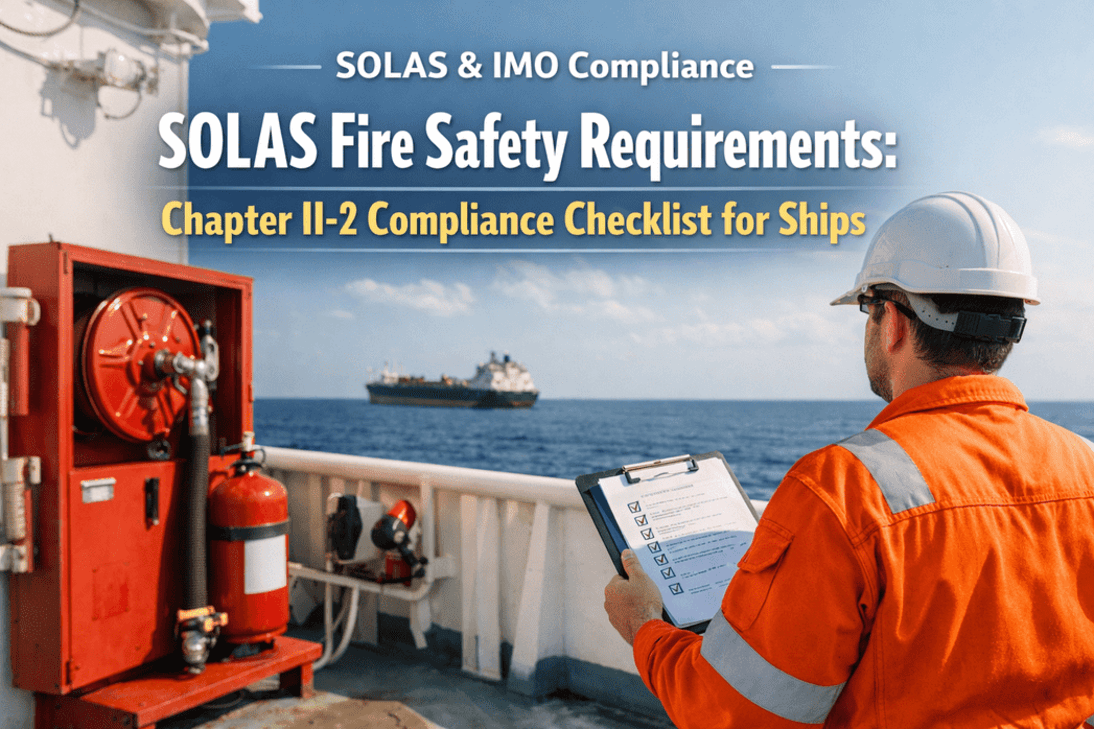
Fire is the most feared hazard at sea — and fire safety deficiencies are the single largest category of Port State Control findings globally. The Paris MoU's 2024 annual report shows fire safety deficiencies accounted for 17.2% of all PSC findings — the largest category by a significant margin, ahead of construction issues at 11.3% and safety management at approximately 10%. This means your vessel is more likely to be detained for fire safety non-compliance than for any other deficiency category. SOLAS Chapter II-2 contains 23 regulations organised into seven parts, covering structural fire protection, fire detection, fire suppression, means of escape, and crew training — supplemented by the International Fire Safety Systems (FSS) Code that specifies technical requirements for every fire system type. The 2026 amendments add critical new requirements: PFOS-containing firefighting foams are now banned (all ships must comply by first survey after January 1, 2026), individually addressable fire detectors are required in Ro-Ro/vehicle spaces on new ships, and fuel suppliers must declare flashpoint compliance on every Bunker Delivery Note. For safety officers and all crew, fire fighting competency is not a training tick-box — it is the operational skill that determines whether a shipboard fire becomes an incident report or a casualty investigation. Portable extinguishers last only 8-10 seconds; engine room temperatures can exceed 93°C within minutes; toxic vapours from burning synthetic materials can incapacitate in seconds without breathing apparatus. The difference between controlled response and catastrophe is training, equipment readiness, and the systematic maintenance discipline that ensures every fire system works when it is needed. To see how Marine Inspection digitalises fire safety equipment maintenance, drill records, and SOLAS compliance across your fleet, book a Marine Inspection demo.
17.2%
of all PSC findings are fire safety deficiencies — the single largest category globally (Paris MoU 2024)
23 regulations in SOLAS Chapter II-2
Monthly fire drills required for all crew
2026 PFOS foam ban effective at first survey
8-10 sec portable extinguisher discharge time
Fire Classes on Ships: Know What You're Fighting
Using the wrong extinguishing agent on the wrong fire class doesn't just fail to control the fire — it can make it dramatically worse. Water on a Class B oil fire causes violent splattering that spreads the fire. Water on a Class C electrical fire creates electrocution risk. Every crew member must know the fire classes present in their working area. Book a Marine Inspection demo to see how the platform maps fire risks by compartment with equipment type and extinguisher placement.
Class A
Ordinary Combustibles
Wood, paper, fabric, rubber, some plastics, furnishings, bedding
Accommodation, stores, galley, cargo (general)
Water, foam, DCP (dry chemical powder)
Will re-ignite if not completely cooled — overhaul after knockdown
Weekly function test of sample detectors; annual test of all detectors; quarterly panel function test
Fire Dampers
Passive
Ventilation ductwork at fire boundaries
Automatic closure (fusible link or remote control) prevents fire spread through ventilation system.
Monthly operation test; annual inspection with reset verification; fusible link replacement per schedule
2026 update: All firefighting foams containing PFOS are banned under SOLAS II-2 amendments. New ships must comply from January 1, 2026; existing ships by first survey after that date.
Fireman's Outfit and Breathing Apparatus
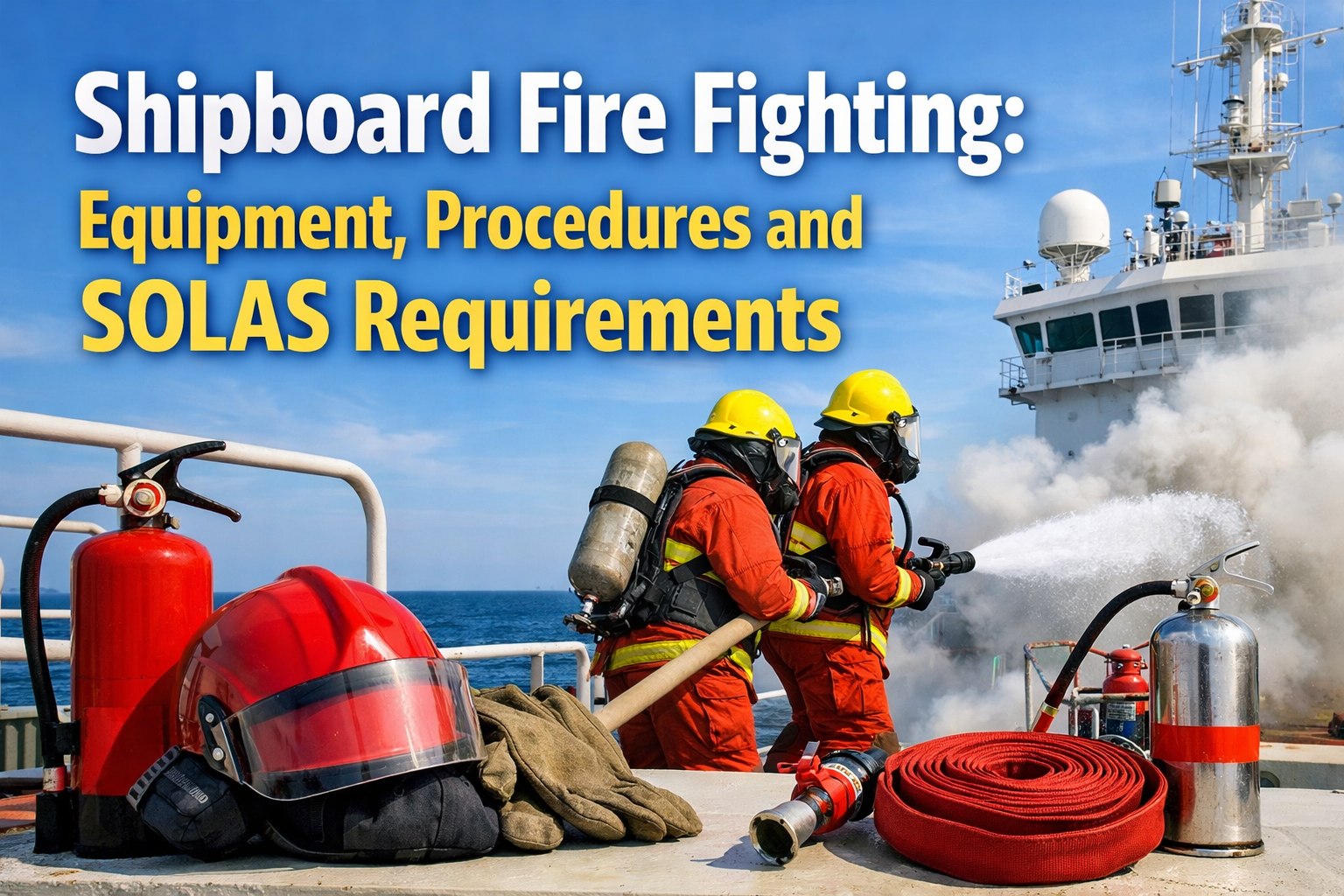
The fireman's outfit is the personal protection that enables trained crew to enter burning or smoke-filled compartments. SOLAS requires minimum 2 fireman's outfits on cargo ships and 4 on passenger ships. Every component must be inspected monthly and maintained ready for instant deployment.
Fire-Resistant Suit: Outer suit protecting against heat and flame. Monthly inspection for integrity, seam condition, reflective strip visibility. Must not restrict movement.
SCBA (Self-Contained Breathing Apparatus): Air cylinder providing minimum 30 minutes breathing air. Face mask, demand valve, pressure gauge. Annual cylinder hydrostatic test. Air quality testing. Monthly function check.
Fire Boots: Steel-toed, heat-resistant boots with non-slip soles. Inspected for sole integrity and upper condition.
Helmet with Visor: Impact and heat protection. Visor provides face protection from radiant heat and debris.
Fireproof Lifeline & Belt: Safety line connecting firefighter to backup person outside the fire zone. Minimum 30m length. Belt with attachment point.
Fireproof Gloves: Heat-resistant gloves allowing manual dexterity for equipment operation.
EEBD (Emergency Escape Breathing Device): Short-term breathing protection for escape from smoke-filled spaces. Located at visible, accessible positions per FSS Code. Not for firefighting — escape only.
Explosion-Proof Lamp: Approved portable lamp for use in potentially explosive atmospheres. Battery condition checked monthly.
Fire Drill Requirements: What SOLAS Demands
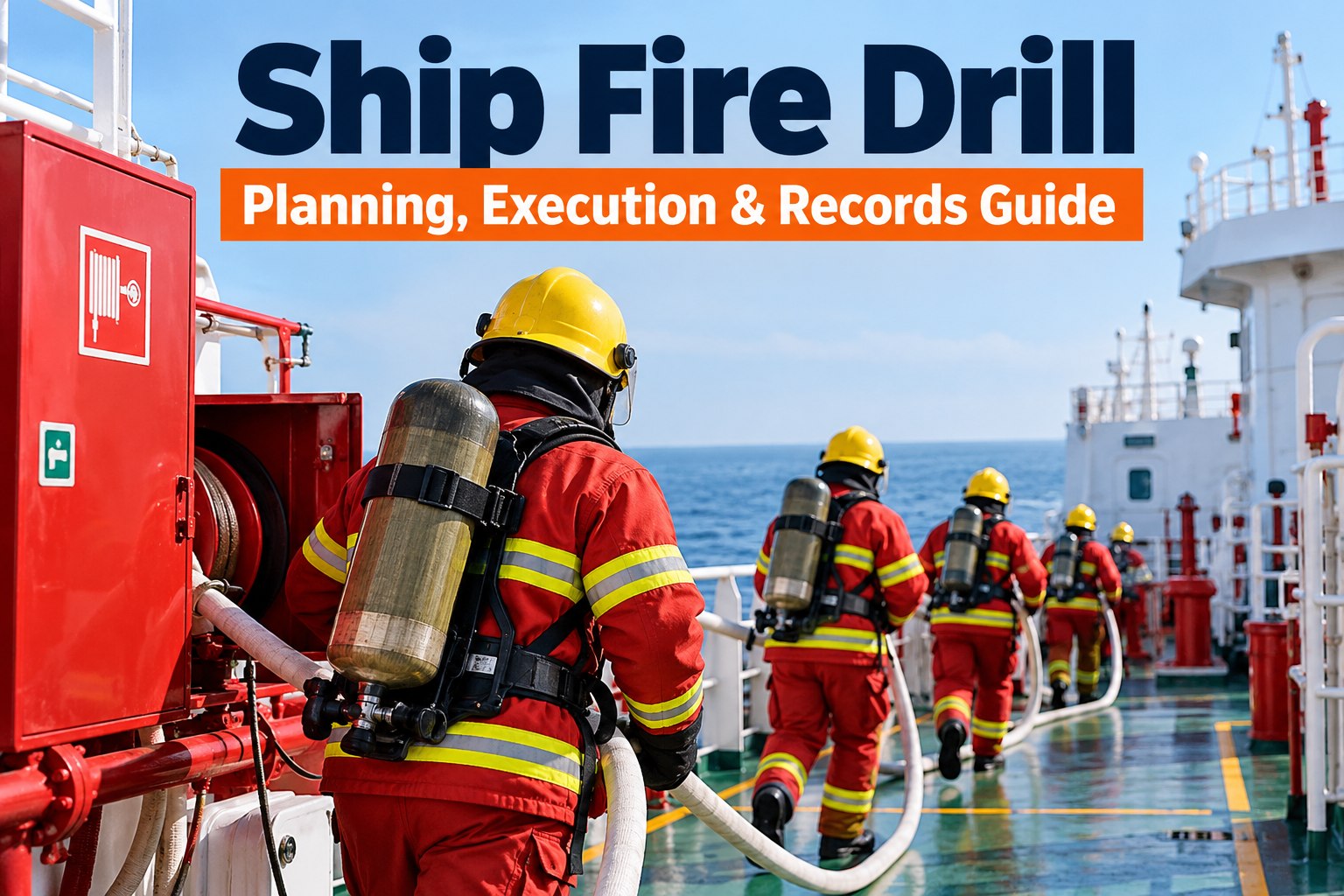
SOLAS mandates fire drills at least once per month, with each crew member participating in at least one drill per month. On passenger ships with more than 25% new crew, a drill must occur within 24 hours of leaving port. Drill records — including date, scenario, equipment used, and participants — must be maintained for PSC verification. Sign up for Marine Inspection to automate fire drill scheduling and capture participation records.
Muster & Communication
All crew report to assigned muster stations. Verify muster list complete and current. Test internal communication between bridge, engine room, and fire stations. Public address system test.
Equipment Deployment
Don fireman's outfit including SCBA. Deploy fire hoses to fire scene. Connect hoses to hydrants. Test fire pump operation under drill conditions. Demonstrate correct extinguisher selection and use.
Scenario Response
Simulate realistic fire scenario (engine room, galley, accommodation, cargo). Practice boundary cooling, ventilation control (fire damper closure), smoke containment, search and rescue of missing crew.
Fixed System Activation (Simulated)
Walk through CO2 or foam system activation procedure without actual release. Verify crew knowledge of pre-release checks (all personnel evacuated, ventilation closed, alarm sounded).
Debrief & Documentation
Post-drill debrief identifying strengths and areas for improvement. Record date, type of drill, scenario, equipment used, participants, and observations. Corrective actions for deficiencies identified.
Varied Locations
SOLAS requires drills in different locations throughout the vessel — not the same space every month. PSC officers check drill records for scenario variety and location rotation.
How Marine Inspection Transforms Fire Safety Compliance
Equipment Maintenance Tracking
Every fire extinguisher, SCBA cylinder, fire hose, detector, and fixed system component tracked with service dates, hydrostatic test expiry, and automated renewal alerts.
Fire Drill Scheduling & Records
Monthly drill scheduling with scenario rotation, participation tracking by crew member, debrief capture, and corrective action follow-up. PSC-ready drill evidence.
Shore Service Certificates
CO2 system inspection certificates, SCBA air quality certificates, extinguisher service tags — all stored digitally with expiry alerts. No more scrambling during PSC.
PFOS Foam Phase-Out Tracking
Track foam concentrate types, manufacturer PFOS compliance certificates, replacement scheduling for legacy foam, and disposal documentation per environmental regulations.
Fire Detection System Testing
Weekly/annual detector test records, panel function test logs, alarm system verification, and fire damper operation test documentation — all captured systematically.
Crew Training Records
Fire fighting training certificates, STCW basic and advanced fire fighting, equipment-specific familiarisation, and competency verification — all accessible during ISM audits.
Fire Safety Is the #1 PSC Finding
See How Marine Inspection Protects Your Fleet
With 17.2% of all PSC findings in fire safety, systematic digital fire equipment maintenance isn't optional — it's the difference between clean inspections and detention. Book a 30-minute demo to see drill records, equipment tracking, and PFOS phase-out management across your fleet.
Engine Room Fire: The Most Common Shipboard Fire Scenario
Engine room fires account for the majority of serious shipboard fire incidents — concentrated fuel sources, hot surfaces, electrical equipment, and oil mist create an environment where fires start fast and escalate faster. Temperature in an enclosed engine room fire can exceed 93°C within minutes and build to over 427°C rapidly.
1Sound the alarm. Activate fire alarm immediately. Do not attempt to assess the fire alone before alerting crew.
2Stop ventilation. Close fire dampers to engine room ventilation. Deny oxygen to the fire. Emergency ventilation stop from bridge or fire control station.
3Shut fuel supply. Close quick-closing fuel valves from outside the engine room (remote-operated). Cut fuel to the fire source.
4Fight or contain. If small and accessible, attack with portable extinguishers (CO2 or DCP for Class B/C). If large or escalating, evacuate engine room and prepare for fixed system release.
5Boundary cooling. Apply water to surrounding bulkheads to prevent fire spread to adjacent compartments. Monitor temperatures of fire boundaries.
6Fixed system release (if required). Confirm ALL personnel evacuated from protected space. Sound CO2 alarm. Close all openings. Release CO2 from the CO2 room (never enter without designated person present).
7Monitor and maintain. Maintain boundary cooling. Do not re-enter until space has cooled and been ventilated. CO2 spaces require gas testing before entry.
Conclusion
Shipboard fire fighting is the safety discipline where PSC finds more deficiencies than any other category — 17.2% of all findings globally. SOLAS Chapter II-2's 23 regulations, supplemented by the FSS Code, define comprehensive requirements across structural fire protection, detection, suppression (fixed CO2, foam, water mist, sprinkler systems), portable equipment, means of escape, and crew training. The 2026 amendments add PFOS foam bans, enhanced Ro-Ro detection requirements, and fuel flashpoint declaration mandates. Fire classes (A through D) require different extinguishing agents — wrong agent on wrong fire makes the situation worse. Engine room fires, the most common serious scenario, require immediate alarm, ventilation closure, fuel isolation, and escalation to fixed system release if initial attack fails. Monthly fire drills with varied scenarios and locations, systematic equipment maintenance (extinguisher servicing, SCBA testing, detector function tests, fire pump verification), and documented crew training form the operational discipline that PSC inspectors verify and that saves lives when fires occur. Marine Inspection provides the digital platform that turns fire safety from paper-based vulnerability into systematic compliance — book a live demo today.
Frequently Asked Questions
FAQ 01
How often must fire drills be conducted under SOLAS?
Fire drills must be conducted at least once per month. Each crew member must participate in at least one fire drill per month. On passenger ships, a fire drill must take place within 24 hours of leaving port if more than 25% of crew have not participated in a drill in the previous month. Drill records must include date, type of drill, scenario, equipment used, location, and participants. PSC officers verify that drills are conducted in different locations throughout the vessel — not the same scenario repeated monthly. The drill must include realistic scenario response, equipment deployment (fireman's outfit, SCBA, hoses, extinguishers), communication between bridge and fire stations, and simulated fixed system activation procedures.
FAQ 02
What fire extinguisher types are required on ships?
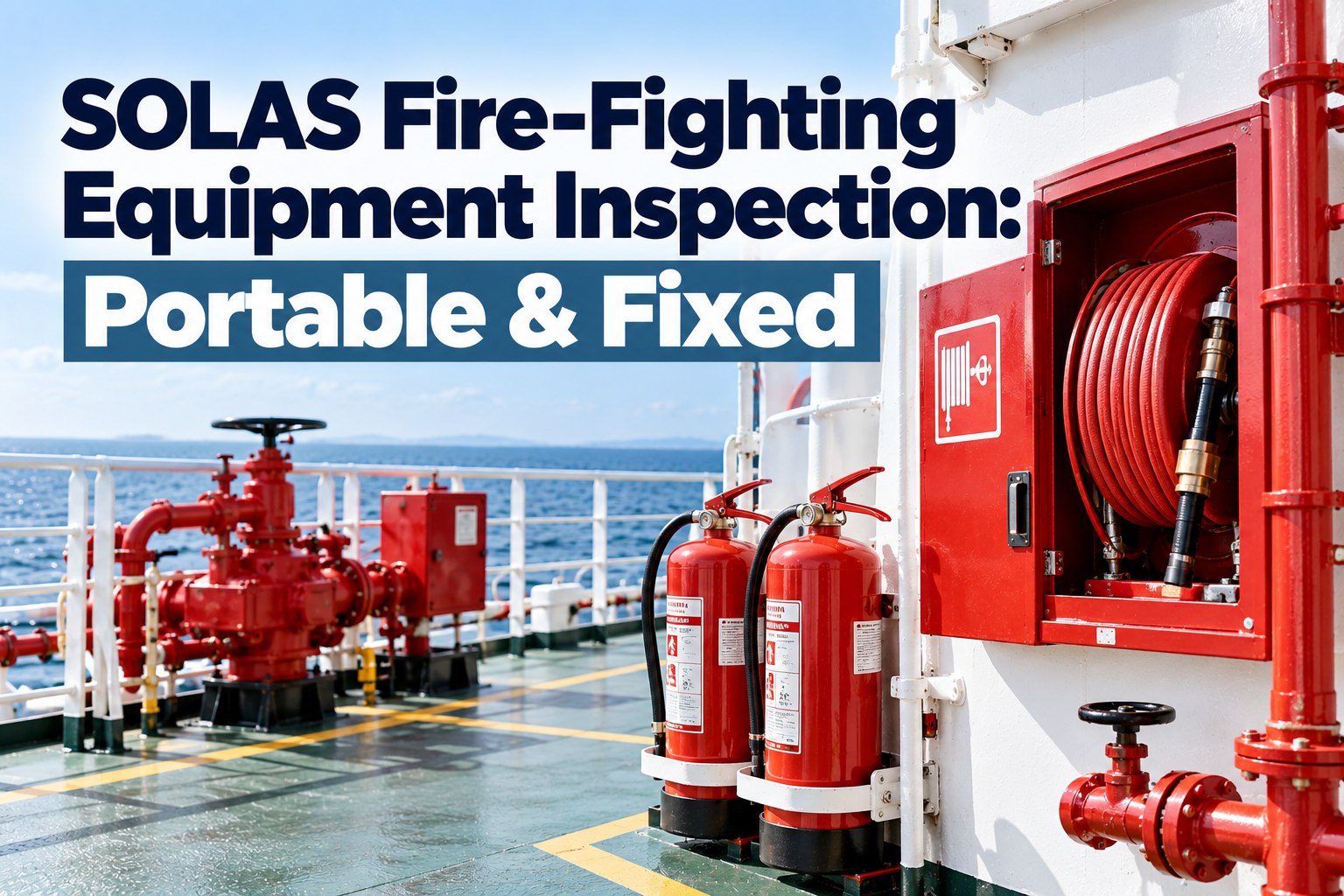
Ships require multiple extinguisher types matched to fire risks by compartment: CO2 extinguishers for Class B (flammable liquid) and Class C (electrical) fires — primary choice for engine room and switchboard areas. Dry Chemical Powder (DCP) for multi-class (A, B, C) fires — versatile but leaves residue that can damage sensitive equipment. Foam extinguishers for Class A and B fires — effective on liquid surface fires. Water extinguishers for Class A fires only — accommodation and general areas. Minimum quantities are based on vessel size and space type per SOLAS II-2. Extinguishers must be serviced annually with tag, hydrostatic tested every 10 years, and spare charges maintained onboard: 100% of total CO2 charges and 50% of other types.
FAQ 03
What is the PFOS foam ban and when must ships comply?
All firefighting foams containing PFOS (Perfluorooctane Sulfonate) are banned for use and storage onboard under SOLAS II-2 amendments. New ships must comply from January 1, 2026. Existing ships must replace PFOS-based foam by their first survey after that date. Operators must obtain manufacturer certification confirming PFOS content is below permitted thresholds and dispose of legacy foam per environmental regulations. PFOS is a persistent organic pollutant that bioaccumulates in the environment — the maritime ban aligns with the Stockholm Convention restrictions on PFOS. Replacement foam concentrates (fluorine-free or low-PFOS alternatives) must be verified compatible with existing proportioning systems and tested to confirm firefighting performance meets required standards.
FAQ 04
How is a fixed CO2 system maintained?
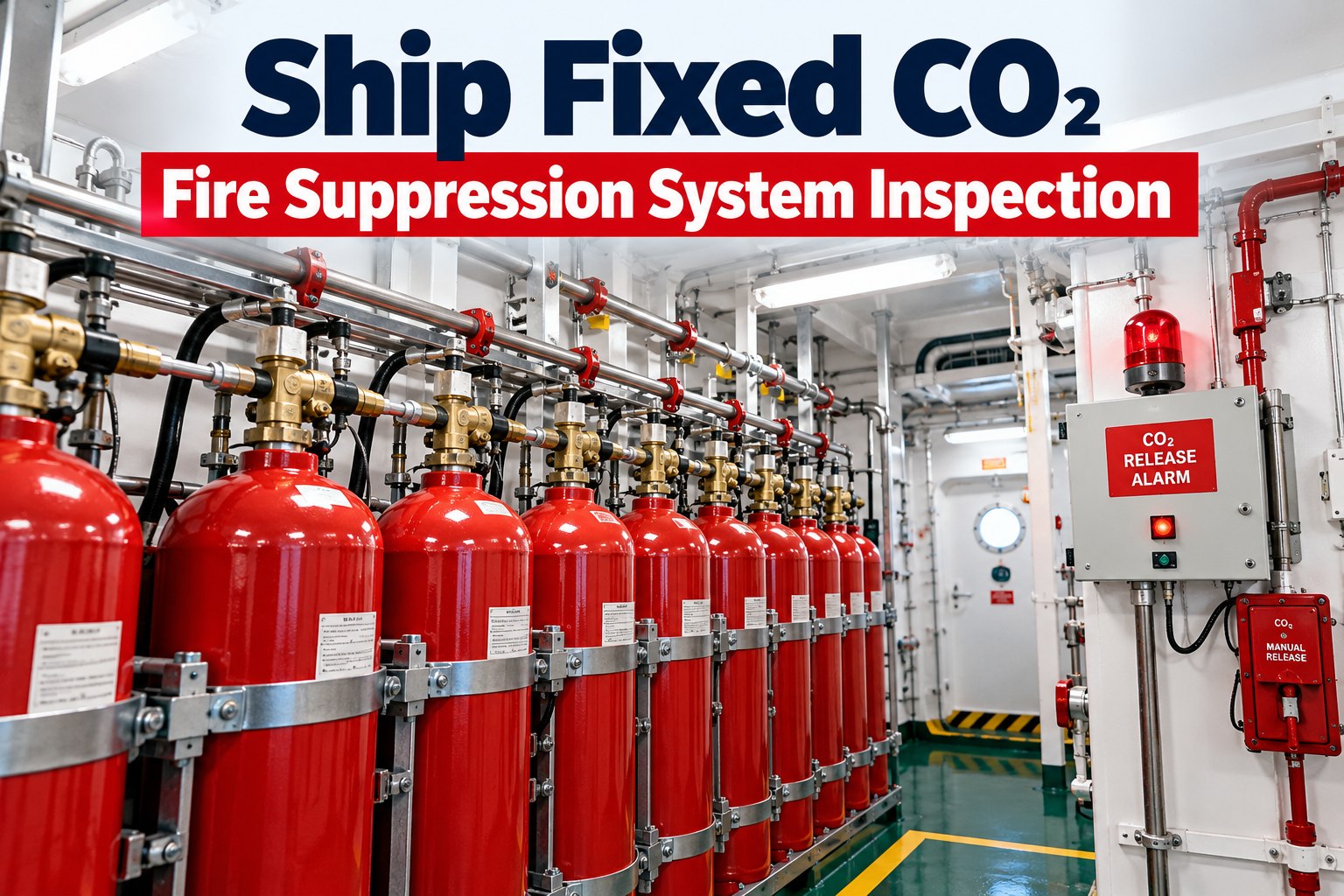
CO2 fixed fire extinguishing system maintenance per MSC.1/Circ.1318 includes: Annual — weigh all CO2 cylinders (must maintain minimum charge weight); check manifold pressure gauges; inspect all discharge piping and nozzles for obstruction; test release mechanism function; verify alarm system operation; inspect access to CO2 room. 2-year — pilot bottle pressure check and replacement if below specification. 5-year — system function test (without discharge) including all control heads, valves, and alarms. 10-year — hydrostatic pressure test of all cylinders. Monthly — verify CO2 room access clear and door secured open; check seals intact on release controls; verify no unauthorized modifications. The CO2 room must never be entered without a designated crewmember responsible for system maintenance present.
FAQ 05
What personal fire fighting equipment is required on ships?
SOLAS requires minimum 2 complete fireman's outfits on cargo ships and 4 on passenger ships. Each outfit includes: fire-resistant outer suit (inspected monthly for integrity, seam condition, reflective strips), SCBA with minimum 30-minute air supply (annual cylinder hydrostatic test, air quality testing), fire-resistant helmet with visor, fire boots (steel-toed, heat-resistant, non-slip), fireproof gloves, fireproof lifeline with belt (minimum 30m), and explosion-proof portable lamp. Additionally, Emergency Escape Breathing Devices (EEBDs) must be placed at easily visible positions throughout machinery spaces per FSS Code — EEBDs are for escape only, not firefighting. SCBA spare cylinders must be maintained onboard with air quality certified.
Book Your Live Demo
Eliminate Fire Safety as Your #1 PSC Risk
17.2% of all PSC findings are fire safety deficiencies. Marine Inspection systematically tracks every fire extinguisher, SCBA cylinder, fixed system inspection, drill record, and crew training certificate across your fleet — eliminating the documentation gaps that trigger detention.