Abandon Ship Procedure: Emergency Evacuation and Lifeboat Launch Guide
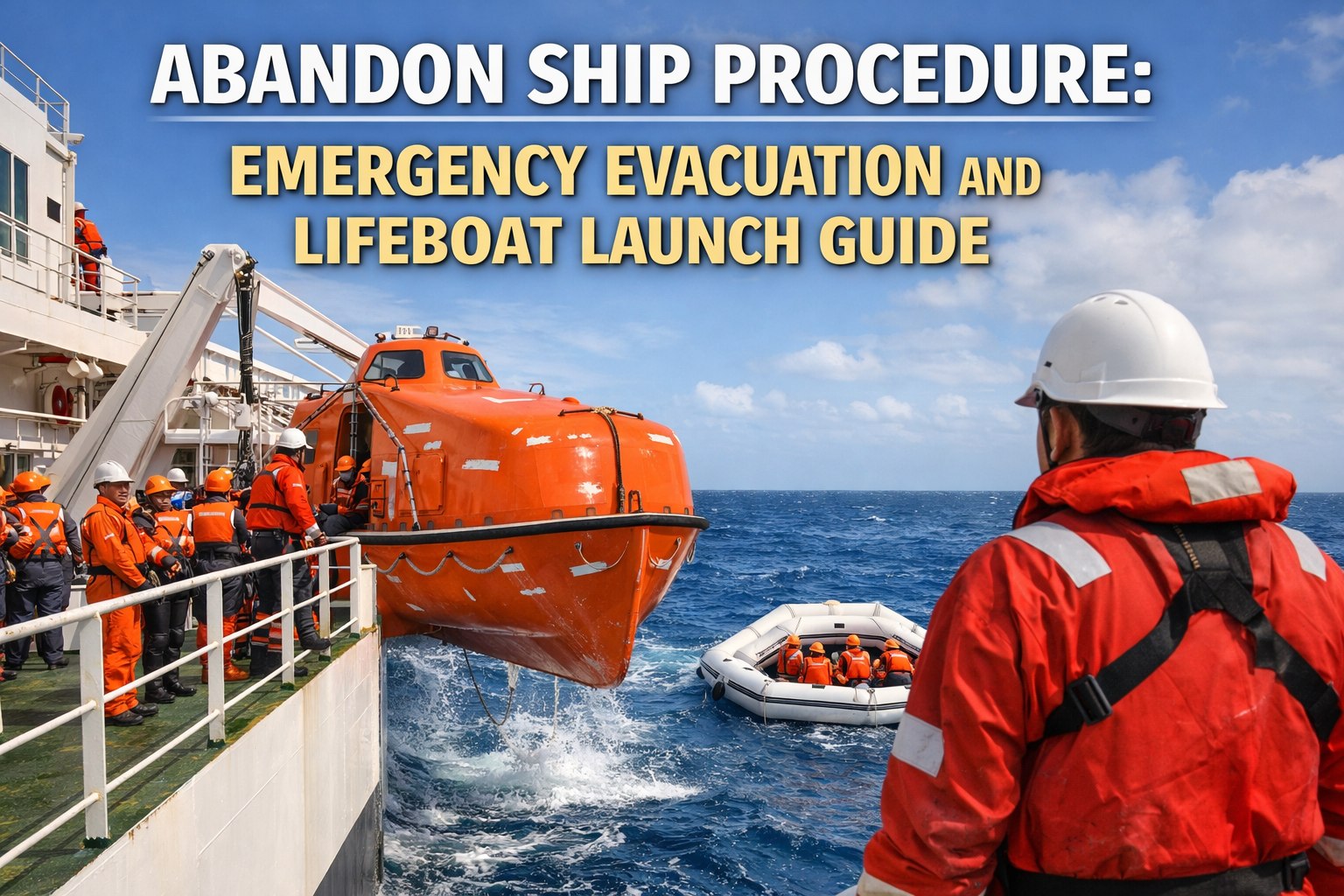
The abandon ship order is the last decision a Master will ever make for a vessel — and the most consequential. Once given, there is no going back: every person on board must transition from the relative safety of a steel hull to survival craft in open water within minutes, often in darkness, heavy weather, or both. SOLAS Chapter III defines this moment with unforgiving precision: cargo ships must be capable of launching all survival craft within 3 minutes of the order; passenger ships within 10 minutes. These are not aspirational targets — they are the design parameters against which every lifeboat davit, every muster station layout, and every crew drill is measured. The Paris MoU reports that life-saving appliance (LSA) deficiencies — including non-functional lifeboats, improperly trained personnel, and expired liferaft servicing — rank among the top five reasons for ship detentions globally. For safety officers and all crew, abandon ship preparedness is the most critical safety competency on any vessel: knowing your muster station, your assigned survival craft, your duties on the muster list, how to don a lifejacket and immersion suit, how to launch a lifeboat, how to deploy a liferaft, and how to activate EPIRB, SART, and VHF for rescue coordination. The difference between survival and tragedy has historically been the quality of training, the regularity of drills, and the systematic readiness of equipment. To see how Marine Inspection digitalises abandon ship drill records, LSA equipment maintenance, muster list management, and SOLAS survival craft compliance across your fleet, book a Marine Inspection demo.
The Abandon Ship Signal
7 short blasts + 1 prolonged blast on the ship's whistle and general alarm, followed by announcement via PA system with clear instructions on muster stations and abandonment method.
3 minCargo ship launch time requirement
10 minPassenger ship launch time requirement
MonthlyAbandon ship drill frequency (SOLAS)
3 monthsLifeboat launch and manoeuvre interval
The Abandon Ship Sequence: From Decision to Departure
Abandonment follows a strict sequence. Each step has a specific purpose and a specific person responsible. Skipping steps or executing them out of order creates the chaos that kills in real emergencies.
Phase 1 — Decision
1Master's Decision: The Master makes the final call to abandon after exhausting all options to save the vessel. This is the most critical decision — abandoning too early risks unnecessary danger in survival craft; too late risks going down with the ship.
2Distress Communication: Before leaving the vessel, the bridge team sends Mayday on VHF Ch.16, activates DSC distress alert on GMDSS MF/HF/VHF, activates EPIRB (if not already deployed), sets SART to active mode. These steps ensure SAR coordination even if ship loses power.
Phase 2 — Muster
3General Alarm + PA Announcement: 7 short + 1 prolonged blast. PA announcement specifies muster stations and abandonment method (lifeboat, liferaft, or direct rescue).
4Crew and Passengers to Muster Stations: Everyone proceeds to assigned muster station via marked escape routes. Don lifejacket. Don immersion suit if ordered (cold water operations). Carry warm clothing.
5Headcount and Verification: Muster station officer checks names against muster list. Missing persons reported immediately to Master. Search decision made based on time and danger.
Phase 3 — Preparation
6Chief Engineer Secures Engine Room: Shuts down machinery, isolates fuel lines, reports status to Master. Reduces explosion and fire risk during final evacuation.
7Survival Craft Preparation: Lifeboat cover removed. Engine started and warming up. Davit lowered to embarkation deck. Liferaft cradles prepared for launch. Collect critical items: GMDSS portable radios, SART, flares, ship's documents.
Phase 4 — Embarkation & Launch
8Ordered Boarding: Crew board assigned survival craft. Assist with seating and safety belt securing. Distribute thermal protection. Stability and proper loading are critical — rushing endangers everyone.
9Launch: Lifeboat lowered by davit to water level. Release hooks when waterborne. Cut painter line. Start engine and move clear of vessel. Liferafts inflated and boarded via embarkation ladder or thrown overboard.
10Master Last to Leave: Master verifies all persons accounted for, then departs as last person. Maintains command until rescue coordination transferred to SAR authorities.
Survival Craft: Types and Launch Methods
Survival Craft Types, Capacities & Equipment
Craft Type
Launch Method
Typical Capacity
Key Equipment Carried
Maintenance Requirements
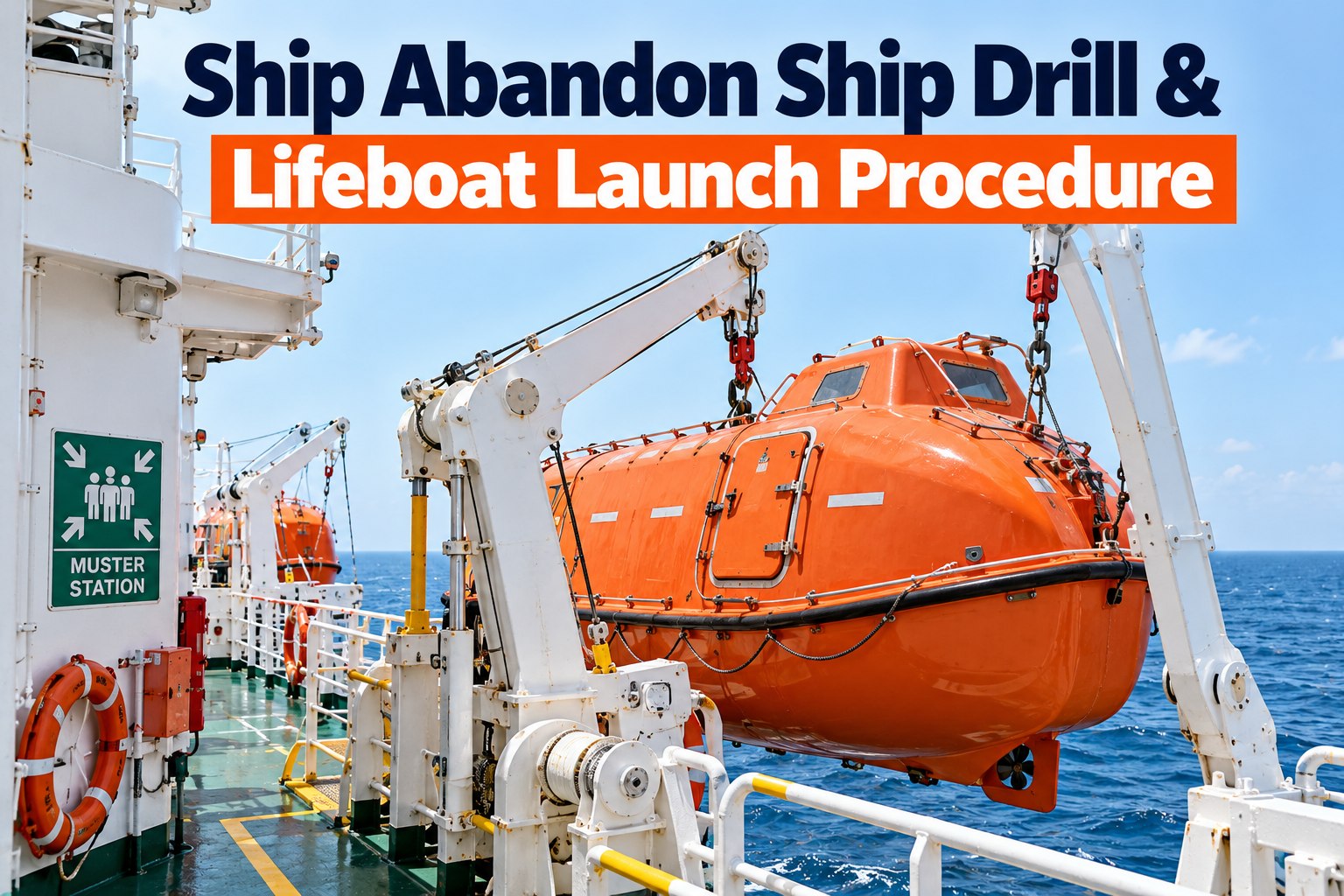
Gravity Davit Lifeboat
Gravity davit lowering; on-load release at water
Up to 150 persons
Diesel engine, oars, water (3L/person), food (10,000 kJ/person), flares, SART, VHF, first aid, sea anchor, bailer
Monthly lowering; quarterly launch with crew and manoeuvre in water; annual davit service; 5-year release hook overhaul
Free-Fall Lifeboat
Free-fall launch from stern ramp at height 1.3× certification height
Typically 20-60 persons
Same as gravity plus harness seats; no rigid lifejackets worn during launch (use inflatable or carry separately)
Monthly boarding/seating drill; quarterly boarding + procedure up to but not including release; 6-monthly free-fall launch
Inflatable Liferaft (Throw-Over)
Throw-overboard; inflate via painter line; board via ladder or jump
Annual service at approved station (max 17-month extension); HRU expiry checked monthly; painter condition
Davit-Launched Liferaft
Hoisted by davit and lowered to water; inflate before or during lowering
25-50 persons typical
Same as throw-over liferaft equipment; davit-compatible hook arrangement
Annual service; quarterly inflation and lowering training (if practicable); davit service per manufacturer
Rescue Boat
Davit launch; typically starboard lifeboat doubles as rescue boat
6+ persons (minimum)
Engine, tow line, searchlight, VHF, first aid, boarding equipment for person in water recovery
Monthly launch and manoeuvre with assigned crew; quarterly at minimum; engine service per PMS
HRU (Hydrostatic Release Unit): auto-releases liferaft if vessel sinks to ~4m depth. An expired HRU makes the raft non-compliant regardless of raft service date. PSC checks both dates independently.
EPIRB, SART, and Emergency Communications
Survival after abandonment depends on rescue — and rescue depends on search and rescue authorities knowing your position. Three systems work together to ensure you are found.
EPIRB
Emergency Position Indicating Radio Beacon
Transmits distress signal to COSPAS-SARSAT satellites with vessel identity and GPS position. Activates automatically via HRU when submerged, or manually. Battery life minimum 48 hours. Position accuracy within 100m with GPS. Registration must be current with MMSI, vessel name, and emergency contacts.
SART
Search and Rescue Transponder
Radar transponder that responds to 9 GHz X-band radar pulses from rescue ships and aircraft. Creates distinctive pattern of 12 blips on rescuer's radar screen, guiding them to your position. Battery life minimum 96 hours standby + 8 hours active. Mount as high as possible on survival craft.
VHF Portable
GMDSS Handheld Radio
Two-way voice communication on VHF Ch.16 (distress) with rescue ships and aircraft. Minimum 2 portable VHF radios required per SOLAS. Waterproof. Battery life minimum 8 hours. Taken to survival craft during abandonment. Essential for real-time coordination with SAR.
Immersion Suits and Personal Survival Equipment
Cold water kills faster than drowning. An unprotected person in water below 15°C loses consciousness within 15-45 minutes; in water below 5°C, survival time can be under 15 minutes. Immersion suits extend survival time by hours through thermal insulation and buoyancy. SOLAS requires immersion suits for every person on board in cold-water operating areas.
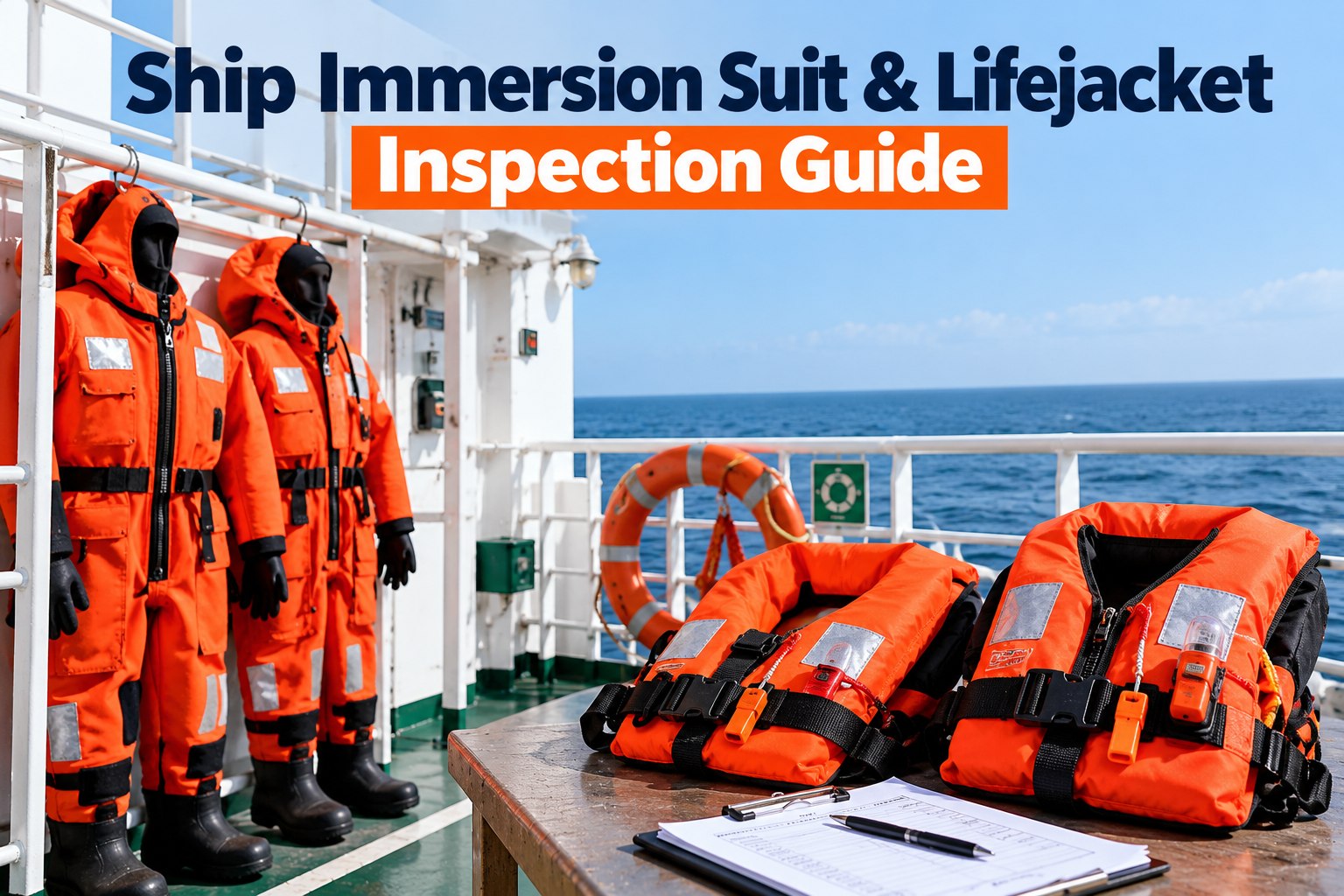
Immersion Suit: Thermal protective suit covering entire body except face. Waterproof. Provides buoyancy. Donning time must not exceed 2 minutes without assistance. Stored at muster station or cabin. Monthly inspection for seal integrity, zipper function, and buoyancy.
Lifejacket: SOLAS-approved personal flotation device. Must support head above water with face clear even if unconscious. Light and whistle attached. Located at muster station and cabin. Monthly inspection; annual service if inflatable type.
Thermal Protective Aid (TPA): Waterproof bag providing protection against heat loss for survivors not wearing immersion suits. Carried in survival craft. Used for injured or hypothermic survivors.
Pyrotechnic Signals: Rocket parachute flares (visible at 25 nautical miles), hand flares, buoyant smoke signals (daytime). Carried in survival craft and on bridge. Expiry dates checked monthly — expired pyrotechnics are non-compliant.
Every Life Depends on Equipment Readiness
See How Marine Inspection Tracks LSA Compliance
Liferaft service dates, HRU expiry, EPIRB registration, pyrotechnic expiry, immersion suit inspections, drill records — all tracked with automated alerts across your fleet. Never miss a compliance date.
SOLAS Chapter III Regulation 19 defines drill requirements in precise detail. Drills must be realistic — not a casual walk-through — because the skill they build is the skill that determines survival in a real emergency.
Frequency: At least one abandon ship drill per month for all crew. Additional drill required when more than 25% of crew are new (passenger ships: within 24 hours of departure).
Alarm: Summoning by general alarm (7 short + 1 prolonged) followed by PA announcement — exactly as in a real emergency.
Muster: Report to muster stations. Check passengers/crew suitably dressed. Verify lifejackets correctly donned. Headcount verification against muster list.
Lowering (Monthly): At least one lifeboat lowered to embarkation position after necessary preparation. Different lifeboats at successive drills (rotation).
Launch (Quarterly): Each lifeboat launched with assigned operating crew aboard and manoeuvred in water at least every 3 months. Rescue boat launched monthly with crew and manoeuvred.
Free-Fall (Quarterly): Crew board free-fall lifeboat, properly secure in seats, commence launch procedure up to but not including actual release. Actual free-fall launch every 6 months.
Liferaft: Davit-launched liferaft training including inflation and lowering at intervals not exceeding 4 months where practicable. Special training liferafts may be used (not part of ship's LSA).
Search & Rescue: Drill should include mock search for passengers/crew trapped in staterooms. Instruction in use of radio lifesaving appliances (EPIRB, SART, VHF).
Documentation: Date, type of drill, scenario, lifeboats launched/lowered, crew participation. Records verified by PSC and class surveyors. Book a demo to see digital drill record management.
How Marine Inspection Digitalises Abandon Ship Readiness
Drill Scheduling & Records
Monthly abandon ship drills scheduled automatically. Participation tracked per crew member. Quarterly launch records maintained with lifeboat rotation. PSC-ready evidence.
LSA Equipment Expiry Tracking
Liferaft service dates, HRU expiry, EPIRB battery and registration, pyrotechnic expiry dates, SCBA cylinder tests — all tracked with automated alerts before deadlines.
Muster List Management
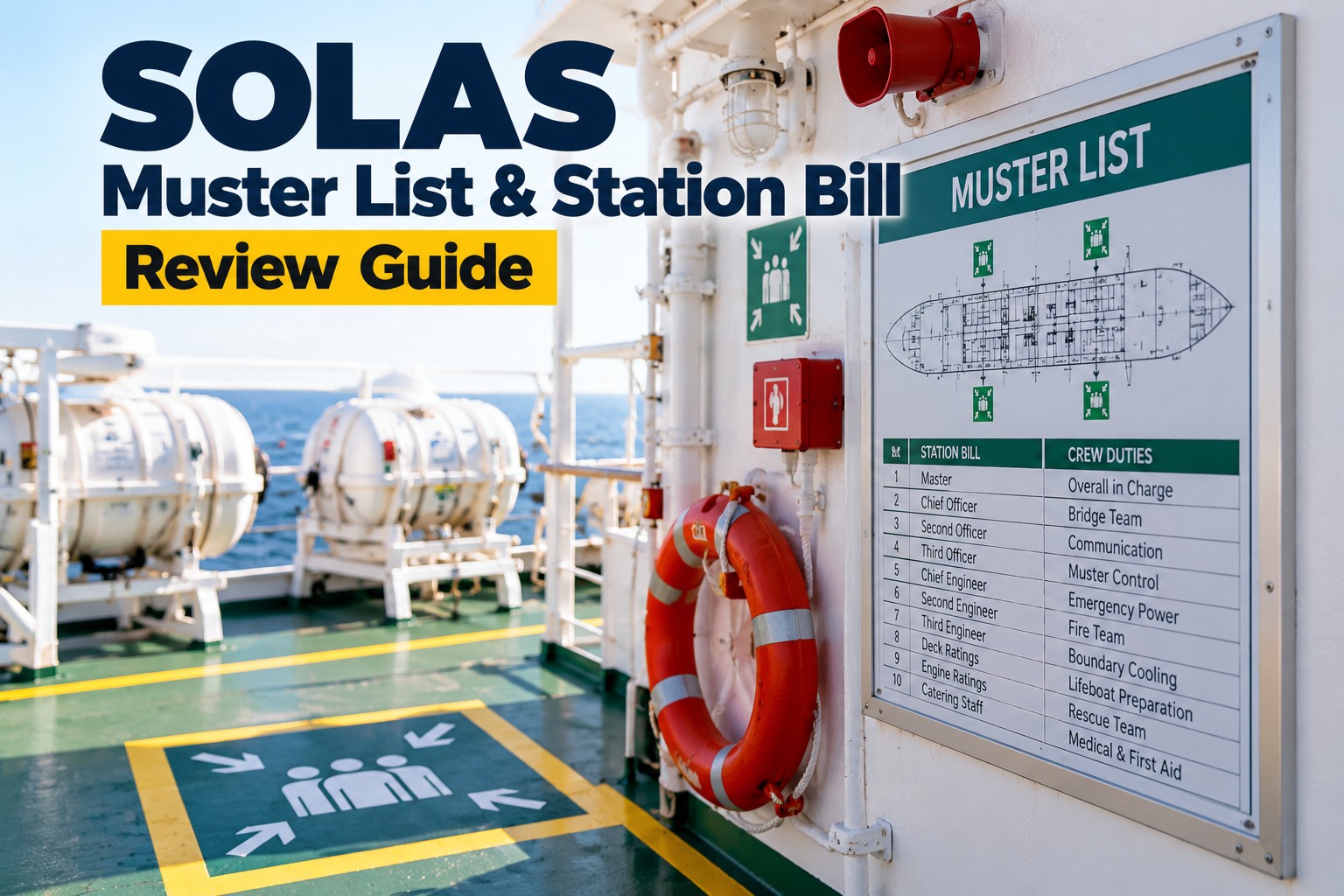
Digital muster list updated with every crew change. Duty assignments, muster stations, and survival craft allocations accessible from any device. Instant verification during drills.
Lifeboat Davit Maintenance
Running hour and calendar-based maintenance for davit mechanisms, falls (wires), release hooks, lifeboat engines, and emergency equipment inside survival craft.
Crew Training Records
STCW personal survival techniques (PST), proficiency in survival craft (PSCRB), lifeboat-specific familiarisation — all tracked per crew member with expiry alerting.
Survey-Ready Documentation
Complete LSA compliance package accessible instantly during class surveys, PSC inspections, and ISM audits. No more scrambling through paper records.
Conclusion
Abandon ship is the emergency where preparation determines survival — the 3-minute cargo ship and 10-minute passenger ship launch requirements leave zero margin for confusion, unfamiliarity, or equipment failure. The abandon ship sequence (Master's decision → distress communication → general alarm → muster and headcount → engine room securing → survival craft preparation → ordered boarding → launch → Master last to leave) must be drilled until it is reflexive. Survival craft (gravity davit lifeboats, free-fall lifeboats, inflatable liferafts, davit-launched liferafts, rescue boats) require specific maintenance intervals: monthly lowering, quarterly launch and manoeuvre, annual liferaft service, HRU expiry monitoring, release hook overhaul. Emergency communication (EPIRB, SART, VHF portable) must be maintained, registered, and taken to survival craft during abandonment. Personal survival equipment (immersion suits, lifejackets, thermal protective aids, pyrotechnics) must be accessible, inspected, and within service dates. Monthly abandon ship drills with realistic scenarios, crew rotation, and documented participation are not compliance theatre — they are the training that saves lives. Marine Inspection provides the digital platform that connects every element of abandon ship readiness into one fleet-wide system — book a live demo today.
Frequently Asked Questions
FAQ 01
What is the abandon ship signal?
The abandon ship signal is 7 short blasts followed by 1 prolonged blast on the ship's whistle and general alarm system, as defined in SOLAS Chapter III Regulation 6.4.2. This is followed by a clear announcement via the public address (PA) system instructing all persons to proceed to their assigned muster stations. The announcement must specify the abandonment method (lifeboat, liferaft, or direct rescue), any special instructions (don immersion suits if cold water), and the muster stations to be used. This exact signal sequence is used during monthly drills so every person on board recognises it instantly in a real emergency.
FAQ 02
How often must abandon ship drills be conducted?
SOLAS requires at least one abandon ship drill per month for every crew member. At least one lifeboat must be lowered monthly (different boats at successive drills). Each lifeboat must be launched with assigned crew aboard and manoeuvred in water at least every 3 months. Free-fall lifeboats: crew board and secure in seats quarterly (up to but not including release); actual free-fall launch every 6 months. Rescue boats launched monthly with assigned crew. Davit-launched liferaft inflation and lowering training at intervals not exceeding 4 months. Passenger ships require drill within 24 hours of departure if more than 25% of crew have not participated in a drill in the previous month. All drill records must document date, scenario, equipment, and participants.
FAQ 03
What is the difference between lowering and launching a lifeboat?
Lowering means bringing the lifeboat from its stowed position down to approximately 1 metre above the water level using the davit system, then returning it to the stowed position — the boat remains attached to the falls (wires) throughout. Lowering is done monthly. Launching means the lifeboat is lowered to the water, the release hooks are disengaged (on-load or off-load release), the painter line is cut, and the lifeboat engine is started for manoeuvring clear of the vessel under its own power. Launching is done quarterly with the assigned operating crew aboard. This distinction matters operationally — lowering tests the davit mechanism and brake; launching tests the complete abandonment capability including release hooks, engine, and crew competency in water.
FAQ 04
What equipment must be taken to survival craft during abandonment?
Survival craft carry permanently stowed equipment per LSA Code including: water (3 litres per person for lifeboats, 1.5 litres for liferafts), food rations (10,000 kJ per person), sea anchor, bailer and buckets, oars/paddles, boat hook, first aid kit, thermal protective aids, fishing kit, signalling mirror, and survival instructions. In addition, crew must bring to the survival craft: EPIRB (if not already activated and deployed), SART (search and rescue transponder), portable VHF radios (minimum 2), rocket parachute flares, hand flares, buoyant smoke signals, ship's documents (logbooks, crew lists, cargo manifest), and GMDSS portable equipment. Personal items: lifejacket (worn), immersion suit (if ordered), warm clothing layers.
FAQ 05
What is a Hydrostatic Release Unit (HRU) and why is it critical?
A Hydrostatic Release Unit (HRU) is a water pressure-activated mechanism that automatically releases a liferaft container when the vessel sinks to approximately 4 metres depth. If the crew cannot manually deploy the liferaft before the vessel goes down, the HRU ensures the raft floats free and inflates automatically via the painter line, providing a survival craft even if the abandonment process wasn't completed. HRU expiry must be checked monthly — an expired HRU makes the liferaft non-compliant regardless of the raft's own service date. PSC inspectors check both dates independently, and an expired HRU is a common detainable deficiency. HRUs are typically replaced every 2 years (varies by manufacturer). The HRU painter is connected to the ship's structure; when the raft floats free, the painter tension triggers inflation, then the weak link breaks, allowing the inflated raft to float clear.
Book Your Live Demo
Ensure Your Fleet Is Always Ready to Abandon Ship
30 minutes with our team. See how Marine Inspection tracks liferaft service dates, HRU expiry, EPIRB registration, pyrotechnic expiry, drill records with crew participation, lifeboat davit maintenance, and muster list management — the complete LSA compliance platform built for safety officers and fleet managers.