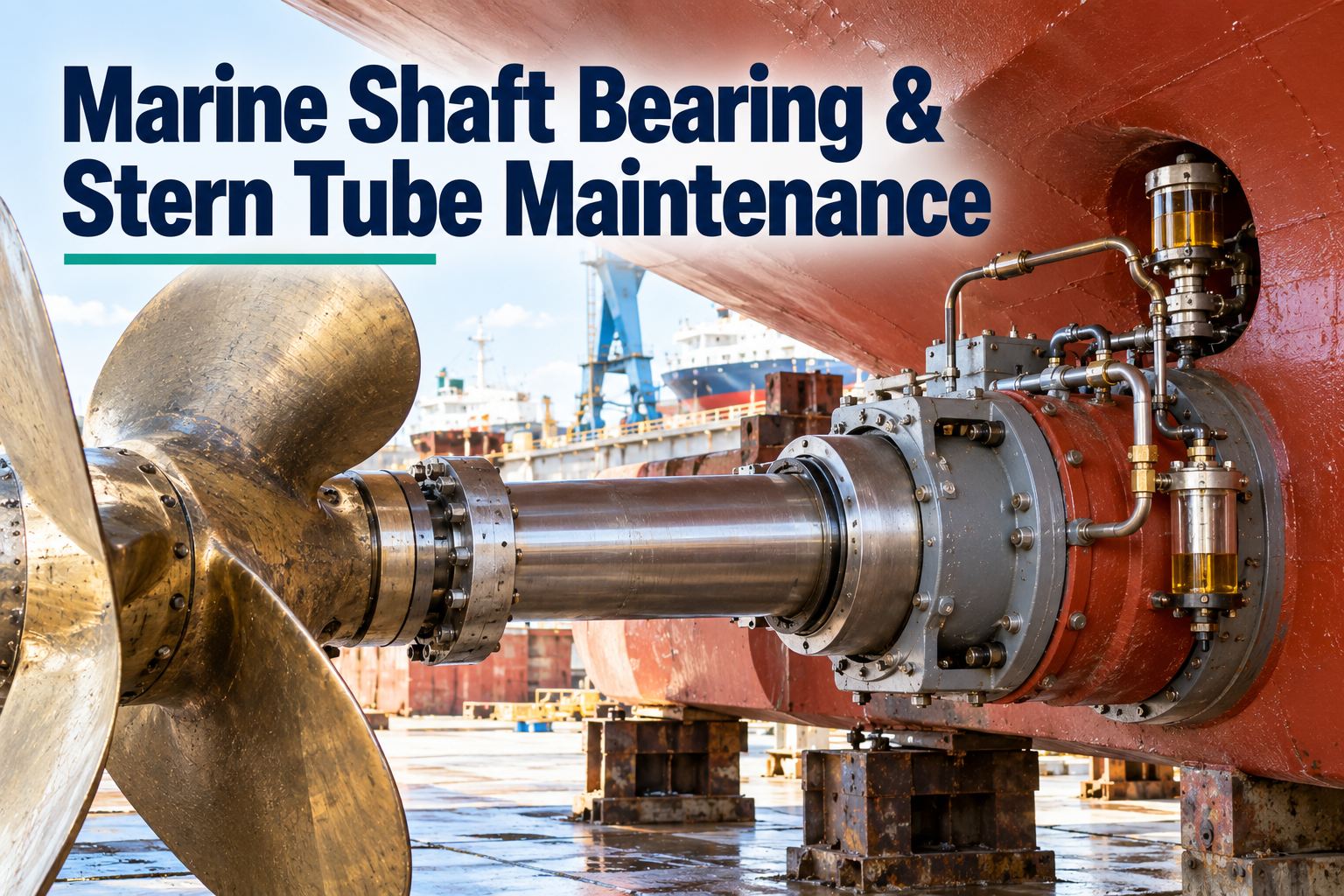
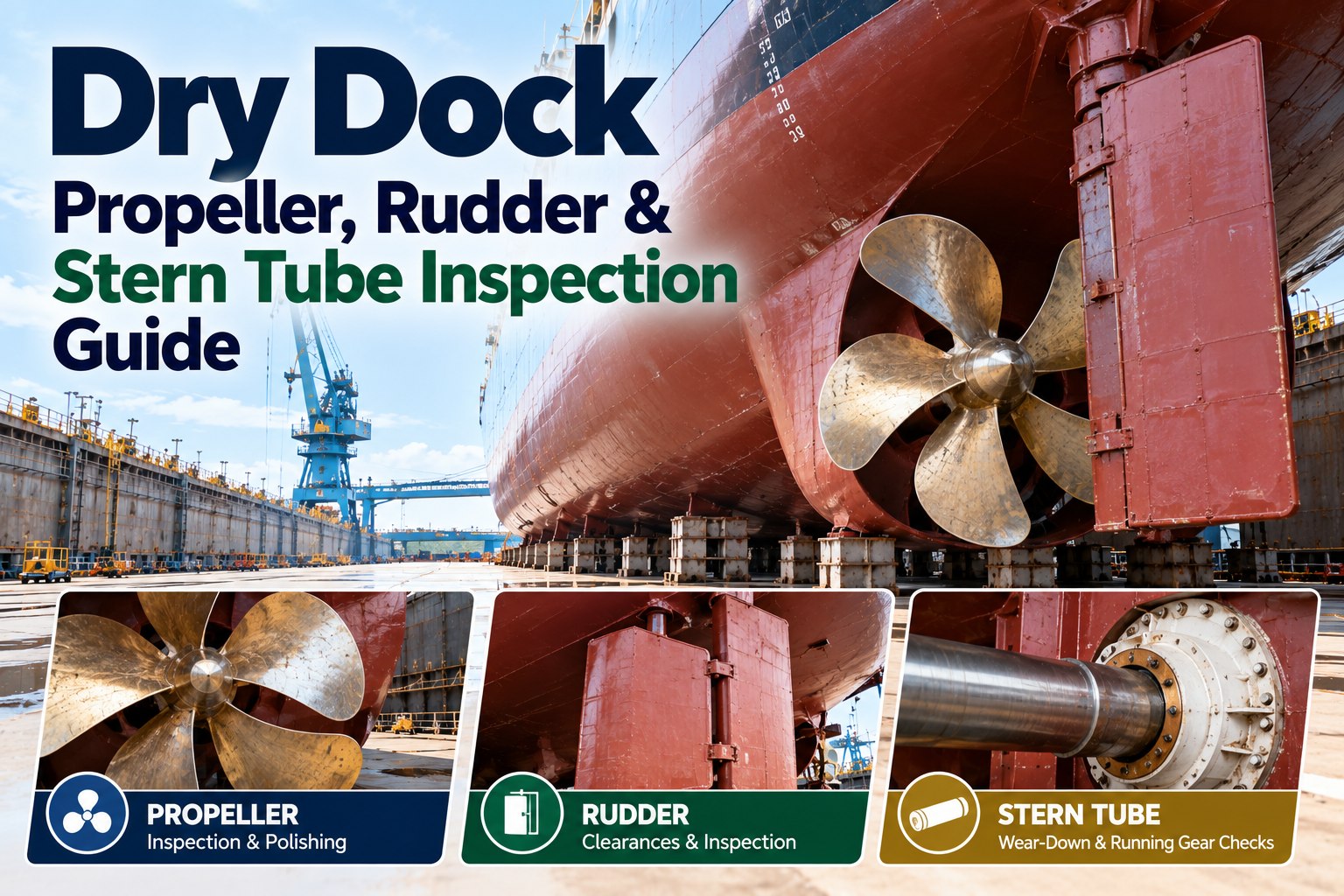
The stern tube is the one bearing on board you cannot open, cannot see, and cannot easily reach — and it carries the entire propeller load at the far end of a shaft that flexes under every sea state. Everything you know about its condition arrives indirectly: a wear-down figure taken once every few years in dry dock, an oil sample, a bearing temperature, and the behaviour of two seals working against sea water. That indirectness is why stern tube failures arrive as surprises and why they are expensive when they do — an aft bearing wiped at sea is an unplanned dry-docking, a drawn shaft and weeks off hire. It is also why class societies let owners trade shaft withdrawal for monitoring: if you can prove condition continuously, you do not have to prove it by dismantling. This guide covers the two lubrication arrangements and how each fails, wear-down measurement and what the trend is telling you, seal condition, oil analysis with the alert levels that matter, the survey-extension route through approved condition monitoring, alignment, and a maintenance and troubleshooting set built around a bearing nobody can inspect underway. Start a free trial of Marine Inspection to keep wear-down records, oil results and seal inspections in one place across the fleet.
Shaft bearing condition — the measurement everything rests on
You never see the bearing. You only ever see how far the shaft has dropped.
Wear-down is the increase in top clearance as the bearing material wears away beneath the shaft. Taken the same way, at the same points, every dry-docking, it is the one number that turns an invisible component into a trend.
A closed system: white metal bearings, oil under a static or circulating head, and seals at both ends holding oil in and sea water out. It runs on a hydrodynamic oil film, so its enemy is anything that thins or breaks that film — water ingress, wrong viscosity, edge loading from poor alignment, or a transient load spike in heavy manoeuvring. When the film goes, the white metal wipes, and it wipes quickly.
Watch: oil analysis, bearing temperature, aft seal leakage, oil consumption
Water-lubricated, composite or rubber
An open system: sea or fresh water flows through a bearing of composite, rubber or synthetic staves, with an inboard seal only. It tolerates far more wear than white metal and fails gradually rather than suddenly, but it wears faster, is sensitive to sand and silt in shallow or river trading, and depends absolutely on flow — a blocked supply or a long stop alongside with no flow damages it quietly.
Watch: wear-down rate, flow and supply pressure, inboard seal, stave condition
The EAL factor, and why stern tube damage has been rising
Ships trading US waters must use environmentally acceptable lubricants at oil-to-sea interfaces, which for most vessels means an ester-based EAL in the stern tube. Industry casualty analysis has linked a large share of recent stern tube incidents to EAL systems with seal problems: EALs typically run with a lower margin at high load and thinner at low temperature, and — critically — even a small amount of sea water triggers hydrolysis, producing acid that attacks the seals and admits more water. The practical consequence is that with an EAL, a water result that would once have been “monitor it” deserves action now, and sampling frequency and viscosity selection matter more than they did on mineral oil.
Wear-down: the trend matters more than the reading
A single wear-down figure tells you almost nothing, because measurement uncertainty on a white metal bearing can be the same order as several years of real wear. Plotted against the as-fitted datum across several dockings, the same figures become a usable forecast — you are looking for a change in slope, not a number.
Wear-down as a percentage of the maker’s renewal limit, docking by docking
Percentages rather than millimetres, because the renewal limit differs by bearing type, diameter and maker. Convert your own readings against your own limit and the shape of the trend is what you act on.
Measure against the datum
Wear-down is the change from the as-fitted clearance, not from the last docking. Keep the original figure in the record permanently — ships lose it in management changes more often than they wear out bearings.
Same method, same points, same people where possible
Poker gauge or feeler, the same access point, shaft in the same rotational position, propeller supported the same way. Changing the method between dockings destroys the comparability that gives the number its value.
Record the conditions, not just the result
Draught and trim, whether the propeller was supported, temperature, who took it. A reading with no conditions attached cannot be defended when it disagrees with the next one.
A step change is an event, not wear
Bearings do not wear in jumps. A sudden increase means either a measurement error or something happened — grounding, a heavy contact, an ice transit, or a period running with the propeller partly out of the water.
Seals: where most of the trouble starts
On a closed system the seals are doing the hard job. The aft seal works in sea water against a rotating liner with the ship moving, and it is the route by which water gets into oil and oil gets into the sea. Neither outcome is recoverable by anything the engine room can do afterwards.
Aft seal
Multiple lip rings running on a liner or chrome sleeve. Look for oil sheen around the stern in port, rising oil consumption from the header tank, and water in the oil sample. Rope or net wrapped around the shaft, fishing gear and ice contact all damage the liner surface, and a scored liner will not hold new lips.
Forward seal
Works in a far kinder environment but leaks into the ship. A persistent drip into the save-all is an early warning of lip wear or of a pressure imbalance in the system, not a nuisance to be wiped up on rounds.
Header tank behaviour
The level is a live instrument. A slow fall means oil is leaving; a slow rise means water is coming in. Log it daily at the same time and the trend appears weeks before an analysis result confirms it.
Parts and provenance
Non-original seal rings have featured repeatedly in casualty investigations. The seal is matched to the liner, the oil type and the design pressure; a dimensionally similar ring from another supplier is not the same component.
The condition record is what buys you the survey extension
Wear-down history against the datum, oil results with dates, seal inspections, bearing temperatures and header tank trends — captured on a phone at the machine and held fleet-wide, so the file class asks for already exists when you apply.
Oil analysis: what the numbers are actually saying
For a closed system, oil analysis is the primary condition indicator between dockings and the evidence base for any extended survey interval. Sampling at intervals not exceeding six months is a common class expectation; ships on EAL or with any history of water ingress should sample more often than that.
What is measured
Why it matters
Typical alert level
What to do on an alert
Water content
Seal leakage. On EAL, water also starts hydrolysis that attacks the seals and makes the problem self-feeding
Any confirmed rising trend; free water at all is serious
Resample to confirm, inspect the aft seal, check header tank trend, plan seal attention at the next opportunity
Tin and lead
White metal coming off the bearing surface — the most direct evidence of bearing distress
Around 10 ppm as a commonly used alert level
Treat as a bearing event. Check temperature trend, reduce load, arrange inspection and alignment assessment
Iron
Shaft, liner or housing wear, or corrosion following water ingress
Around 30 ppm as a commonly used alert level
Correlate with water content; rising together points at the seal rather than the bearing
Copper
Bearing backing or associated components
Around 50 ppm as a commonly used alert level
Trend it against tin and lead; copper alone is usually less urgent than white metal
Chloride
Distinguishes sea water ingress from condensation — changes the diagnosis completely
Presence above the laboratory’s reporting threshold
Confirms aft seal leakage. Inspect the seal and liner rather than continuing to monitor
Viscosity
Wrong grade in use, mixing of grades, or degradation. Drives film thickness directly
Outside the maker’s band for the grade in use
Confirm what was actually bunkered and topped up. Correct the grade before chasing anything else
Acid number
Oil degradation; on ester-based EAL, a rise follows water contact and precedes seal attack
Rising trend against the new-oil baseline
Investigate the water path. Oil change alone without fixing the ingress buys very little
Bearing temperature
Not an oil test, but read alongside: a rapid rise above the alert level is bearing distress in progress
Around 65 °C is a typical alert for oil-lubricated white metal
Reduce revolutions, trend against sea water temperature, prepare for inspection. An exponential rise is an emergency
Trading shaft withdrawal for monitoring
The conventional cycle draws the shaft on a fixed interval. With an approved monitoring arrangement and a notation from your society, that interval can be extended substantially, because the evidence of condition is continuous rather than periodic. Exact intervals, notations and acceptance criteria differ between societies — confirm yours before planning a docking around it.
Two ways to satisfy the same requirement
Schematic only. Intervals, class notations and acceptance criteria vary by society and by whether the system is oil, fresh water or sea water lubricated — treat your own society’s rules as the authority.
What an extension normally depends on
An approved arrangement and the corresponding class notation applied to the ship
Oil or water analysis at defined intervals, from an approved laboratory, with results retained on board
Wear-down and clearance records maintained against the original datum
Bearing temperature monitoring and records, where the arrangement calls for it
Seal condition confirmed at each docking, with inboard and outboard seals examined
An unbroken record: the moment monitoring lapses or an abnormality is found, the concession lapses with it
Alignment: the cause behind most wiped bearings
Casualty analysis keeps returning to the same root cause — adverse local alignment at the aft bearing, usually combined with something else. The aft bearing carries a disproportionate share of the load, and if the shaft sits in it at an angle the load concentrates on an edge rather than spreading along the length.
Edge loading
A shaft entering the bearing at a slope contacts at the aft edge instead of along the bore. Contact pressure rises, the oil film thins where it is needed most, and the white metal wipes at that edge first — which is exactly where the evidence is found afterwards.
Slope boring and multi-slope bearings
Machining the bore to match the shaft’s deflected attitude spreads the load along the bearing. Multi-slope designs go further and are increasingly specified where single-bearing arrangements have given trouble.
Measure afloat, correct in dock
Alignment measured with the ship afloat reflects the hull as it actually sits. Those readings inform the bearing offsets before dry-docking, so the yard period is spent correcting rather than discovering.
Hull and loading condition
Hull deflection changes with draught and cargo distribution, and the shaft line follows it. A ship trading in a condition very different from the one it was aligned for will load its aft bearing differently than intended.
Partially immersed propeller
Extended running in ballast with the propeller breaking the surface produces load transients the bearing was never sized for. It appears repeatedly in stern tube damage investigations.
After any grounding or heavy contact
Alignment and wear-down should both be checked. Damage to the shaft line is frequently discovered months later in an oil sample rather than at the time of the event.
Maintenance schedule
A baseline consistent with common maker and class practice. The ship’s own shafting manual and the society’s rules take precedence, particularly where a monitoring notation is in force.
Interval
Task
What good looks like
Daily
Record stern tube header tank level and bearing temperature; check forward seal save-all
Level steady, temperature stable against sea water temperature, save-all dry
Daily
Note oil consumption and any visible sheen astern in port
Consumption flat over weeks; no sheen at any time
Weekly
Check circulation pump or gravity system operation, filters and cooler where fitted
Flow proven, differential pressure normal, no leaks at connections
Monthly
Plot header tank level, temperature and consumption as trends, not as spot readings
A chart someone looks at, not a column of numbers nobody compares
Quarterly
Inspect intermediate shaft bearings, check clearances and holding-down arrangements
Clearances within the manual, no fretting or movement at the chocks
Six-monthly
Stern tube oil sample to an approved laboratory; file the result against the shaft record
Full suite including water, chloride, wear metals, viscosity and acid number, trended against the previous results
Six-monthly
Review the analysis trend with the technical office and record the decision taken
A written conclusion each time, including “no action, trend flat”
Annual
Verify monitoring arrangement still matches the class notation and that records are complete
No gaps in sampling, no missing reports, notation conditions all satisfied
Every dry-docking
Wear-down measurement against the as-fitted datum, recorded with method and conditions
Same method and access points as previous dockings; result plotted on the trend immediately
Every dry-docking
Inspect aft seal, liner surface and rope guard; clear any wrapped rope or netting
Liner unscored, lips intact, rope guard secure and undamaged
Every dry-docking
Check propeller for damage, cavitation erosion and security of the connection
Blades undamaged, nut and locking arrangement correct, no fretting at the taper
Per class cycle
Shaft withdrawal, NDT of the taper and keyway area, bearing and seal renewal as found
Survey completed within the interval applicable to the ship’s arrangement and notation
Troubleshooting matrix
Symptom
Likely causes, in order
What to do
Header tank level falling
Aft seal leaking to sea; forward seal leaking inboard; pipe or cooler leak
Check the save-all and look for sheen astern. Oil leaving to sea is a reportable event, not a top-up job.
Header tank level rising
Sea water entering past the aft seal; cooler leak; condensation
Sample immediately and test for chloride. Chloride present means sea water and an aft seal problem.
Water in the oil sample
Aft seal wear; scored liner; rope damage; on EAL, hydrolysis accelerating the damage
Confirm by resampling, inspect the seal at the earliest opportunity, and increase sampling frequency until resolved.
Tin or lead rising
White metal distress from edge loading, film breakdown or water contamination
Treat as a bearing event. Reduce load, trend temperature closely, arrange inspection and alignment assessment.
Bearing temperature climbing
Oil film breaking down; wrong viscosity; low oil level; overload from alignment
Reduce revolutions and monitor. A rapid or exponential rise is an emergency — stop before the bearing decides for you.
Wear-down jumped between dockings
Measurement error or different method; a load event such as grounding, contact or ice
Re-measure with the original method before concluding anything. If the jump is real, investigate what happened in service.
Oil sheen astern in port
Aft seal leaking oil to sea
Stop the loss, report as required, and plan seal attention. This is a pollution incident regardless of quantity.
Vibration at certain revolutions
Propeller damage or fouling; shaft misalignment; worn bearing; blade loss or bent blade
Note the revolution range and avoid it, inspect the propeller at the next opportunity, check alignment and wear-down together.
Water-lubricated bearing wearing fast
Silt and sand in shallow or river trading; loss of flow; stave damage
Verify flow and supply pressure, check strainers, shorten the wear-down measurement interval for that trade.
Viscosity off-spec in the report
Wrong grade bunkered; grades mixed during topping up; degradation
Trace what was actually added. Correct the grade before investigating film-related symptoms further.
Frequently asked questions
What is stern tube bearing wear-down?
The increase in clearance between the shaft and the top of the bearing as the bearing material wears away beneath the shaft, so the shaft sits lower. It is measured with a poker gauge or feeler at each dry-docking and compared against the as-fitted clearance recorded when the bearing was new.
Why measure against the as-fitted figure rather than the last one?
Because measurement uncertainty on a white metal bearing can be the same size as several years of genuine wear. Against the original datum across several dockings, the trend is readable; against a single previous reading, you are often looking at noise.
How often should stern tube oil be analysed?
At intervals not exceeding six months is a common class expectation for a closed system, and it is a condition of most extended-survey arrangements. Ships running EAL, or with any history of water in the oil, should sample considerably more often than that.
What alert levels are used in stern tube oil analysis?
Commonly cited alert levels are around 10 ppm for tin and lead, 30 ppm for iron and 50 ppm for copper, with any confirmed water — particularly with chloride present — treated seriously. Use the levels your laboratory and bearing maker specify for your installation, and act on the trend rather than a single result.
Can the shaft withdrawal interval really be extended?
Yes, with an approved monitoring arrangement and the corresponding class notation, the interval can be extended well beyond the conventional cycle. It depends on continuous evidence — analysis at defined intervals, wear-down records against the datum, seal condition confirmed at each docking — and the concession lapses the moment the record breaks or an abnormality appears.
Why are EAL oils associated with more stern tube damage?
Ester-based EALs typically run with a lower margin at high load and are thinner at low temperature, and they react with water. Even a small amount of sea water past the aft seal starts hydrolysis, producing acid that attacks the seal and lets more water in. Casualty analysis has found a large proportion of recent incidents involved EAL systems with seal problems.
What temperature should an oil-lubricated bearing run at?
Around 65 °C is a typical alert level for white metal, but the absolute figure matters less than the trend normalised against sea water temperature. A gradual climb over weeks and a rapid exponential rise are two different problems — the second one does not leave time to investigate.
What causes white metal to wipe?
Loss of the hydrodynamic oil film. In practice that means adverse local alignment at the aft bearing producing edge loading, often combined with water contamination, wrong viscosity, transient load spikes in heavy manoeuvring, or extended running with the propeller partly out of the water.
Keep the shaft record continuous, not once every dry-docking
Wear-down against the datum, oil analysis trends, seal inspections, temperatures and header tank behaviour — captured at the machine and held fleet-wide, with due-date alerts for sampling, inspections and survey windows.