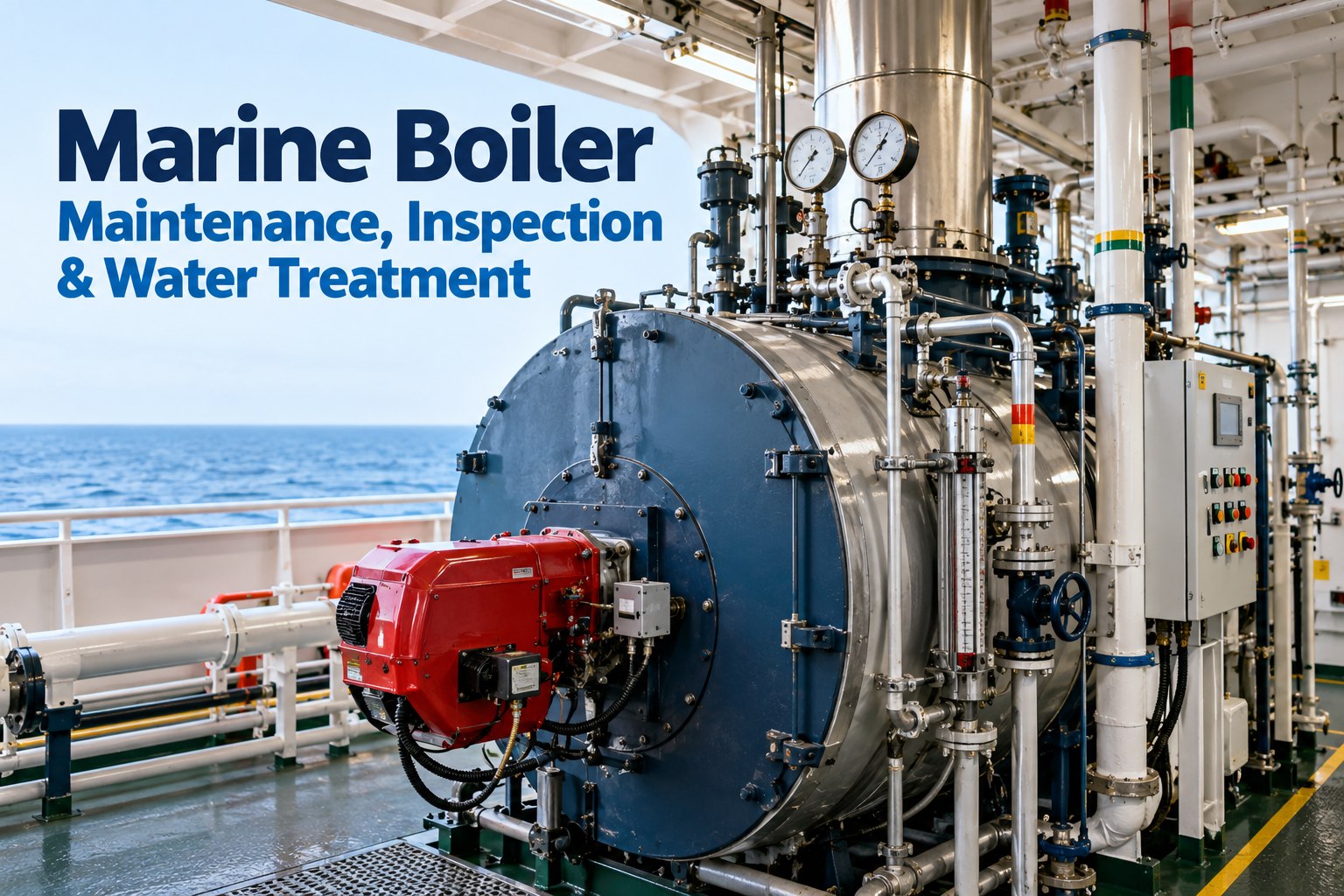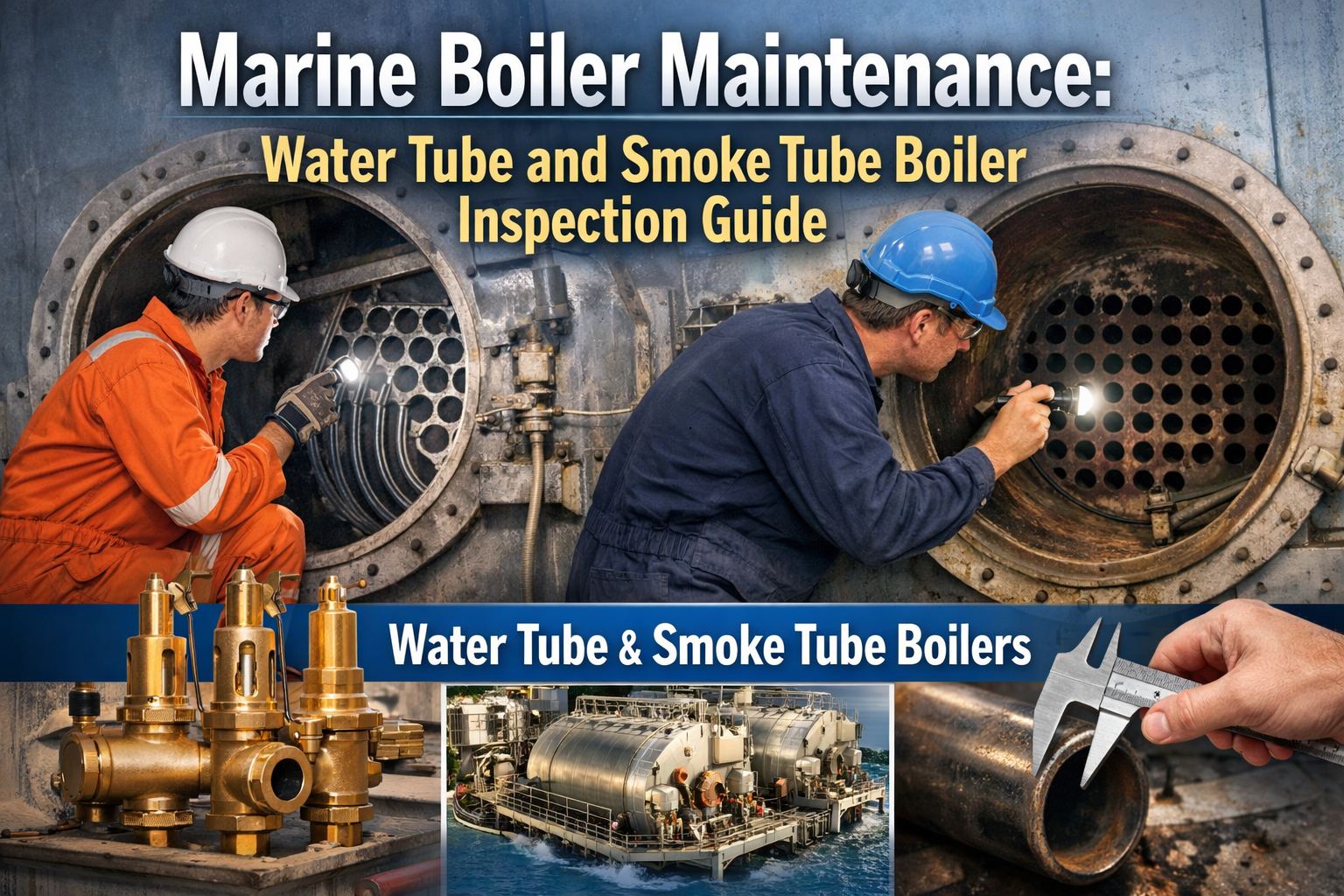
Marine boilers are the silent workhorses of the engine room — generating the steam that heats heavy fuel oil for combustion, drives cargo pumps on tankers, services accommodation heating, feeds domestic hot water systems, and powers auxiliary machinery across the commercial fleet. Their pressure vessel nature makes them among the most hazardous equipment on any vessel: a single water level loss followed by uncontrolled rewatering can produce a catastrophic explosion that has historically killed crew and destroyed vessels. This is why SOLAS requires at least two safety valves on every boiler, why classification societies conduct biennial surveys until age eight and annual surveys thereafter, and why water treatment is not a chemistry exercise but a life-safety discipline. For marine engineers, boiler maintenance sits at the intersection of combustion engineering, water chemistry, pressure vessel integrity, and safety valve regulation — a combination that demands both daily watchkeeping discipline and systematic planned maintenance. Marine engineers building systematic boiler maintenance records can start a free trial of Marine Inspection to digitalise survey readiness, water treatment logs, and safety valve test evidence.
Marine Boiler Types: Comparison
| Feature | Smoke Tube (Fire Tube) | Water Tube | Exhaust Gas Economiser |
|---|---|---|---|
| Heat Path | Hot gases inside tubes, water surrounds | Water inside tubes, hot gases outside | Exhaust gases flow through tubes; water surrounds |
| Pressure Range | Low to medium (typically <20 bar) | Medium to high (up to 100+ bar) | Typically low-medium; linked to auxiliary boiler |
| Steam Production | Low to moderate volumes | High volumes, rapid response | Variable (depends on engine load) |
| Typical Use | Auxiliary steam, fuel heating, heating services | Steam propulsion, high-demand tankers, large auxiliary | Fuel-saving economiser during sea voyages |
| Efficiency | Lower — slower response to load changes | Higher — fast response, better heat transfer | Very high — uses waste heat |
| Survey Interval | 2-yearly until age 8, annually thereafter | 2-yearly until age 8, annually thereafter | 2-yearly until age 8, annually thereafter |
| Inspection Access | Manhole and hand holes; straightforward | Steam drum, mud drum, multiple tube banks | Often gas-side and water-side access; some require water cleaning |
| Water Treatment | Critical — standard marine boiler treatment | Extra critical — high pressure amplifies chemistry issues | Shared with auxiliary boiler; common circuit |
| Failure Modes | Tube end cracking, overheat rupture from scale, corrosion | Flame impingement rupture, quick start-up cracking, scale | Gas-side fouling, exhaust-side corrosion, thermal fatigue |
| Emergency Operation | Not permitted without water | Not permitted without water | Can run without water if depressurised and <400°C |
Boiler Water Treatment: The Most Important Maintenance Activity
Water treatment is the single most important determinant of boiler longevity and safety. Untreated or poorly treated water causes scale formation (reducing heat transfer and causing overheating), corrosion (particularly oxygen pitting at the water line), and deposits that block circulation and trigger tube failures. The quality of water treatment directly determines how long a boiler can operate safely between overhauls. Marine engineers who book a Marine Inspection demo can see how the platform tracks water treatment readings with automated alerts when parameters drift outside limits.
| Parameter | Target Range | Why It Matters | Test Frequency |
|---|---|---|---|
| pH (alkalinity) | 10.8 – 11.5 | Low pH causes corrosion; high pH causes caustic embrittlement and foaming | Daily |
| Chloride | Preferably as low as possible; max 500 ppm | High chloride accelerates corrosion and carryover; indicates salt contamination | Daily |
| Phosphate | Per treatment regime (typically 20-50 ppm) | Prevents scale by forming soft sludge with calcium and magnesium | Daily |
| Hydrazine / Oxygen Scavenger | 0.1 – 0.3 ppm | Removes dissolved oxygen; prevents pitting corrosion at water line | Daily |
| TDS (Total Dissolved Solids) | <1,000 μS/cm conductivity | High TDS triggers foaming, priming, and carryover into steam line | Daily |
| Hardness | Zero (softened feedwater) | Any hardness causes scale formation and tube overheating | Daily |
| Dissolved Oxygen (feedwater) | <0.02 ppm | Primary cause of corrosion; requires deaeration and chemical scavenging | Weekly |
The Seven Critical Boiler Maintenance Activities
Boiler maintenance is not a single activity — it is seven interdependent maintenance streams that together ensure operational safety, combustion efficiency, and survey readiness. Each activity addresses a different failure mode, and neglecting any one eventually causes one of the others to fail. Sign up for Marine Inspection to track all seven streams with automated maintenance scheduling.
Boiler Survey: What Surveyors Examine
Classification boiler surveys follow strict protocols. Before survey, the boiler is shut down, cooled below 100°C, depressurised, emptied, and isolated from any other boilers in service. The surveyor attends with drawings and follows a planned routine to ensure no component is missed.
Expert Review: Boiler Maintenance in the Digital Era
Boiler maintenance is one of the engine room disciplines where systematic digital records produce disproportionate safety and commercial returns. Water treatment chemistry is inherently a trend analysis problem — a single pH reading outside limits is concerning, but a pH trend showing gradual decline over two weeks is a diagnostic signal pointing to a specific treatment failure. Spreadsheet-based water treatment logs cannot surface these trends in time for corrective action. Digital platforms with automated threshold alerts do.
The 2025-2026 regulatory environment adds complexity. EU ETS and FuelEU Maritime requirements mean that boiler fuel consumption is now a direct carbon cost variable — exhaust gas economiser effectiveness, combustion efficiency, and boiler tube cleanliness all affect CII ratings and emissions allowance costs. Boilers that run with 10-20% lower auxiliary fuel consumption thanks to clean economiser tubes deliver measurable commercial returns. For marine engineers, this reframes routine boiler maintenance from a survey-compliance exercise into an operational efficiency programme with direct financial impact. Schedule a walkthrough to see how Marine Inspection connects boiler maintenance with fleet-wide compliance and efficiency management.
Conclusion
Marine boilers sit at the intersection of pressure vessel safety, combustion engineering, water chemistry, and classification compliance. Whether you're managing smoke tube auxiliary boilers, high-pressure water tube installations, or composite boilers with exhaust gas economisers, the fundamental maintenance disciplines remain the same: disciplined water treatment with daily parameter monitoring, combustion efficiency management, safety valve integrity, regular tube inspection, refractory condition monitoring, safety device testing, and burner system maintenance. Classification surveys at 2-yearly intervals (annually after age 8) verify the outcomes of this daily discipline — but surveys cannot rescue a boiler whose water chemistry has drifted out of control for six months. The marine engineers who keep boilers operational, efficient, and survey-ready are those whose daily maintenance produces documented evidence that surveyors, charterers, and regulators can verify. Marine Inspection provides the platform that turns daily boiler checks into that verification trail — sign up today to build systematic boiler maintenance across your fleet.