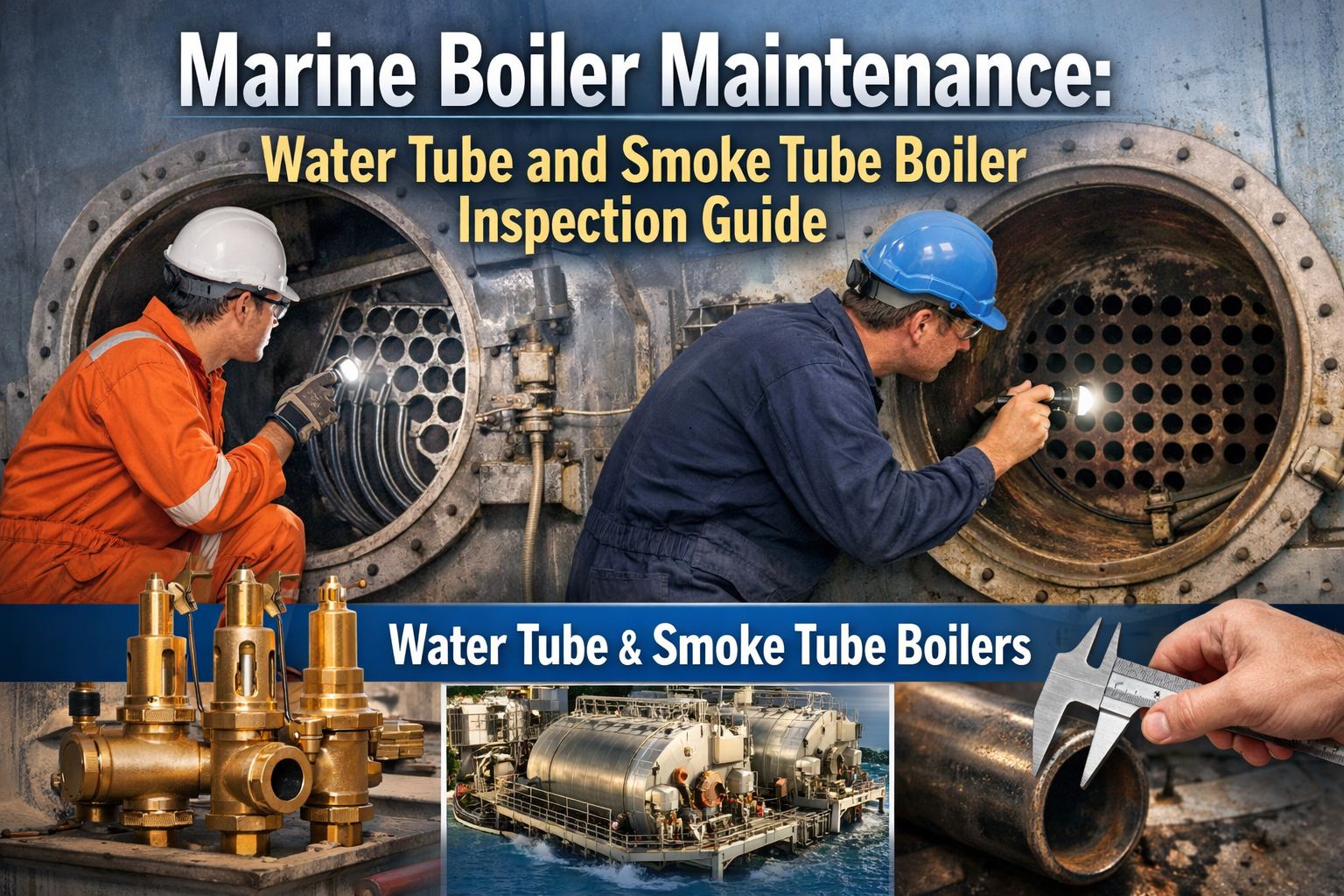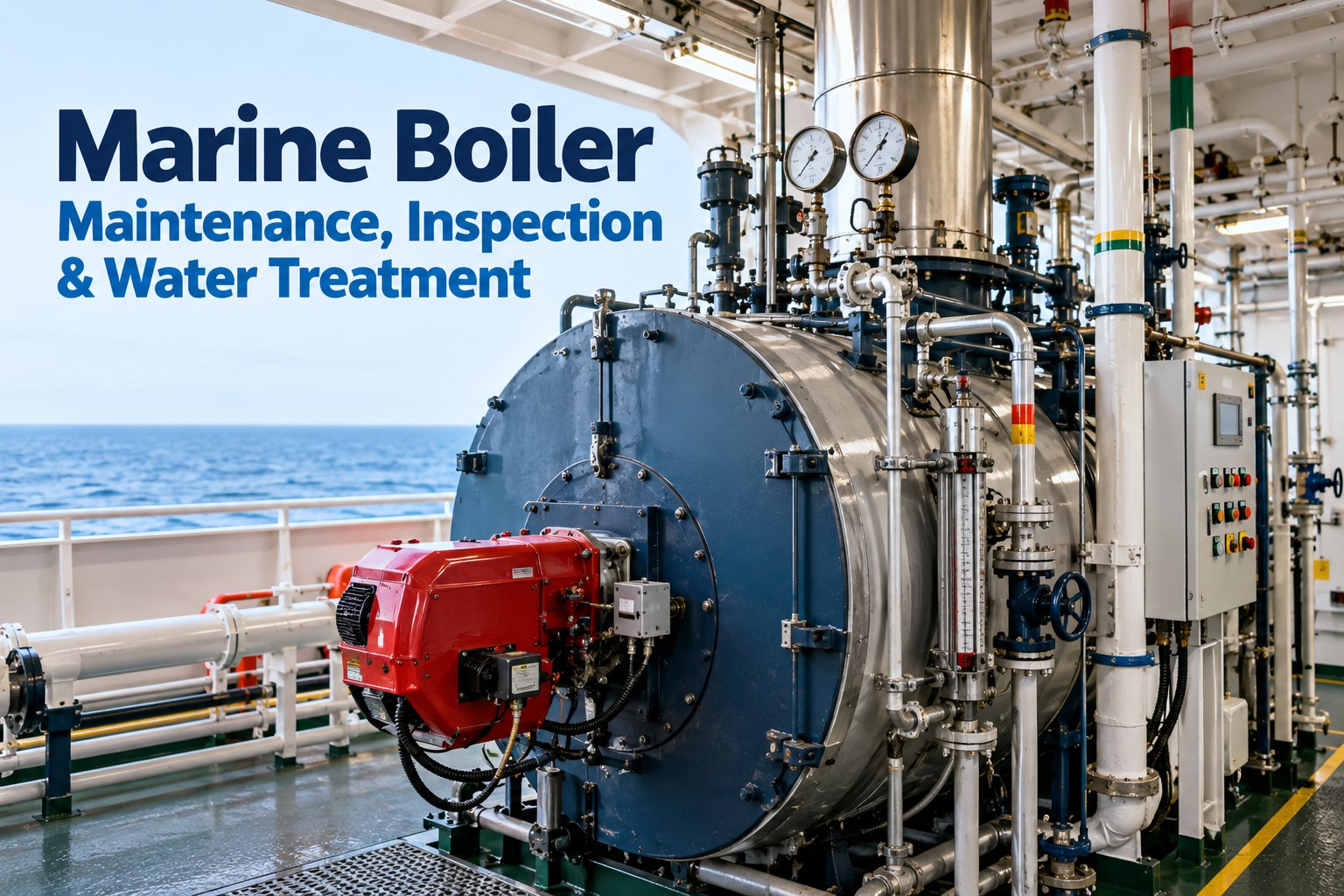
Marine boiler maintenance is the routine of testing boiler water, blowing down, checking safety valves and protective devices, cleaning the fire side and exhaust gas economiser, and keeping the records class will ask for. It matters because the auxiliary boiler and economiser supply steam for fuel heating, accommodation and cargo services, and they are pressure vessels with a fire on one side. Get it wrong and the cost ranges from scale and tube failures to an economiser fire in the funnel at sea.
Keep the steam plant safe: a chief engineer’s routine for boiler water, valves and economiser care
Daily water tests, blowdown, safety valve checks and survey records in one routine you can hand over at crew change.
Free sign-up · Offline checklists at sea · Signed PDF reports for class
For a chief engineer, the boiler is one of the few machines where routine checks and class survey requirements overlap almost completely. Class wants to see the boiler examined internally twice in every five-year cycle, the safety valves set and tested, and feed water records that show the water side has been looked after. A ship that keeps clean daily logs walks into those surveys with the evidence already in hand.
This guide follows that routine in order: water treatment limits, blowdown, maintenance intervals, safety valve and protective device tests, economiser cleaning and soot fire prevention, fire side and refractory care, troubleshooting and survey preparation. If you want the daily tests and weekly checks on a phone-friendly checklist that works offline, you can start logging boiler tasks free.
Boiler water treatment on ships: test limits and what they mean
Boiler water treatment keeps scale and corrosion off the heat transfer surfaces. The daily test tells you whether the chemistry is holding, and whether something, usually sea water through a leaking condenser or drain cooler, is getting in. Typical control limits for low and medium pressure boilers are below. Always follow your chemical supplier’s programme and the boiler maker’s figures where they differ.
| Boiler water test | 0–15 bar | 15–30 bar | If out of range |
|---|---|---|---|
| pH | 10.5–11.5 | 10.5–11.5 | Low: corrosion risk. Adjust alkaline dosing |
| P-alkalinity (ppm CaCO3) | 50–300 | 150–300 | High: carry-over and foaming. Blow down |
| Chloride (max ppm Cl) | 300 | 150 | Rising: sea water ingress. Find the leak |
| Phosphate (ppm PO4) | 30–70 | 30–70 | Low: hardness can form scale. Dose |
| Dissolved solids (max ppm) | 1,500 | 1,000 | High: blow down to reduce |
| Hydrazine excess (ppm N2H4) | 0.1–0.3 | 0.1–0.3 | Low: oxygen corrosion risk. Dose scavenger |
Boiler water limits as published by SteamEsteem for steam boilers. Feed water limits on the same source: chloride max 5 ppm, pH 8.5–9.0, residual hardness max 0.1 °dH. Some programmes use sulphite instead of hydrazine as the oxygen scavenger.
Chloride: how close the boiler can run to its limit (0–15 bar boiler)
The typical and warning readings are illustrative. A steady climb in chloride over several days points to contamination, not dosing.
Boiler blowdown procedure: surface and bottom blowdown step by step
Blowdown removes dissolved solids and sludge that treatment chemicals have brought out of solution. Surface (scum) blowdown takes off the concentrated water and foam near the water level; bottom blowdown removes sludge from the lowest point. Follow the boiler maker’s procedure and your ship’s permit system. A typical sequence:
Check the water test first
Blowdown is driven by the test: dissolved solids, alkalinity or chloride near the limit. Do not blow down by habit alone.
Tell the watch and check the overboard line
Confirm the ship is clear to discharge and the overboard valve is open. Agree who watches the gauge glass.
Raise the level slightly
Bring the water a little above normal working level so the blowdown does not take it near the low-level trip.
Open the valves in the right order
Open the shut-off valve fully first, then the blowdown valve gradually. This protects the shut-off seat from wire drawing.
Blow in short bursts
Watch the gauge glass throughout. Bottom blowdown is usually done at low firing or with the burner off, as the maker directs.
Close in reverse and record
Close the blowdown valve, then the shut-off. Check level, retest within the hour and log what was done and why.
Every water test, blowdown and valve check, logged once and ready for class
Readings flag themselves when they near a limit, and the action you take goes straight into the boiler record.
Free to start · Works offline on board · Export to signed PDF
Auxiliary boiler maintenance intervals: daily to five-yearly
Most auxiliary boiler maintenance runs on a simple ladder: water and level checks every watch or day, function tests weekly or monthly, an annual class external survey and two internal surveys in each five-year cycle. The exact tasks come from the maker’s manual and your planned maintenance system; the class intervals come from IACS UR Z18.
- Boiler and feed water tests
- Gauge glass blow-through
- Burner flame and smoke check
- Hot well and drains for oil or sea water
- Low water level alarm and trip test
- Flame failure test
- Economiser soot blowing as the maker directs
- Bottom blowdown if water tests call for it
- Burner nozzle and igniter check
- Feed pump and circulation pump condition
- Safety valve easing gear free to operate
- Fire side inspection where accessible
- Class external survey in the annual window
- Safety and protective device tests
- Safety valve and relieving gear tested
- At least two internal surveys
- Maximum 36 months between them
- Safety valve setting verified each time
Daily to monthly tasks are typical practice; set your own from the maker’s manual. Annual and five-yearly items are from IACS UR Z18. For the wider engine room plan, see engine room maintenance.
Boiler safety valve test and protective device checks
Safety valves and protective devices are where boiler maintenance meets class most directly. IACS UR Z18 sets out what the surveyor examines and when.
Internal survey
Boilers, superheaters and economisers examined internally on water-steam side and fire side. Mountings and safety valves examined, and opened out as the surveyor considers necessary.
Annual external survey
Carried out within the annual survey window, including tests of safety and protective devices and of the safety valve with its relieving gear.
Interval and extension
At least two internal surveys per five-year period, no more than 36 months apart. In exceptional circumstances an extension of up to 3 months may be granted.
Exhaust gas economisers
For shell-type units, all accessible welded joints get a visual examination for cracking; NDT may be required. If steam cannot be raised in port, the chief engineer may set the valves at sea and log the results.
Note the extension condition: feed water chemistry records are part of the evidence. Patchy daily water logs can cost you the flexibility you need when a survey falls at an awkward port. For how class surveys fit together across the ship, see class society compliance.
Exhaust gas economiser cleaning and soot fire prevention
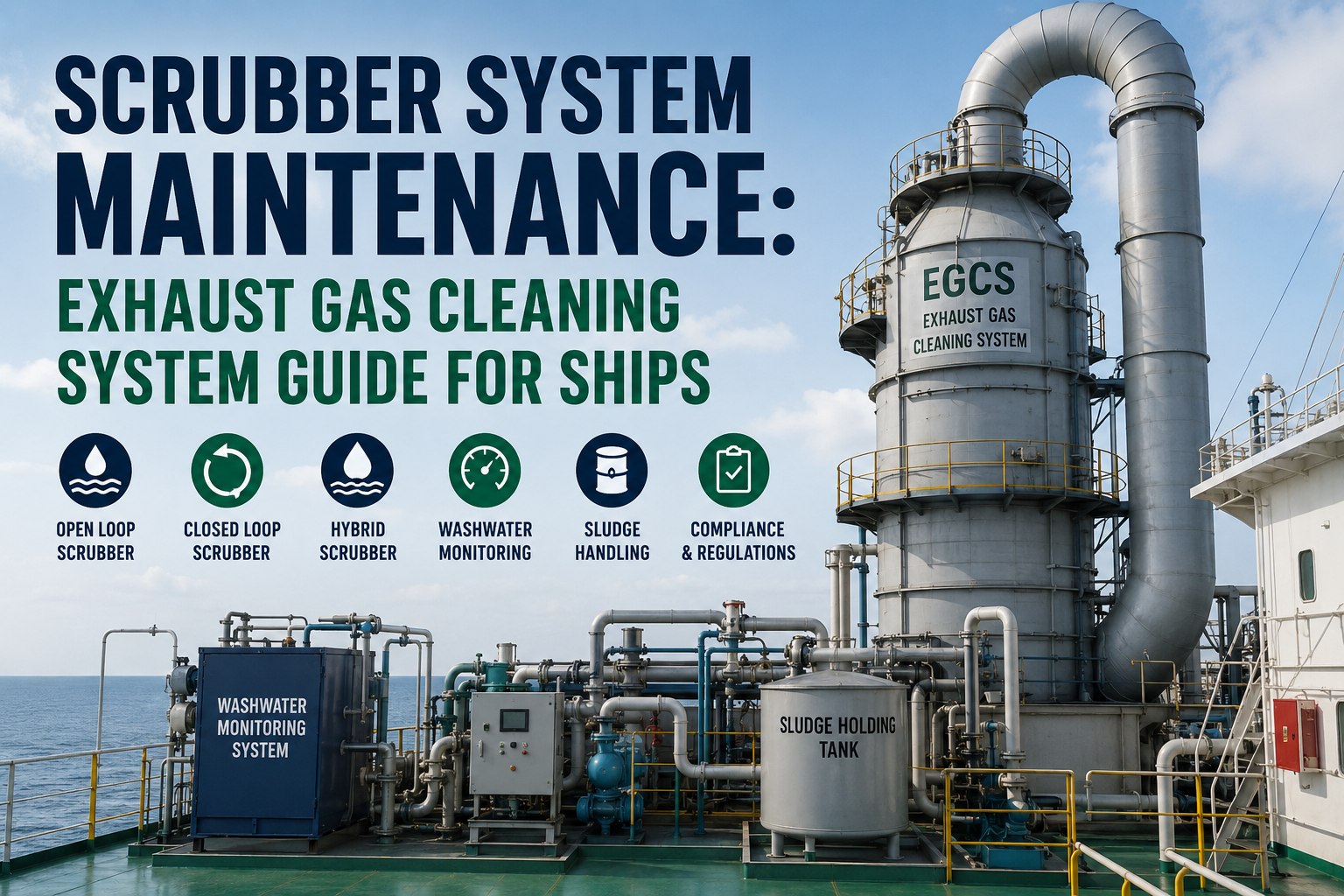
The exhaust gas economiser (economizer) is where boiler maintenance most often turns into a fire. Soot from the main engine builds up on the tubes; at low load it can be wet and oily and ignite at a much lower temperature than you would expect. Marine Insight describes three stages:
Soot fire
Wet, oily soot ignites at low load. Usually small, because the water in the tubes carries the heat away.
Hydrogen fire
Water dissociates and reacts with carbon, forming hydrogen and carbon monoxide that burn fiercely.
Iron fire
The tubes themselves burn. Water or steam on the fire at this stage can feed the reaction.
The auxiliary boiler’s furnace tube overheated and cracked, most likely because a control fault let the burner fire with too little water. Feed water was lost, circulation through the exhaust gas economiser stopped, and the economiser overheated with the engine still running. Soot ignited and the fire spread in the funnel uptakes. The MAIB found soot blowers had not been run automatically, the water-washing system was not used and the crew did not understand how to fight an economiser fire.
Composite boiler maintenance: fire side, burner and refractory checks
Composite boilers combine an oil-fired section and an exhaust gas section in one pressure vessel, so fire side condition matters on both. When the boiler is shut down and cooled for inspection, work through the fire side with a clear checkpoint type for each item, so the record shows what was looked at, tested or measured.
Marine boiler troubleshooting: symptom, cause, check and fix
Most boiler faults show up first as an alarm, a test result or a change in flame. Use the guide below as a starting point, then follow the maker’s fault-finding guide.
| Symptom | Likely cause | Check | Fix |
|---|---|---|---|
| Chloride rising day by day | Sea water through condenser or drain cooler | Test condensate and hot well; isolate coolers one at a time | Repair the leak, blow down, adjust dosing |
| Burner fails to light | Igniter, nozzle, fuel temperature or air ratio | Spark, nozzle condition, fuel viscosity, air damper | Clean or renew nozzle and igniter; correct fuel heating |
| Flame failure trips | Dirty flame scanner, poor atomisation, water in fuel | Scanner lens, atomiser, fuel drains | Clean scanner, overhaul atomiser, drain fuel |
| Black smoke | Too little air or poor atomisation | Air register, fan, nozzle wear | Reset air-fuel ratio, renew worn nozzle |
| Priming or carry-over | High alkalinity or solids, oil in the water, level too high | Water test, hot well for oil | Surface blowdown, find the oil source |
| Low water level alarms | Feed pump, feed check valve, level control or tube leak | Feed pump pressure, valve, controller, make-up rate | Repair the cause before resetting; never fire with low water |
| Economiser outlet temperature rising | Soot build-up or soot fire starting | Gas temperatures, pressure loss across the tubes | Soot blow if no fire; if fire, follow the fire procedure |
Boiler survey preparation: what the surveyor will ask for
Good boiler survey preparation starts weeks before the surveyor boards. Plan the shutdown and cooling time, line up the records and make sure the boiler is safe to enter.
Records to have ready
- Daily boiler and feed water test logs
- Chemical dosing and blowdown records
- Safety valve settings and last test dates
- Protective device test records
- Repairs, tube plugging and refractory work since the last survey
- Economiser cleaning and water washing records
Boiler made ready
- Shut down, cooled and drained as the maker directs
- Manholes and handholes opened, gaskets ready
- Isolated and locked out, enclosed space permit issued
- Fire side cleaned enough to see the surfaces
- Lighting and access arranged
How Marine Inspection helps with marine boiler maintenance
Marine Inspection turns the boiler routine above into checklists your crew can complete on a phone, online or off, with the evidence class asks for attached as they go.
Offline water test log
Daily readings entered at the boiler, with limits set to your programme so out-of-range values stand out.
Photo evidence
Refractory, tubes and gauge glasses photographed and attached to the inspection.
Automatic work orders
A failed trip test or a chloride trend raises a job, so the fix is tracked to close-out.
Survey and certificate alerts
Annual and internal boiler survey dates tracked, with warnings before the window closes.
Signed PDF reports
Boiler inspection and test records exported for the surveyor and the office.
Multi-language crew portal
Checklists your ratings and junior engineers can follow in their own language.
Plans scale from a single ship to a fleet; see Marine Inspection pricing.
Marine boiler maintenance: the routine that keeps you survey-ready
Marine boiler maintenance comes down to a few habits done every day: test the water and act on the result, blow down for a reason, keep the safety devices proven, keep the economiser clean and never fire a boiler with low water. Do those consistently, record them properly, and the annual and internal surveys become a review of records you already have. Keep those records in one place with a digital engine room logbook.
Walk into the next boiler survey with every water test and valve check already on file
Free sign-up · Offline at sea · Signed PDF reports