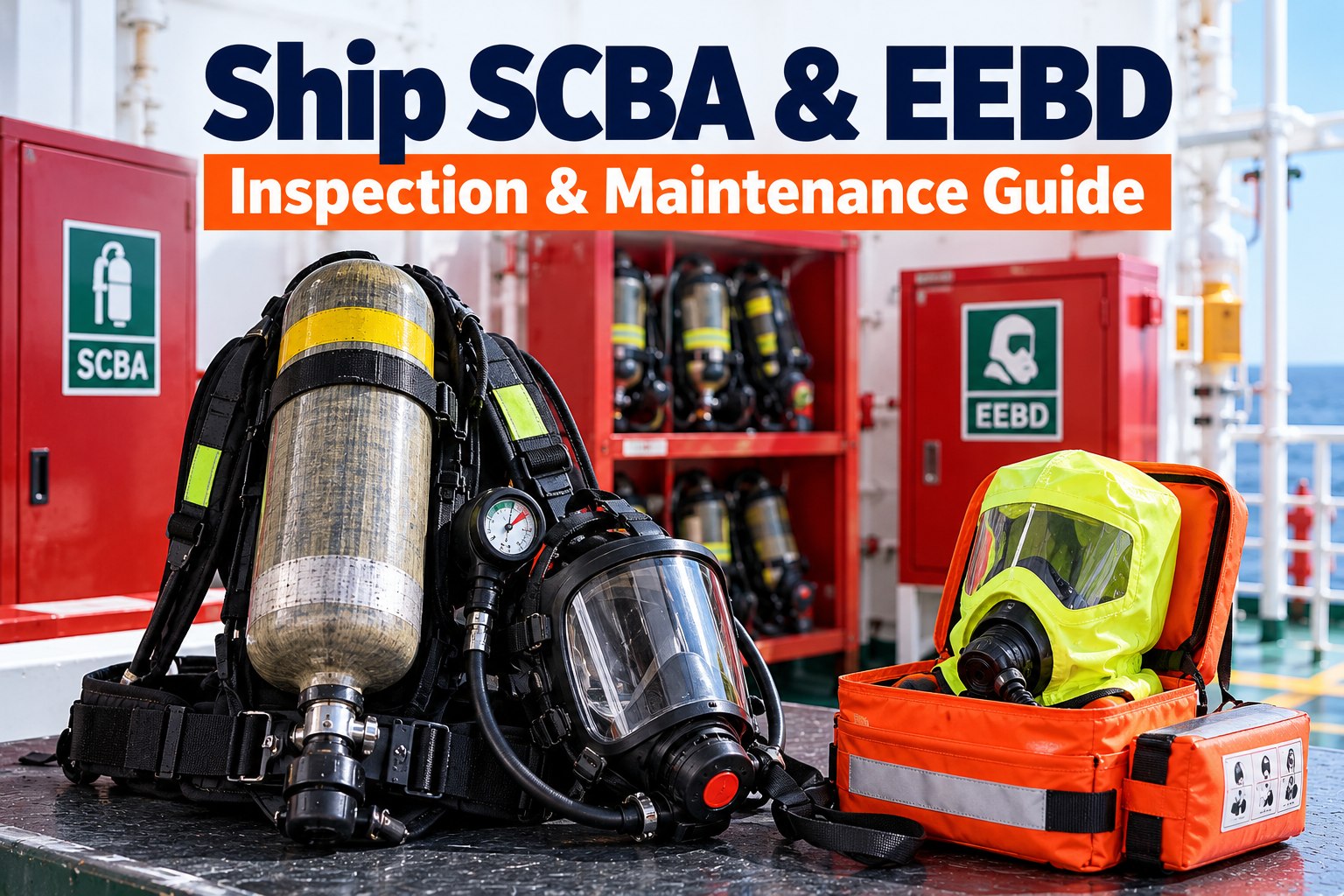
In a smoke-filled engine room, breathing apparatus is the difference between a rescue and a casualty. The fire party depends on SCBA sets that hold full pressure, seal against the face and warn before the air runs low. Everyone else depends on EEBDs being where the escape route needs them. This guide covers SOLAS requirements, cylinder pressure and mask checks, EEBD placement and the weekly to five-yearly servicing in IMO’s maintenance guidelines. Book a demo to track breathing apparatus servicing.
Ship SCBA and EEBD inspection: ready to breathe when the space fills with smoke
Minimum durations from the FSS Code. One is for fighting a fire, the other only for escaping it.
SCBA vs EEBD: two different jobs
An EEBD is never a substitute for SCBA. It is designed only to get a person out of a hazardous atmosphere, not to fight a fire or enter an enclosed space.
| Aspect | SCBA (fire-fighter’s outfit) | EEBD |
|---|---|---|
| Purpose | Fire-fighting, rescue, entry into smoke | Escape from a hazardous atmosphere only |
| Duration | At least 30 minutes; at least 1,200 L of free air | At least 10 minutes |
| Low-air warning | Audible and visual alarm before air falls to 200 L | Not required in the same way |
| Spares | Two spare charges per set, or onboard recharging | Spare units in a control station |
| Users | Trained fire party members | Anyone escaping, after familiarisation |
Summary of SOLAS II-2/10 and 13 and FSS Code Chapter 3. Check your ship’s fire control plan and flag requirements.
SOLAS requirements for breathing apparatus
Amendments in force since 1 July 2014 strengthened fire-fighter’s outfit rules, with deadlines for existing ships that have now passed.
From SOLAS II-2/10, II-2/13 and II-2/15 and Lloyd’s Register class news 18/14. Passenger ships have higher numbers.
SCBA and EEBD inspection intervals
IMO’s guidelines for maintenance and inspection of fire protection systems and appliances (MSC.1/Circ.1432) set these checks. Makers’ instructions may add more.
Crew
Crew
Crew or shore service
Shore service
Summary of MSC.1/Circ.1432. Chemical and gas tankers have extra monthly and annual checks under the IBC and IGC Codes.
SCBA cylinder pressure: reading the gauge
The weekly check confirms each cylinder sits in the correct pressure range set by the maker. The example below uses a 300 bar cylinder and is illustrative; always use the maker’s minimum.
Every set, every week, on record
Log gauge readings per cylinder, flag low pressure at once and track hydrostatic test dates for the whole fleet.
Mask seal and SCBA function checks
Most makers give a short pre-use check sequence. These are the typical steps; follow your set’s instructions exactly.
Visual check
Harness, straps, hoses, visor and cylinder valve undamaged; cylinder in date.
Pressure check
Open the cylinder valve; gauge reads within the full range.
Leak check
Close the valve; pressure should hold steady over the time the maker specifies.
Low-air alarm
Vent slowly; whistle or alarm sounds at the set pressure.
Mask seal
Negative-pressure check: inhale with supply blocked; the mask should pull in and hold.
Demand valve
Positive pressure on breathing; no free flow when connected and sealed.
Facial hair and glasses can break the mask seal. Make sure wearers can achieve a seal before relying on them.
EEBD placement on board
EEBD locations must be shown on the fire control plan. Accommodation numbers are fixed by SOLAS; machinery space numbers come from a risk assessment agreed with class.
From Bahamas Maritime Authority Marine Notice 81 and MSC/Circ.1081 guidance. Your flag may differ.
Breathing apparatus servicing and air quality
Some work belongs to the crew, and some must go to an approved service station.
On board
- Weekly gauge checks and monthly locker checks
- Pre-use checks and cleaning after drills
- Recharging cylinders, if a compressor is fitted
- Annual mask and demand valve checks
Ashore or by service engineer
- Annual air quality check of the compressor, unless crew have an approved test device
- Five-yearly hydrostatic test of SCBA cylinders
- EEBD servicing to maker’s instructions; EEBD cylinders tested at least every five years under some flags
- Replacement at end of maker’s service life
SCBA and EEBD inspection checklist
Use this for weekly and monthly breathing apparatus checks.
How Marine Inspection tracks breathing apparatus
Marine Inspection gives each SCBA set, cylinder and EEBD its own record, with weekly checks, service dates and test due dates. It sits with drills and lifesaving equipment in our crew safety inspection module. The cards below are illustrative.
Breathing apparatus FAQs
How often should SCBA be inspected?
Gauges weekly, lockers monthly, masks and demand valves annually, and cylinders hydrostatically tested every five years, under MSC.1/Circ.1432.
How long does an EEBD last?
At least 10 minutes under the FSS Code. It is for escape only, never for fire-fighting or entering enclosed spaces.
How many spare SCBA cylinders are needed?
Two spare charges per set. Cylinders used in drills must be recharged on board or replaced from enough spares.
When must the SCBA low-air alarm sound?
Before the air in the cylinder falls to 200 litres, with both audible and visual warning.
Where should EEBDs be placed?
Two in accommodation on cargo ships, machinery space units along escape routes based on a risk assessment, and spares in a control station.
Can Marine Inspection track SCBA servicing?
Yes. Book a demo to see breathing apparatus records and test dates.
Air you can count on
Full cylinders, sealed masks and EEBDs in the right place, checked every week and proven on record.