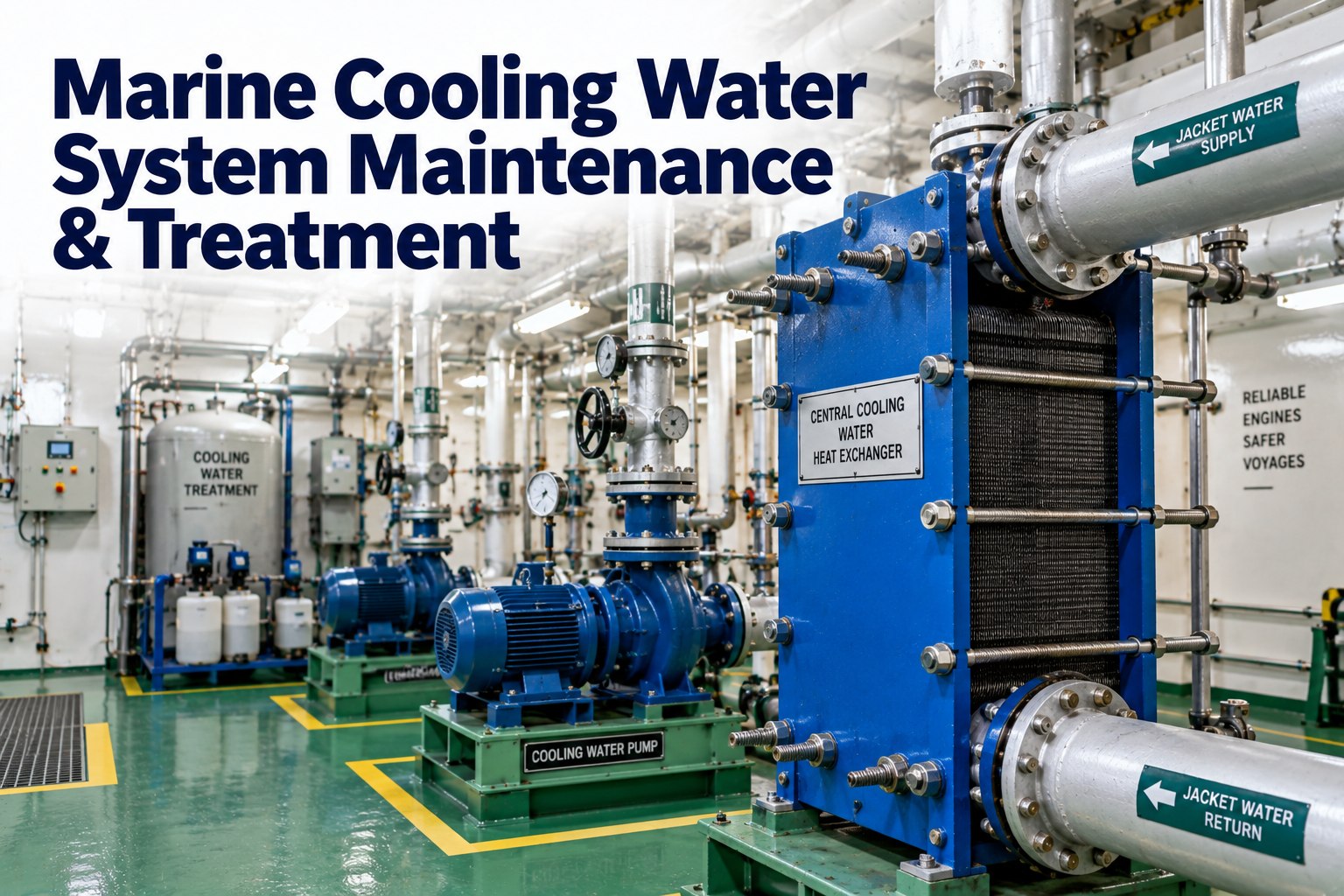
Cooling water is the cheapest thing in the engine room and the most expensive to get wrong. Untreated or badly treated water corrodes liner jackets and cylinder heads, scales heat exchangers until temperatures creep up, and pits pipework from the inside where nobody sees it until a leak appears. A cracked liner seal or a leaking cooler turns into oil in the jacket water, water in the sump, or seawater in the freshwater system, and each of those can take an engine out of service. Almost none of it is sudden. It builds over months, which is why the weekly water test and the heat exchanger differential readings matter more than any single maintenance job. This guide covers the whole system: how central cooling is arranged and where the heat goes, the chemistry to hold and how to test for it, dosing and top-up discipline, diagnosing contamination from a rising chloride or an oily sample, cleaning and pressure testing heat exchangers, pump and ancillary checks, and the seawater side that most fouling problems start on. Treat the figures here as typical control ranges, because the engine maker's manual and the chemical supplier's data sheet decide the limits for your ship. To keep test results and cleaning records with the equipment rather than in a folder on the desk, try Marine Inspection free.
Most cooling water failures are visible in the test log months before they are visible in the engine. The habits on this page are cheap. The repairs they prevent are not.
Know where the heat goes
Most modern ships use central cooling: seawater cools a central freshwater circuit, and that low temperature circuit cools everything else, while a separate high temperature circuit cools the engine jackets. Understanding which circuit a temperature alarm belongs to saves a great deal of guessing.
- Sea chests, high and low suctions, strainers
- Seawater pumps, usually duty and standby
- Central coolers, plate type on most ships
- Anti-fouling and anti-corrosion protection
- Overboard discharge and vacuum arrangements
- Charge air cooler, low temperature stage
- Lubricating oil coolers, main and auxiliary
- Air compressors, alternators, auxiliary equipment
- Three-way temperature control valve
- Expansion tank and venting
- Cylinder jackets, heads and exhaust valve cages
- Jacket water cooler and preheater
- Freshwater generator, using jacket heat
- Circulating pumps and thermostatic control
- Expansion tank with the treatment dosing point
Treatment chemistry and control ranges
Jacket cooling water is treated to stop corrosion, scale and cavitation damage. Nitrite-borate inhibitors are the common choice for marine engines, with molybdate-based products used on some systems. Do not mix inhibitor types, and do not use oily inhibitors, which coat the cooling surfaces and reduce heat transfer.
| Parameter | Typical control range | Why it matters | If it is out of range |
|---|---|---|---|
| Nitrite as NO2 | Commonly 1,000–2,400 ppm, with routine maintenance targets often quoted around 1,440 ppm | Forms the passivating film that protects the metal surfaces | Low: dose per the product data sheet and retest. High: stop dosing, no further benefit and it wastes chemical |
| pH | Commonly 8.3–10.0 | Slightly alkaline water protects the metal. Acidic water attacks it | Low: dose alkalinity control as the supplier specifies, then retest |
| Chloride | Most engine makers recommend a maximum of 50 ppm | Chlorides break down the protective film formed by the nitrite | Investigate for seawater ingress at once. Until it is back below the limit, guidance is to keep nitrite near the upper limit |
| Hardness | As low as practical, which is why distilled or demineralised water is used | Hardness forms scale on the hottest surfaces first | Use distilled make-up water and treat as the supplier specifies |
| Appearance and oil | Clear, no film, no rust particles | Oil insulates surfaces and feeds bacterial growth | Find the leak path before topping up and dosing again |
| Glycol, where fitted | Per maker, with inhibitor compatibility confirmed | Freeze protection changes heat transfer and chemistry | Confirm the inhibitor is compatible before mixing anything |
The weekly test routine
Testing is quick, so the discipline is in doing it the same way each time and writing down the result even when nothing has changed. That is what turns individual readings into a trend.
Dosing, filling and topping up
Most chemistry problems are caused not by the dosing but by the top-up. Water lost to evaporation should be replaced with distilled water, because the treatment stays behind when water evaporates. Water lost through a leak or a drain-down took the treatment with it, so it should be replaced with treated water and the level of inhibitor checked afterwards.
- Flush after cleaning until the water runs neutral, then drain
- Fill with distilled or demineralised water, leaving room in the expansion tank
- Prepare and add the inhibitor solution at the initial dose in the data sheet
- Top up to the working level and circulate, commonly for at least 24 hours
- Test and confirm the values before considering the system settled
- Test first. Dose against a measured value, never by habit
- Work out the addition from the product's dosage table, which is normally given per cubic metre of system volume
- Add through the dosing pot or the expansion tank as the supplier specifies
- Circulate, then retest after the period the supplier gives
- Record the quantity added, the system volume used in the calculation and the result
Reading the test results: what contamination looks like
The value of testing is diagnostic, not administrative. Each of these patterns points somewhere specific.
Heat exchangers: watch the differentials, then clean
Coolers lose performance gradually. The way to catch it is to log inlet and outlet temperatures on both sides, and the pressure drop across each side, at a fixed load. A rising temperature difference at the same load, or a rising pressure drop, means fouling somewhere.
- Compare the plate pack dimension with the maker's figure when closing up
- Open, clean and inspect on the maker's interval or on rising differential
- Check plates for pitting, cracking and erosion, particularly at the ports
- Renew gaskets as specified. Do not reuse deformed gaskets
- Keep the plate order and orientation exactly as marked
- Pressure test both sides after assembly before returning to service
- Clean tubes mechanically or chemically as the manual allows
- Check tube ends for erosion, which is where seawater velocity bites first
- Inspect and renew sacrificial anodes, and record the condition found
- Check the water boxes and coatings for corrosion and blistering
- Pressure test after tube work, and plug or renew leaking tubes as approved
- Record how many tubes are plugged, since capacity falls as the count rises
Pumps, valves and controls
The cooling system is only as good as the flow through it. These are the items that quietly reduce flow or hide a problem.
The seawater side, where fouling starts
Marine growth, silt and shell reduce flow before they block anything completely, and corrosion at high flow velocity attacks pipe bends, cooler tube ends and fittings. Guidance commonly limits flow velocity in seawater and freshwater lines to around 3 metres per second for this reason.
Troubleshooting matrix
Records that prove the system is managed
Cooling water work sits inside the machinery survey arrangement, and a surveyor will usually ask for the water test log before anything else.
Frequently asked questions
Weekly is common practice for jacket cooling water, with periodic laboratory analysis alongside. The supplier's programme and the engine maker's manual set the requirement for your ship.
Commonly between 1,000 and 2,400 ppm as NO2, with routine maintenance targets often quoted around 1,440 ppm. Always work to the data sheet of the inhibitor carried on board.
Chlorides attack the protective film the nitrite forms, so corrosion accelerates. Most engine makers set a maximum around 50 ppm, and a rising value usually means seawater is getting in.
Losses through evaporation are replaced with distilled water, because the chemical stays in the system. Losses through leakage or draining are replaced with treated water, then the levels are checked again.
By trend, not by calendar. A rising temperature difference or pressure drop at the same load is the signal. That is why the readings are worth logging at a fixed reference condition.
The water test log, treatment records, cooler cleaning and pressure test records, and any laboratory analysis. See our main engine overhaul guide and turbocharger guide, since cooling problems show up in both.
Marine Inspection records water tests, dosing, cooler cleaning and pressure tests at the machine, offline, links them to the equipment and running hours, and builds the survey pack from the same data.