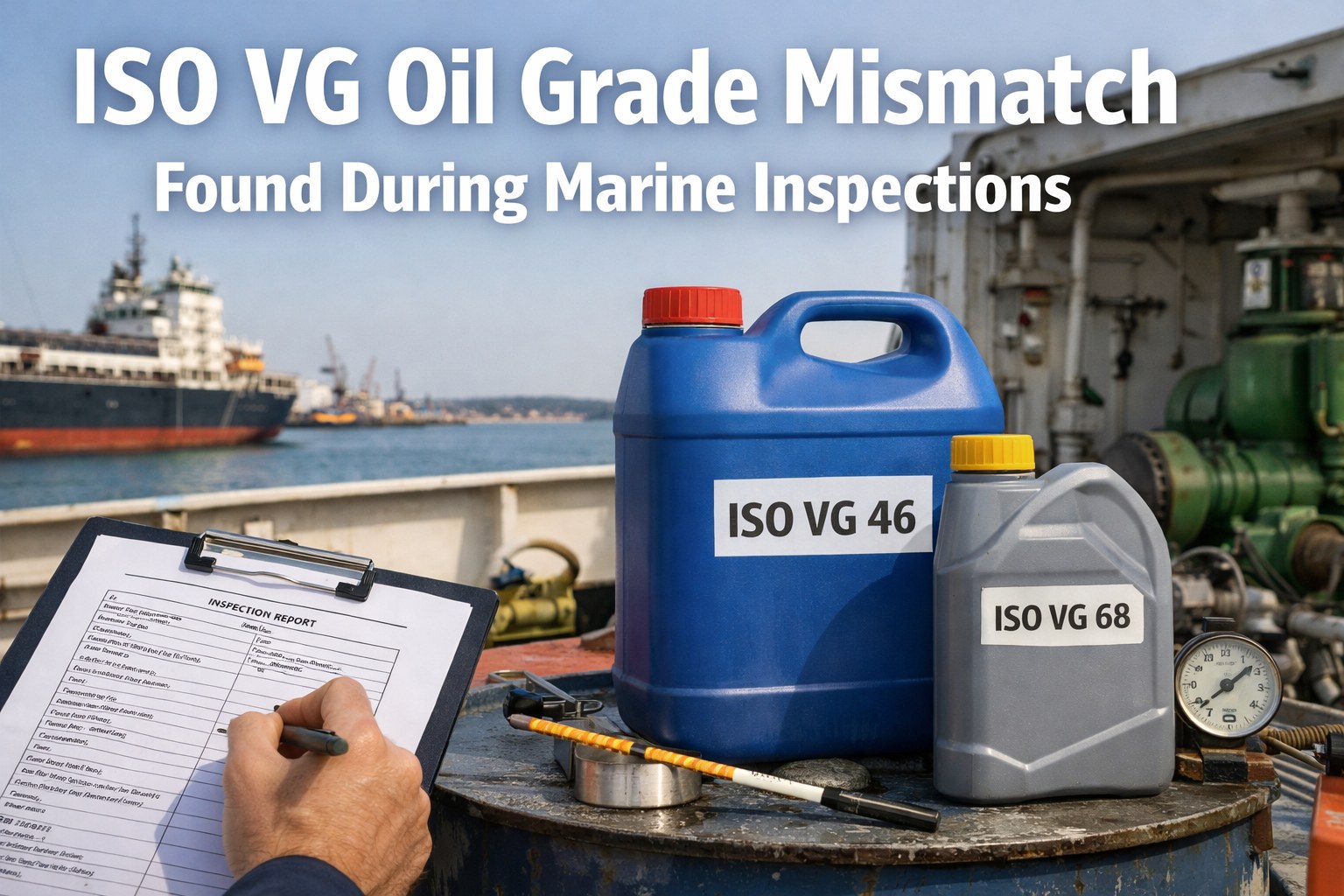
Port State Control inspectors board your vessel requesting engine room documentation. They pull manufacturer manuals, cross-check recommended oil specifications, then examine stored lubricant containers. Main engine crankcase shows SAE 40 on barrels—but manual specifies ISO VG 68. Hydraulic steering system runs ISO VG 32—manual requires ISO VG 46. Auxiliary engine uses SAE 30—correct per manufacturer but no documentation trail confirming specification match. Three viscosity mismatches trigger "improper lubrication management" findings, requiring corrective action before sailing. These violations stem from incorrect viscosity grades: wrong oil thickness creates accelerated wear, system failures,and compliance deficiencies that signup to digital oil specification tracking prevents through Marine Inspection's maintenance software that automatically matches installed oils against manufacturer requirements, maintaining inspection-ready viscosity documentation across all vessel lubrication systems.
5-7
Oil Systems Inspected
Main engine, aux engines, hydraulics, gearboxes, compressors
3
Verification Methods
Manual specs, container labels, oil analysis reports
ISO VG
Primary Standard
International viscosity grading system at 40°C
Understanding Viscosity Standards Inspectors Use
Port State Control officers verify oil viscosity using two primary classification systems: ISO VG (International Standards Organization Viscosity Grade) and SAE (Society of Automotive Engineers). ISO VG measures kinematic viscosity at 40°C in centistokes (cSt), with grades ranging from ISO VG 2 to ISO VG 1500. Common marine applications use ISO VG 32 (hydraulic systems), ISO VG 46 (deck machinery), ISO VG 68 (gearboxes), ISO VG 150 (stern tubes), and ISO VG 220 (heavily loaded bearings). SAE grades like SAE 30, SAE 40, and SAE 50 apply primarily to engine crankcases and measure viscosity at 100°C. Inspectors cross-reference installed oil grades against manufacturer manual specifications—mismatches between actual viscosity and required grades indicate improper lubrication management. Schedule a demo to see how Marine Inspection's digital maintenance platform automatically tracks oil viscosity specifications across all systems, eliminating manual cross-checking and maintaining compliant documentation for inspection readiness.
Common Marine Oil Viscosity Grades by System
Five Viscosity Verification Steps Inspectors Follow
PSC officers execute systematic viscosity verification to identify specification mismatches that indicate poor lubrication management or potential equipment damage risk.
1
Manufacturer Manual Review
Inspection Action:
Inspectors request lubrication charts from engine room manuals showing required oil specifications for each system. They photograph or note specified viscosity grades (ISO VG or SAE) for main engine, auxiliaries, hydraulics, gearboxes, and compressors.
Common Findings:
Missing lubrication charts, outdated manuals not reflecting current equipment, generic viscosity recommendations without system-specific details. Vessels unable to produce manufacturer specifications fail this initial verification.
2
Physical Container Inspection
Inspection Action:
Officers examine oil drums, containers, and storage areas verifying labels show correct ISO VG or SAE grades. They check containers feeding active systems—hydraulic reservoir showing ISO VG 32 supply, main engine sump displaying SAE 40 barrels, stern tube showing VG 150 containers.
Common Findings:
Unlabeled containers, mixed viscosity grades in same storage area, ISO VG 46 containers supplying system requiring VG 68, relabeled drums with uncertain contents. Any container lacking clear viscosity identification triggers compliance questions.
3
Cross-Reference Verification
Inspection Action:
Inspectors match physical oil grades against manufacturer requirements. They compare hydraulic system specification (manual: ISO VG 46) against installed oil (container: ISO VG 32), auxiliary engine requirement (manual: SAE 40) versus actual oil (sump sample: SAE 30), gearbox specification (manual: VG 100) versus container supplying system (label: VG 68).
Common Findings:
Viscosity mismatches between specifications and installed oils. Using thinner oil than specified (VG 32 instead of VG 46) increases wear. Using thicker oil (VG 68 instead of VG 46) impedes flow. Either deviation indicates improper lubrication management.
4
Oil Analysis Report Review
Inspection Action:
Officers request oil analysis reports from shore laboratories showing tested viscosity values. Reports should confirm installed oil maintains specification—ISO VG 46 oil testing at 41-51 cSt at 40°C (within ±10% tolerance), SAE 40 oil maintaining viscosity at 100°C per SAE J300 standards.
Common Findings:
Viscosity degradation beyond acceptable limits, contamination affecting viscosity, no analysis reports for critical systems within 6 months, analysis showing viscosity outside specification range indicating wrong oil or severe degradation.
5
Documentation Trail Verification
Inspection Action:
Inspectors examine Oil Record Book entries, planned maintenance system records, and bunker delivery notes confirming viscosity specifications during oil purchases and changes. They verify documentation shows deliberate selection of correct viscosity grades rather than arbitrary choices.
Common Findings:
Generic oil change entries without viscosity documentation, delivery notes not matching installed oils, planned maintenance showing scheduled changes but no viscosity verification, absence of decision-making trail showing proper specification selection.
Automate Viscosity Specification Tracking
Marine Inspection's digital maintenance platform automatically cross-references installed oil viscosity grades against manufacturer specifications, maintains documentation trails for PSC verification, and alerts crews when oil changes require specific viscosity confirmations. Eliminate manual tracking and ensure continuous compliance.
Why Viscosity Mismatches Fail Inspections
Incorrect oil viscosity creates three failure categories during PSC inspections: equipment damage risk, operational safety concerns, and documentation deficiencies showing inadequate lubrication management.
Equipment Damage Risk
Using oil viscosity lower than specified (ISO VG 32 in system requiring VG 46) creates insufficient film thickness—metal surfaces contact directly causing accelerated wear. Using viscosity higher than specified (VG 68 in system designed for VG 46) restricts flow, causes pump cavitation, increases energy consumption, and elevates operating temperatures.
Inspectors identify this through bearing temperature sensors showing elevated readings, pump noise indicating cavitation, wear debris in oil analysis, or visual inspection revealing scoring on bearing surfaces—all traceable to wrong viscosity selection.
Operational Safety Concerns
Hydraulic steering systems using incorrect viscosity (VG 32 instead of required VG 46) lose response precision during maneuvers. Deck machinery running thicker oil than designed (VG 100 vs. specified VG 68) experiences sluggish performance in cold conditions. Emergency systems like fire pumps requiring quick starts fail when oil viscosity impedes rapid circulation.
PSC officers test critical systems during inspections—slow hydraulic response, emergency pump startup delays, or winch operation failures in ambient conditions reveal viscosity-related performance degradation requiring immediate correction.
Documentation Deficiencies
Inability to demonstrate proper viscosity selection indicates systematic lubrication management failures. Missing manufacturer specifications, no documentation linking oil purchases to system requirements, or Oil Record Book entries lacking viscosity details all suggest crew doesn't understand proper lubrication requirements.
Inspectors cite ISM Code non-conformities when vessels cannot produce viscosity verification documentation. This triggers broader safety management system examinations potentially uncovering additional deficiencies beyond lubrication issues.
ISO VG vs SAE: Conversion and Compliance
Confusion between ISO VG and SAE viscosity systems creates compliance issues when crews substitute oils without understanding specification equivalencies. ISO VG 100 hydraulic oil is not equivalent to SAE 30 engine oil despite similar viscosity at some temperatures—they measure viscosity at different conditions (40°C vs. 100°C) and contain different additive packages for specific applications. Proper conversion requires understanding viscosity index (VI) which describes how viscosity changes with temperature. An ISO VG 46 oil at 40°C might equal SAE 20 at 100°C, but only oils with similar VI convert accurately. Sign up to access Marine Inspection's viscosity specification database that maintains proper ISO/SAE equivalencies for marine equipment, preventing substitution errors that fail inspections. The platform automatically flags when crew attempts substituting oil grades without proper viscosity matching, maintaining specification compliance across equipment changes and oil supplier transitions.
"Port State Control viscosity verification has intensified significantly over the past 5 years. Inspectors now routinely photograph oil container labels, compare them against manufacturer manuals, and cite discrepancies as evidence of inadequate lubrication management. The most common violation: vessels running ISO VG 32 hydraulic oil when manufacturers specify VG 46—crew buys cheaper thinner oil without understanding wear implications. Vessels demonstrating systematic viscosity tracking through documented specification verification, oil analysis confirming proper grades, and Oil Record Book entries showing deliberate viscosity selection consistently avoid these findings. The key is proving proper oil selection wasn't accidental—it requires documentation showing crew understands viscosity requirements and actively maintains correct grades across all systems."
Chief Marine Engineer
Classification Society Technical Department | 20+ Years PSC Inspection Coordination
Implementing Viscosity Compliance Management
Systematic viscosity specification management requires integrated tracking connecting manufacturer requirements, oil inventory, system assignments, and verification documentation. Successful vessels implement digital lubrication management maintaining current manufacturer specifications for all equipment, oil inventory database showing viscosity grades and quantities, system-to-oil assignment records linking each lubrication point to correct viscosity, and automated Oil Record Book entries documenting viscosity specifications during changes. Schedule a demo to see how Marine Inspection's maintenance software connects equipment manuals, oil specifications, inventory management, and compliance documentation into unified workflows. The platform generates inspection-ready viscosity verification reports showing all systems match manufacturer requirements, maintains photographic evidence of oil container labels matched to specifications, and alerts crews when oil changes require specific viscosity confirmations—eliminating manual cross-checking while ensuring continuous PSC readiness across fleet operations.
Maintain Inspection-Ready Viscosity Documentation
Marine Inspection's digital platform eliminates viscosity specification confusion through automated manufacturer requirement tracking, oil-to-system matching verification, and instant PSC-ready documentation showing all lubricants meet proper viscosity grades. Fleet operators reduce inspection findings while preventing equipment damage through systematic viscosity management guided by marine maintenance software.
Frequently Asked Questions
What's the difference between ISO VG and SAE viscosity grades?
ISO VG (International Standards Organization Viscosity Grade) measures kinematic viscosity at 40°C and applies primarily to industrial/hydraulic oils. SAE (Society of Automotive Engineers) grades measure viscosity at 100°C and apply to engine oils. ISO VG 46 means 46 centistokes at 40°C ±10% (41-51 cSt). SAE 40 means specific viscosity range at 100°C per SAE J300 standards. These are not directly equivalent—ISO VG 100 ≠ SAE 30 even though numbers seem similar. Conversion requires considering viscosity index (VI) and temperature. PSC inspectors expect crews to use correct system specified by manufacturer—using SAE oil in ISO-specified hydraulic systems or vice versa fails inspection regardless of similar viscosity numbers.
How do inspectors verify oil viscosity matches manufacturer specifications?
Inspectors use three-step verification: (1) Review manufacturer manuals to identify specified viscosity grades for each system, (2) Physically examine oil containers supplying those systems checking label specifications match requirements, (3) Compare oil analysis reports showing tested viscosity values confirm proper grades. They photograph oil drums showing ISO VG 32 label, then check if hydraulic system manual requires VG 46—mismatch indicates improper lubrication. They may request sump samples for immediate viscosity testing if discrepancies suspected. Vessels must demonstrate clear documentation trail: manual shows VG 46 requirement → purchase order shows VG 46 ordered → container label shows VG 46 delivered → oil analysis confirms VG 46 characteristics → Oil Record Book entry documents VG 46 installed.
What happens if hydraulic system runs ISO VG 32 when manual specifies VG 46?
Using thinner oil (VG 32 vs. required VG 46) creates insufficient film thickness between moving parts, increasing metal-to-metal contact and accelerating wear. Hydraulic pumps experience internal leakage reducing pressure and system response. Operating temperatures rise as thinner oil provides less cushioning. In cold ambient conditions, VG 32 offers better flow than VG 46 which tempts crews to use thinner oil—but warm-weather operation creates protection deficiency. PSC inspectors cite this as "inadequate lubrication management" requiring immediate oil change to correct specification. Classification societies may require bearing inspections if VG 32 operated long term in VG 46 system. Correct approach: use specified VG 46 and accept slightly slower cold-start performance which is designed into system tolerances.
Can we substitute SAE 85W-90 gear oil for ISO VG 68 in reduction gearbox?
Substitution depends on manufacturer approval and additive compatibility. SAE 85W-90 gear oil typically has viscosity range overlapping ISO VG 90-100 at 40°C, making it thicker than VG 68 at operating temperature. If gearbox manufacturer specifically approves SAE grades as alternative to ISO VG specifications, substitution is acceptable—but this approval must be documented. More problematic: gear oils contain extreme pressure (EP) additives for tooth contact loads while some gearboxes with bronze components require non-EP oils to prevent corrosion. Inspectors look for manufacturer explicit approval of substitution rather than crew assuming equivalency. Safest approach: use exact specification stated in manual (ISO VG 68 if specified) unless manufacturer technical bulletin specifically lists SAE alternatives. Document any approved substitution in maintenance records showing deliberate specification compliance rather than arbitrary oil selection.
How often should oil analysis verify viscosity stays within specification?
Main engine crankcase: every 1,000-2,000 running hours or per manufacturer schedule. Auxiliary engines: every 500-1,000 hours. Hydraulic systems: every 2,000 hours or annually. Gearboxes: every 2,000 hours or 6 months. Stern tubes: annually. Compressors: every 1,000 hours. More frequent analysis required if operating conditions are severe (high temperatures, heavy loads, contamination risk). Oil analysis reports should show: kinematic viscosity at 40°C for ISO VG oils confirming within ±10% of grade (VG 46 testing 41-51 cSt), viscosity at 100°C for SAE oils confirming within specification range, viscosity index (VI) showing oil maintains performance across temperature range. Viscosity trending matters—gradual viscosity increase indicates oxidation/contamination, gradual decrease indicates fuel dilution or wrong oil added during top-ups. PSC inspectors expect 3-6 months of analysis history demonstrating systematic monitoring rather than isolated tests.