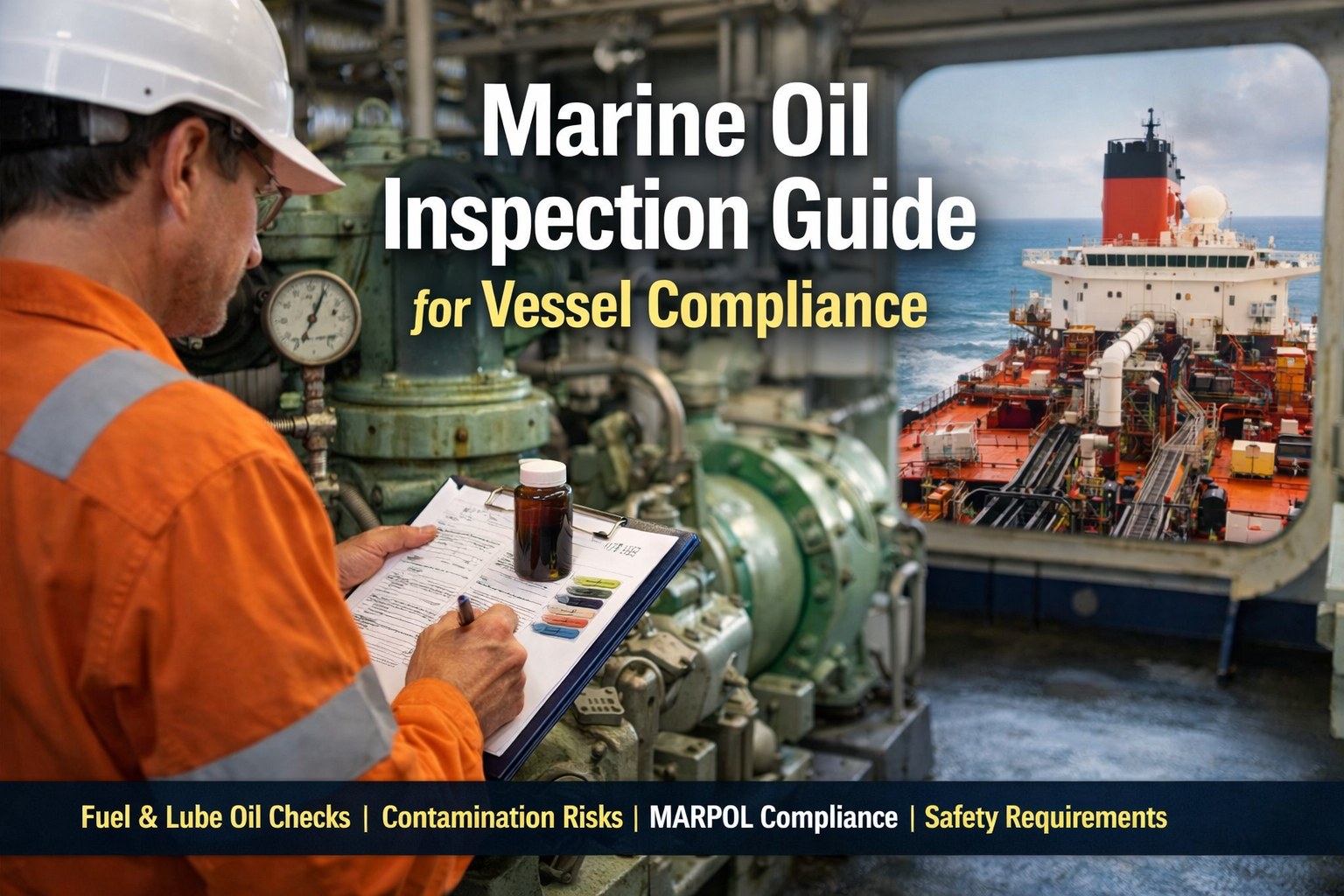
Marine Oil Inspection Guide for Vessel Compliance & Safety
Vessel compliance isn't optional—it's mandatory. For maritime operators, a single overlooked oil inspection creates cascading risks: MARPOL violations triggering six-figure fines, port state control detentions costing $20,000+ per day, and equipment failures stranding vessels mid-voyage. The stakes are clear: authorities can link offences occurring outside their jurisdiction to the records kept onboard, with multi-million dollar fines for owners, operators, and ship management companies. Marine oil inspection—covering both fuel oil and lubricating oil systems—stands as your first line of defense against regulatory penalties, operational failures, and safety incidents. Maritime professionals ready to eliminate compliance gaps with automated inspection tracking can leverage Marine Inspection's digital platform that schedules tests, tracks results, and maintains regulatory documentation across your entire fleet.
Marine Oil Inspection Compliance Landscape
MARPOL Violation Fines
$100K+
Average penalty for oil record book falsification
Port Detention Cost
$20K/Day
Daily loss during compliance holds
Engine Failure Rate
35%
Caused by inadequate oil monitoring
Critical Oil Inspection Categories for Vessel Compliance
Marine oil inspection encompasses four distinct categories, each carrying specific regulatory requirements and operational implications. Understanding which inspections apply to your vessel determines compliance obligations and prevents costly oversights.
Fuel Oil Inspection
Pre-bunkering and post-bunkering fuel quality verification to prevent contamination, ensure MARPOL compliance, and protect engine systems from damaging impurities.
Key Tests Required:
• Sulfur content (MARPOL Annex VI compliance)
• Water and sediment content (ASTM D1796)
• Viscosity, density, flash point (ISO 8217)
• Compatibility testing for fuel blending
Testing Frequency: Before every bunkering + quarterly stability checks
Lubricating Oil Analysis
Condition monitoring of main engine, auxiliary engine, stern tube, and hydraulic system oils to detect wear metals, contamination, and degradation before equipment failure.
Key Tests Required:
• Viscosity and Total Base Number (TBN)
• Wear metal analysis (Fe, Cu, Pb, Al)
• Water content and acid number
• Flash point and insolubles
Testing Frequency: Main engine every 500-1000 hours, auxiliary every 1000-2000 hours
MARPOL Documentation
Oil Record Book (ORB) entries, IOPP Certificate maintenance, and discharge monitoring to demonstrate regulatory compliance during port state control inspections.
Regular calibration of oil testing equipment, oil discharge monitoring systems, and separator alarms to ensure accurate readings and prevent false compliance claims.
Equipment Requiring Calibration:
• Oil Content Monitor (5-year calibration)
• Oily-Water Separator 15ppm alarm
• Onboard test equipment
• Fuel oil purifiers and settling tanks
Schedule: OCM 5 years, OWS annually, test kits per manufacturer spec
Fuel Oil Contamination Risks and Detection Methods
Fuel oil contamination remains the leading cause of engine damage and MARPOL violations. Water with high water content will burn less efficiently as the calorific value is reduced, and high amounts of water cause problems while transferring, settling at the bottom over time. Contamination sources include water ingress during bunkering, microbial growth in storage tanks, incompatible fuel blending, and chemical additives from off-spec suppliers. Schedule a demo to see how our platform tracks fuel testing results and compares them against ISO 8217 specifications automatically.
Fuel Oil Contamination Detection Matrix
Contamination Type
Detection Method
Threshold Limits
Engine Impact
Water Content
ASTM D1796 centrifuge test
Max 0.5% v/v
Reduced combustion efficiency, injector fouling
Total Sediment
ISO 10307 hot filtration
Max 0.10% m/m
Filter clogging, fuel pump wear
Sulfur Content
ISO 8754 XRF analysis
0.10% ECA / 0.50% global
MARPOL violation, cold corrosion
Microbial Growth
FUELSTAT rapid test (15 min)
Detection threshold
Fuel system corrosion, filter plugging
Incompatibility
ASTM D4740 spot test
Spot rating 1-2 acceptable
Asphaltene precipitation, sludge
Automate Your Fuel Oil Testing Program
Marine Inspection software schedules pre-bunkering tests, imports laboratory results directly into vessel records, and triggers instant alerts when fuel samples exceed ISO 8217 specifications—preventing contaminated fuel from damaging expensive engine systems.
Systematic lubricating oil analysis detects machinery problems 500-1000 running hours before catastrophic failure. Main engine bearing metal increases may necessitate load reduction or speed restrictions when oil analysis reveals sudden wear metal spikes. Sign up today to connect oil analysis results directly to equipment histories with automated trend tracking and threshold alerts.
Main Engine Lube Oil - Critical Parameters
Viscosity (cSt @ 40°C)
Measures oil film thickness and flow characteristics
Normal: ±10% of fresh oil value
Action: >15% change indicates oxidation or fuel dilution
Total Base Number (TBN)
Reserve alkalinity to neutralize acids
Normal: >50% of fresh oil TBN
Action: TBN <25% requires immediate oil change
Iron (Fe) Content
Indicates wear in liners, rings, bearings
Normal: 20-50 ppm (system dependent)
Action: 5-10x increase signals accelerated wear
Water Content
Detects cooling system leaks
Normal: <0.2% by volume
Action: >1% indicates seal failure
MARPOL Annex I Compliance and Documentation
MARPOL Annex I compliance centers on three pillars: accurate Oil Record Book entries, valid IOPP Certificates, and properly functioning oil discharge monitoring equipment. False statements by crew members to US Coastguard inspection teams and prosecutors, destruction or concealment of bypassing equipment, and incriminating records add considerably to the level of fines incurred. Marine Inspection's digital compliance tools eliminate manual ORB entry errors and track certification renewals automatically.
MARPOL Compliance Workflow for Oil Operations
1
Oil Record Book (ORB) Maintenance
✓ Record all oil transfers, discharges, bilge operations within 24 hours
✓ Master signature required on each ORB page per IMO MEPC.1/Circ.736/Rev.2 guidelines
✓ Officer in charge must countersign entries
✓ Include maintenance/breakdown records for OWS equipment
PSC Focus: Recent entries reviewed to verify documented operations match actual procedures
2
IOPP Certificate Validity
✓ Oil tankers ≥150 GT and all ships ≥400 GT require IOPP Certificate
✓ Initial survey before issuance, renewal every 5 years
✓ Annual surveys within 3 months of anniversary date
✓ Form A/B supplement must match actual equipment
Detention Risk: Expired certificates result in immediate port hold
3
Equipment Compliance
✓ 15 ppm bilge alarm operational and tested monthly
Criminal Violation: OWS bypass triggers felony prosecution in US waters
Sampling Procedures for Oil Inspection
Sample quality determines analysis accuracy. A contaminated or unrepresentative sample generates misleading results that mask actual machinery condition or fuel quality issues. Book a demo to explore our mobile app's step-by-step sampling checklists that ensure crews follow proper procedures every time.
Fuel Oil Sampling Protocol
Step 1
Pre-Bunkering Collection
Collect samples from top, middle, and bottom of supply tank before transfer. Minimum 1-liter sample for laboratory testing in clean sealed bottles. Document with photos and timestamps.
Step 2
Visual Inspection
Examine sample clarity—fuel should be clear and bright. Cloudy appearance indicates water contamination or asphaltene instability. Check for sediment after 30-minute settling.
Step 3
Laboratory Dispatch
Ship to ISO 8217-accredited lab within 24-48 hours. Request priority testing for sulfur content, total sediment, water content, and compatibility if blending.
Lubricating Oil Sampling Protocol
Step 1
Sampling Point Selection
Sample from designated point after filtration during operation. Purge 200-300ml stagnant oil before collecting actual sample to ensure representative quality.
Step 2
Collection Technique
Use clean dedicated bottles—never reuse containers. Collect 250ml minimum for full analysis. Fill completely, cap immediately, allow cooling with cap slightly loosened.
Step 3
Labeling and Shipping
Label with vessel name, equipment ID, oil type, date, running hours. Ship to laboratory within 72 hours. Request expedited analysis for suspected abnormal conditions.
Centralize Your Oil Inspection Program
Marine Inspection software digitizes sampling checklists, automates test scheduling, imports laboratory results directly into equipment records, and maintains complete MARPOL documentation—ensuring your vessels stay PSC-ready while preventing equipment failures across your fleet.
Effective oil inspection requires scheduled testing aligned with operational patterns and regulatory requirements. Get started with Marine Inspection to automate these schedules based on running hours, calendar intervals, and regulatory deadlines—ensuring no required test gets missed.
Oil Inspection Frequency Matrix
System/Test Type
Onboard Testing
Shore Laboratory
Regulatory Requirement
Fuel Oil - Pre-Bunkering
Visual, flash point, water test
Full ISO 8217 analysis every bunkering
MARPOL Annex VI sulfur verification
Main Engine Lube Oil
Weekly TBN, viscosity, water
Every 500-1000 running hours
Manufacturer recommendation
Auxiliary Engine Oil
Bi-weekly flash point check
Every 1000-2000 hours
Best practice
Stern Tube Oil
Weekly water contamination
Every 6 months full analysis
Classification society
Frequently Asked Questions
What are MARPOL Annex I requirements for oil discharge from machinery spaces?
Ships may discharge machinery space bilge water containing oil only when proceeding en route, more than 12 nautical miles from nearest land, with oil content not exceeding 15 ppm as measured by approved oily-water separator equipment. The discharge must not produce visible traces on water surface. All discharges must be recorded in the Oil Record Book with details including date, location, quantity, and reason. Ships must have operational 15 ppm bilge alarm systems and automatic stopping devices.
How do I detect fuel oil contamination before it damages my engines?
Pre-bunkering testing is essential. Before accepting fuel delivery, collect representative samples and conduct laboratory analysis for water content, total sediment, sulfur content, and compatibility testing if blending with existing fuel. Water content above 0.5% causes combustion efficiency loss and microbial growth. Total sediment exceeding 0.10% clogs filters and damages fuel pumps. Incompatible fuels create asphaltene precipitation requiring expensive tank cleaning. Post-bunkering, monitor fuel purifiers for excessive sludge buildup and conduct quarterly stability tests.
What lubricating oil test results require immediate action?
Immediate action required when water content exceeds 1% (indicates seal failure risk), TBN drops below 25% of fresh oil value (acid neutralization depleted), flash point decreases more than 20°C (fuel dilution creating fire hazard), or wear metals increase 5-10 times normal levels (accelerated component wear). These conditions demand machinery inspection, potential operational restrictions, and expedited corrective maintenance. Marine Inspection's software automatically categorizes results into action-required versus monitor-trend classifications based on configurable thresholds.
How does Marine Inspection software maintain compliance with oil inspection requirements?
Marine Inspection integrates oil inspection scheduling, laboratory result tracking, and MARPOL documentation into unified compliance workflows. The software automatically generates sampling schedules based on running hours, calendar dates, and regulatory requirements—eliminating missed tests. Laboratory results import directly into equipment histories, triggering alerts when parameters exceed thresholds. Digital ORB functionality ensures complete oil operation records with automatic timestamps and electronic signatures. IOPP Certificate and OCM calibration tracking provides advance notification of upcoming survey due dates with automated work order generation.
What's the cost impact of inadequate oil inspection versus systematic testing?
Systematic oil inspection costs $5,000-$15,000 annually for typical merchant vessels. This prevents catastrophic failures averaging $150,000-$300,000 for main engine bearing damage, plus operational losses of $20,000-$50,000 daily during repairs. MARPOL violations from inadequate ORB maintenance generate fines starting at $100,000. Port detention costs $20,000+ daily. Marine Inspection software costs $200-$400 monthly per vessel—delivering 20-30x ROI through prevented failures and avoided violations. Single prevented failure pays for years of software subscription.
Transform Your Vessel Oil Inspection Program
Marine Inspection's comprehensive software eliminates oil inspection gaps through automated scheduling, integrated laboratory results, digital MARPOL documentation, and predictive maintenance triggers—reducing compliance risks while preventing costly equipment failures across your entire fleet with cloud-based accessibility from ship to shore.