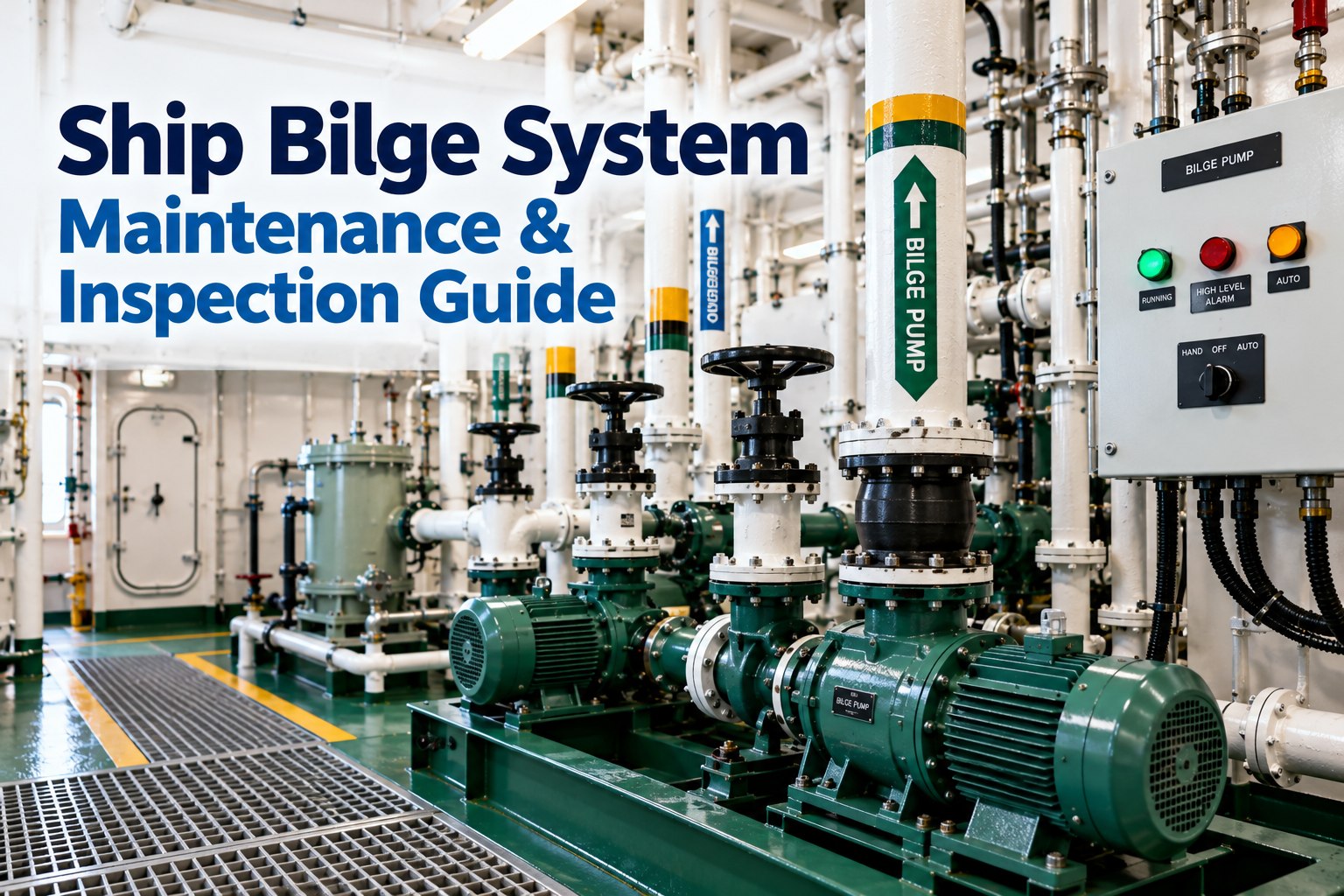
Ship bilge system maintenance is the routine of keeping bilge wells clean, suctions clear, non-return valves tight, high-level alarms working and the emergency bilge suction ready, with records that prove it. It matters because the bilge system is the ship’s first defence against flooding and a frequent route for oil pollution, and port state control inspectors test both. Get it wrong and the cost ranges from a failed alarm test and a deficiency to an oily bilge, a pollution case or a detention.
Dry wells, working alarms, clean records: getting the bilge system through any inspection
Suction tests, alarm checks, valve care and well cleaning in one routine the whole engine department can follow.
Free sign-up · Offline checklists at sea · Signed PDF reports
Every ship has a bilge system, and most of the time it is ignored until a high-level alarm sounds at 0300. The arrangement is simple: wells and strum boxes collect water, mud boxes and non-return valves guard the suction lines, a valve chest routes the bilge main to the pumps, and the water goes to a holding tank and oily water separator. One extra line, the emergency bilge suction, can dump large volumes of water overboard through a main sea water pump if the engine room floods.
Because it is simple, inspectors expect it to work every time. This guide covers what SOLAS and MARPOL require, how to run a bilge suction test, alarm and emergency suction checks, non-return valve and mud box care, bilge well cleaning, PSC deficiencies and the records inspectors ask to see. To run the round on your crew’s phones, offline, you can start logging bilge checks free.
Ship bilge system maintenance starts with knowing the layout
Before testing anything, the engineer doing the round should be able to trace every suction from the well to the overboard or the holding tank. A typical engine room arrangement looks like this:
Typical arrangement; your ship’s bilge and ballast diagram is the reference. Keep it posted near the valve chest.
Bilge pumping arrangement under SOLAS and MARPOL: what the rules require
Three sets of rules shape the bilge system. Inspectors check the equipment against them and the records against what the crew say they do. For the wider regulatory picture see SOLAS compliance.
Bilge pumping arrangements
An efficient bilge pumping system able to pump from and drain any watertight compartment, with arrangements that stop water passing from the sea or ballast into dry spaces or between compartments. Reg. 35-1 also requires an emergency, or direct, bilge suction in the machinery space.
Periodically unattended machinery spaces
Bilge wells must be placed so liquid build-up is detected at normal angles of heel and trim, and be large enough to hold normal drainage during the unattended period.
Oily bilge water
Machinery space bilge water can only go overboard through approved oily water separating equipment at 15 ppm or less, with the 15 ppm alarm and automatic stop working. Bilge water movements and discharges are entered in the Oil Record Book.
Summary based on SOLAS II-1, IACS UI SC251 and Marine Insight’s summary of the unattended machinery space rules. Check the exact text and your class rules for your ship.
Bilge suction test: how to prove every suction draws
A suction that is blocked, a valve that will not open or a mud box with a torn gasket only shows itself when you try to pump. Test every suction, one at a time, rather than assuming the main works because one well empties.
Plan and line up
Check the bilge diagram, confirm where the water will go (holding tank, not overboard) and agree who watches each well.
Put water in the well
If the well is dry, add clean water so you can see the level fall. A dry well proves nothing.
Open one suction only
Open the suction valve for that well alone, start the pump and watch the level and the pump suction gauge.
Watch for air leaks
Poor vacuum or a pump that loses suction points to a leaking mud box cover, gasket, valve or pipe.
Close and repeat
Close that suction, check the non-return valve holds, then move to the next well.
Record each suction
Log every well tested, the result and any defect, so the record shows the whole system was proven.
Show the inspector every bilge test, not just the last one
Each well, alarm and valve check recorded with the time, the result and a photo if something was wrong.
Free to start · Works offline on board · Export to signed PDF
Bilge alarm test and emergency bilge suction checks
High-level alarms and the emergency bilge suction are both things you hope never to need, which is exactly why they fail unnoticed. Test them on a fixed routine, and test the whole chain: the float or sensor, the alarm panel, the engineer call system and the bridge where it is linked.
Look at every well, sound or check levels, note anything unusual about how much water is coming in.
Bilge high-level alarm test on each well by lifting the float or raising the level, confirmed at the panel and engineer call.
Bilge suction test on each well; emergency bilge suction valve operated through its full travel.
Alarms proven, wells dry, automatic bilge pump and its excess-inflow alarm working where fitted.
Bilge valves, non-return valves and suction ends opened, inspected and overhauled; pipework checked for wastage.
Typical intervals; set your own in the planned maintenance system and follow the ship’s SMS. Pre-departure checks are covered in pre-departure inspection.
Bilge non-return valve and mud box maintenance
Non-return valves and mud boxes are small parts with big consequences. A non-return valve stuck open can let water flow from one compartment to another, or back from the sea; a mud box with a damaged cover or gasket lets air in and kills the suction.
Bilge well cleaning and the bilge maintenance checklist
A clean, dry, oil-free bilge well is the easiest thing for an inspector to judge and one of the most telling. Oil in the bilge points to a leak someone has not traced; rags and debris point to suctions that will choke when you need them.
Aft bilge well pump-outs per day: spotting a hidden leak (illustrative)
Illustrative only. Pump-outs rising from one to four a day flagged a leaking sea water pump seal, repaired on Friday. Logging how often each well is pumped shows a leak long before an alarm does.
Bilge system PSC deficiency and detention risks
Bilge findings at port state control fall into two groups: safety (alarms, suctions, valves) and pollution (oil in the bilges, OWS and Oil Record Book). Hong Kong’s published list of detained ships for 2025 includes examples of both.
Newcastle, Australia, January 2025
Bilge water discharged overboard with no sample water flowing through the 15 ppm measuring cell; 15 ppm alarm arrangements defective.
Bremen, Germany, September 2025
About 34 cm of oily water found in the engine room pipe tunnel, to be discharged and cleaned.
High-level alarm not working
Float stuck, sensor fouled or alarm not reaching the engineer call system.
Suction or valve inoperative
Choked strum box, seized valve or emergency bilge suction that cannot be opened.
Oily bilges
Oil in wells or tank tops with no record of where it came from or where it went.
Records that do not add up
Oil Record Book entries that do not match holding tank soundings or OWS running hours.
Detention examples from the Hong Kong Marine Department’s 2025 detention list. Common findings are typical inspection points, not ranked statistics.
How Marine Inspection supports ship bilge system maintenance
Marine Inspection puts the bilge round on the crew’s phones, works offline in the engine room and turns every test into evidence.
For the full engine room routine see engine room maintenance, and for plans by fleet size see Marine Inspection pricing.
Ship bilge system maintenance: test it, clean it, record it
Ship bilge system maintenance does not need to be complicated: test every suction and every alarm on a fixed routine, keep the wells clean and dry, keep the non-return valves and mud boxes in order, exercise the emergency bilge suction and record all of it. Do that and the bilge system will be ready when it matters, and ready for the inspector when it does not. Keep the results in a digital engine room logbook so the round never depends on one person remembering.
Prove every bilge suction, alarm and valve with a record the inspector can read
Free sign-up · Offline at sea · Signed PDF reports