An engine room audit is where paper and machinery meet. The PMS says a job was done, the alarm log says a test passed, the oil record book says the sludge went ashore, and the auditor checks each claim against the space itself. This checklist gives chief engineers the route, the records and the live tests that auditors and PSC officers use, and shows how to keep the whole audit with its evidence in Marine Inspection.
Engine room audit checklist: test the records, the alarms and the space itself
A clean engine room with weak records fails an audit, and so do perfect records over a leaking fuel line. Score the four areas below separately, because an inspector will.
Why the engine room audit matters: fire, pollution and PSC
The engine room carries most of a ship’s fire risk and nearly all of its pollution risk, and both show up in inspection data. A finding here can be a detention, and a falsified record can be a criminal case. See machinery findings tracked across a fleet.
Engine room audit route: walk the machinery spaces in order
A fixed route stops the audit becoming a tour of whatever looks interesting. Start in the control room with the records, then walk the spaces with them in hand, so every claim on paper can be checked against the machinery. Load this route as a free audit template.
PMS records audit: what the running hours should prove
A planned maintenance system is only as good as the data in it. Auditors sample a few machines and follow them from counter to job card to spare part. Our PMS for ships guide explains how the system is structured; here is what to test. See PMS evidence attached to each job.
Counters match the system
Running hours in the PMS agree with the counters on the machine and the engine log.
Overdue and deferred jobs
Every deferral has a reason, a risk assessment and shore approval where the procedure demands it.
Critical equipment identified
The ISM Code expects equipment whose sudden failure is hazardous to be identified and its back-ups tested regularly.
Job history says what was found
Readings, wear and parts used recorded, not just “done”.
Spares for critical items
Minimum stock held and the store count matches the inventory.
Class survey items aligned
Continuous survey items due match the PMS schedule and class status report.
Oil record book and Annex VI records audit
Pollution records are where inspectors look for consistency over time. Check the books against the tanks, the bunker notes and each other. Entry codes are covered in our oil record book entries guide, and the cross-checks inspectors calculate are in how oil records are audited.
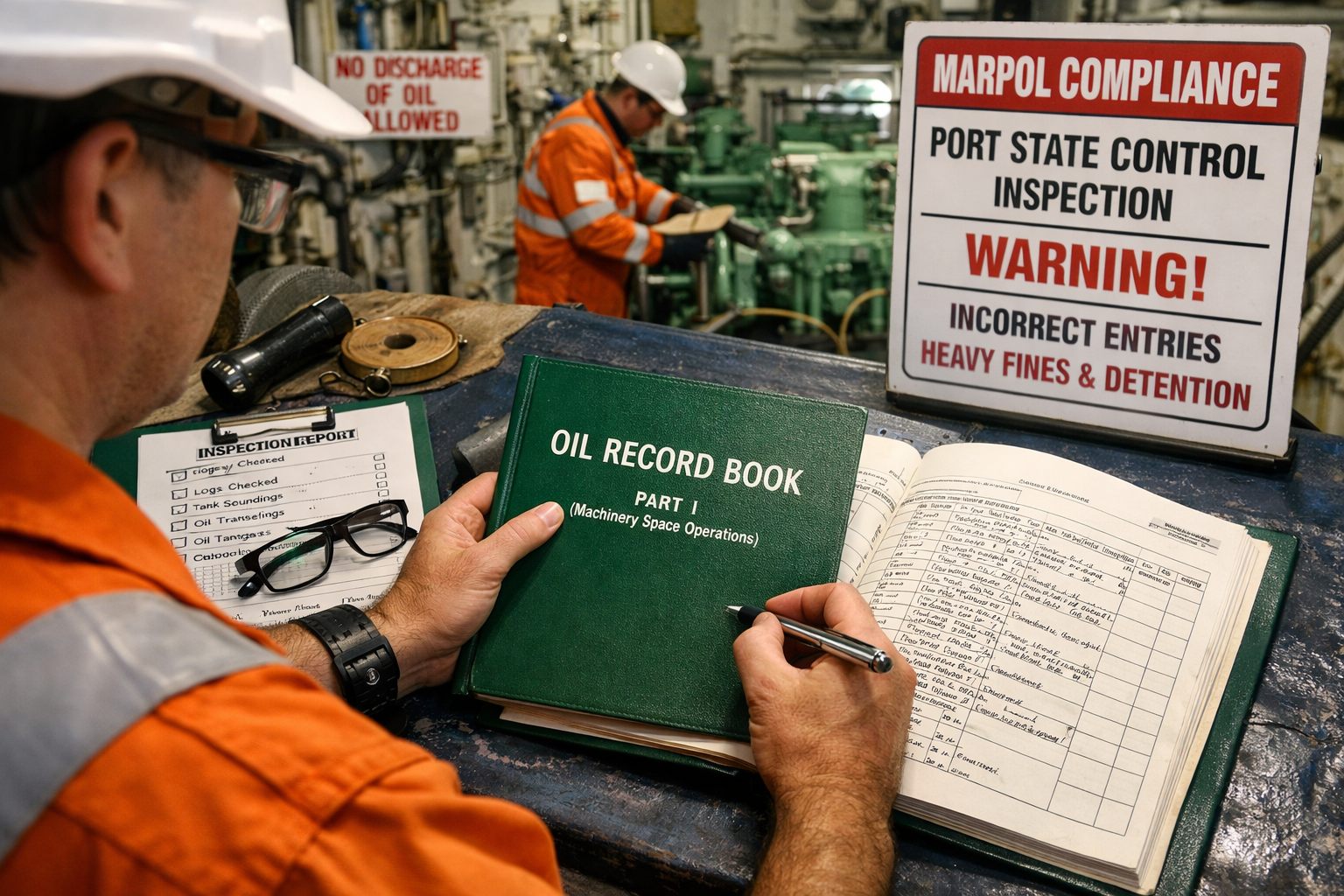
Oil record book Part I
- Entries in code order, dated, signed by the officer and each page by the master
- Sludge and bilge quantities agree with tank soundings and capacities
- Incinerator, shore discharge and evaporation entries backed by receipts and logs
- OWS and 15 ppm alarm entries match maintenance and test records
- Book kept on board for three years after the last entry
Annex VI records
- Bunker delivery notes kept for three years; samples kept at least 12 months
- Fuel changeover records for each emission control area entry and exit
- Record book of engine parameters kept with the NOx Technical File
- Ozone-depleting substances record book, where the ship has such systems
- Fuel oil consumption data collected for the IMO reporting system
Electronic record books are allowed where the flag approves them under IMO guidelines (MEPC.312(74)).
Ring the engine room to ready before the auditor boards
PMS status, alarm tests, pollution records and walk-round photos gathered in one audit pack per ship.
Alarm and safety device testing: the record and the live test
Auditors ask for the test record and then ask for a test. If the two disagree, the record loses. Intervals below are typical; follow the maker, class and your own procedures where they differ. Schedule each test as a recurring job free.
| Device or system | What to test | Typical interval | Evidence |
|---|---|---|---|
| Main engine safety system | Shutdowns and slowdowns from their sensors | Per maker, often quarterly | Test record with values |
| Oil mist detector | Alarm and slowdown function | Per maker, often monthly | Test log |
| UMS alarms | Engineer call, watch alarm, extension to cabins and mess | Before each unmanned period; weekly | UMS checklist |
| Bilge high level alarms | Each float or sensor in turn | Weekly or monthly | Alarm log |
| Quick-closing valves | Remote closing from outside the space | Per procedure, at least at drills | Drill and test record |
| Emergency stops | Fuel pumps, purifiers, ventilation fans | Per procedure | Test record |
| Emergency generator | Automatic start and connection to the emergency switchboard | Weekly start, periodic load test | Log with start time and load |
| Emergency fire pump | Start, suction and pressure at the hydrants | Weekly or at drills | Log with pressures |
| Fire detection | Detector heads tested in rotation | Per maker; all heads over a cycle | Test log by loop |
| Boiler safety devices | Low water, flame failure, safety valves | Per maker and class | Test record |
Machinery space fire risk: what engine room auditors look for
Most engine room fires start when oil meets a hot surface. SOLAS has required protection against this since July 2003, and IMO’s engine room fire guidance (MSC.1/Circ.1321) lists the shipboard habits that go with it. The routine machinery checks sit in our engine room inspection checklist; see fire-risk findings logged with photos.
Hot surfaces insulated
Surfaces above 220°C that oil could reach after a pipe failure must be insulated or shielded. Check lagging after every repair.
High-pressure fuel pipes
Double-walled delivery pipes with leak collection; leakage alarms working.
Spray shields on flanges
Fuel, lube and hydraulic oil joints near ignition sources fitted with shields, not left off after maintenance.
No oil in the bilges or on tank tops
Excessive oil leakage has led to detention on fire risk grounds.
Oily rags and waste
Kept in closed metal bins, emptied regularly.
Flexible hoses
Fuel hoses with doubtful condition or no date replaced, not tightened while running.
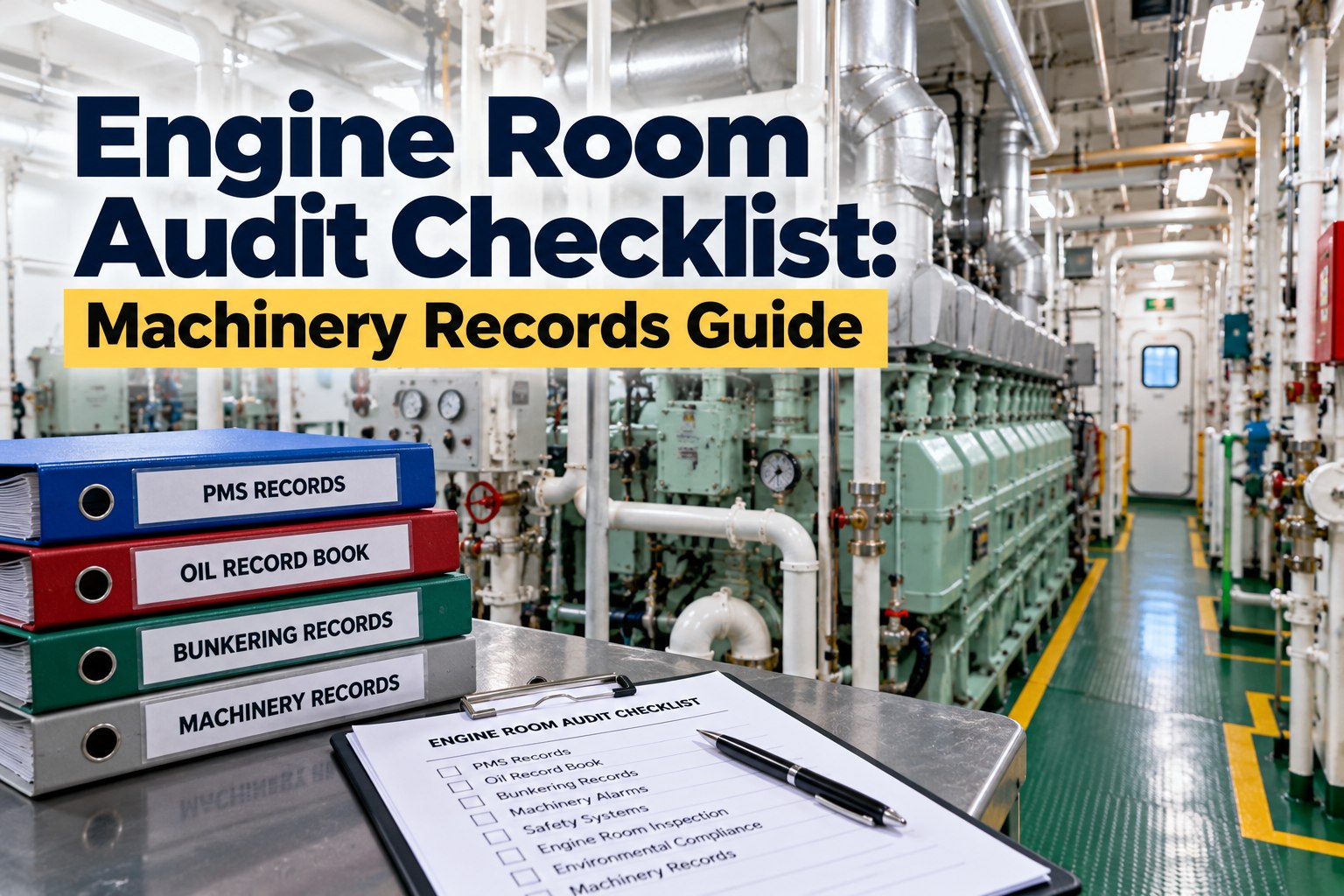
Engine room audit checklist
Tick these items on each audit. They follow the route above, so findings can be logged where they are seen.
Records
Tests
Machinery spaces
How Marine Inspection builds the chief engineer’s engine room audit pack
The hard part of an engine room audit is gathering evidence from five systems before the auditor arrives. Marine Inspection assembles it as one pack per ship, with each section showing what is complete and what still needs attention. The pack below is an illustrative example.
Engine room audit FAQs
What does an engine room audit cover?
The planned maintenance records, pollution records such as the oil record book and bunker notes, alarm and safety device tests, and the physical condition of the machinery spaces, with a focus on fire and pollution risk.
Who carries out an engine room audit?
The chief engineer usually prepares it and the company’s technical superintendent or internal auditor carries it out, often as part of the ISM internal audit. Class surveyors and PSC officers inspect the same items from the outside.
How long must the oil record book be kept?
On board, readily available, for three years after the last entry. Bunker delivery notes are also kept for three years, and fuel samples for at least 12 months.
Which engine room items most often lead to detention?
Fire safety items lead the statistics: oil leaks and missing insulation on hot surfaces, emergency generators or fire pumps that fail to start, inoperative quick-closing valves and untested fire detection. Pollution records that do not add up are the other major risk.
Why do PMS running hours matter in an audit?
They prove that maintenance is based on how the machine has actually run. Hours that do not match the counters suggest the system is filled in after the fact.
Can the oil record book be kept electronically?
Yes, where the flag State approves an electronic record book that meets IMO guidelines. Marine Inspection can link those records to the audit pack.
An engine room that matches its records
Plan audits, test alarms, reconcile records and close machinery findings with photo evidence, ship by ship.