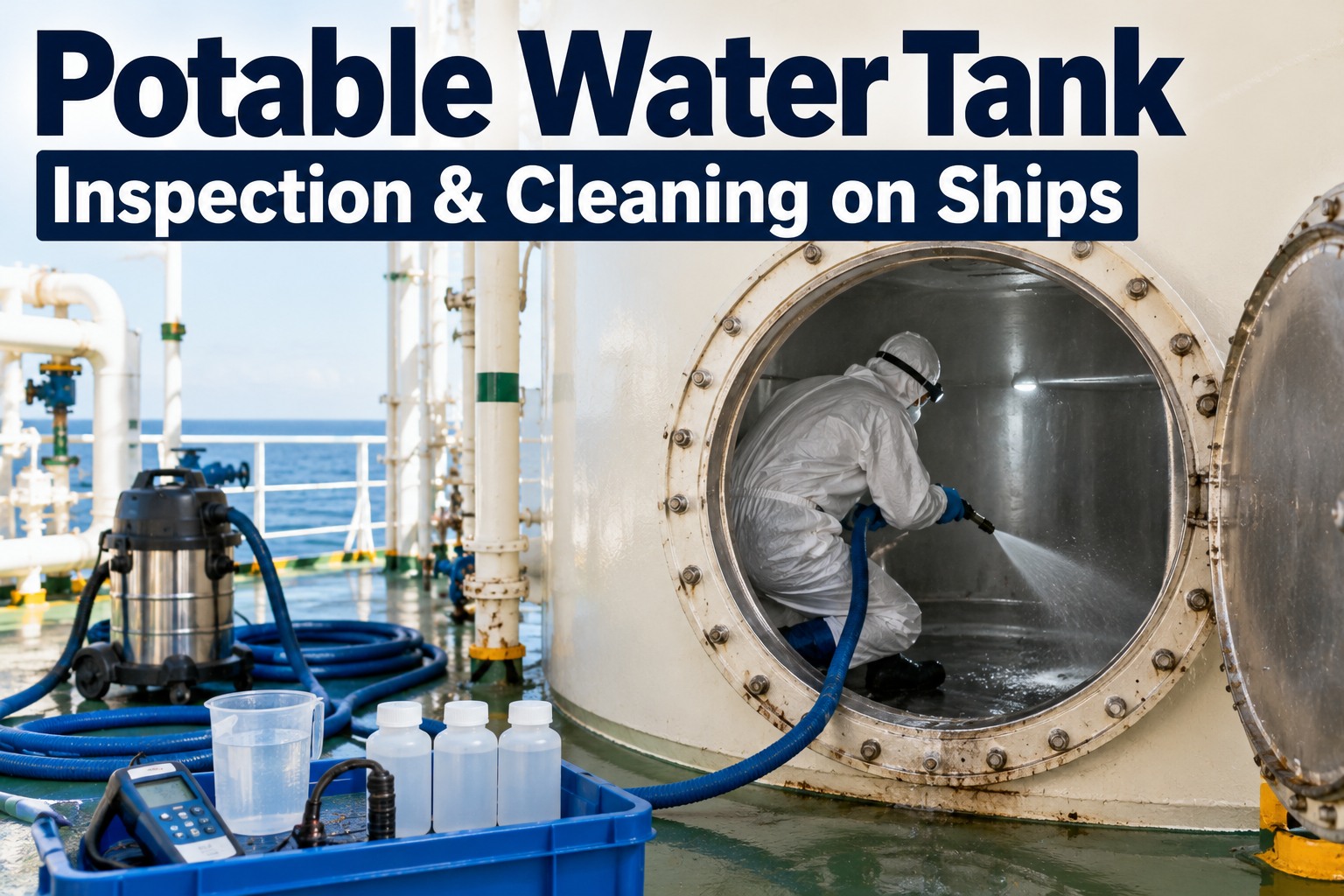
Potable water tank inspection is one of those jobs that is easy to log and easy to neglect, until a sample fails or a port health officer asks when the tank was last cleaned. What does the Maritime Labour Convention require, which intervals and chlorine levels do published sources give, and what should a Chief Officer be able to show on the day? This guide covers potable water tank inspection and cleaning on ships using the MLC 2006 inspection wording, the UK MCA notice, the WHO guide, a 2013 review and two recent port health studies. It labels what is flag-specific, old or small-sample, and ends with a checklist and a troubleshooting table. For tracking the dates, see our certificate and compliance tracking.
What Inspectors and Port Health Officers Look For in Drinking Water
A documented weekly inspection, a sound tank and water that tests clean
Three different readers look at your potable water. A port State control officer checks the MLC food and catering items, where the Paris MoU questionnaire asks whether frequent inspections of drinking water supplies, their storage spaces and the galley are documented. Port health officers may sample the water itself. Your flag State sets the numbers you work to. The MLC does not, because the ILO says the Convention leaves water quality standards to flag State implementation and points to the 2001 WHO and ILO guidelines.
That makes the paper trail the first thing anyone sees. We found no published port State control count of drinking water deficiencies on their own, so we cannot say how often they cause detentions. What the sources do show is how often samples come back with a poor residual or a positive result, covered below. The 2014 UK notice is only one flag's guidance, but it is the most specific published set of intervals we reached, and we use it as an example throughout.
Potable Water Requirements: MLC 2006, WHO Guidance and Flag State Notices
Four sources, and what each one actually gives you
Inspectors ask: are the inspections written down? The Paris MoU questionnaire wording matches this.
Means: the numbers you work to usually come from your flag State.
We did not obtain: the full text, so we quote no clause numbers from it.
Note: amendments exist, so check your own flag's current notice.
The practical reading is simple. The MLC wants the inspection done and written down, WHO guidance gives the public health framework and your flag State gives the intervals, chlorine targets and records. Where your flag has no notice of its own, a port health officer will often work from WHO guidance, so a water safety plan is a sensible way to show how you manage the system.
How Often Should Potable Water Tanks Be Cleaned and Inspected?
The UK MCA interval list, from weekly checks to the five-year pressure test
The question is searched constantly and there is no one global answer. The best published example is the annex of the UK MCA notice, which sets out intervals from a weekly inspection by the Master to a five-yearly pressure test of the tanks. The timeline shows them in order. It also says tanks should be marked Potable Water, kept independent of the hull and away from oil tanks where practicable, rotated in use to avoid stagnation, and sized for at least a two-day supply except where a water-making plant can reliably cover the difference.
Potable Water Chlorination and Sampling: What the Evidence Shows About Residuals
Chlorine targets quoted in the sources
The UK notice describes routine chlorination at loading as good practice, not a requirement, with a target of 0.2 mg/L residual free chlorine and a commercial test kit to check it. A 2013 review in International Maritime Health quotes the WHO drinking water guideline of 0.2 to 0.5 mg/L free chlorine and a passenger ship water safety plan operational limit of at least 0.2 mg/L and no more than 5.0 mg/L, with hourly monitoring during bunkering and limits above 2.0 and below 5 mg/L. For cargo ships, the authors recommend not less than 0.2 mg/L, checked regularly by an assigned crew member.
What sampling at ports and in surveys has found
The shape of the problem is clear even though the data is limited. A 2005 survey of 950 samples from 342 ships, cited in the 2013 review, found 8.6% with coliform agents and only 20% with a free chlorine residual in the 0.2 to 5 mg/L range. A conference abstract from the Port of Leixões, Portugal, covering 100 samples from 11 cargo ships in 2022 to 2024, found free chlorine below 0.2 ppm in 56 of 95 readings and Legionella pneumophila at 14 of 63 points. Both are older or small studies, not fleet rates, and the Leixões abstract does not state its limits.
A Legionella case that shows the response
A separate Leixões abstract describes a cargo ship where three February and March 2022 samples were positive for Legionella pneumophila at 50, 130 and 200 CFU per litre. The port health authority recommended thermal shock, disinfection and a water safety plan because the ship had none, both tanks were chlorinated and 25 later samples from April 2022 to May 2024 were negative. The abstract gives no dosing rates or contact times, so we cannot use it as a procedure. It does show that a written plan and a verified result changed the outcome.
How to Plan a Potable Water Tank Clean, Disinfection and Inspection
A six-step planning sequence, and why we quote no dosing rate
Cleaning is a planned job that touches enclosed space entry, chemicals, coatings and test records at once. The sequence below is our suggested order for planning. The disinfection strength and contact time depend on your method, your chemical supplier's data sheet and your flag or port health requirements, so take them from your own procedure.
Raise the job as a planned task with an owner, a due date and a place for before and after photographs. Tracking it through preventive maintenance schedules and maintenance work orders keeps the next due date visible instead of buried in a logbook.
Potable Water Troubleshooting: Symptoms, Likely Causes and First Checks
From low chlorine to a positive Legionella sample
Use the table as a general guide to the first checks. It is our own summary and not a regulation, and any suspected contamination should be handled under your water safety plan and, if needed, with port health advice.
| Symptom | Likely cause | What to check | Typical first fix |
|---|---|---|---|
| Residual chlorine below target | Dosing stopped, stale water or no residual left after loading | Test kit reading, dosing equipment, how long the water has stood | Restore dosing and re-test, then log both readings |
| Chemical or oily smell or taste | Contamination from a hose, supplier water or a system fault. One 2013 review notes solvents found in tap water with an aromatic smell | Source of the last bunkering, hose condition, other taps | Stop use of the affected supply and sample it before serving |
| Brown or rusty water | Corroded pipework or a failed tank coating | Tank condition at the next inspection, filters | Flush, inspect and plan coating repair |
| Cloudy water after loading | Supplier water quality or a blocked filter | Supplier certificate, filter state | Clean or replace the filter and re-test |
| Legionella found in a sample | Warm, stagnant water and dead legs. A port study followed a positive sample with chlorination of both tanks and a water safety plan | Temperatures, dead legs, how often outlets are used | Follow your water safety plan and port health advice |
| Hot water below temperature | Calorifier or circulation fault | Calorifier set point, circulation pump | Repair the fault and re-check temperatures |
Potable Water Inspection Checklist for the Chief Officer
A checklist with a checkpoint type on each item
Use this checklist for the weekly inspection and again before arrival. Pair it with your ship's own water safety plan. For the wider inspection, see our complete port state control preparation guide for ship masters.
| Item | What to check | Checkpoint type |
|---|---|---|
| Master's weekly inspection | Done, recorded in the logbook and signed by the right people | Record |
| Tank marking and outlets | Tanks marked Potable Water, outlets labelled, non-potable outlets marked unfit for drinking | Visual |
| Tank condition | Coating intact, no rust, sediment or leaks, manholes and vents secure | Visual |
| Free chlorine residual | Measured with a calibrated test kit and logged with date and location | Test |
| Bunkering record | Supplier, date, quantity and any supplier water quality certificate kept | Record |
| Filters | Cleaned or replaced to the planned interval, with a record | Record |
| Hoses | Dedicated potable hoses, clean, stored off the deck, flushed and disinfected to the plan | Visual |
| Hot water system | Calorifier temperature and circulation checked, with a record | Test |
| Tank clean and disinfect record | Last clean, disinfection and any inspection dates available to show | Record |
| Sampling | Samples taken to the water safety plan and results filed, including from outlets | Test |
| Crew information | Water quality reports available to the crew in a language they understand | Record |
Six Potable Water Habits That Lead to Failed Samples and Findings
What the studies and notices point to
Keeping Potable Water Records, Photos and Due Dates in One Place
How a dated photo repository, task ownership and deadlines support drinking water safety
Water findings recur when the dates slip and nobody owns the fix. Marine Inspection supports a dated photo repository, observations turned into tasks with owners, deadlines and evidence, and certificate and equipment tracking. A dated photo of a clean tank, a task for a failed chlorine reading with a named owner and a due date and tracked filter and hose intervals give a Chief Officer a record to show an inspector. It does not replace your SMS, water safety plan or flag State requirements. See Marine Inspection pricing for plans.