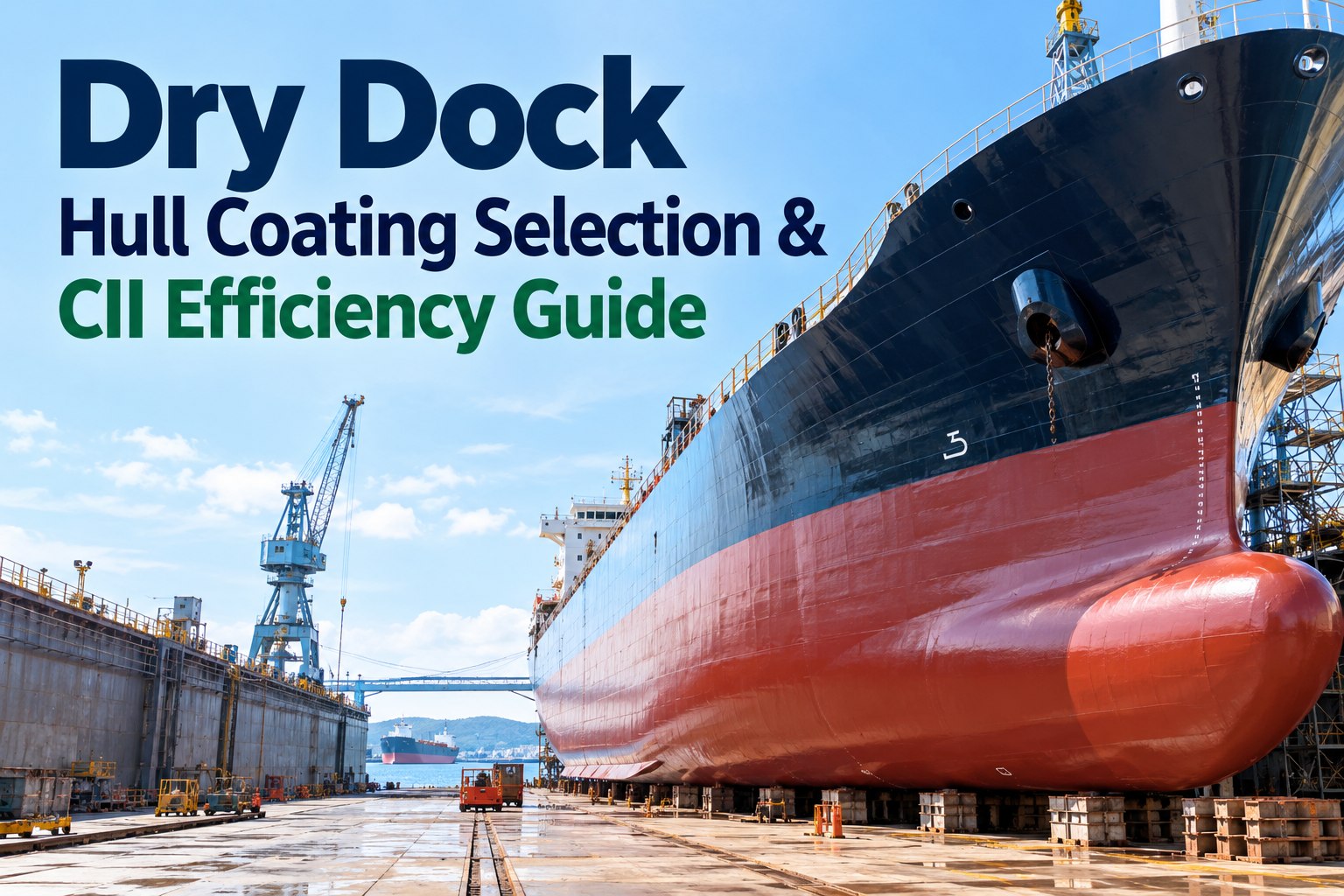
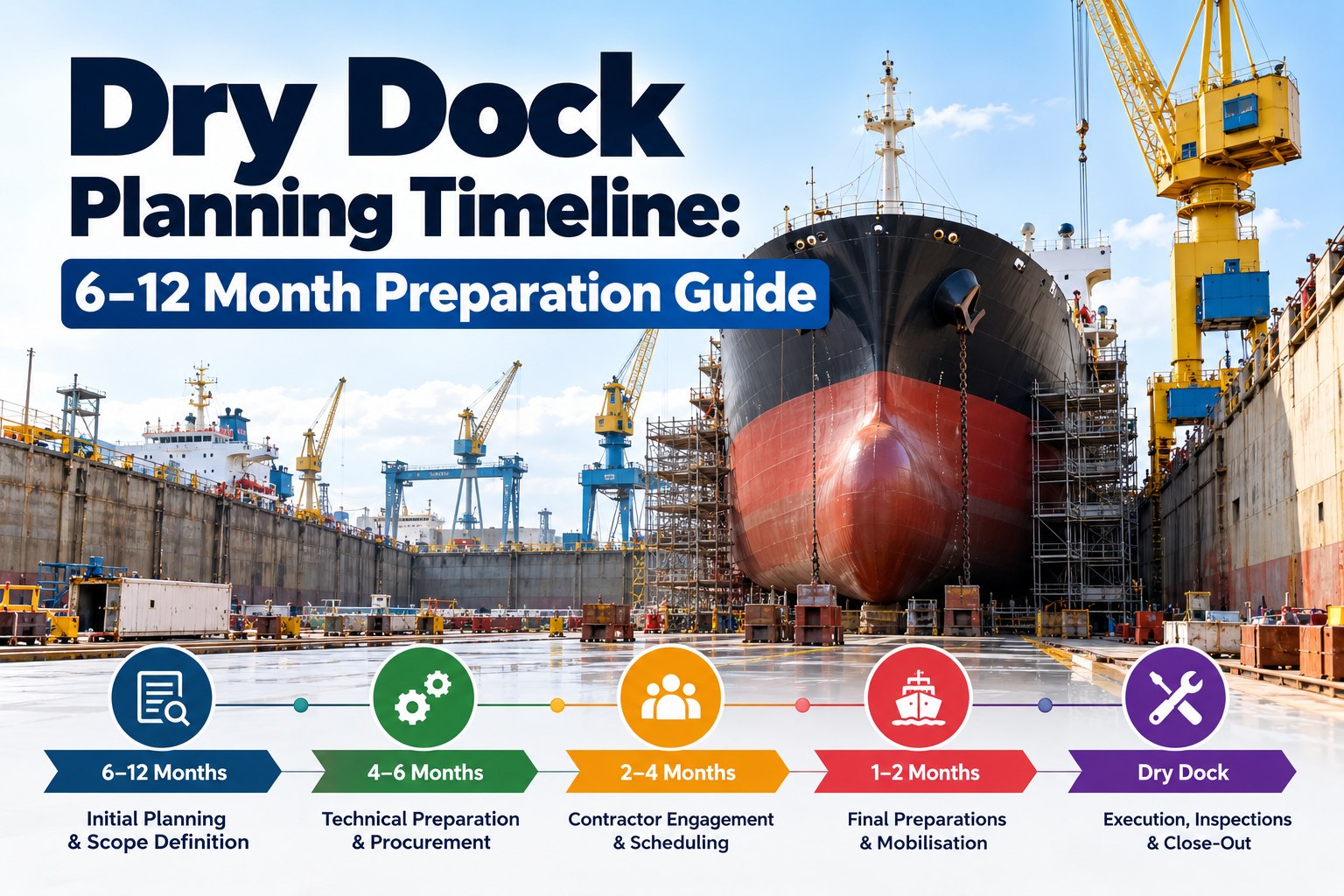
Dry Dock Hull Coating Selection & CII Efficiency Guide
A hull coating is specified in an afternoon and lived with for five years. That was always true, but it used to be a corrosion and schedule decision. It is now a carbon intensity decision, because the required CII tightens every single year of the docking cycle you are about to begin — and from 2027 it tightens faster than it has so far.
That is the part that changes how a technical superintendent should think about the specification. The coating has to be good enough not for the trade the ship is in today, but for a rating threshold that keeps moving underneath it until the next docking. This guide works through the systems available, what the fuel savings honestly are once measured rather than modelled, how surface preparation governs everything, where the anti-fouling regulation now sits, and what to write into the dock specification so you get what you paid for.
Dry dock · hull coating & CII
The hull coating you choose this docking has to beat a target that moves every year until the next one
Reduction factors against the 2019 reference line, adopted through MEPC.338(76) and MEPC.400(83). The shape of the picture is what matters: a coating that only performs out of dock loses the race in the middle of the cycle.
Hold the docking specification, the coating record and the performance history in one place
The carbon intensity regime applies to cargo, cruise and passenger ships above 5,000 gross tonnes trading internationally, under MARPOL Annex VI. Each year the ship calculates an attained operational CII — annual carbon dioxide mass over transport work — and is rated A to E against a required CII derived from a 2019 reference line and an annual reduction factor.
Those reduction factors are the reason the coating decision has changed. They are not a flat requirement held constant across a docking cycle.
2026
11%
2027
13.625%
2028
16.25%
2029
18.875%
2030
21.5%
Through 2026 the factor rose two percentage points a year. From 2027 the annual increment becomes 2.625 points, adopted via MEPC.400(83) in April 2025. A hull coated in 2026 and next docked in 2031 has to carry the ship across that step change on the performance it had on day one, minus whatever it has lost since.
The consequence of falling short is not a fine. A ship rated E in a single year, or D for three consecutive years, has to develop a plan of corrective actions inside the Ship Energy Efficiency Management Plan Part III, approved by the flag Administration or a recognised organisation, describing how it will reach C or better. MARPOL Annex VI imposes no direct financial penalty; the cost arrives through chartering and financing, which is precisely where a technical department has the least control and the most to explain. The wider emissions picture these sit inside is covered in our guide to the MARPOL annexes.
What is still moving, and what is not
The IMO Net-Zero Framework was approved at MEPC 83 in April 2025, but its adoption was adjourned by one year at the extraordinary session held 14 to 17 October 2025, on a vote of 57 in favour, 49 against and 21 abstaining. Commentators put its entry into force no earlier than 2028 once the tacit acceptance and entry-into-force periods are counted. Meanwhile Phase 2 of the CII review runs from spring 2026 to spring 2028 and reopens the metric itself — idle and port time, capacity versus actual cargo carried, correction factors. None of that changes the regime governing the docking in front of you. CII as written is what this coating will be judged against for most, if not all, of its service life.
Hull roughness and the fuel penalty a coating has to beat
Before comparing products it is worth being concrete about the quantity being bought. Coating performance is a roughness story, and roughness has a scale a superintendent can hold in their head.
A new hull sits at roughly 120 microns average hull roughness. Fouling and deterioration take an eight-year-old hull into the 300 to 400 micron range. Readings are taken with a hull roughness analyser over around 100 locations including bow, stern, midships and the boot-top, each traverse sampling ten readings across 50 millimetres.
The soft side of the problem is larger than most people expect. A slime layer half a millimetre thick covering up to half the hull has been put at a 25 to 30 per cent increase in greenhouse gas emissions. Slime is not the dramatic barnacle growth that appears in presentations; it is the invisible film that a ship carries for months without anybody on board noticing, and it is the single biggest reason a coating that looked excellent out of dock stops delivering by year three.
Hull coating systems compared: SPC, foul-release and hybrid
Four families cover almost every specification written today. The last column is the one worth reading twice, because every system fails in a characteristic way and the failure is usually a mismatch with the trade rather than a bad product.
System
How it keeps the hull clean
Where it fits
What goes wrong when it is mismatched
Self-polishing copolymer
Controlled erosion of the binder steadily exposes biocide at the surface
The default for mixed trading, variable idle periods and spot-blast dockings; proven over long cycles
Polishing rate is tuned to an activity profile — a ship that idles far more than assumed fouls, one that runs harder than assumed exhausts the film early
Silicone foul-release
Very low surface energy and a very smooth surface; fouling cannot adhere and releases with movement through the water
Steady, well-utilised trading; effective at speeds down to below 10 knots
Long static periods allow settlement the coating cannot shed, and the surface is the softest of the four — damage is permanent until the next docking
Hard foul-release
A harder, more damage-tolerant release surface with the same non-stick principle
Faster ships; release properties are typically more effective above 17 knots
On a slow or part-laden trade the release mechanism never properly engages and the ship carries the fouling it attracts
Hybrid foul-release
Release chemistry with biocide included to cover the periods when water flow alone will not clean the hull
Trades with genuine extended idle time that still want release-grade smoothness
Carries the cost of a premium system and the biocide constraints of a conventional one; needs the idle assumption to be honest
Underneath all four sits the anticorrosive scheme, which is not a coating choice so much as the thing that determines whether any of them survive. A premium fouling control topcoat over a tired, under-prepared anticorrosive is money spent on the wrong layer.
Foul-release hull coating savings: claimed, modelled and measured
This is where specifications go wrong, and it is worth separating three numbers that routinely get quoted as though they were one.
Manufacturer claims run to around 10 per cent. Modelled savings by vessel type range from 3.5 per cent for supply vessels through 4.8 per cent ro-ro and passenger, 5.1 per cent gas tanker, 5.9 per cent bulk carrier, 6.5 per cent container and 7.2 per cent Aframax to 8.6 per cent VLCC. Operator data from VLCCs in service showed improvement out of dock of up to around 5 per cent, and average fuel savings of around 3 per cent across the full docking cycle.
Three per cent over a cycle is a real and worthwhile number. It is not ten. Build the business case on the measured figure and the premium system still earns its place on the right trade; build it on the brochure figure and the gap will be found by somebody in finance two years from now, at which point the technical argument for good coatings gets harder for everyone.
Evidence over brochure
Keep the coating history where the performance history already is
Specification, applied scheme, film thickness records, roughness readings and the next docking’s plan held against the vessel — so the next coating decision is made on what this hull actually did, not on what the last proposal promised.
There is no best coating, only a best fit, and the fit is decided by four honest answers about how the ship is actually operated rather than how she was chartered to operate.
01
Speed, as sailed
Silicone release systems work at speeds down to below 10 knots. Hard foul-release needs more water flow, with release properties typically more effective above 17 knots. Use the speed profile from the performance data, not the design speed on the particulars.
02
Idle and waiting time
Static periods are the weakness of pure release chemistry; early generations were poor at it and the problem has been managed rather than eliminated. If the ship genuinely waits — at anchorage, in a slow trade, between fixtures — a hybrid carrying biocide is the honest answer.
03
Water temperature and trade area
Warm, nutrient-rich waters shorten every assumption in the proposal. A ship that spends her year in the tropics is running the coating at the hard end of its envelope and should be specified as such.
04
Exposure to physical damage
Mechanical strength has improved but remains the weak point of silicone systems. The bulbous bow takes anchor chain damage, the boot-top takes fender, tug and mooring impact, and propeller coatings can peel or deteriorate under cavitation and debris. A ship that berths hard, frequently, needs that written into the scheme.
Cost belongs in the same conversation rather than a separate one. Silicone systems have been put at triple or more the cost of a traditional self-polishing system, against a service life at least equivalent to SPC at up to five years, with some products offered at ten or more. The arithmetic only works if the operating profile lets the coating deliver, which is why the four answers above have to be real.
Surface preparation decides what the hull coating can deliver
Every coating comparison assumes correct application, and in practice that assumption is where most of the difference between promised and delivered performance is lost. Release systems in particular are usually specified over full abrasive blasting to Sa 2.5, rather than the spot blasting a conventional system will tolerate — and that means an extended dry dock period, which is a cost and a schedule consequence that belongs in the comparison from the start.
The anchor pattern left by blasting is what the anticorrosive keys into; the smoothness of the finished topcoat is what the water sees. Both are set during the dock period and neither can be improved afterwards.
Full blast or spot blast
A spot-blasted hull keeps the roughness history of every previous scheme underneath the new one. Full blasting resets it. If the business case rests on smoothness, paying for the blast and not the premium topcoat is often the better trade.
Climatic conditions during application
Steel temperature above dew point by the specified margin, humidity within range, readings logged at the frequency the product data sheet demands. These are the records that settle a warranty claim three years later.
Film thickness, measured not assumed
Dry film thickness to the specified scheme, measured across agreed areas rather than sampled where access is easy. Under-thickness on the anticorrosive is the defect that surfaces as blistering long after the yard has been paid.
Overcoating intervals
Each layer has a minimum and maximum interval before the next. Exceeding the maximum on a tie coat is a common yard shortcut under schedule pressure, and it is invisible until adhesion fails.
Anti-fouling regulation that shapes the hull coating specification
Two regulatory items sit directly on the coating specification, and both are now firmly in the present tense rather than on a horizon.
Cybutryne is banned, with a hard backstop
The amendments prohibiting cybutryne in anti-fouling systems entered into force on 1 January 2023. A ship carrying a cybutryne-containing system must either have it removed, or have a coating applied that forms a barrier preventing it leaching — at the next scheduled renewal of the anti-fouling system after 1 January 2023, but no later than 60 months following the last application. The International Anti-Fouling System certificate form was revised accordingly, and new vessels require a manufacturer declaration at delivery. For anything applied immediately before the ban, that 60-month backstop is now very close, which makes this a docking to settle it rather than defer it.
Grooming is cleaning, as far as the port is concerned
Grooming — the periodic removal of microfouling slime before it establishes — is how a release coating is kept at its rated performance, and each product carries its own recommended frequency. The complication is jurisdictional: local authorities generally consider grooming an underwater cleaning operation and impose restrictions accordingly. A coating strategy that depends on regular grooming needs the trade routes checked against where that grooming is actually permitted, and increasingly against what capture requirements apply. Autonomous hull grooming robots are emerging into this gap but do not change the permissions question.
Both belong in the biofouling management plan and record book rather than in somebody’s memory of the last docking, and the broader inspection regime around hull condition — coatings, cathodic protection, in-water survey — is set out in our guide to hull maintenance and inspection.
Writing the hull coating specification for dry dock
The specification is the only moment at which a superintendent has leverage. Afterwards there is a painted ship and an invoice.
State the scheme, not the product familyEvery layer named, with the minimum dry film thickness per coat and the total for the scheme. “Premium foul-release system” is not a specification; it is an invitation to substitute.
Name the preparation standard per areaFull blast or spot blast, the standard to be achieved, and the anchor pattern required — stated separately for flat bottom, vertical sides, boot-top and bulbous bow, because they do not wear alike.
Set hold points with names against themPreparation accepted, anticorrosive accepted, scheme complete. Each signed by a named person on each side before the next stage begins, not reconstructed at the end from photographs.
Require the climatic and thickness log as a deliverableThe record is part of what the yard is being paid for. Ask for it at handover, not when a defect appears and the data has gone with the contractor.
Take roughness readings at both endsOn arrival and before undocking, over the same locations, so the next cycle has a baseline and the scheme has a measured result rather than an opinion.
Write down the assumptions the proposal was priced onSpeed, idle days, trade area, grooming frequency. If the trade changes, the record shows why the coating underperformed, which is a far better conversation than a dispute about the product.
Keeping that package attached to the vessel rather than to a project folder is what makes the next docking a decision rather than a reconstruction, and it belongs alongside the rest of the maintenance record in the planned maintenance system.
Measuring whether the hull coating worked
The weakness in most coating programmes is that nobody ever establishes whether the last one delivered, which means every docking argues the same case from first principles. Three measurements close that loop.
Out of dock
A speed and power reference established in good conditions shortly after undocking, as the baseline the rest of the cycle is judged against.
Through the cycle
Ongoing speed-power deviation, weather-corrected, so the shape of the decay is visible while something can still be done about it rather than at the next docking.
At the next docking
Roughness readings over the same locations as last time, plus a photographic record of the condition by area, which together say what the scheme actually did.
The point of all three is the same: to make the coating decision at the following docking an evidence-based one. A fleet that can show the measured deviation curve for two systems on comparable ships has an argument no proposal can match.
Dry dock hull coating: frequently asked questions
Does hull coating really affect the CII rating?
Yes, through fuel burned per unit of transport work. The attained CII is annual carbon dioxide mass over transport work, so anything that lowers the power needed for a given speed lowers the attained figure. Measured full-cycle savings from a premium release system on VLCCs have been reported at around 3 per cent on average, which is meaningful against reduction factors that tighten every year.
Which is better, SPC or foul-release?
Neither, in the abstract. Self-polishing copolymer suits mixed trading with variable idle periods and tolerates spot-blast dockings. Silicone release suits steady, well-utilised trading and works down to below 10 knots; hard release wants higher speeds, typically above 17 knots. The honest operating profile decides, not the product ranking.
How much fuel does a foul-release coating actually save?
Manufacturer claims reach around 10 per cent, and modelling by vessel type ranges from 3.5 per cent for supply vessels up to 8.6 per cent for VLCCs. Operator data from VLCCs in service showed up to around 5 per cent out of dock and about 3 per cent averaged across the full docking cycle. Use the measured range in the business case.
Why does slime matter if the hull looks clean?
Because it is a hydrodynamic problem rather than a visual one. A slime layer half a millimetre thick covering up to half the hull has been associated with a 25 to 30 per cent increase in greenhouse gas emissions — a penalty no visual inspection from the quay would suggest.
What average hull roughness should I expect?
Around 120 microns on a newbuild, rising into the 300 to 400 micron range on an eight-year-old hull through fouling and deterioration. Readings are taken across roughly 100 locations including bow, stern, midships and boot-top, which is why comparing cycles requires using the same locations each time.
Is full blasting worth the extra dock days?
Where the case rests on smoothness, usually yes, and release systems are generally specified over full abrasive blasting to Sa 2.5 rather than spot blasting. Spot blasting carries forward the roughness of every earlier scheme, so a premium topcoat over an unreset substrate buys much less than the proposal assumes.
What do I have to do about cybutryne?
If the ship carries a cybutryne-containing system it must be removed, or a barrier coating applied to stop it leaching, at the next scheduled renewal of the anti-fouling system after 1 January 2023 and no later than 60 months after the last application. The International Anti-Fouling System certificate reflects the position, and new vessels need a manufacturer declaration at delivery.
Can I rely on in-water grooming to keep performance up?
Only where it is permitted. Grooming removes microfouling slime before it establishes and each coating carries its own recommended frequency, but local authorities generally treat it as an underwater cleaning operation and restrict it. Check the trade routes against where grooming can actually be carried out before a strategy depends on it.
Do the pending IMO changes affect this docking?
Not materially. The Net-Zero Framework was approved in April 2025 but its adoption was adjourned by a year in October 2025 and it is not expected in force before 2028, while Phase 2 of the CII review runs to spring 2028. The reduction factors already adopted through 2030 are what this coating will be measured against for most of its life.
Dry dock & planned maintenance
Make the next coating decision from measurement, not memory
Marine Inspection holds the docking specification, the applied scheme and its film thickness and climatic records, roughness readings by location, and the inspection history for every hull in the fleet — so the performance of the last coating is evidence you can put in front of a proposal.