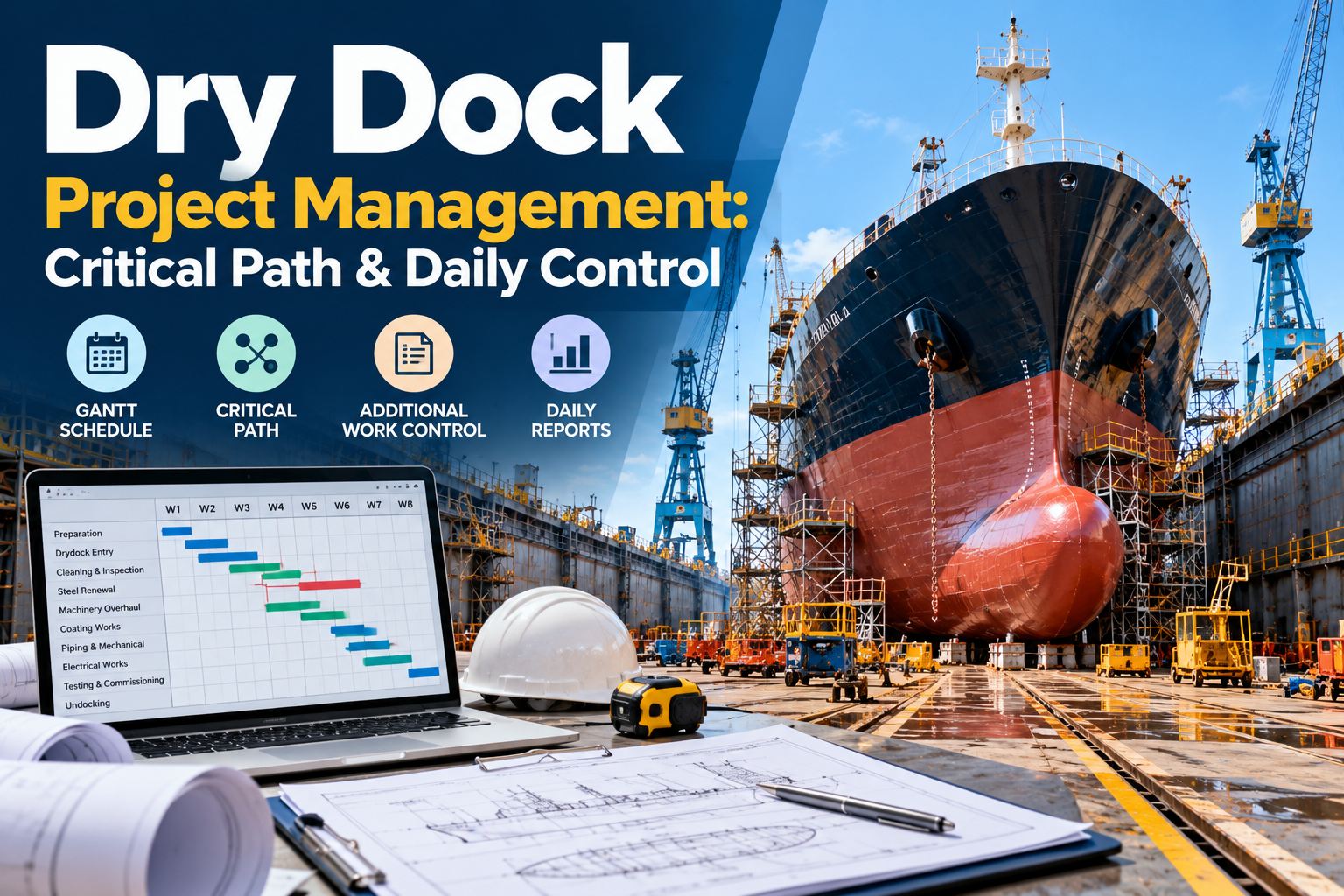
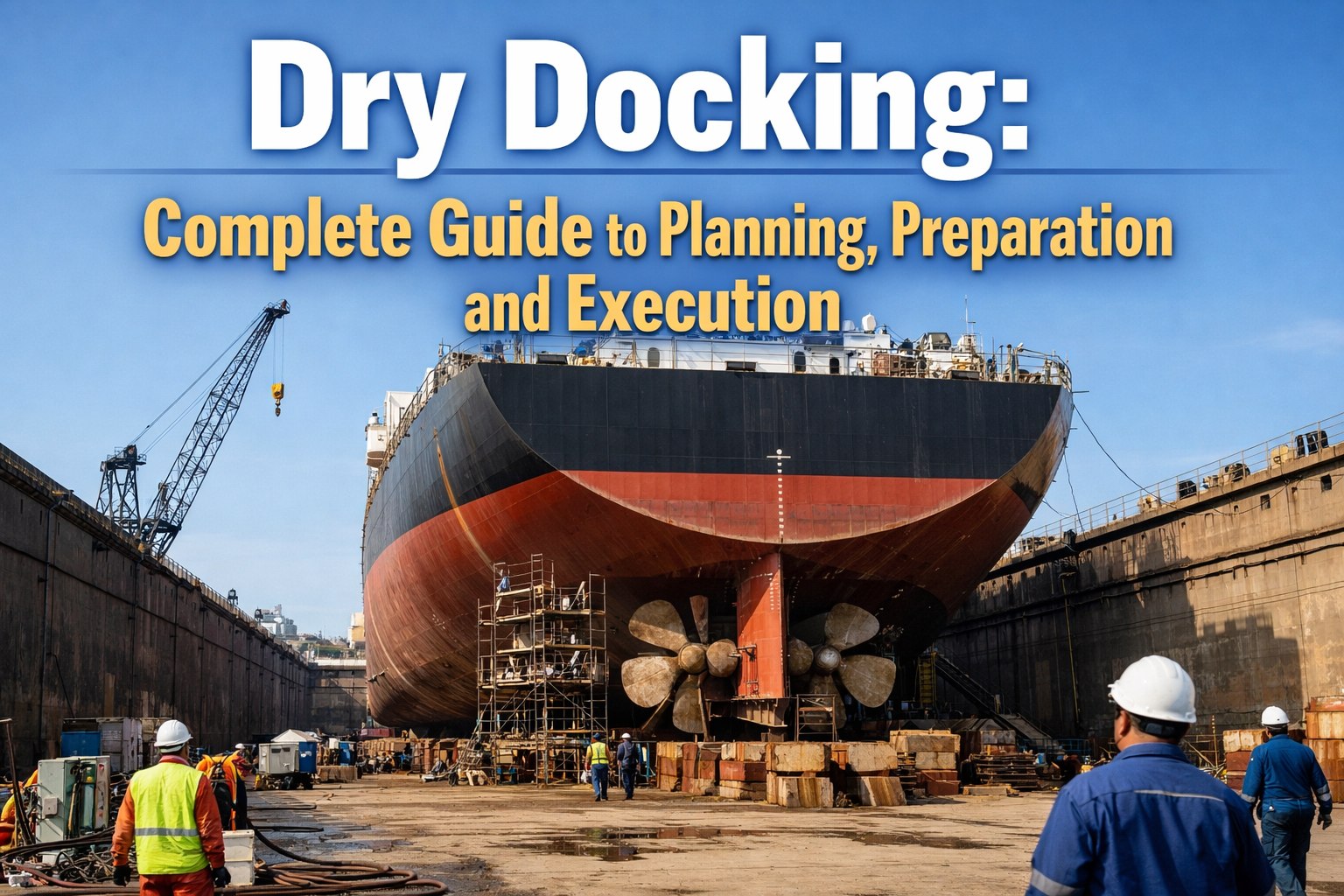
Dry Dock Project Management: Critical Path & Daily Control
A fleet manager does not run a dry dock. A superintendent does that, standing in the dock bottom at seven in the morning with fifty contractors and a yard foreman who has his own view of the sequence. The fleet manager’s job is narrower and harder to do well: to know, every morning, whether the undocking date is still real — and to know it from a report rather than from a feeling.
Dry dock · project control
Most of the work in a docking can slip without costing a day. Three or four items cannot, and they are the whole job.
The shape is typical rather than universal, but the lesson holds on every hull: the chain usually runs through hull preparation into coating and its cure window, and finishes at flooding. Work with float absorbs problems. Work on the chain converts them straight into days.
See every vessel’s docking from the same screen, not from fifty separate emails
What the critical path in a dry dock actually runs through
Dockings differ by ship and scope, but the chain is remarkably consistent, and it is rarely the work people worry about most. Machinery overhauls are usually resourced well and have float. The chain runs through the items that physically block the dock or depend on conditions nobody controls.
01
Docking down and the bottom survey
Nothing underwater starts until the ship is on the blocks and the survey has been taken. A delay here pushes everything behind it with no absorption anywhere.
02
Hull preparation
Washing and blasting occupy the whole hull and exclude most other external work. Extend it and you have not just lost those hours, you have moved the coating window.
03
Coating and its cure window
The item most often on the chain, because it is the one bound by conditions. Steel temperature, humidity and overcoating intervals are not negotiable, and a lost weather day cannot be recovered by adding people.
04
Anything found rather than planned
Wasted steel discovered during the dock lands on the chain by definition — it needs access, staging and then recoating of the renewed area, which puts it back in front of the coating programme.
05
Flooding and undocking
A fixed event with a tide and a dock booking behind it. Miss the window and the cost is not the hours lost, it is the next available slot.
Note what that list implies. Coating is on the chain and weather is on the coating, which means the single most effective thing a fleet manager can do for the schedule happens months earlier — getting the steel found before arrival so it never reaches the chain at all. The relationship between coating condition, hull work and the docking plan is covered further in our guide to hull maintenance and inspection.
10 – 21 days
Typical intermediate docking for a product tanker
30 days +
Special survey dockings, where scope and class work expand together
12 – 18 months
The planning runway: condition assessment, specification, tender, logistics
The daily control cycle that keeps a docking honest
Control in a docking is daily or it is nothing. Weekly reporting on a fourteen-day project means you learn about a problem when a seventh of the dock has already gone. The rhythm below is drawn from how experienced repair project managers actually run the day, and the time limits matter as much as the meetings.
That last line is the discipline most often lost. A yard coordination meeting that works through every open item takes two hours, exhausts the people who need to be in the dock, and still fails to surface the one activity that moved. The agenda is project status — progress, docking, undocking, departure — and then the critical path and its roadblocks, and nothing else.
The daily technical report worth reading
A fleet manager reads the report from ashore, often for several ships at once, usually in the evening. It has to answer four questions in the first paragraph, and most reports answer none of them.
Is the undocking date still the date
Stated as a date, every day, with a yes or no. If it has moved, by how many days and because of which activity. A report that does not carry this line is a diary, not a control document.
What moved on the critical path
Each chain activity with planned and actual progress, and the forecast finish. Progress on items with float is background; progress on the chain is the news.
What was added today and by whom
Additional work raised, approved, priced, and the running total against the ceiling. Added work with no schedule assessment attached is an unanswered question, not a completed line.
What decision is needed, and by when
Named, with a deadline and a consequence of not deciding. A report that asks for nothing is usually a report from somebody who has stopped expecting an answer.
Three tells that a report has been written to reassure rather than to inform: percentage complete that only ever rises in round numbers; the same photographs of different compartments; and a milestone date that stays fixed for a week while the activities feeding it all report late. None of those require being in the dock to spot.
The dry dock control set: what to watch daily
Six signals carry almost all the early warning available to somebody not standing in the dock. The last column is the point — each signal is only useful if it comes with the question you ask when it moves.
Signal
What it shows
What good looks like
The question when it moves
Forecast undocking date
The only number that matters, restated daily
Unchanged, or changed once with a named cause
Which chain activity moved it, and what would recover it
Chain activity progress
Planned against actual on the handful of zero-float items
Actual tracking planned within a day
Is this a resource problem, an access problem or a conditions problem
Additional work raised
New scope entering the project, by count and value
Falling after the first three days as discovery completes
Is this genuinely emergent, or scope that was always there and never specified
Committed against ceiling
Everything ordered so far against the approved limit
A gap that is still shrinking slowly, not in steps
At today’s rate, what day does this reach the ceiling
Open class items
Survey items raised and not yet cleared
Clearing steadily across the dock, not banked for the end
Which of these needs the ship still on the blocks
Access and staging held
Spaces still occupied, scaffolding not yet struck
Released on plan, space by space
What is waiting on that space, and is it on the chain
Additional work order discipline
Every experienced repair manager starts from the same three realities: it is impossible to gather all the requirements at the beginning, changes will appear during execution, and there will always be more to do than the time and money allowed. Additional work is therefore not a failure of planning. Uncontrolled additional work is.
The control is procedural and it has to exist before arrival, because the moment to agree how extra work is handled is never the moment extra work appears.
Priced and recorded before executionEvery addition written, priced against the rates agreed in the tender, and signed before anything is cut or lifted. Work done first and priced afterwards is priced by one party.
A schedule assessment attached, alwaysNot just what it costs but which activity it touches and whether that activity has float. An addition with no schedule line is the one that moves the date without anybody noticing.
One approval threshold, set in advanceWhat the superintendent clears on site and what needs the office. Define the figure before the ship arrives, so nobody is negotiating authority at the same time as scope.
A declared ceiling, and a plan for reaching itAn agreed limit for the whole project, visible daily. Knowing on day six that the current rate reaches the ceiling by day ten is a usable fact; discovering it on day ten is not.
Owner-furnished material where it paysHigh-value items supplied by the owner rather than bought through the yard, decided at tender rather than improvised when the item becomes urgent.
The right to rejectQuality standards written into the contract with rejection rights for non-conforming work, because the leverage to enforce them disappears the day the ship floats.
One running record per docking, not fifty email threads
Marine Inspection keeps the specification, the daily reports, additional work and its approvals, class items and the close-out evidence against the vessel — so the position is the same whether you read it in the dock, in the office, or six months later during a warranty claim.
Dry dock cost control while the ship is on the blocks
Cost control in a docking is not a monthly exercise. Three figures need to be visible on the same line every day, because the gap between them is the whole story.
The common failure is reporting only the middle bar. Committed spend is a historical fact and it is always comfortably under the ceiling until suddenly it is not. The forecast out-turn — committed plus a projection of the current rate of additional work to undocking — crosses the line days earlier, which is exactly the warning a fleet manager is paid to act on.
Docking coordination: fifty contractors in one hull
A busy docking has the yard’s own trades, specialist subcontractors, class and flag surveyors, equipment makers’ service engineers, the owner’s superintendents and the crew, all working in the same confined steel box. Nothing about that is solved by a schedule alone.
One owner per space, per shift
Spaces are allocated rather than shared. Two trades in one tank is how hot work meets a solvent, and how neither finishes on time.
Permits gate the sequence
Hot work, confined space entry and working aloft are the real scheduling constraints in a tank, not the labour. Build the day around what can be permitted.
Simultaneous operations named in advance
The combinations that cannot run together are known before arrival. Writing them down turns a daily argument into a five-minute check.
Makers’ engineers booked to the chain
A specialist who arrives two days late for a non-critical item costs nothing. The same delay on a chain item costs the dock. Book them against the chain, not the convenience.
Surveyor attendance planned, not summoned
Class attendance points are scheduled activities with their own lead time. Treating them as something you call for on the day is a reliable source of lost mornings.
The crew counted as a resource
Ship’s staff carry out, witness and accept a great deal of this work while also being on watch. Overcommitting them is the quietest way to lose a day.
Reading dry dock schedule slippage before it is admitted
Nobody reports a delay on the day it starts. These are the signals that appear first, and all of them are visible from a desk.
1
The milestone holds while its predecessors slip
Three feeding activities report two days late each and the milestone date does not move. That is not recovery, it is a date that has not been recalculated.
2
Progress rises faster than the hours
Percentage complete climbing while man-hours expended stay flat usually means the easy portion of the activity was done first and the estimate behind it has not been revised.
3
Staging stays up
Scaffolding not struck on plan is the most physical signal available. Spaces that should have been released and were not mean the work inside them is not finished, whatever the report says.
4
Class items bank up for the end
Survey items clearing slowly through the dock and then all scheduled for the last two days is a plan with no room in it, and surveyors do not work to that shape.
5
The report gets shorter
Reporting thins out when the news is bad and the person writing it hopes to recover before anybody asks. A shrinking report is a reason to call, not to relax.
Closing out the docking so the next one is cheaper
The last two days decide how much of this project is worth anything afterwards. Leverage ends when the ship floats, and the record is the only thing that survives.
Formal acceptance
Documentation that all contract work has been completed, inspected and accepted, item by item, rather than a single signature across a package.
A structured handback
The handover arranged to protect the owner’s rights, because warranty claims made later rest entirely on what was recorded now.
Warranty terms held, not filed
Shipyard warranty management is an underappreciated function that protects the operating budget for a year afterwards. It only works if somebody owns the dates.
The additional work post-mortem
Every addition reviewed against one question: could this have been specified beforehand? The answers are next docking’s specification.
The schedule as built
What the chain turned out to be, against what was planned. Two dockings of that record and the next plan stops being guesswork.
Everything attached to the vessel
Reports, approvals, certificates and photographs held against the ship in the planned maintenance system rather than in a project folder nobody opens again.
Wider planning around the docking — the phases before arrival, scope building, documentation and choosing the yard — is covered in our complete dry docking guide. This page assumes that work is done and the ship is already on the blocks.
Dry dock project management: frequently asked questions
What is usually on the critical path in a dry dock?
Docking down and the bottom survey, hull preparation, coating and its cure window, anything discovered rather than planned, and flooding and undocking. Coating is the most common chain item because it is bound by steel temperature, humidity and overcoating intervals, none of which can be fixed by adding labour.
How long should a docking take?
An intermediate docking for a product tanker typically runs 10 to 21 days, while special survey dockings extend to 30 days or more as scope and class work expand together. Planning runs 12 to 18 months ahead of arrival, from condition assessment through specification, tender and logistics.
How often should the project be reported on?
Daily. On a two-week project, weekly reporting means a problem is learned about after a seventh of the dock has gone. Experienced repair managers run a short team meeting at the site, a short meeting onboard and a yard coordination meeting of 30 to 45 minutes, with a written report following the same day.
What should the daily yard meeting cover?
Project status — progress, docking, undocking and departure — then the critical path and its roadblocks only. Everything else belongs in the written report. A meeting that works through every open item exhausts the people who should be in the dock and still misses the activity that moved.
How should additional work be controlled?
Every addition priced and recorded before execution, against rates agreed in the tender, with a schedule assessment attached naming the activity it touches. Set the approval threshold between site and office before arrival, declare a ceiling for the project, and report committed spend and forecast out-turn against it daily.
Why forecast the out-turn rather than track committed spend?
Because committed spend is history and sits comfortably under the ceiling until it does not. The forecast — committed plus the current rate of additional work projected to undocking — crosses the ceiling several days earlier, which is when there is still something to be done about it.
What are the early signs a docking is slipping?
A milestone date holding while the activities feeding it all report late; percentage complete rising faster than hours expended; scaffolding not struck and spaces not released on plan; class items banking up for the final days; and a daily report that is getting shorter.
Is the cheapest yard the cheapest outcome?
Not reliably. A yard pricing well below the market average but routinely requiring rework will typically cost more in total once schedule and re-doing the work are counted. Price is one input alongside capability, availability, location and track record with the vessel type.
What matters most at handback?
Formal documentation that all contract work has been completed, inspected and accepted, and a structured handback that protects the owner’s rights for warranty claims. Leverage ends when the ship floats, so anything not recorded by then is effectively conceded.
Dry dock & planned maintenance
Know the date is real before somebody tells you it is not
Marine Inspection holds the docking specification, daily reports, additional work and approvals, class items and handback evidence against every vessel — so a fleet manager reads one position per ship instead of assembling it from fifty messages a day.