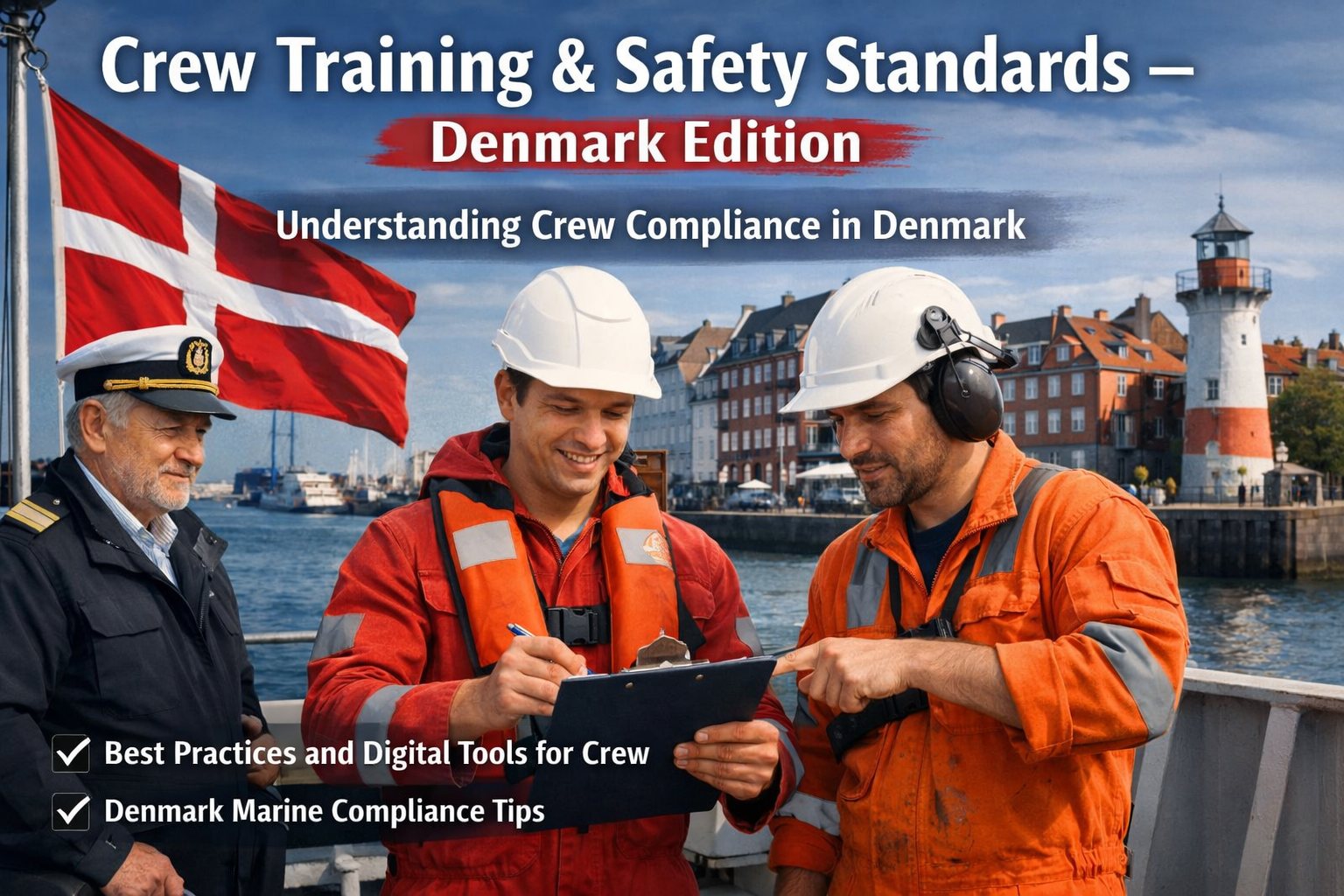
A Danish ferry operator discovered their STCW compliance certificates weren't the problem—their training documentation system was. After a Maritime Labour Convention inspection in Aarhus flagged inconsistencies across their 45-member crew, they faced $95,000 in potential fines and a 72-hour vessel detention. The training had happened, the qualifications existed,but proving continuous competency through outdated paper logbooks created gaps inspectors couldn't verify. When Denmark conducts over 350 MLC inspections annually and maintains some of Europe's strictest crew welfare standards, digital training documentation becomes the difference between operational continuity and costly port delays.
Denmark's Crew Training & Safety Landscape
Critical compliance metrics every vessel operator must track
350+
MLC inspections
Annual Maritime Labour Convention inspections by Danish Maritime Authority
100%
STCW verification
All crew must have verifiable training records for Danish port clearance
5 years
certificate validity
Maximum period before mandatory refresher training for most certifications
24 hrs
rest requirement
Minimum rest in any 7-day period under Danish enforcement of MLC standards
Denmark enforces crew standards through a multi-layered approach combining STCW (Standards of Training, Certification and Watchkeeping), MLC (Maritime Labour Convention), and national Danish Maritime Authority regulations. Vessels calling at Copenhagen, Esbjerg, or Frederikshavn face rigorous inspections covering crew qualifications, training records, rest hour compliance, and safety drill documentation. The challenge isn't meeting these requirements—it's proving continuous compliance through verifiable, auditable records that traditional paper-based systems struggle to maintain.
Understanding Crew Compliance in Denmark
Danish Maritime Authority (DMA) inspectors evaluate crew compliance across four primary dimensions: certification validity, documented training completion, rest hour adherence, and safety drill execution. Each dimension requires specific documentation that must be produced immediately upon request during port state control inspections.
Denmark Maritime Crew Compliance Framework
Four enforcement pillars and required documentation
STCW Certification
IMO Convention Standards
Certificate of Competency
Certificate of Proficiency
Medical fitness certificates
Endorsement attestations
Verification Point
Every port state control; pre-departure checks; random crew interviews
Training Records
Continuous Competency Proof
Onboard safety drills
Security awareness training
Specialized equipment training
Refresher course completion
Documentation Period
Minimum 3 years retained; monthly drill logs; annual training summaries
Rest Hour Compliance
MLC 2006 Requirements
Daily rest period logs
Work hour documentation
Watchkeeping schedules
Exception justifications
Record Keeping
Last 12 months accessible; signed by master and crew member monthly
Safety Drills
SOLAS Chapter III
Abandon ship drills
Fire drills
Man overboard exercises
Crew participation records
Execution Schedule
Weekly fire/abandon ship drills; documented crew attendance and performance
The regulatory landscape is evolving with Denmark's focus on crew welfare and safety culture. Recent DMA guidance emphasizes not just compliance with minimum standards but demonstration of systematic safety management. Vessels with frequent Denmark port calls should implement digital crew management systems that automatically track certification expiry, schedule mandatory training, and maintain audit-ready documentation. Maritime operators ready to digitize crew compliance can start with a free marine CMMS platform that includes crew training and certification tracking modules.
Best Practices and Digital Tools for Crew Management
Leading maritime operators in Denmark have transformed crew compliance from administrative burden to strategic advantage. This transformation relies on three operational foundations: automated certification tracking, digital drill documentation, and real-time rest hour monitoring that ensures both regulatory compliance and crew welfare.
Automated Certification Tracking
Digital crew management systems automatically monitor every crew member's certificate expiration dates, triggering alerts 90, 60, and 30 days before expiry. No manual calendar tracking, no surprise expirations, no last-minute scrambles for replacement crew. The platform maintains digital copies of all certificates accessible to inspectors within seconds.
Digital Drill Documentation
Mobile-first drill logging allows masters to document safety exercises in real-time: participant names, drill scenarios, performance observations, corrective actions. Photo and video evidence captures equipment usage and crew response. Copenhagen-based ferry operators report 65% faster PSC drill record reviews after implementing digital documentation.
Rest Hour Compliance Monitoring
Automated watchkeeping systems track work hours and rest periods in real-time, flagging potential MLC violations before they occur. Dashboard views show compliance status across entire crew, enabling proactive schedule adjustments. Digital signatures eliminate paper form handling while creating tamper-proof audit trails Danish authorities accept immediately.
Pre-Inspection Crew Compliance Checklist for Danish Ports
72 Hours Before Danish Port Arrival
☐
Verify all crew certificates current (STCW, CoC, CoP, medical, passport validity)
☐
Review rest hour records for past 3 months; flag and document any exceptions
☐
Confirm drill completion within required timeframes (weekly fire/abandon ship)
☐
Prepare crew training matrix showing all completed courses and upcoming renewals
☐
Verify Safe Manning Document matches actual crew complement and qualifications
Upon DMA Inspector Boarding
☐
Present digital crew management dashboard with real-time compliance status
☐
Provide immediate access to all certificate digital copies (no searching physical files)
☐
Demonstrate drill documentation system with photo/video evidence from recent exercises
☐
Show automated rest hour tracking with crew member digital signatures
Multi-vessel operations benefit significantly from centralized crew pool management. Fleet managers can track qualifications across all personnel, identify training gaps before scheduling crew assignments, and ensure every vessel sails with properly certified complement. Companies managing Denmark routes can schedule a demo showing how fleet-wide crew compliance management works for operations with multiple vessels and rotating personnel.
Paper vs. Digital Crew Management: Copenhagen-Aarhus Route Example
| Compliance Factor |
Paper-Based System |
Digital Crew Platform |
Impact |
| MLC Inspection Preparation |
2-3 hours |
15-20 minutes |
89% time reduction |
| Certificate Expiry Incidents |
8 per year |
0-1 per year |
88% reduction |
| Drill Documentation Completeness |
67% |
98% |
31 point improvement |
| Rest Hour Violations |
15 per year |
2 per year |
87% reduction |
| Annual Compliance Costs |
$62K |
$12K |
$50K savings |
Data from 4-vessel passenger ferry operation running daily Denmark routes, tracked over 24 months post-digitalization.
Streamline Denmark Crew Compliance
Stop manual certificate tracking and paper drill logs. Build automated crew management systems that Danish Maritime Authority inspectors verify in minutes, not hours.
Denmark-Specific Training Requirements
Beyond international STCW and MLC standards, Denmark maintains additional crew training requirements for vessels operating in Danish waters. The Danish Maritime Authority requires enhanced safety training for passenger vessels, specialized training for hazardous cargo operations, and documented competency in environmental protection procedures. Understanding these Denmark-specific elements is essential for operators treating Danish ports as regular calls rather than occasional stops.
Passenger Vessel Enhanced Training
Denmark requires additional training beyond STCW for vessels carrying more than 12 passengers. This includes crowd management certification, crisis management training, and human behavior training specific to passenger operations. Ferry operators on Denmark routes must maintain records proving all crew completed this training within the past 5 years. Digital platforms automatically track these specialized certifications alongside standard STCW requirements.
Non-compliance: $15,000-$45,000 fines plus potential passenger certificate suspension
Environmental Compliance Training
Danish Maritime Authority requires documented training in MARPOL compliance, ballast water management, and waste handling procedures. Crew members responsible for these operations must complete approved courses and maintain current certificates. Inspectors specifically check that personnel operating environmental equipment (scrubbers, ballast water treatment systems, incinerators) have appropriate training documentation.
Enforcement: $8,000-$25,000 per untrained crew member operating environmental systems
Danish Language Proficiency (Commercial Vessels)
Vessels engaged in regular Denmark domestic trade may require documented Danish language proficiency for deck officers to ensure effective communication with port authorities and pilots. While English is widely accepted for international operations, domestic routes (inter-Danish port calls) face additional scrutiny. Digital crew management systems track language certifications and flag gaps before scheduling crew on Denmark-domestic routes.
Requirement varies by operation type; consult DMA for specific route requirements
Common Crew Compliance Deficiencies in Denmark
Analysis of Danish Maritime Authority PSC inspection data reveals recurring crew compliance issues that account for 70% of crew-related detentions. Understanding these common deficiencies allows operators to implement preventive controls before inspections occur.
Expired Certificates
32% of deficiencies
Most common: Medical certificates expired by less than 30 days. Officers frequently overlook approaching expiry dates. Digital systems eliminate this through automated 90-day advance alerts.
Solution: Automated certificate expiry tracking with escalating alerts
Incomplete Drill Records
28% of deficiencies
Drill logs missing participant signatures, lack specific scenarios documented, or show gaps exceeding weekly requirements. Paper systems make consistent documentation difficult during actual operations.
Solution: Mobile drill logging with mandatory fields and photo evidence
Rest Hour Violations
24% of deficiencies
Work hour records showing less than 10 hours rest in 24-hour period or less than 77 hours in 7 days. Manual calculation errors contribute to violations even when actual rest was adequate.
Solution: Automated rest hour calculation with real-time compliance monitoring
Training Matrix Gaps
16% of deficiencies
Unable to demonstrate crew received required vessel-specific training (ship-specific safety procedures, equipment operation). Records exist but aren't organized for inspector review.
Solution: Digital training matrix with searchable records by crew and course type
Implementation Strategy for Digital Crew Management
Transitioning from paper-based crew documentation to digital systems doesn't require immediate fleet-wide deployment. The most successful implementations follow a vessel-by-vessel approach, establishing processes on one ship before expanding. Maritime operators can begin with free crew management tools to test the system on a single vessel before committing to multi-ship deployment.
60-Day Digital Crew Compliance Implementation
Phase 1
Data Migration & System Setup
Days 1-20
Upload all crew certificates (STCW, medical, passport scans)
Configure certification expiry alerts (90/60/30 day warnings)
Import historical training records and drill logs
Train master and chief officer on mobile drill documentation
Set up automated rest hour tracking module
Phase 2
Parallel Operation & Testing
Days 21-45
Run digital + paper systems simultaneously to verify accuracy
Document 3-4 safety drills using mobile app with photo evidence
Test inspector access features (compliance dashboard, certificate viewer)
Conduct internal audit using digital records only
Gather crew feedback on mobile app usability and adjust workflows
Phase 3
Full Digital Transition
Days 46-60
Discontinue paper-based crew documentation systems
Complete first PSC inspection using digital crew records
Expand implementation to remaining fleet vessels
Establish monthly crew compliance review process
Configure fleet-wide crew pool management for multi-vessel operations
Crew Welfare and Safety Culture
Denmark's enforcement approach emphasizes safety culture beyond minimum compliance. Danish Maritime Authority inspectors assess whether training and rest hour systems actually promote crew welfare or merely satisfy regulatory checkboxes. Digital platforms support this cultural shift by making compliance transparent, reducing administrative burden on crew, and enabling data-driven safety improvements.
How Digital Systems Improve Safety Culture
Reduced Administrative Burden
Crew spend 75% less time on paperwork—officers report this time reinvested in actual safety oversight and mentoring junior crew rather than form-filling.
Targeted Training Identification
Analytics reveal which drills crew struggle with, enabling focused retraining. One Denmark operator reduced fire drill response time by 40% after data identified procedural confusion.
Fatigue Risk Management
Real-time rest hour monitoring prevents overwork before it occurs. Masters receive alerts when crew approach MLC limits, enabling proactive schedule adjustments rather than reactive violations.
Continuous Improvement Metrics
Track safety KPIs over time: drill participation rates, near-miss reporting frequency, training completion speed. Data-driven insights replace gut-feel assessments of safety program effectiveness.
Ready to Transform Crew Compliance?
Join maritime operators already using digital crew management to eliminate certificate expiry incidents, accelerate PSC inspections, and build stronger safety culture across Denmark operations.
Frequently Asked Questions
What crew certifications must vessels maintain for Denmark port calls?
Vessels calling at Danish ports must maintain valid STCW certificates for all crew members in accordance with their roles: Certificate of Competency (CoC) for officers, Certificate of Proficiency (CoP) for ratings, medical fitness certificates (valid within 2 years for crew under 18, within 2 years for crew over 18), and Basic Safety Training certificates. Additionally, vessels must carry the Minimum Safe Manning Document verifying crew complement meets flag state and coastal state requirements. Passenger vessels require enhanced training certificates for crowd management and crisis response. All certificates must be available for inspection in English or Danish with official translations if issued in other languages. Digital crew management platforms consolidate all certificates in searchable databases that inspectors can verify within minutes.
How does Denmark enforce Maritime Labour Convention rest hour requirements?
Denmark enforces MLC 2006 rest requirements through port state control inspections that review work/rest hour records for the previous 3 months. Crew members must receive minimum 10 hours rest in any 24-hour period and minimum 77 hours rest in any 7-day period. Rest periods may be divided into no more than two periods, one of which must be at least 6 hours in length. Vessels must maintain signed records (by both master and crew member) documenting daily rest hours. Danish inspectors specifically look for patterns indicating systemic overwork, calculation errors in manual logs, and missing crew signatures. Violations result in deficiency notices requiring immediate correction, fines ranging from $5,000-$30,000 depending on severity, and potential vessel detention until compliance is demonstrated. Digital rest hour tracking eliminates calculation errors and provides real-time compliance monitoring that prevents violations before they occur.
What safety drill documentation do Danish inspectors require?
Danish Maritime Authority inspectors require comprehensive records of all safety drills conducted aboard vessel. For fire drills (required weekly): date/time, drill scenario, equipment used, crew participation list, performance observations, and any corrective actions identified. For abandon ship drills (required weekly): launching procedures practiced, crew assigned positions, communication systems tested, and time required to complete drill. Additional drills (man overboard, damage control, oil spill response) should follow similar documentation standards. Records must show drills occur at varied times to ensure all crew participate, include crew who joined vessel recently, and demonstrate continuous improvement in response times and procedures. Photo or video documentation strengthens drill records significantly—Copenhagen-based operators report 60% faster PSC drill reviews when inspectors can view drill footage rather than reading text descriptions. Digital drill logging platforms capture all required information through mobile apps with mandatory fields, automatic date/time stamping, and integrated photo/video upload capabilities.
How often must crew complete refresher training under Denmark regulations?
Denmark follows STCW Convention requirements for refresher training with some enhanced national standards. Basic Safety Training (BST) certificates remain valid for the holder's career once issued (no refresher required). However, Advanced Fire Fighting, Medical First Aid, and other proficiency certificates typically require revalidation every 5 years through approved refresher courses. Security Awareness Training and Ship Security Officer training require refresher every 5 years. Passenger vessel-specific training (crowd management, crisis management) requires refresher every 5 years. Denmark additionally requires annual onboard refresher training in emergency procedures, documented through drill logs and training matrix records. Vessels must maintain training matrices showing all crew completed course status and upcoming renewal dates. Digital crew platforms automatically track these varied renewal schedules and trigger alerts 6 months before expiry, enabling proactive training scheduling rather than last-minute course enrollment when certificates approach expiration.
What are penalties for crew compliance violations in Danish ports?
Penalties for crew compliance violations in Denmark vary by severity and type. Certificate deficiencies: Expired officer certificates result in immediate officer disqualification from watchkeeping duties, potential vessel detention until replacement officer arrives ($500-$2,000 per day detention costs), and fines of $8,000-$25,000 per expired certificate. Rest hour violations: Minor infractions (occasional violations with documented justification) generate deficiency notices requiring correction within 14 days; systematic violations trigger fines of $15,000-$45,000 and potential detention. Inadequate safety drill documentation: Deficiency notices requiring immediate corrective drills and documentation; repeated violations result in $5,000-$20,000 fines. Training record gaps: Fines of $3,000-$15,000 per crew member lacking required training documentation. Denmark also reports all deficiencies to flag states and the Paris MoU database, which increases future PSC targeting and can affect insurance premiums. Serious violations may result in criminal prosecution of masters and ship operators under Danish maritime law. Digital crew management systems reduce violation risk by 85-90% through automated compliance monitoring and preventive alerts.