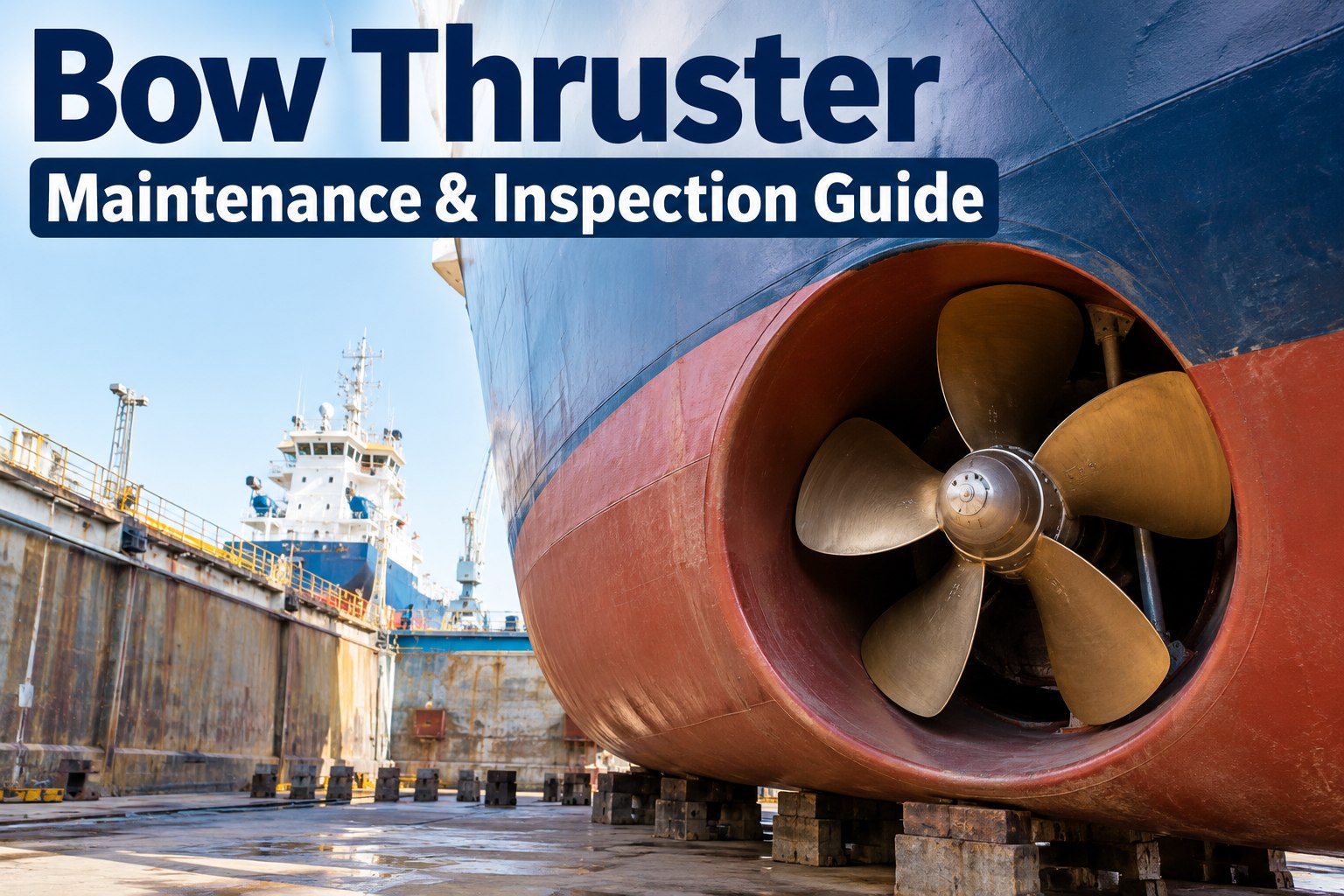
A bow thruster is easy to ignore until it fails alongside a berth or a platform, and then it tends to fail expensively. What does bow thruster maintenance need to cover, and what do published incident reports say about how thrusters actually fail? This guide, written for the Chief Engineer, covers bow thruster maintenance, tunnel and azimuth thruster inspection, seal leaks, motor insulation tests, dry-dock inspection and troubleshooting. It draws on two Transportation Safety Board of Canada reports, an IMCA safety flash, IACS UR Z3 and vendor guidance, and it says which numbers are vendor claims and which intervals are our own placeholders. For electrical routines, see our electrical maintenance and insulation testing.
Bow Thruster Failure Cases: What Four Published Reports Teach Engineers
Two TSB reports, one IMCA flash and a vendor case, each with a maintenance lesson
Published reports are the best evidence for what actually fails, because they name the conditions, not just the symptoms. The four cases below are different in kind. Two are independent TSB investigations of a tanker blackout and a ferry berthing strike, one is an IMCA safety flash from an OSV and one is a vendor's own case study. Read them as examples of how thruster problems reach the bridge, not as a statistical picture.
Maintenance lesson: the local breaker was not part of the mandatory periodic inspection regime. The TSB could not determine the source of the overload.
Maintenance lesson: the thruster was in service with known problems and no formal mitigating measures. Ammeter readings were available via the engine room but were not checked.
Maintenance lesson: the manual required a daily visual check of hydraulic oil, which the crew did, but the task was missing from the planned maintenance system.
Maintenance lesson: it advised running to 50% load and measuring at least every two weeks until dry dock. The page is a vendor's own case, not an independent report.
What they share is that the fix was already known. Breaker settings were in the manufacturer's manual, the daily oil check was in the thruster manual and the status indication was a known gap. The failure was in the maintenance system around the thruster, not only in the thruster.
How to Inspect a Bow Thruster: Five Layers From Seal to Control Station
The areas that should each have a named check in the planned maintenance system
How often do thrusters fail?
The only failure rate we reached comes from a 1993 survey quoted in a 2012 oil filtration vendor compendium, which gave an average 7.65 failures a year for azimuth thrusters and 2.80 for tunnel thrusters, and an IMCA survey for 1991 to 1994 that attributed 15% of lost positions to thrusters. The compendium also says water in the gear and hydraulic oil causes most thruster breakdowns, which is the vendor's claim. The data is old, so we use it for the relative picture only.
Thruster Seal Leaks and Oil Analysis: Catching Water Ingress Early
What the sources say about seals, oil and water
A 2012 vendor compendium says water mostly enters through the thruster main seal, and IMCA SF 21/18 shows how it can happen: net fouling damaged the seal, seawater entered the hydraulic system, lubrication quality dropped and suction filters clogged with water and oil residue. IMCA's recommendations were to check the manuals and make sure the right intervals are in the PMS and to install equipment for random chemical sampling to detect water ingress early. We found no published water limit in ppm in any source, so take the alarm limit from the maker and your oil laboratory.
A ship equipment guide published in 2024 adds practical points: analyse hydraulic oil regularly for contamination and wear particles, take periodic grease samples from thruster bearings and replace seals during a rebuild even if they look good. It gives no sampling intervals, so the interval must come from your maker. Seals are also on the dock inspection list, because UR Z3 asks for the sealing arrangement of propeller blades, shaft and steering column to be verified.
Thruster Motor Insulation Testing and Breaker Settings
The one-megohm rule, the polarization index and why the trend matters
A vendor blog states the one-megohm rule: minimum insulation resistance of one megohm per kilovolt of rating plus one, with a polarization index typically 2 or above for dry insulation and near 1 for wet or contaminated insulation. It names IEEE 43 but gives no values, so treat the rule as a starting point and use the motor maker's figures. More useful than any single reading is the trend, because the example below passes the minimum every year while the reading falls to a fraction of the first.
| Check | What the source states | Confirm with |
|---|---|---|
| Minimum resistance | One megohm per kilovolt of rating plus one megohm (vendor blog) | Motor maker, class rules, IEEE 43 |
| Polarization index | Ratio of 10-minute to 1-minute reading. Dry insulation typically 2 or above, wet insulation near 1 | The accepted PI value for the insulation class |
| Test voltage | Commonly 500 V or 1,000 V DC for low-voltage motors | Rated voltage and maker's instruction |
| Temperature | Correct readings to a reference temperature, 40 degrees Celsius in the blog's example, before trending | The correction method your procedure uses |
| Trend | Falling readings over years can pass the minimum and still show decline | Your planned maintenance trend record |
Breaker settings belong in the same record as the motor tests. The Bro Anna report found the local breaker accepted a higher load than the main breaker because its trip and time delay settings differed from the manufacturer's, and the ship managers then issued a fleet-wide notice to check bow thruster breaker settings. Add each breaker in the supply chain to your maintenance work orders with the maker's values and the date it was checked.
Bow Thruster Dry-Dock and Underwater Inspection: What Class and the Guides Ask For
A planning ladder and a dock checklist with checkpoint types
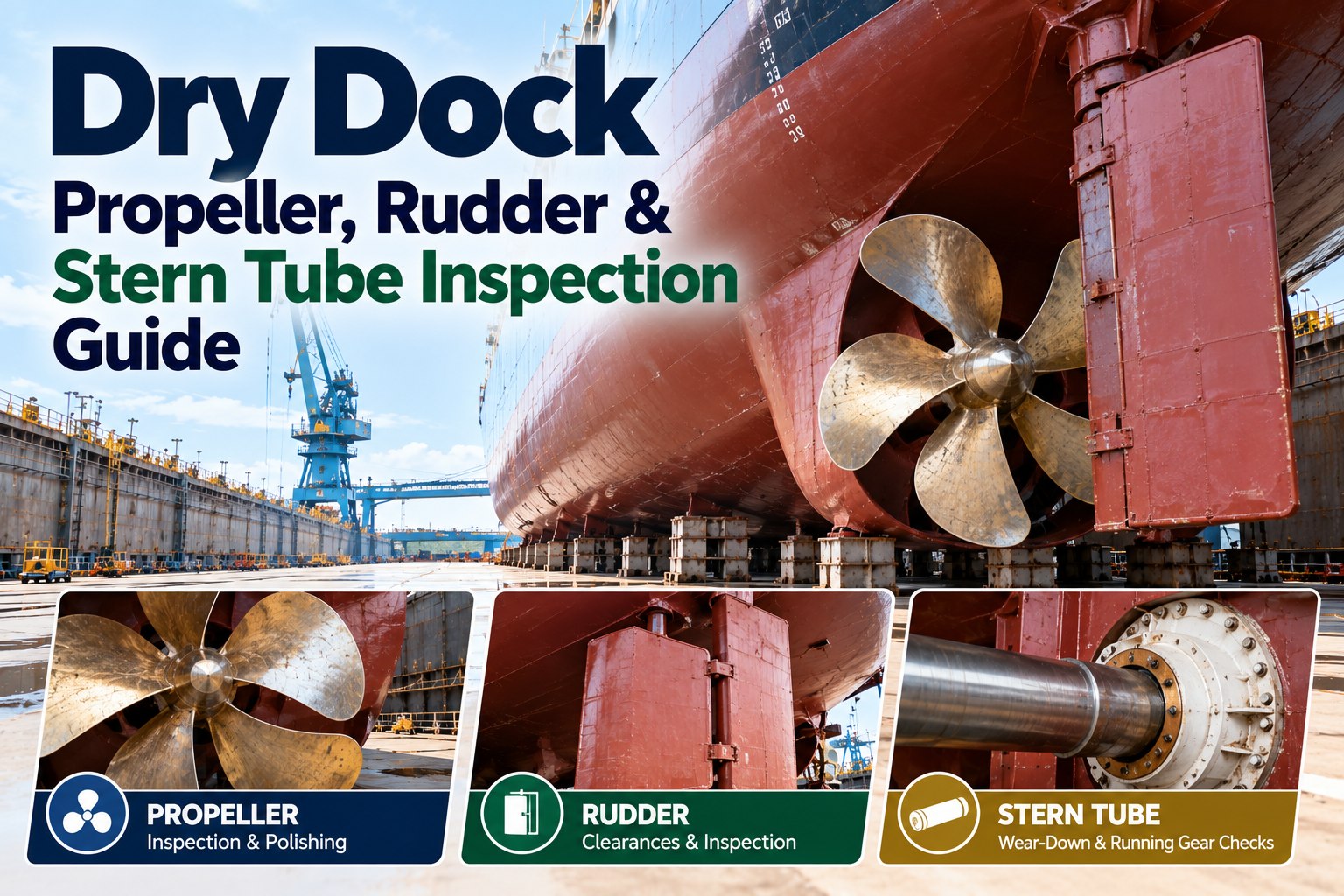
IACS UR Z3, revision 7 of 2018, says in clause 2.6 that visible parts of side thrusters are to be examined, covering the gear housing and the condition of propeller blades and fastenings, with the sealing arrangement verified. In-water survey is covered in general terms. A 2024 equipment guide recommends periodic underwater diver inspection of tunnel, propeller and anodes between dockings, and a full inspection in dry dock. Plan the dock work early, with the hull inspection and your thruster list in one task set.
| Item | What to check | Checkpoint type |
|---|---|---|
| Visible thruster parts | Gear housing, propeller blades and fastenings examined, as UR Z3 clause 2.6 requires for side thrusters | Visual |
| Seals | Blade, propeller shaft and seal arrangement verified. Check for net, rope or line damage | Visual |
| Tunnel and grilles | Corrosion, damage, marine growth and debris, grilles secure | Visual |
| Propeller | Blade damage, wear and balance, especially after repair | Test |
| Shaft and alignment | Wear, corrosion and alignment, using the maker's method | Test |
| Anodes | Condition recorded and replaced as planned | Record |
| Hydraulic and gear oil | Samples taken and results filed. Filters inspected | Record |
| Motor insulation | Insulation resistance and polarization index recorded and compared with the trend | Test |
| Breaker settings | Every breaker in the supply chain compared with the maker's settings and recorded | Record |
| Controls | Control transfer, status lights, ammeter and alarms tested from every station | Test |
| Dock report | Findings, photographs and repair list filed against the thruster | Record |
Bow Thruster Troubleshooting: From Oil Level to Overload Trips
A symptom-to-action guide built from the published cases
Use the table as a first-check guide. It is our summary of the causes the cases describe, and it does not replace the maker's troubleshooting chart. A thruster that trips repeatedly should be investigated, not simply reset, and any unresolved fault should be communicated to the bridge.
| Symptom | Likely cause | First check | Typical action |
|---|---|---|---|
| Oil level rising or oil milky | Water ingress through a damaged seal, as in IMCA SF 21/18 | Sample the oil and check the seal for fouling or damage | Stop use where the manual requires, plan dry-dock inspection and seal replacement |
| Thruster trips on overload | Mechanical load from fouling or a damaged blade, or breaker settings that differ from the maker's, as in Bro Anna | Breaker trip and delay settings, motor current, blade and tunnel condition | Restore maker's settings, investigate the load and do not simply reset repeatedly |
| Rising vibration | Propeller damage, imbalance, misalignment or wear | Vibration at several loads, diver or dock inspection | Shorten measurement intervals and plan an inspection |
| Motor temperature rising | Overload, cooling fault or insulation problem | Temperature sensor trend, cooling and insulation resistance | Isolate and test, then correct the cause |
| No response from the wing console | Control transfer fault, broken wire or panel fault, as in Apollo | Test transfer at each station and confirm status indication | Repair before departure or apply formal mitigations and tell the bridge |
| Slow or erratic thrust | Hydraulic pump or filter problem, or pitch feedback fault on a CPP unit | Oil condition, suction filters, pump pressures | Clean or replace filters and test the system against the manual |
Six Bow Thruster Maintenance Habits That Lead to Failures
What the TSB, IMCA and vendor cases point to
Keeping Thruster Records, Photos and Due Dates in One System
How a dated photo repository, task ownership and deadlines support thruster reliability
Thruster problems recur when the check exists in the manual but not in the system. Marine Inspection supports a dated photo repository, observations turned into tasks with owners, deadlines and evidence, and certificate and equipment tracking. A dated photo of a seal, a task for a rising oil level with a named owner, tracked oil sample dates and a record of every breaker setting give a Chief Engineer a trail to show a superintendent, a surveyor or a charterer. It does not replace the maker's manual or class. See Marine Inspection pricing for plans, and see our hydraulic system maintenance for hydraulic units.