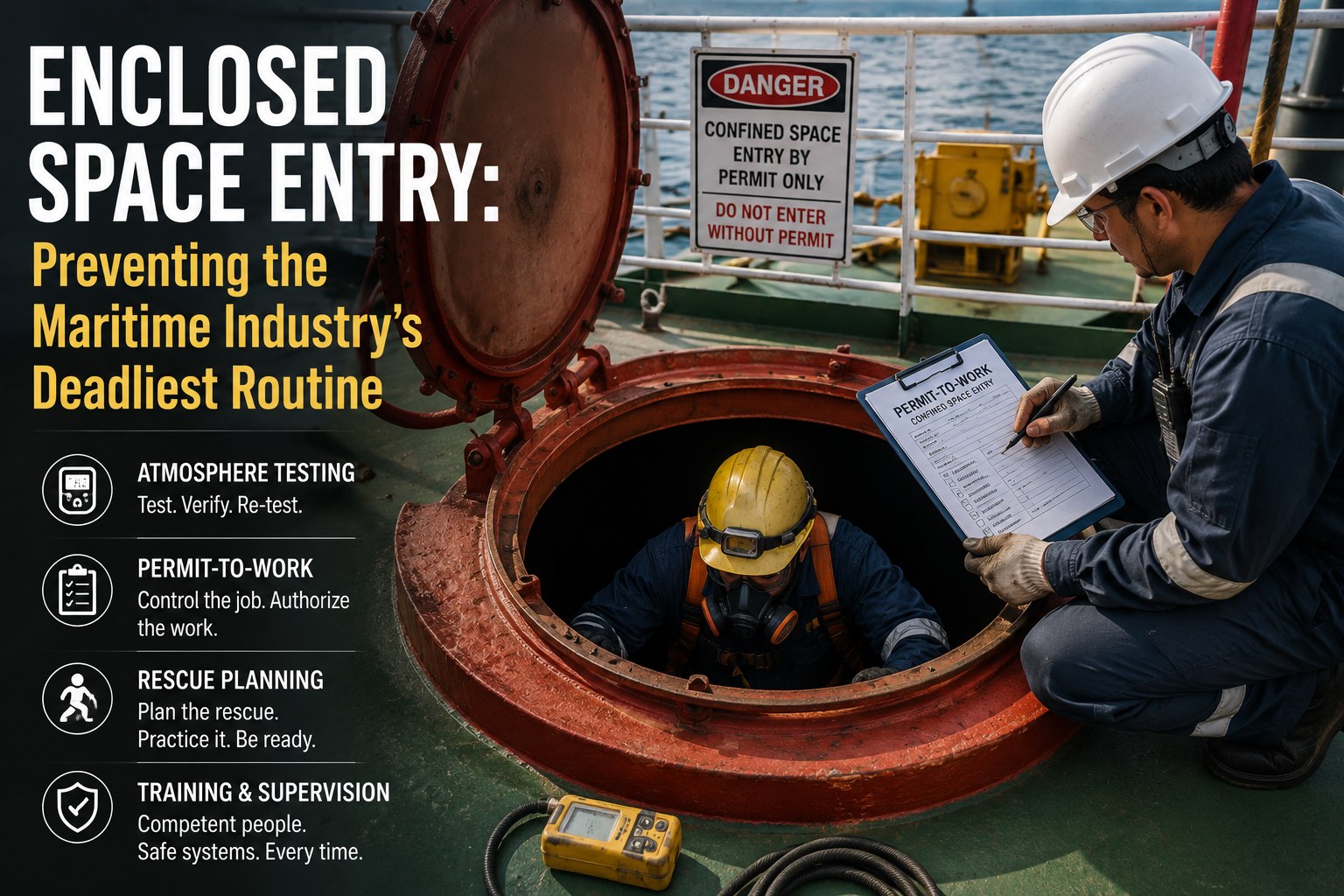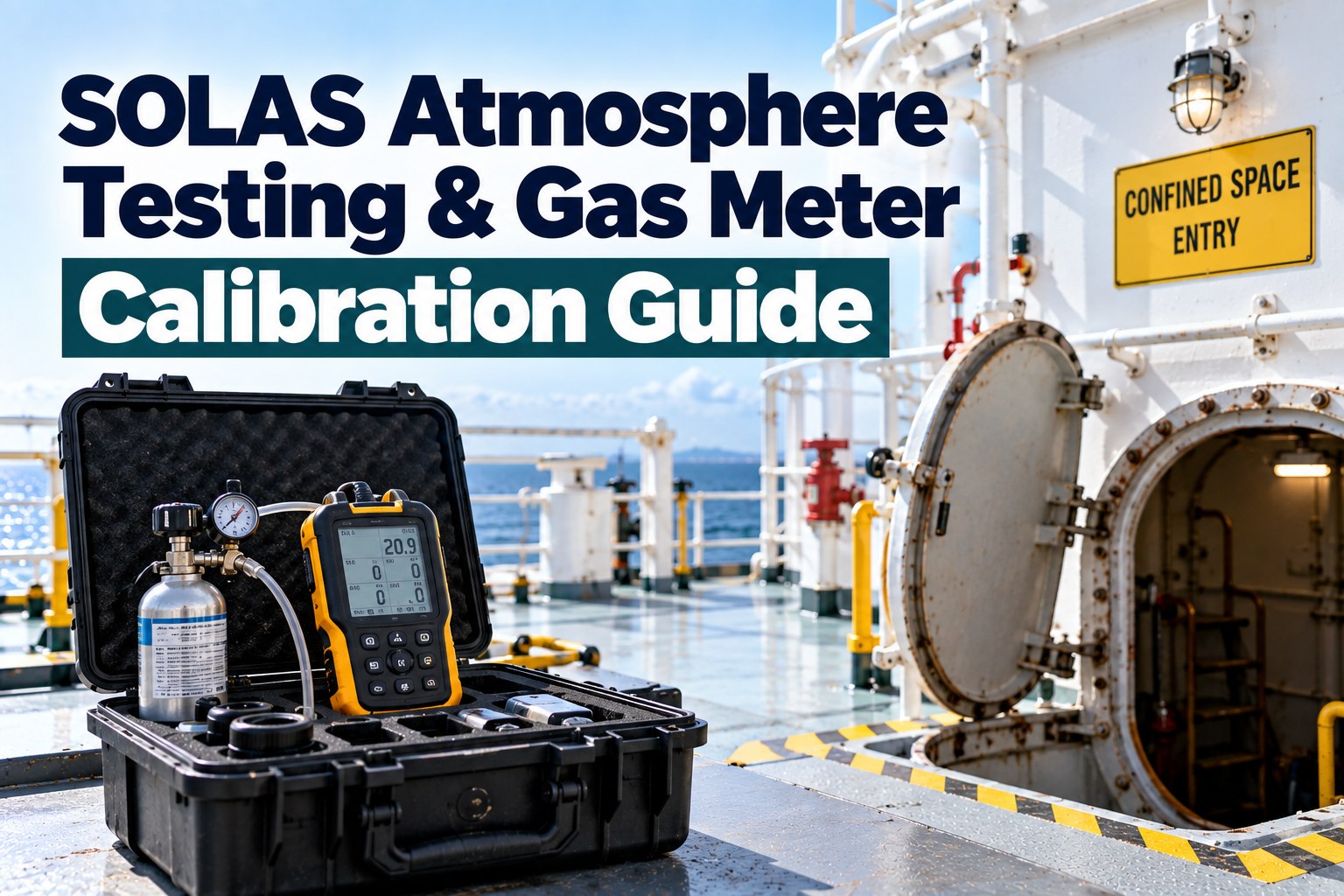
Almost every enclosed space fatality at sea involves an atmosphere that somebody believed had been tested. The instrument was on board, it was switched on, it showed a reading, and the reading was wrong — because the sensor had drifted since its last calibration, because the sample line had not purged, because the meter was measuring at the hatch rather than at the level where the person was going, or because the gas that killed them was one the instrument did not have a channel for. The equipment failed nobody. The method did.
This guide is about the instrument and the technique: what a multi-gas meter must be able to measure, the difference between zeroing, bump testing and calibration, how to sample a space before anyone goes into it, and how to read the result honestly — including the gas most four-channel meters on board cannot see at all.
The meter does not tell you the space is safe. It tells you what reached the sensor.
A clean screen on a four-gas meter is not a clean atmosphere. It is four gases, measured wherever the sample was drawn from, by sensors that were last proved on a date somebody should be able to tell you.
Atmosphere testing before entry: what the rules require you to measure
Since 2016, SOLAS chapter XI-1 regulation 7 has required ships to carry an appropriate portable atmosphere testing instrument, capable as a minimum of measuring oxygen, flammable gases or vapours, hydrogen sulphide and carbon monoxide, together with the means to calibrate it. That is the four-gas meter every ship now has. The revised recommendations for entering enclosed spaces go further and expect personal gas detection to cover carbon dioxide as well, and to keep working in an oxygen-depleted atmosphere.
Oxygen
Flammable gases and vapours
Hydrogen sulphide
Carbon monoxide
Carbon dioxide
The acceptance criteria every atmosphere test is judged against
The revised recommendations set numbers rather than adjectives, which is a considerable improvement on “safe for entry”. If any one of them is not met, the space is unsafe and nobody goes in.
Two points about the oxygen figure catch people out. It is not “above 19.5 per cent”, which is the number many crews carry in their heads from older guidance — it is normal atmospheric oxygen, 20.9 per cent. And it is a ceiling as well as a floor in practice: a reading above 21 per cent means the space is oxygen-enriched, which is its own serious hazard and usually means a leaking oxygen line rather than a good atmosphere.
Gas meter calibration, bump testing and zeroing: three different things
These three are used interchangeably on board and they are not interchangeable at all. Only one of them proves the instrument is still accurate.
Sets the baseline
Proves it responds and alarms
Corrects the drift
The failure that hides in plain sight
Gas meter calibration intervals and what a failed bump test means
The intervals below are the accepted working practice; the maker’s manual for your instrument is what governs, and several flag administrations and company systems set something tighter.
Bump test
Full calibration
Sensor replacement
A failed bump test is a straightforward outcome: the instrument goes out of service until it has been calibrated and passes. It does not get used for one more entry because the calibration kit is ashore. And the span gas has its own expiry date printed on the cylinder — calibrating against gas that has passed its date proves nothing, so the cylinders belong in the same schedule as the instrument, alongside the ship’s other pressure vessels and gas cylinders.
Atmosphere testing sequence: sampling a space you have not entered
The whole point of a pre-entry test is that it is carried out from outside. That means a sample line and an aspirator or pump, and it means the sequence matters more than the instrument.
Ventilate first, then test
Zero and bump in clean air
Purge the sample line fully
Test at several levels
Record what was measured, not that it was
Keep testing after entry begins
Why gases stratify, and why one atmosphere test is not a test
Gases do not mix themselves evenly in a still space. They settle according to their density, which means the atmosphere at the hatch and the atmosphere at the tank bottom can be entirely different things.
Hydrogen sulphide and most hydrocarbon vapours are heavier than air and collect at the bottom, which is also where oxygen depletion is usually worst and where a person is going to end up. Methane is lighter and gathers under the deckhead. A meter lowered to the working level and no further can produce a perfectly acceptable set of readings for a space with a lethal layer sitting a metre below the last sample point.
Gas sensor types, what they measure and what fools them
Knowing which sensor is behind each channel changes how you read the screen, because each technology fails in a characteristic way rather than at random.
| Sensor | Usually measures | What fools or degrades it | Practical consequence |
|---|---|---|---|
| Catalytic bead | Flammable gases as per cent LFL | Needs oxygen to burn the sample on the bead; poisoned by silicones, sulphur compounds, lead and halogenated vapours | Under-reads badly in an inerted or oxygen-depleted space — the worst possible place to be optimistic |
| Infrared | Hydrocarbons and carbon dioxide | Dirty or fogged optics; condensation in the sample line | Works without oxygen, which is why it is the right choice for inerted tanks |
| Electrochemical | Oxygen, carbon monoxide, hydrogen sulphide | Finite cell life that runs whether used or not; cross-sensitivity between toxic gases; extremes of temperature and humidity | A cell near the end of its life reads low and gives no warning that it is doing so |
| Photo-ionisation | Volatile organic compounds at low ppm | High humidity; a lamp that has become dirty or weak | Useful for cargo vapours a four-gas meter will not see, but it is an addition rather than a replacement |
The maker’s manual for your instrument is authoritative on sensor type, cross-sensitivity and life. Two meters that look identical may not carry the same sensor behind the same channel label.
The catalytic bead problem in oxygen-depleted and inerted atmospheres
This is the single most dangerous technical trap in shipboard gas testing, and it is worth stating plainly. A catalytic bead sensor measures flammable gas by burning a small sample of it on a heated element. Burning requires oxygen. In a space that has been inerted, or one where oxygen has been consumed by rust or cargo, there is not enough oxygen for the reaction — so the sensor reads low or reads nothing, in an atmosphere that may be thick with flammable vapour.
The revised recommendations address this directly by expecting detection equipment to be capable of operating in oxygen-depleted atmospheres. In practice that means an infrared sensor for the flammable channel where inerted spaces are in scope, or a separate instrument for those spaces. If your ship inerts cargo tanks and carries only catalytic bead instruments, that is a gap worth raising before somebody finds it the hard way — and cargo tanks, pump rooms and slop spaces carry their own regime on top of this, set out under the MARPOL annexes.
The CO2 channel most four-gas meters do not have
A standard four-gas meter measures oxygen, flammable gas, carbon monoxide and hydrogen sulphide. It does not measure carbon dioxide, and electrochemical cells are not the technology for it — carbon dioxide measurement needs an infrared sensor, which on most ships means a second instrument rather than a fifth channel.
That matters most with organic cargoes. Grain, timber, wood pellets, fishmeal and similar cargoes consume oxygen and give off carbon dioxide as they respire. Because the two move together, a modest fall in oxygen can sit alongside a large rise in carbon dioxide — and carbon dioxide is odourless, tasteless and dangerous at concentrations well below the level at which the oxygen reading looks alarming. Effects can begin at one or two thousand parts per million; the eight-hour exposure limit is 5,000 ppm, which is the same 0.5 per cent that the entry criteria set.
Where it bites
What to check
Why it is missed
Continuous monitoring and personal gas detection during entry
A pre-entry test describes the atmosphere at one moment. Entry changes it. Disturbing sludge releases hydrogen sulphide, opening a section of pipework releases whatever was in it, and a ventilation fan that stops changes the space within minutes.
Everybody who enters carries personal gas detection, and it is worn in the breathing zone rather than clipped to a bag at the bottom of a ladder. The attendant at the entrance keeps continuous communication and watches the readings as well as the person. And the entry permit has a stated validity — a maximum of eight hours under the revised recommendations — after which the space is re-tested and a fresh permit issued rather than the old one extended.
Gas meter calibration records and the entry permit
Two records carry the weight here, and inspectors and auditors ask for them in the same breath.
The instrument record
The entry permit
The commonest audit finding in this area is not a missing instrument. It is an entry permit with a signature where the readings should be, and a meter whose last calibration certificate nobody on board can produce.
What changed for atmosphere testing in 2026
The carriage requirement itself is unchanged: SOLAS chapter XI-1 regulation 7 has required a portable atmosphere testing instrument since 2016 and still does. What changed is the guidance around it, and the change is substantial enough that ships are working through it now.
Resolution MSC.581(110) took effect on 3 December 2025 and replaced the long-standing recommendations for entering enclosed spaces. For atmosphere testing specifically it brings in numeric pre-entry criteria, expects personal gas detection for every entrant covering oxygen, carbon dioxide, flammable gases and toxic gases, expects that equipment to be capable of operating in oxygen-depleted atmospheres, and caps the entry permit at eight hours. It also asks for a ship-specific enclosed space register and an enclosed space emergency response plan.