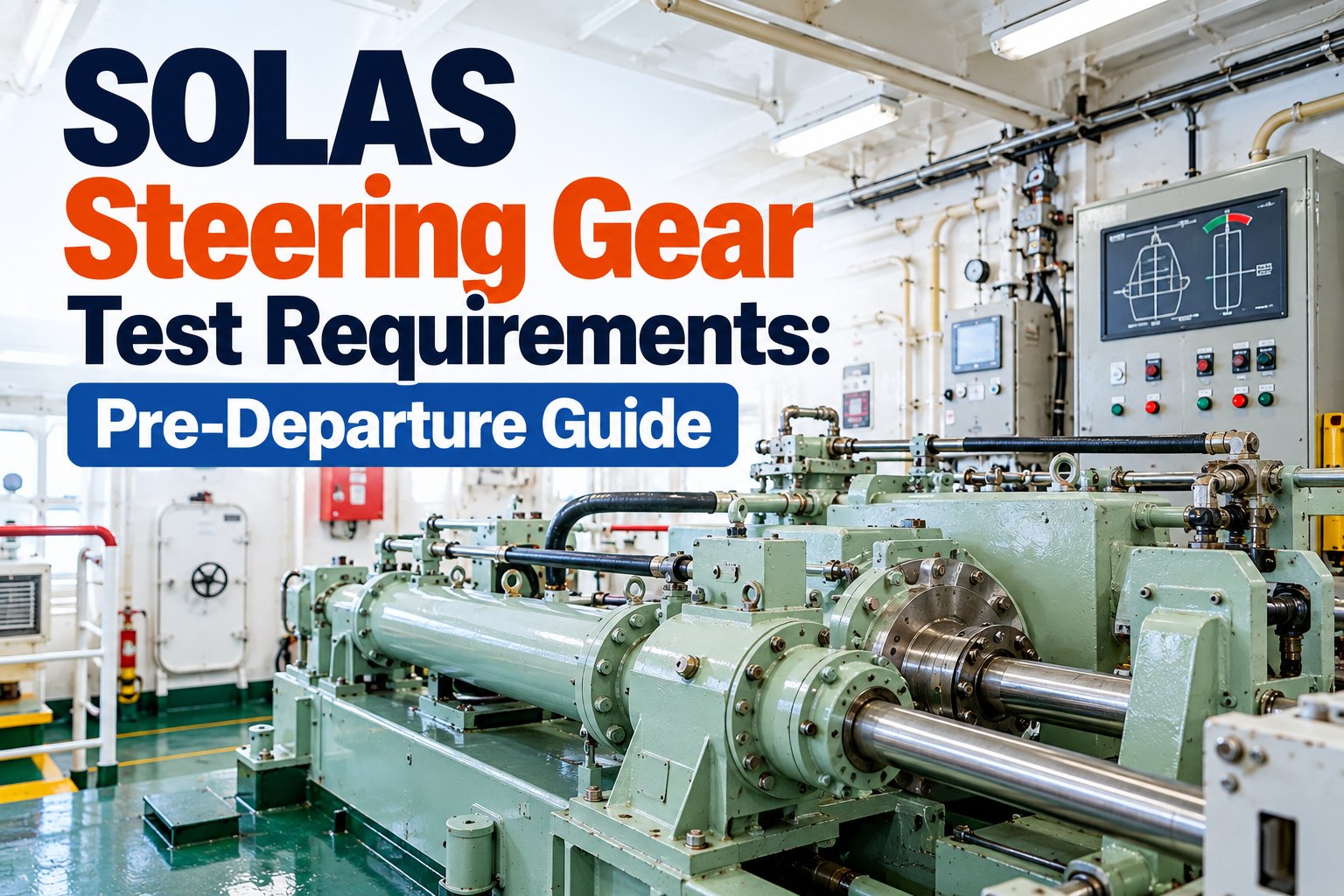
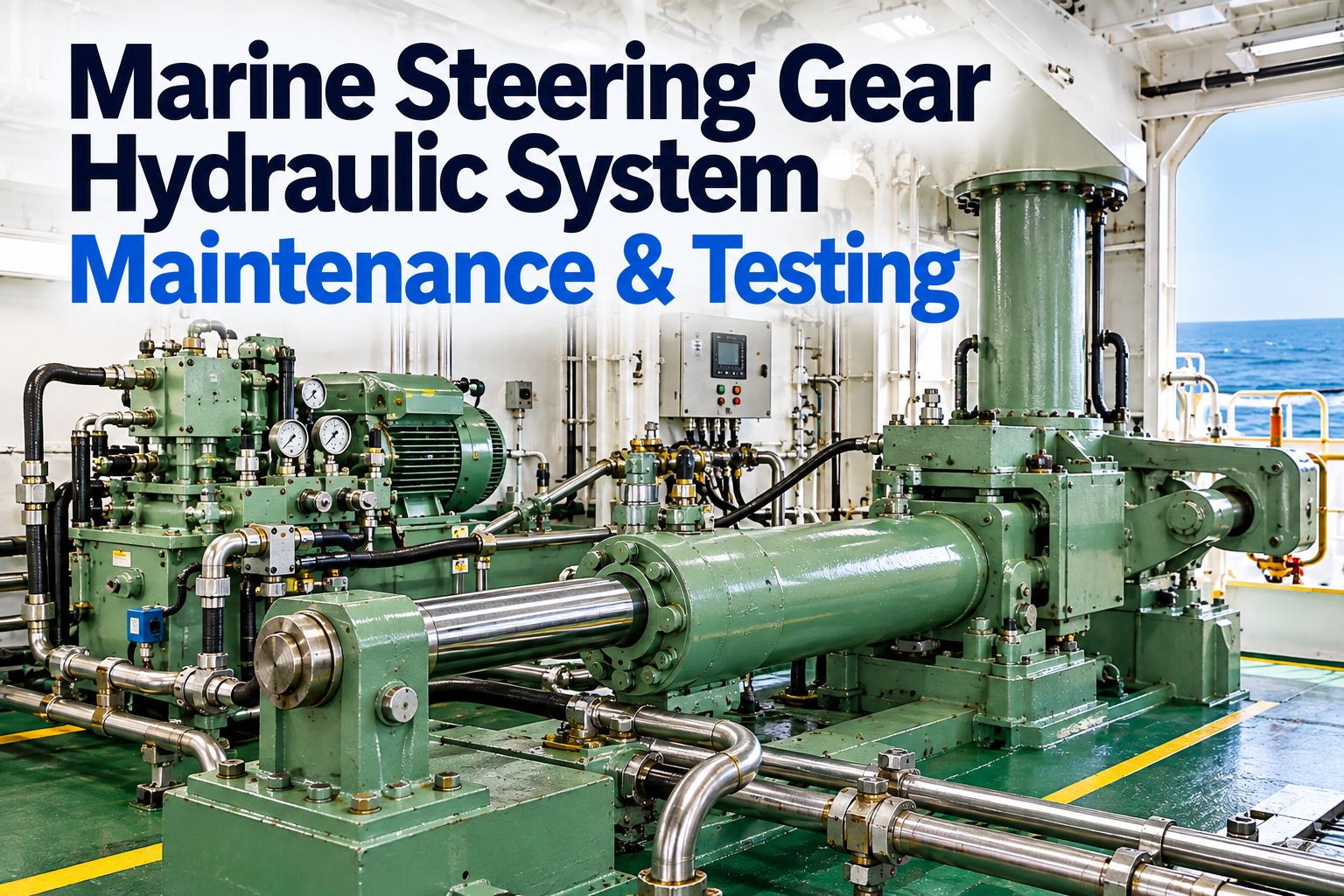
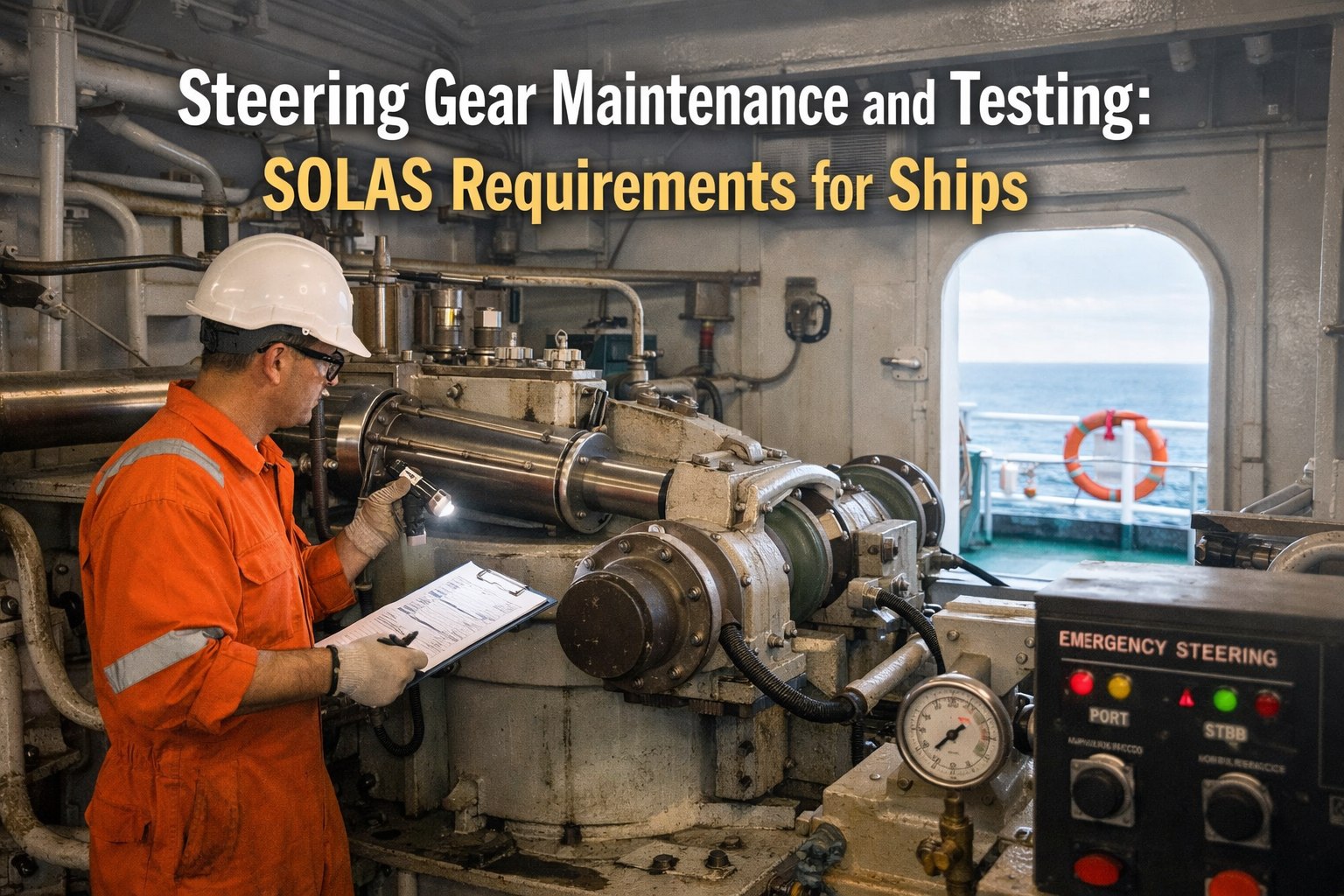
SOLAS Steering Gear Test Requirements: Pre-Departure Guide
The steering gear test is the most routine thing a chief engineer does and one of the easiest deficiencies to write up, because it leaves a paper trail with a time on it. It is also the one rudder test that happens before every single departure, on every ship. SOLAS V/26 requires the steering gear to be checked and tested by the ship’s crew within twelve hours before departure — not on the day, not before arrival, within twelve hours — and it lists what that check covers. An inspector who wants to test the ship’s discipline rather than its machinery asks for the record, compares the time against the departure time, and then asks the duty officer to describe the changeover procedure. Neither question involves opening anything. It sits alongside the wider SOLAS chapter V navigation safety inspection checklist. This guide covers the twelve-hour regime item by item, the performance the gear is built to deliver, the three-monthly emergency steering drill and what it must include, the block diagram and changeover familiarity requirement, the short-voyage waiver and its weekly alternative, and what gets recorded. Start a free trial of Marine Inspection to log pre-departure tests with times and keep the drill records in one place.
What the gear is built to do, and what you are proving before departure
The pre-departure test is not a performance test — nobody is timing the rudder alongside. It confirms that the systems capable of delivering these figures are all present, powered, responding and talking to each other.
Pre-departure discipline
A test with no time on it is a test an inspector can question
Steering gear tests logged with the time they were carried out, drill records held against the three-monthly cycle, and defects raised as jobs rather than noted and forgotten.
SOLAS steering gear test requirements before departure
SOLAS V/26 requires the steering gear to be checked and tested by the ship’s crew within twelve hours before departure. The regulation then lists what the test procedure includes, where applicable, and separately what the checks and tests must include.
The steering test requirements cover, where applicable
aThe main steering gear
bThe auxiliary steering gear
cThe remote steering gear control systems
dThe steering positions located on the navigation bridge
eThe emergency power supply
fThe rudder angle indicators in relation to the actual position of the rudder
gThe remote steering gear control system power failure alarms
hThe steering gear power unit failure alarms and automatic isolating arrangements
And the steering gear checks and tests must include
1Full movement of the rudder according to the required capabilities of the steering gear
2A visual inspection of the steering gear and its connecting linkage
3The operation of the means of communication between the navigation bridge and the steering gear compartment
Three details that decide whether the test stands up
Rudder angle indicators are checked against the actual rudder, not against each other. An indicator agreeing with the helm order while the rudder sits somewhere else is precisely the failure the item exists to catch, and it needs someone in the steering compartment watching the stock. Communications are part of the test, not a courtesy — the means of communication between bridge and steering compartment is a listed item. Both units, both control systems. Testing the one in use and assuming the other is fine defeats the purpose of having two.
Pre-departure steering gear test record: what good looks like
What a good record looks like. The value is in the time and the initials, because those are the two things an inspector can check against something else. See how the test is captured with a timestamp rather than written up afterwards from memory.
Steering gear test record — pre-departure
SOLAS V/26 · within 12 hours of departure
Departure1840 LT
Test started1505 LT
Within windowYes — 3 h 35 m
Carried out by2/E and 3/O
Main steering gear, both pumps
Run individually and together
tested
Auxiliary steering gear
Operated, rudder responded
tested
Remote control systems
Both systems, changeover proved
tested
Bridge steering positions
All positions, including standby
tested
Emergency power supply
Changeover proved on load
tested
Rudder angle indicators
Checked against actual rudder position
tested
Power failure alarms
Control system and power unit alarms
tested
Automatic isolating arrangements
Operated where fitted
tested
Full rudder movement
Hard over to hard over, both ways
tested
Visual inspection
Gear and connecting linkage, no leaks
tested
Bridge to steering compartment communications
Both directions, primary and back-up
tested
Defects found: none. Any defect found here becomes a job with an owner before departure, not a remark in the log.
Every departure, every ship
The record is the part an inspector can actually check
Time-stamped test records, the three-monthly drill cycle tracked, and a fleet view showing which vessel has a drill falling due before the next port.
Steering gear test requirements under SOLAS V/26 — what each check proves and what to record
Item
What the test is actually proving
What to record
Main steering gear
Each power unit runs and moves the rudder, individually and together
Units tested and any abnormal noise, temperature or current noted
Auxiliary steering gear
The second means of steering exists, is powered and moves the rudder
Operated and rudder response confirmed
Remote control systems
Both systems drive the gear and the changeover between them works
Both systems tested and changeover proved, not assumed
Bridge steering positions
Every steering position on the bridge controls the rudder
Each position tested, including any standby or wing position
Emergency power supply
Steering survives loss of main power
Changeover proved with the gear on load
Rudder angle indicators
What the bridge sees matches where the rudder is
Indicator compared against the actual rudder, with someone at the stock
Control system power failure alarms
The bridge will know when a control system fails
Each alarm tested individually, not as a group
Power unit failure alarms and isolating arrangements
A failed unit announces itself and is isolated automatically where fitted
Alarms and automatic isolation operated and reset
Full rudder movement
The gear achieves the travel it was designed for, with nothing fouling
Hard over to hard over both ways, with the angles reached
Visual inspection
The mechanical path from ram to stock is intact
Linkage, tiller, rams and hydraulic connections checked by hand; leaks noted
Communications
Bridge and steering compartment can talk during an emergency
Both directions tested on the primary and any back-up means
The record itself
That the test happened inside the twelve-hour window
Date and time of the test, departure time, and who carried it out
Emergency steering drill requirements: once every three months
Separate from the routine tests, SOLAS V/26 requires emergency steering drills at least once every three months to practise emergency steering procedures. The regulation is specific about what they include, and each element exists because it has failed somewhere.
1
Direct control within the steering gear compartment
Steering from the compartment itself, using the local control arrangement. The first time a crew does this should not be the time it is needed, in a seaway, in the dark, with the ship swinging.
2
The communications procedure with the navigation bridge
Orders passed and acknowledged reliably, in a noisy compartment, using whatever the ship actually has. This is the element that most often fails in drills, and the failure is usually about phrasing and repetition rather than equipment.
3
Backup steering: alternative power supplies, where applicable
Proving that the gear can be powered from the emergency source and that the people on watch know how to make that happen.
4
Recorded with the date and the details
The regulation requires the date and details of emergency steering drills to be recorded. “Emergency steering drill carried out” is a date without details, and it is the entry most often challenged.
Make the drill worth running
Vary who takes the local control, so it is not always the same engineer. Run at least one drill with the bridge passing real headings rather than a single order. Time how long it takes from the decision to the moment the ship is under local control — that number is the drill’s actual output, and it should get shorter. Record it, and record who took part, because a drill that develops nothing and proves nothing still costs the same amount of time.
Steering gear block diagram and changeover familiarity
Most ships have hydraulic steering gear with two power units and two control systems, and the whole point of the display requirement is that anyone can work out how to move between them under pressure. Ship steering arrangements differ enough between vessels that experience elsewhere is not a substitute for the diagram in front of you.
Simple operating instructions with a block diagram must be permanently displayed on the navigation bridge and in the steering gear compartment, showing the changeover procedures for remote steering gear control systems and steering gear power units.
Permanently displayed means fixed and legible, not laminated and taped to a locker, not obscured by a notice board, and not a photocopy that has faded to grey. Inspectors check both locations, and the compartment copy is the one usually missing.
The diagram must match the ship as it is now. Modifications to the steering system that never reached the diagram are common on older vessels, and a diagram that describes a different arrangement is worse than none.
Officers concerned with operation or maintenance must be familiar with the ship steering systems and with the procedures for changing from one system to another. This is tested by asking, and it is asked in front of the diagram.
Brief new joiners against the diagram on arrival. Familiarity is a crew-change problem more than a training problem, and the inspector will not ask the person who has been aboard two years.
Did anything change for steering gear in 2026?
No. The SOLAS amendments that entered force on 1 January 2026 did not alter regulation V/26 or the steering gear performance requirements — the twelve-hour test, the three-monthly drill and the recording obligation are unchanged. The 2026 package affected fire-extinguishing media, lifting appliances, oil fuel flashpoint declarations, container loss reporting and electronic inclinometers instead. If you are auditing steering compliance against a 2026 checklist, the steering entries should read exactly as they did the year before. The full picture is in the SOLAS 2026 amendments checklist.
Short-voyage waiver: weekly steering gear checks
What it allows
The Administration may waive the requirement to carry out the checks and tests before every departure for ships which regularly ply on voyages of short duration. It does not remove the obligation — it changes the interval.
What replaces it
Such ships carry out the checks and tests at least once every week. Weekly, on a schedule, recorded the same way — and the emergency steering drill requirement is unaffected.
Who decides
The Administration, in writing. A ship operating to a weekly regime without documented flag approval is operating outside the twelve-hour rule with nothing to show for it, which is a straightforward finding.
Steering gear inspection findings and detainable defects
Steering inspection findings an inspector writes up
Test record with no time, or a time outside the twelve-hour window
Only the running system tested, with the standby untouched
Block diagram missing from the steering compartment
Diagram not matching the installed arrangement
Emergency steering drill overdue, or recorded with no details
Officer unable to describe the changeover procedure
Alarms recorded as tested as a group rather than individually
Conditions that stop the ship
Rudder angle indicator not agreeing with the actual rudder position
Auxiliary steering gear inoperative
No communication between bridge and steering compartment
Emergency power supply to the steering gear not proven
Hydraulic steering leakage sufficient to threaten loss of oil from a system
Control system failure alarms inoperative
Rudder unable to achieve full designed travel
Steering gear test records SOLAS requires you to keep
1
Date and time of the test, against the departure time. This is the single entry that proves compliance with the twelve-hour requirement, and a date alone does not.
2
Who carried it out. Named, and ideally two people, because the rudder indicator check needs someone at each end.
3
Which items were tested, not a single line saying the steering gear was tested. The regulation lists items; the record should follow the list.
4
Any defect found, and what happened to it. A defect recorded and closed is evidence the system works. A defect recorded and left open across several departures is evidence of the opposite.
5
Date and details of every emergency steering drill, including who took part and what was practised.
6
Consistency between records. The deck log, the engine log and the test record should agree on times. Inspectors compare them, and discrepancies invite a longer look at everything else.
How long before departure must steering gear be tested?
Within twelve hours before departure, by the ship’s crew. Record the time as well as the date, because the time is what demonstrates the test fell inside the window.
What does the pre-departure test have to cover?
Where applicable: the main steering gear, the auxiliary steering gear, the remote steering gear control systems, the bridge steering positions, the emergency power supply, the rudder angle indicators against the actual rudder position, the remote control system power failure alarms, and the power unit failure alarms and automatic isolating arrangements. It must also include full rudder movement, a visual inspection of the gear and connecting linkage, and operation of the bridge to steering compartment communications.
How often are emergency steering drills required?
At least once every three months. The drill must include direct control within the steering gear compartment, the communications procedure with the navigation bridge, and, where applicable, the operation of alternative power supplies. The date and details must be recorded.
What performance must the steering gear deliver?
Main steering gear must move the rudder from 35° on either side to 35° on the other with the ship at its deepest seagoing draught and running at maximum ahead service speed, and from 35° on either side to 30° on the other in not more than 28 seconds under the same conditions. Auxiliary steering gear must move the rudder from 15° on either side to 15° on the other in not more than 60 seconds, at half maximum ahead service speed or 7 knots, whichever is greater.
Can the twelve-hour test be waived?
The Administration may waive it for ships which regularly ply on voyages of short duration, in which case the checks and tests are carried out at least once every week. It is a flag decision and should be documented; the emergency steering drill requirement is not affected.
Where must the block diagram be displayed?
Simple operating instructions with a block diagram showing the changeover procedures for remote steering gear control systems and steering gear power units must be permanently displayed on the navigation bridge and in the steering gear compartment. The compartment copy is the one most often missing.
Do both steering systems need testing, or just the one in use?
Both. The regulation lists the remote steering gear control systems in the plural, and the whole purpose of a second system is that it works when the first does not. Testing only the system in use is a standard finding.
What is recorded after the test?
The date the checks and tests were carried out, and the date and details of emergency steering drills. In practice record the time too, the items tested, who carried it out, and any defect with its outcome — because that is what makes the entry defensible rather than merely present.
Before the next departure
Make the twelve-hour window provable, not arguable
Time-stamped steering tests against each departure, the item list followed rather than summarised, and drill records that carry the details the regulation asks for.