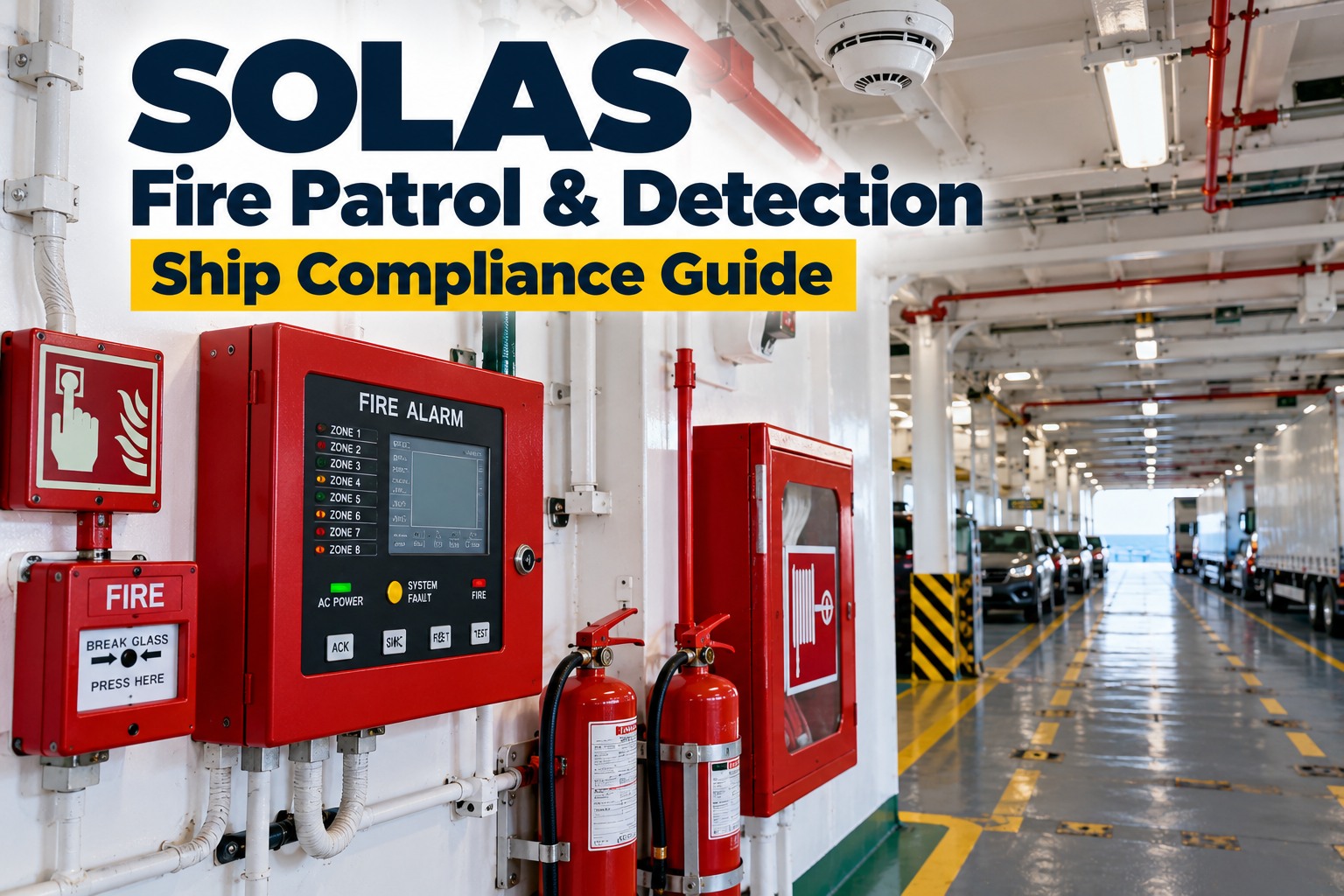
A fire on a ship is found by something: a detector, a call point, a crew member on patrol, or a camera. For a Safety Officer, the job under SOLAS Chapter II-2 is to make sure that something works at the moment it is needed, in every space that can burn. This guide covers fire detection and patrol, the alarm panel behind them, and the 2026 changes for vehicle, special category and ro-ro spaces.
How Detection and Patrol Work Together on a SOLAS Ship
Why regulation 7 treats detection as the first link in the fire response chain
SOLAS Regulation II-2/7 states its purpose in one line: detect a fire in the space of origin and provide an alarm for safe escape and fire-fighting. Everything else on this page is a way of meeting that sentence. A detector finds heat or smoke, the panel tells the bridge, and a person or a camera confirms what is happening. If one link is slow, the next link starts late.
Detection systems do not replace people. Where a space is hard to cover, such as an open vehicle deck, the people and the cameras fill the gaps. For the wider picture of Chapter II-2, including structural fire protection and suppression, see our SOLAS fire safety requirements and Chapter II-2 compliance checklist.
How a signal moves from a detector in a space to an alarm on the bridge
UK guidance defines a section as a group of detectors and manual call points, and a loop as an electrical circuit linking detectors of various sections to the control panel. The panel shows which section is in alarm, sounds an audible and visual alarm that is distinct from any other system, and sends it to the bridge and to a responsible engineer officer. The diagram below shows the path in simple form.
What Changed in 2026 for Vehicle, Special Category and Ro-Ro Spaces
Which resolutions amended SOLAS II-2 and the FSS Code, and when they took effect
Resolution MSC.550(108) amends SOLAS Chapter II-2, regulations 7 and 20. Resolution MSC.555(108) amends FSS Code Chapters 7 and 9, which cover fixed water-based systems and fixed fire detection and alarm systems. Both entered into force on 1 January 2026, according to Eagle and Lloyd's Register. The effect differs sharply between a ship whose keel was laid after that date and one built before it.
What applies to each ship group, and how new and existing ships are treated differently
New cargo ships and ro-ro passenger ships need fixed detection and alarm in vehicle, special category and ro-ro spaces. For new cargo ships the Administration approves detector type, spacing and location, and corridors, stairways, escape routes, control stations and cargo control rooms must be protected by detection and alarm or sprinklers, depending on the adopted method (IC, IIC or IIIC). Existing cargo ships keep the requirements that applied before the amendments, according to Eagle.
| Ship group | Detection in vehicle, special category and ro-ro spaces | Video monitoring | Source |
|---|---|---|---|
| Ro-ro passenger ships, keel laid from 1 Jan 2026 | Combined smoke and heat detectors. Administration may accept linear heat detectors. | Replay for at least 7 days at a continuously manned control station | Eagle; LR |
| Ro-ro passenger ships, keel laid before 1 Jan 2026 | Heat detectors added to smoke detectors, or combined detectors, by the first survey on or after 1 Jan 2028 | Replay for at least 24 hours, by the same date | Eagle; LR |
| Cargo ships, keel laid from 1 Jan 2026 | Fixed detection and alarm. Administration approves type, spacing and location. | Section 4.4 applies to new cargo ships | LR; Eagle |
| Cargo ships, keel laid before 1 Jan 2026 | Requirements in place before MSC.550(108) continue to apply | Not stated in the sources read | Eagle |
What the existing-ship deadline of January 2028 means for retrofit planning
For existing ro-ro passenger ships, the sources describe three items by the first survey on or after 1 January 2028: heat detectors in addition to smoke detectors, or combined smoke and heat detectors; an effective video monitoring and recording system with replay of at least 24 hours; and a fixed water-based monitor system for vehicle-carrying weather deck areas. Lloyd's Register asks owners to submit modification plans for approval well before the date. Eagle adds that a fixed detection and alarm system is not required if an efficient patrol is kept up by a continuous fire watch at all times during the voyage.
Detector Types, Spacing and Sections: Getting Coverage Right
How far apart heat, smoke and combined detectors may be placed in a space
FSS Code Chapter 9 sets maximum floor area and spacing for each detector type. A heat detector covers up to 37 m², and a smoke detector or a combined smoke and heat detector covers up to 74 m². Maximum distance between detector centres is 9 m for heat and combined detectors and 11 m for smoke detectors. The maximum distance from bulkheads is 4.5 m for heat and combined detectors and 5.5 m for smoke detectors. MSC.1/Circ.1695 provides a unified interpretation of the spacing requirements.
| Detector type | Max floor area per detector | Max distance between centres | Max distance from bulkheads |
|---|---|---|---|
| Heat | 37 m² | 9 m | 4.5 m |
| Smoke | 74 m² | 11 m | 5.5 m |
| Combined smoke and heat | 74 m² | 9 m | 4.5 m |
What timed disconnection of smoke detector sections means during loading and unloading
Smoke detectors in special category and ro-ro spaces may be disconnected during loading and unloading, because exhaust fumes can cause nuisance alarms. On new ro-ro passenger ships the disconnection must match the operation's duration and reset automatically. Heat detection and manual call point disconnection are not permitted. UK guidance adds that the central unit should indicate whether sections are disconnected, and that manual call points cannot be disconnected in this way. Make a habit of reading the panel at the end of cargo work.
Fire Patrol Rounds: What a Real Patrol Looks Like on a Vehicle-Deck Ship
When rounds must happen, how the patrol is instructed and what hatches are needed
UK guidance says SOLAS requires an efficient fire patrol system on specific classes of passenger ships, and that patrol instructions belong in standing orders or ISM procedures. Vehicle decks must be inspected immediately after loading and before discharge, and the patrol should continue when the ship is in port. Inspection hatches are needed to detect smoke sources, except in enclosed spaces with no electrical wiring or combustible materials. This is national guidance on the SOLAS text, so confirm the classes and detail with your flag state.
How to keep patrol records that stand up to a surveyor and an investigator
A patrol is only as strong as its record. Log who walked which deck, when, and what they saw. Record every detector fault, who owns the repair and when it was closed. If a fire does occur, an unbroken record of rounds is evidence of a working system. If there is a gap, the record shows where. This advice is ours, not a regulatory text, and your company procedure should say how long to keep the logs.
The Alarm Panel and Manual Call Points: What a Surveyor Will Ask You to Demonstrate
What to show about the panel, the alarm, the power supply and the call points
UK guidance sets out the panel and alarm expectations in detail. The alarm control panel should be on the bridge, in the continuously manned central control station or in the main fire control station, with a bridge indicating unit if it is in the main fire control station. The detection system should be self-monitoring for faults. Manual call points are required throughout accommodation, service spaces and control stations, and at each exit. No point should serve more than two decks, and corridors should be within 20 m of a call point.
| Item | What the guidance says | What to be ready to show |
|---|---|---|
| Alarm indication | Audible and visual, distinct from any other system, heard on the bridge and by a responsible engineer officer | The alarm sounding at both places during a test |
| Panel position | Bridge, the continuously manned central control station, or the main fire control station (with a bridge indicating unit) | The panel, the indicating unit and a clear zone list |
| Fault monitoring | The system should be self-monitoring for faults | No active faults, or faults logged with a repair task |
| Power supply | A single supply failure must not degrade the system. The battery must run it for the emergency supply period. | Battery condition and the emergency feeder |
| Manual call points | Throughout accommodation, service spaces and control stations, and at each exit. No point serves more than two decks. Corridors within 20 m of a call point. | Call points unobstructed and tested |
| Detector testing | Detectors testable without removing a component. At least one detector head per zone tested at re-survey. | Test records by zone, with dates |
How detectors are tested, serviced and proven at survey
UK guidance says all detectors shall be of a type that can be tested for correct operation without the removal of any component, that detectors should be serviced and cleaned by the manufacturer or an authorised agent, and that at least one detector head per zone should be tested at re-survey. Detectors should be placed so that they work under all expected ventilation conditions, which matters on vehicle decks with strong air movement. Keep test records by zone, with dates, so the next survey starts from evidence, not memory.
Video Monitoring, Verification and the Alarm-to-Action Sequence
Why video replay now sits next to detection on ro-ro and vehicle decks
The 2026 amendments add video monitoring and recording to vehicle, special category and ro-ro spaces. Eagle reports that on new passenger ships, replay must be available at a continuously manned control station for at least 7 days, and continuous crew monitoring is not required. Existing ships have a lower replay requirement of 24 hours. Video helps in two ways: it lets the bridge confirm an alarm quickly, and it gives investigators a record afterwards.
A five-step alarm response that confirms the fire without slowing the response
The aim is to confirm without delaying. A section alarm is verified on video or by a patrol, and the result is reported straight to the bridge. If there is an established fire, the fire party acts at once. The sequence below is our training illustration, and your own fire control plan and company procedures decide the real steps.
Mistakes That Leave Detection Compliant on Paper and Weak in a Real Fire
Six patterns that surveyors and investigators find in detection and patrol arrangements
Systems That Keep Patrol Records, Detector Tests and Retrofit Tasks Together
How patrol findings, detector faults and retrofit actions become tracked tasks with owners
Fire detection depends on small, repeated checks: detector tests by zone, panel faults, call point condition, patrol rounds and the retrofit work for the 2028 deadline. Marine Inspection supports a dated photo repository, observations turned into tasks with owners, deadlines and evidence, and certificate and equipment tracking, so each finding stays visible until it is closed. For vehicle-deck specifics, see our ro-ro and car carrier inspection guide for vehicle deck safety and ventilation in 2026.