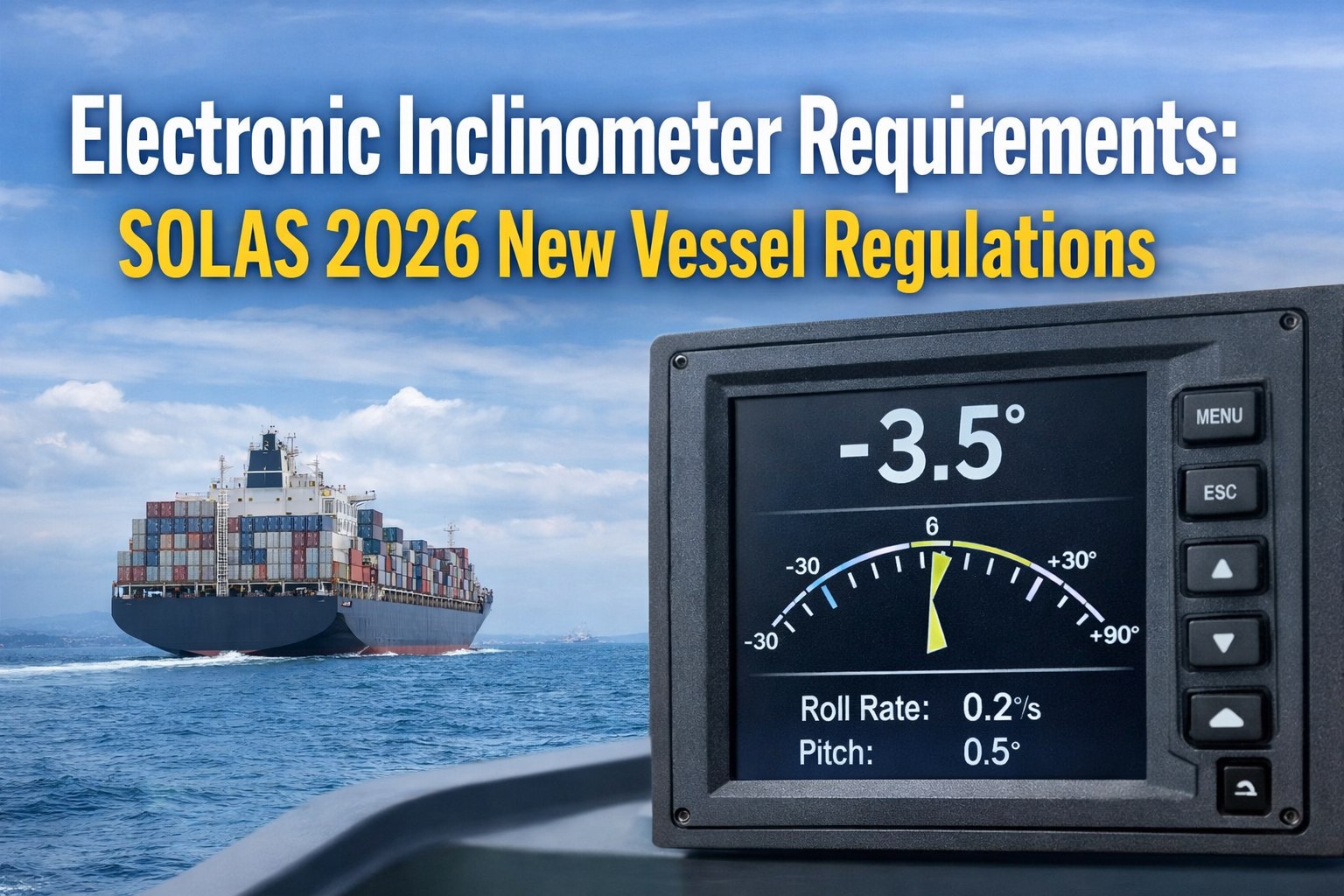
The new SOLAS electronic inclinometer requirements under Regulation V/19.2.12, effective 1 January 2026, mandate that all new container ships and bulk carriers of 3,000 gross tonnage and above must be fitted with an electronic inclinometer (or equivalent means) to determine, display, and record the ship’s roll motion. Adopted through IMO Resolution MSC.532(107), this regulation addresses growing concerns over parametric rolling, container stack collapses, and bulk cargo shifts that have led to significant losses in recent years. The inclinometer output must connect to the Voyage Data Recorder (VDR) for accurate reconstruction of roll motion during investigations. Naval architects and superintendents responsible for newbuild specifications now face critical decisions on system selection, installation location, integration, and compliance with performance standards in MSC.363(92). This detailed guide explains the full requirements, technical specifications, applicability, and practical implementation steps. Start a free trial of Marine Inspection to manage newbuild compliance, stability monitoring records, and SOLAS documentation in one digital platform.
Why IMO Introduced Mandatory Electronic Inclinometers in SOLAS 2026
Parametric rolling and excessive heel angles have contributed to major container losses and bulk carrier casualties in recent years. Traditional mechanical inclinometers often lack the precision and recording capability needed for modern high-stability vessels. The new electronic inclinometer requirement (SOLAS Reg. V/19.2.12 via MSC.532(107)) provides real-time roll data to the bridge team and feeds accurate motion records into the VDR. This improves operational decision-making in heavy weather and strengthens post-casualty investigations. Exemptions apply to existing ships, occasional bulk carriers, and general cargo ships carrying containers on deck. Book a Marine Inspection demo to see how the platform helps newbuild teams track stability-related SOLAS compliance from design to delivery.
Exact Scope and Applicability of the SOLAS Electronic Inclinometer Rule
The regulation targets vessels most vulnerable to dangerous roll motions due to their cargo configuration and stability characteristics.
Technical Requirements and Performance Standards
Electronic inclinometers must deliver reliable, real-time data under demanding sea conditions.
| Parameter | Requirement | Notes |
|---|---|---|
| Measurement Range | ±90° heel/roll | Covers extreme angles |
| Accuracy | ±1° or 5% of reading (whichever greater) | High precision for safety decisions |
| Roll Period | 4–40 seconds | Captures typical ship motions |
| Display | Real-time heel angle, roll amplitude, peak hold | Visible on bridge |
| Interface | IEC 61162-1 / IEC 61162-2 compliant | Integration with VDR and other systems |
| VDR Connection | Mandatory recording of roll motion | For accurate playback in investigations |
Installation and Integration Considerations for Naval Architects & Superintendents
Proper sensor placement and system integration are critical for accurate data and regulatory approval.
| Item | Recommendation | Compliance Impact |
|---|---|---|
| Sensor Location | Low in the ship, near centerline, protected from vibration and moisture | Ensures accurate roll measurement |
| Power Supply | Dual redundant supply from main and emergency sources | Continuous operation in all conditions |
| VDR Integration | Direct interface per VDR performance standards (MSC.333(90)) | Mandatory for roll motion reconstruction |
| Bridge Display | Clear, daylight-visible display meeting MSC.191(79) | Immediate awareness for watchkeepers |
| Type Approval | Approved to MSC.363(92) by recognised organisation | Required for statutory certification |
Benefits of Electronic Inclinometers Beyond Compliance
Beyond meeting SOLAS 2026 rules, these systems deliver operational and safety advantages for new vessels:
- Real-time awareness of parametric rolling risk in following or quartering seas
- Better decision support for speed and course adjustments in heavy weather
- Improved post-incident analysis through accurate VDR data
- Enhanced stability monitoring during cargo operations on bulk carriers
- Support for advanced stability software and weather routing tools
SOLAS Electronic Inclinometer Compliance Checklist for Newbuild Projects
Use this checklist during design review, yard supervision, and handover.
How Marine Inspection Supports Newbuild Teams with SOLAS 2026 Requirements
Marine Inspection provides dedicated modules for newbuild compliance tracking, including electronic inclinometer specification checklists, installation verification records, VDR integration testing logs, and digital handover documentation. Superintendents and naval architects can maintain a complete audit trail from design approval through to flag state certification. Schedule a tailored demo for your newbuild or fleet renewal project and see how the platform simplifies SOLAS stability monitoring compliance.