China's maritime fleet now exceeds 5,500 commercial vessels with a combined value surpassing $255 billion, making it the world's largest shipowner by tonnage. With the revised Maritime Code taking effect on May 1, 2026, which formally recognises electronic transport records as legally equivalent to paper documents, China's shipowners face a decisive inflection point: digitise inspection and maintenance workflows or risk non-compliance across an increasingly enforcement-heavy regulatory landscape. The China Maritime Safety Administration operates 11 regional branches and more than 70 local offices, conducting port state control inspections under Tokyo MOU standards with additional Chinese-specific requirements, and high-risk vessels face 100% inspection rates. For fleet operators managing multi-vessel operations across China's 18,000 km coastline, manual inspection logs, spreadsheet-based maintenance schedules, and paper checklists are no longer viable. Shipowners ready to transition to digital vessel management can explore Marine Inspection's purpose-built maritime CMMS platform that unifies inspections, maintenance scheduling, compliance tracking, and fleet analytics in a single offline-capable system designed for China's regulatory environment.
$255B
China-Owned Fleet Value
World's largest shipowner by tonnage, surpassing Greece
36,000+
CCS-Surveyed Vessels
210 million GT under China Classification Society oversight
May 2026
Revised Maritime Code
Electronic records gain legal parity with paper documents
15%
MSA Detention Rate
Non-compliant vessels face immediate operational halt
Core Capabilities of Maritime CMMS Software for China Operations
A maritime Computerised Maintenance Management System designed for China operations must address specific regulatory, operational, and environmental demands that generic enterprise CMMS platforms cannot accommodate. From CCS classification survey cycles to MSA port state control readiness, the software must bridge shore-side fleet management with onboard technical operations, even in areas with limited or no internet connectivity. Fleet managers evaluating maritime CMMS platforms for China compliance should prioritise the following eight capabilities that directly impact vessel uptime, safety performance, and regulatory outcomes.
Digital Inspection Checklists
Pre-built templates aligned with CCS survey requirements, MSA PSC focus areas, and ISM Code audit criteria. Inspectors complete checklists on tablets with photo evidence, GPS timestamps, and offline synchronisation when vessel connectivity resumes.
AI-Powered Maintenance Scheduling
Machine learning algorithms analyse equipment running hours, condition data, and historical failure patterns to generate optimised planned maintenance schedules. The system balances maintenance windows against voyage itineraries and port availability to minimise off-hire time.
Real-time visibility across certificate expiry dates, survey due dates, CCS classification milestones, and MSA inspection readiness scores. Automated alerts escalate to shore management when compliance windows approach critical thresholds.
Electronic engine room logs, deck logs, and oil record books that meet China MSA requirements for retrievable, accurate, and auditable records. Entries are tamper-evident with blockchain-grade integrity verification as mandated by the revised Maritime Code.
Fleet Analytics & Reporting
Cross-fleet KPI dashboards tracking maintenance backlog, deficiency trends, equipment reliability scores, and cost-per-vessel benchmarks. Automated reports satisfy ISM Code management review requirements and support CCS annual survey preparation.
Predictive Maintenance Engine
Sensor-driven condition monitoring for critical systems including main engine, auxiliary generators, steering gear, and ballast water treatment. Algorithms detect degradation patterns weeks before failure, converting unplanned breakdowns into scheduled interventions.
Centralised inventory tracking across all vessels with minimum stock alerts, procurement workflow automation, and supplier integration. The system forecasts spare parts demand based on planned maintenance schedules and historical consumption rates.
Offline & Multi-Vessel Sync
Full platform functionality without internet connectivity, critical for vessels operating in remote waters. Data synchronises automatically when connectivity resumes, with conflict resolution protocols ensuring shore and ship records remain consistent across the fleet.
China's 2026 Regulatory Landscape: Why Digital Workflows Are No Longer Optional
Three regulatory developments converging in 2025-2026 make digital vessel management software a compliance necessity rather than an operational convenience for China-based shipowners. Understanding these regulatory drivers helps fleet managers justify software investment and prioritise implementation timelines.
What Changed
China's top legislature passed the revised Maritime Code on October 28, 2025, after extensive public consultation. Spanning 16 chapters and 310 articles, it introduces a dedicated section on electronic transport records (Articles 82-86) within Chapter IV. Electronic records meeting statutory requirements now carry the same legal effect as paper transport documents.
Digital Requirements
Electronic records must be: (i) complete and accurate in content, (ii) readily retrievable for inspection, (iii) capable of identifying the issuer, and (iv) verifiable as to the holder's identity. Conversion between electronic and paper records is permitted by mutual agreement.
Software Implication
Maritime CMMS platforms must support tamper-evident digital records with full audit trails, issuer authentication, and retrieval capabilities that satisfy these four statutory conditions.
What Changed
China Classification Society, surveying over 36,000 ships totalling 210 million GT as of November 2025, launched its International Ship Business Operation Center in January 2025 and published Technical Guidelines for Data Exchange of Ship Digital Survey. CCS issued new Rules for Classification of Sea-Going Steel Ships (RCN No.3, effective January 1, 2026) alongside updated Guidelines for Certification of Safety Management Systems (effective January 1, 2026).
Digital Requirements
CCS now supports 5G-enabled remote surveys, AR/VR-assisted inspections, and UAV-based hull assessments. Classification data exchange requires standardised digital formats compatible with CCS systems for initial, annual, intermediate, and renewal surveys.
Software Implication
Vessel maintenance software must generate survey-ready digital records that align with CCS data exchange standards, enabling seamless classification survey preparation and reducing survey time by pre-populating condition data.
What Changed
China MSA published a notice in January 2026 on overseas application of electronic certificates for seafarers in unlimited navigation areas. MSA enforcement under the Maritime Traffic Safety Law requires vessels to maintain safety management systems with documentation available for inspection at any time. Special inspection campaigns targeting mechanical and electrical equipment failures continue to apply heightened scrutiny at Chinese ports.
Digital Requirements
Article 11 of the Maritime Traffic Safety Law requires owners, operators, and managers to establish and run management systems for safe operation and pollution prevention. MSA issues compliance and safety management certificates upon system examination. Digital systems must support both original and verified electronic copies.
Software Implication
Maritime CMMS must maintain always-accessible certificate repositories, track equipment maintenance histories for MSA inspection readiness, and generate compliance reports demonstrating systematic safety management as required by law.
Digital vs. Manual Workflows: Operational Impact Comparison
The transition from paper-based to digital vessel management fundamentally changes how inspections, maintenance, and compliance activities flow between vessel and shore. For China shipowners managing fleets across domestic and international routes, the operational impact of this transition is measurable across every metric that affects profitability, safety, and regulatory standing.
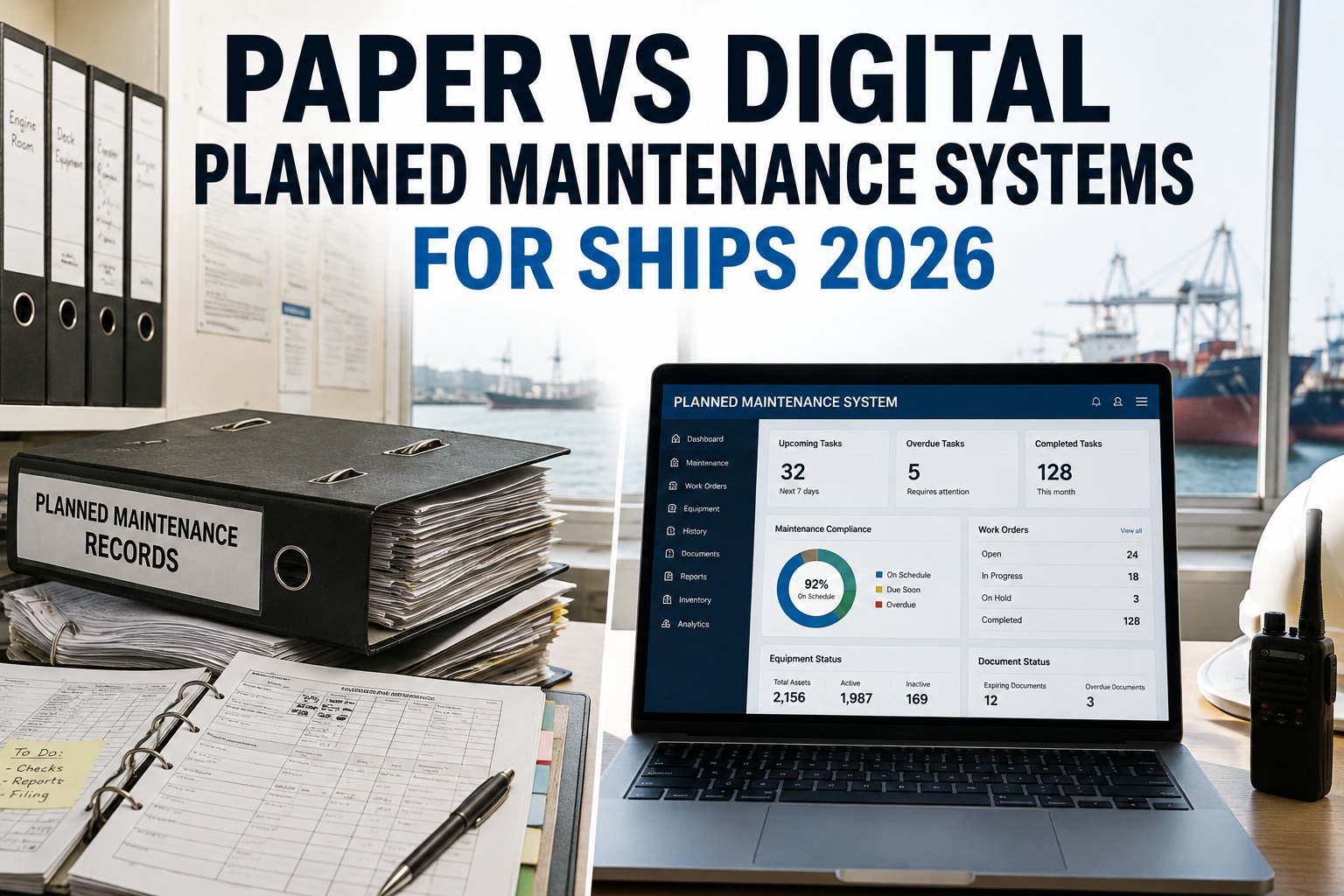
Workflow Comparison: Paper-Based vs. Digital Maritime CMMS
| Operational Area |
Paper-Based Workflow |
Digital CMMS Workflow |
| Inspection Completion |
4-6 hours per inspection with manual forms, photo printing, and filing |
1-2 hours with digital checklists, integrated camera, and auto-filing |
| Maintenance Scheduling |
Calendar-based intervals disconnected from actual equipment condition |
Condition-based triggers with AI optimisation around voyage schedules |
| Deficiency Tracking |
Logged in spreadsheets, often duplicated, status updates delayed days |
Real-time tracking with automatic escalation and photo-verified closure |
| Survey Preparation |
2-3 weeks gathering records, photocopying logs, compiling folders |
Instant report generation with all maintenance history pre-organised |
| PSC Readiness |
Reactive document searches when inspector boards; certificates may be outdated |
Continuous readiness scoring with expiry alerts 90/60/30 days ahead |
| Shore Visibility |
Weekly emailed reports; fleet condition unknown between reports |
Live fleet dashboard with vessel-by-vessel health status |
| Spare Parts |
Manual stock counts, phone/email ordering, no consumption forecasting |
Automated reorder alerts with demand forecasting from PMS data |
| Regulatory Compliance |
Manual tracking of 50+ certificates per vessel; human error risk high |
Automated certificate tracking with renewal workflow triggers |
Workflow Comparison: Paper-Based vs. Digital Maritime CMMS
Inspection Completion
Paper: 4-6 hours per inspection with manual forms, photo printing, and filing
Digital: 1-2 hours with digital checklists, integrated camera, and auto-filing
Maintenance Scheduling
Paper: Calendar-based intervals disconnected from actual equipment condition
Digital: Condition-based triggers with AI optimisation around voyage schedules
Deficiency Tracking
Paper: Logged in spreadsheets, often duplicated, status updates delayed days
Digital: Real-time tracking with automatic escalation and photo-verified closure
Survey Preparation
Paper: 2-3 weeks gathering records, photocopying logs, compiling folders
Digital: Instant report generation with all maintenance history pre-organised
PSC Readiness
Paper: Reactive document searches when inspector boards; certificates may be outdated
Digital: Continuous readiness scoring with expiry alerts 90/60/30 days ahead
Shore Visibility
Paper: Weekly emailed reports; fleet condition unknown between reports
Digital: Live fleet dashboard with vessel-by-vessel health status
Spare Parts
Paper: Manual stock counts, phone/email ordering, no consumption forecasting
Digital: Automated reorder alerts with demand forecasting from PMS data
Regulatory Compliance
Paper: Manual tracking of 50+ certificates per vessel; human error risk high
Digital: Automated certificate tracking with renewal workflow triggers
See How Digital Workflows Replace Paper Across Your Fleet
Marine Inspection's maritime CMMS connects inspections, maintenance scheduling, compliance tracking, and fleet analytics in a single platform purpose-built for China's regulatory requirements and offline vessel operations.
Implementation Workflow: From Paper to Digital in 5 Phases
Successfully deploying maritime CMMS software across a China-based fleet requires a structured implementation approach that accounts for vessel availability, crew training capacity, shore-office integration, and regulatory continuity. Rushing deployment creates data gaps, crew resistance, and parallel systems that defeat the purpose of digital transition. Operators who plan a phased fleet digitisation rollout achieve full adoption faster by building confidence incrementally rather than demanding overnight transformation.
Phase 1
Discovery & Assessment
Weeks 1-3
Audit existing maintenance records, inspection logs, and compliance documentation across fleet
Map current workflows: who inputs data, where it is stored, how it flows to shore
Identify regulatory gaps: certificate tracking, overdue PMS jobs, outstanding deficiencies
Assess vessel IT infrastructure: connectivity, available devices, crew digital literacy
Phase 2
Data Migration & Configuration
Weeks 4-8
Import equipment hierarchies using SFI Group coding for standardised asset classification
Migrate planned maintenance schedules with running-hour counters and interval triggers
Load certificate database with expiry dates, issuing authorities, and renewal requirements
Configure inspection templates for CCS survey types, MSA PSC focus areas, and ISM audits
Phase 3
Pilot Vessel Deployment
Weeks 9-14
Deploy on 1-2 vessels with engaged technical officers willing to champion adoption
Run parallel operations: digital and paper simultaneously for 4-6 weeks to validate data
Conduct onboard training for Chief Engineers, Chief Officers, and designated crew
Collect feedback, resolve usability issues, and refine workflows before fleet-wide rollout
Phase 4
Fleet-Wide Rollout
Weeks 15-24
Deploy across remaining vessels in waves of 3-5 ships per cycle to manage support load
Integrate shore-side dashboards for fleet managers, superintendents, and DPA
Enable automated reporting for ISM management reviews and classification survey prep
Establish data quality governance: who reviews, approves, and closes work orders
Phase 5
Optimisation & Predictive Analytics
Month 7 Onwards
Activate AI-driven predictive maintenance using accumulated equipment data
Implement cross-fleet benchmarking to identify underperforming vessels and best practices
Connect maintenance data with operational KPIs: fuel efficiency, CII rating, downtime hours
Continuous improvement cycle: review KPIs quarterly, refine maintenance intervals, update templates
Expert Review: Selecting Maritime CMMS for China Fleet Operations
China's maritime regulatory environment presents unique software requirements that many global CMMS vendors underestimate. The combination of CCS classification standards, MSA enforcement intensity, and the revised Maritime Code's digital record mandates creates a compliance framework that demands purpose-built maritime functionality rather than adapted industrial maintenance software.
The most critical selection criterion for China operations is genuine offline capability. Unlike European or North American coastal routes with reliable 4G/5G coverage, Chinese domestic routes along the Bohai Sea, Yellow Sea, and South China Sea frequently encounter connectivity gaps that render cloud-only platforms useless. When a Chief Engineer needs to complete a planned maintenance job at 0300 with no satellite bandwidth, the system must function identically to its connected state.
Equally important is the platform's alignment with Chinese regulatory data formats. CCS has published Technical Guidelines for Data Exchange of Ship Digital Survey, establishing standardised digital formats for classification data. Software that cannot generate CCS-compatible survey records forces technical teams into manual data re-entry, negating the efficiency gains that justified the investment. With the revised Maritime Code requiring electronic records to be "complete and accurate in content" and "readily retrievable for inspection," the margin for data integrity failures has narrowed to zero.
Fleet operators should also evaluate the vendor's understanding of China MSA port state control focus areas. The top PSC deficiency categories, including safety management systems, crew competency, and equipment standards, each map to specific CMMS modules. A platform that tracks equipment maintenance history without connecting it to PSC inspection outcomes provides incomplete value. The best platforms model the MSA inspector's workflow and pre-validate vessel readiness against known focus areas before the boarding ladder goes down. Fleet operators who invest in PSC-ready compliance platforms consistently report fewer deficiencies and zero detentions across China MSA inspection cycles.
China Maritime Digitisation Timeline: Key Milestones Through 2026
China's maritime digitisation strategy extends well beyond individual software adoption. Government-led initiatives, classification society innovation, and regulatory mandates are creating an ecosystem where digital vessel management transitions from competitive advantage to baseline requirement. Operators who align their digital transformation with China's maritime policy trajectory position themselves ahead of enforcement timelines rather than scrambling to comply reactively.
May 2019
Guiding Opinions on Intelligent Shipping
Ministry of Transport and six departments jointly set the strategic goal for China to become a global innovation hub for intelligent shipping by 2025, prioritising maritime data sharing and cross-border data exchange.
Jan 2025
CCS International Ship Business Operation Center
CCS launched its integrated lifecycle service platform, providing one-window access to classification services with digital-first workflows for survey scheduling, document management, and certificate issuance.
Jun 2025
MIIT Industrial Internet Shipbuilding Guide
Ministry of Industry and Information Technology published a 116-page reference guide on fused application of the Industrial Internet in shipbuilding, establishing digital standards from design through delivery and lifecycle management.
Oct 2025
Revised Maritime Code Passed
Standing Committee of the NPC adopted the revised Maritime Code (16 chapters, 310 articles) with dedicated provisions recognising electronic transport records and establishing institutional guarantees for shipping digitalisation.
Jan 2026
CCS Rules & MSA E-Certificates
New CCS Sea-Going Steel Ships rules (RCN No.3) and Safety Management System certification guidelines took effect. MSA announced overseas application of electronic seafarer certificates for unlimited navigation.
May 2026
Revised Maritime Code Takes Effect
Electronic transport records gain legal parity with paper documents. Shipowners must ensure digital record systems meet the four statutory requirements for completeness, retrievability, issuer identification, and holder verification.
Prepare Your Fleet for China's Digital Maritime Future
Marine Inspection's maritime CMMS platform aligns with China's regulatory trajectory, from CCS digital survey standards to the revised Maritime Code's electronic record requirements. Deploy across your fleet with offline capability, AI-powered maintenance scheduling, and compliance dashboards built for MSA inspection readiness.
Frequently Asked Questions
What makes maritime CMMS software different from standard industrial CMMS for China operations?
Maritime CMMS platforms are purpose-built for vessel-specific requirements that standard industrial systems cannot address. These include SFI Group equipment hierarchy coding, classification survey cycle tracking (CCS initial, annual, intermediate, and renewal surveys), offline functionality for vessels at sea without connectivity, and regulatory compliance modules covering ISM Code, SOLAS, MARPOL, and China MSA-specific requirements. Standard CMMS platforms lack the ship-shore synchronisation architecture, multi-vessel fleet dashboards, and maritime regulatory intelligence that China operations demand. The revised Maritime Code's requirement for electronic records that are "readily retrievable for inspection" specifically necessitates maritime-grade data architecture rather than generic maintenance databases.
How does the revised Chinese Maritime Code (effective May 2026) affect vessel maintenance software requirements?
The revised Maritime Code, passed on October 28, 2025, introduces Articles 82-86 establishing the legal framework for electronic transport records. Electronic records must meet four statutory conditions: completeness and accuracy of content, availability for retrieval and inspection, identifiability of the issuer, and verifiability of the holder's identity. For vessel maintenance software, this means digital logbooks, inspection records, and maintenance histories must incorporate tamper-evident audit trails, user authentication, and retrieval capabilities that satisfy these legal standards. Platforms lacking these features may create compliance exposure after May 1, 2026, when the code takes effect.
Can maritime CMMS work offline on vessels with limited connectivity in Chinese waters?
Genuine offline capability is essential for China fleet operations, as vessels frequently transit areas with unreliable connectivity including portions of the Bohai Sea, East China Sea, and South China Sea routes. Quality maritime CMMS platforms store the complete database locally on vessel-side servers or tablets, allowing crews to complete inspections, log maintenance actions, update running hours, and manage work orders without any internet connection. When connectivity resumes, the system synchronises data to shore-side servers with conflict resolution protocols. Marine Inspection's platform operates fully offline with automatic sync, ensuring zero data loss regardless of connectivity conditions.
How does predictive maintenance work in maritime CMMS and what ROI can China shipowners expect?
Predictive maintenance in maritime CMMS works by collecting sensor data from critical equipment (main engine vibration, lube oil analysis, bearing temperatures, coolant pressures) and applying machine learning algorithms to detect degradation patterns before they cause failures. The system converts this analysis into maintenance recommendations timed around voyage schedules and port availability. For China shipowners, professional digital compliance platforms typically cost $50,000-150,000 annually per vessel, while a single detention averages $2-5 million in total costs including off-hire, repair, penalties, and reputation damage. Even preventing one minor deficiency that delays cargo operations by hours can pay for annual subscription costs, with most operators achieving positive ROI within the first month.
How should China shipowners prepare for CCS digital survey requirements?
China Classification Society has published Technical Guidelines for Data Exchange of Ship Digital Survey and now supports 5G-enabled remote surveys, AR/VR-assisted inspections, and UAV-based hull assessments. To prepare, shipowners should ensure their maintenance software generates records in CCS-compatible digital formats, maintain complete equipment maintenance histories accessible through standardised data structures, and keep survey-related documentation digitally organised by survey type (initial, annual, intermediate, renewal). CCS surveys over 36,000 ships totalling 210 million GT, and the trend toward digital-first classification processes means shipowners with properly configured CMMS platforms experience significantly shorter survey times and fewer findings due to pre-validated condition data.