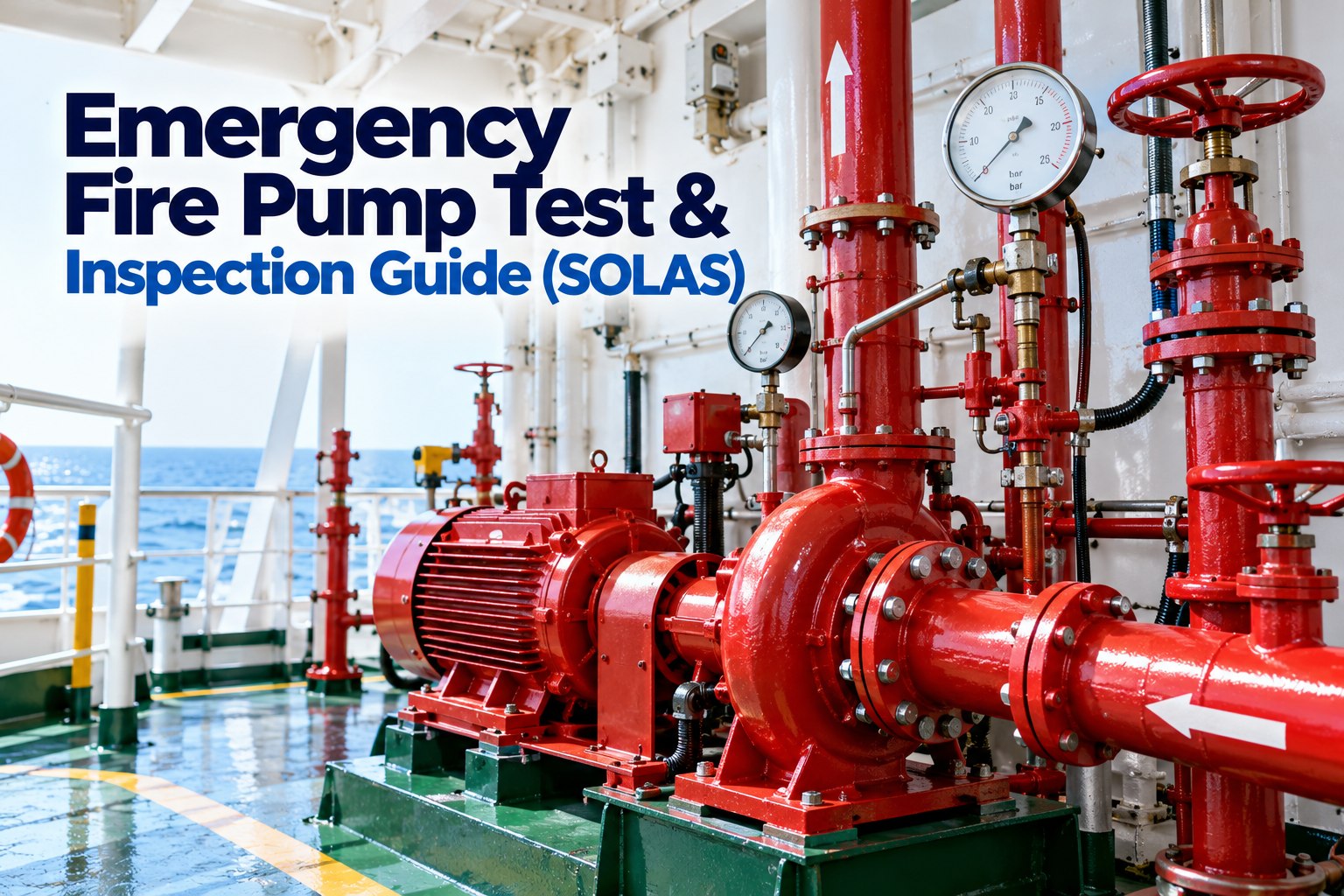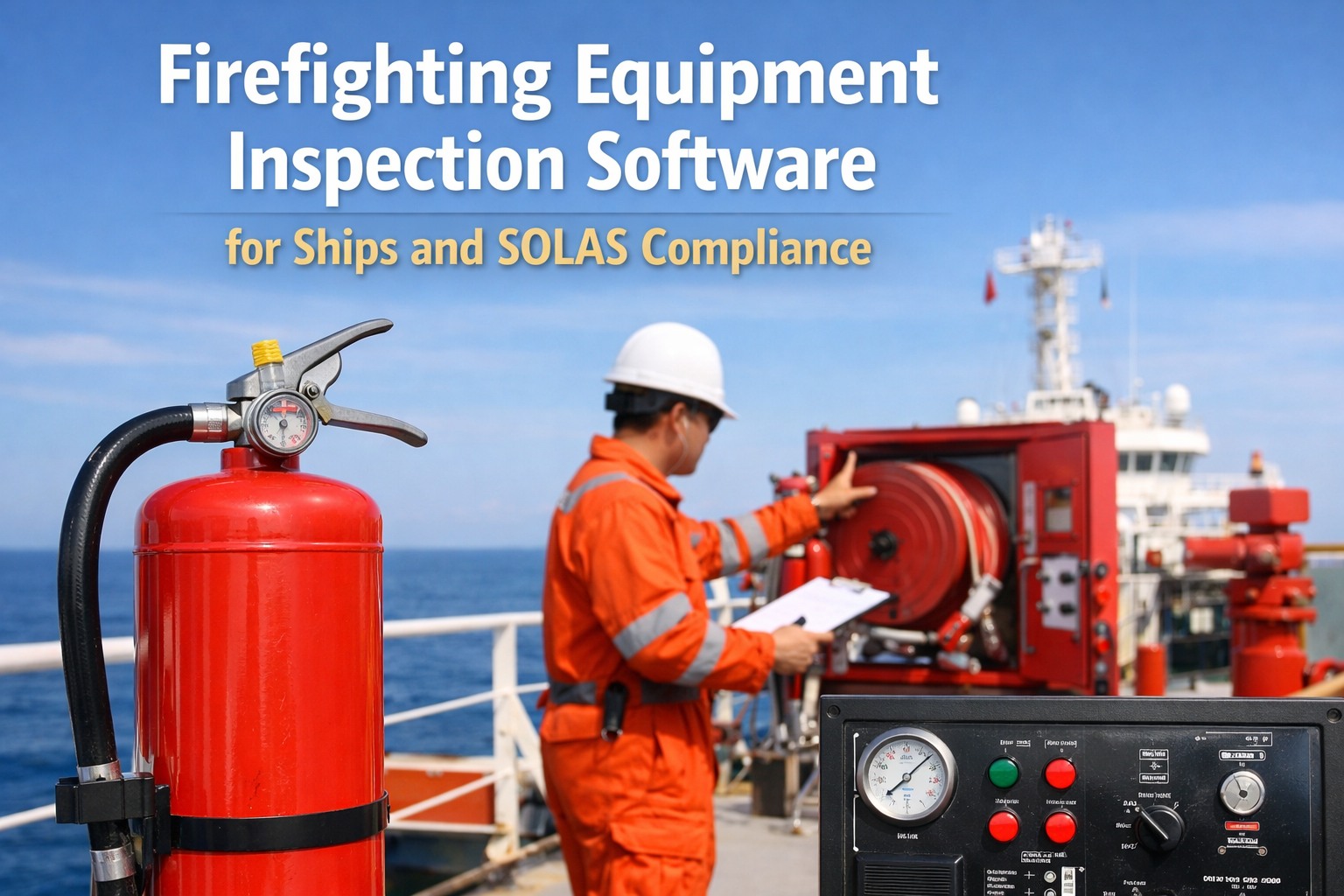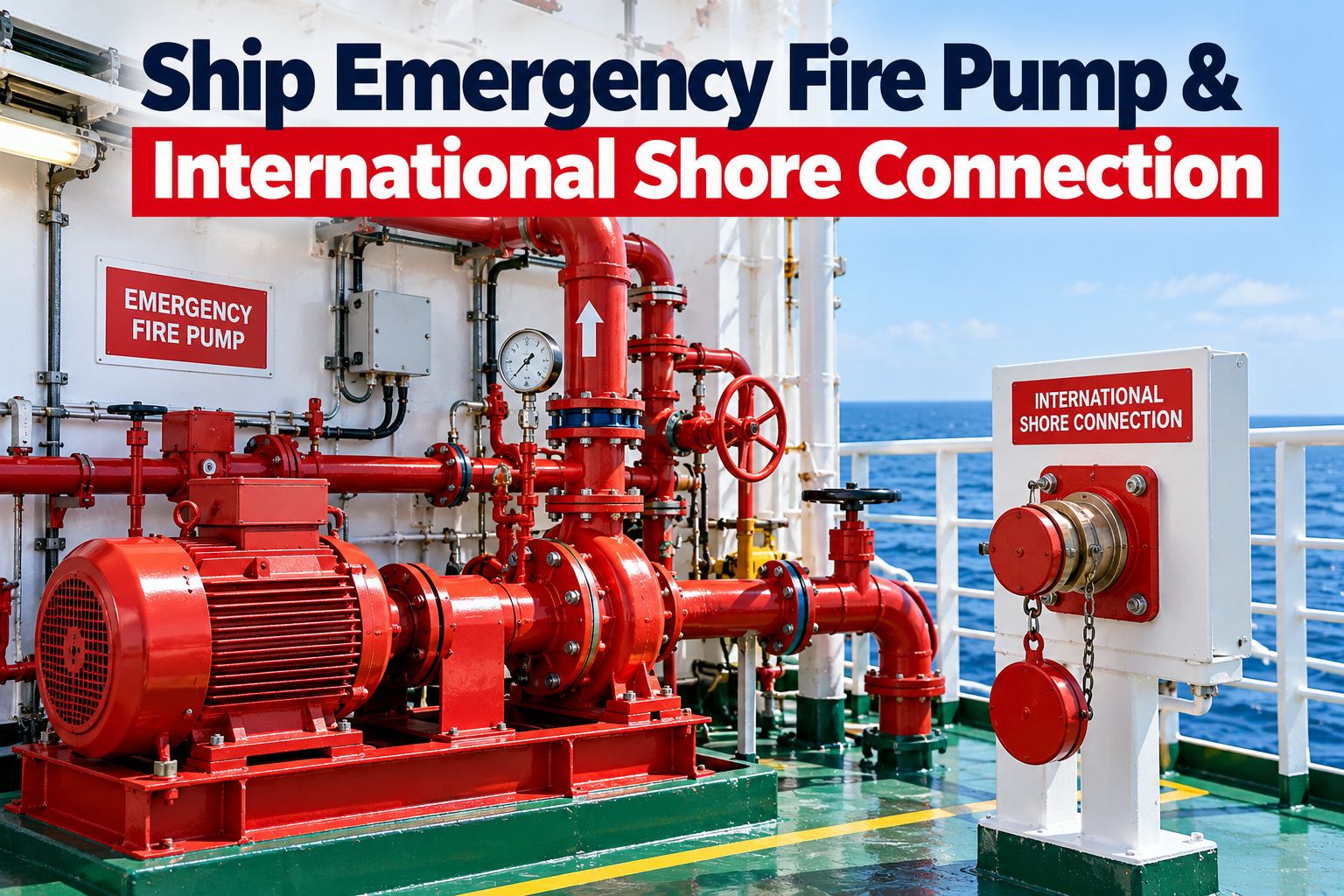
When an engine room fire knocks out the main fire pumps, the emergency fire pump is what keeps water on deck. It has to start from cold, prime itself, push enough pressure to the furthest hydrant and keep doing so with the machinery space cut off. In port, the international shore connection lets shore fire services feed the fire main. This guide covers SOLAS and FSS Code requirements, priming and capacity testing, isolation valves, the shore connection and the checks PSC officers make. Book a demo to track fire pump tests.
Ship emergency fire pump and international shore connection: ready when the engine room is lost
Emergency fire pump requirements under SOLAS and the FSS Code
SOLAS Chapter II-2 requires an emergency fire pump on cargo ships where a fire in one compartment could put all the main fire pumps out of action. FSS Code Chapter 12 sets how it must perform.
Summary of SOLAS II-2/10 and FSS Code Chapter 12. Ships with fixed water-based systems supplied by the emergency pump need more capacity. Check your approved fire plan.
Isolation valves: protecting the fire main
The fire main has an isolation valve, outside the machinery space, so a fire in the engine room cannot drain the system when the emergency pump starts. The annual test checks the emergency pump with the isolation valves closed, proving it can supply the deck on its own.
Valve condition
Operates freely; spindle extended where needed; position clearly marked open or closed.
Accessible in a fire
Can be reached and closed without entering the burning space.
Crew know it
The isolation valve is part of the emergency pump start routine and is closed in engine room fire drills.
Emergency pump priming and starting
Many emergency fire pumps sit above the waterline and depend on a priming system. A typical start routine is below; follow the instructions posted at the pump.
Typical sequence only. If the pump loses prime, check suction valve, strainer, air leaks on the suction side and priming system.
Fire pump capacity and pressure testing
PSC officers often ask for each fire pump to be run on its own with two hoses at the ship’s extremities. Bahamas Maritime Authority guidance notes that general service or ballast pumps must not be used for the two-hose test.
Record every pump test with the pressure
Log monthly runs, annual flow tests and isolation valve checks per pump, and spot falling pressure before PSC does.
International shore connection: what every ship must carry
Ships of 500 gross tonnage and upwards must carry at least one international shore connection, with arrangements to use it on either side. Its standard flange lets any shore fire service connect to the ship’s fire main.
| Item | Standard dimension |
|---|---|
| Outside diameter | 178 mm |
| Inside diameter | 64 mm |
| Bolt circle diameter | 132 mm |
| Slots in flange | 4 holes, 19 mm diameter |
| Flange thickness | 14.5 mm minimum |
| Bolts and nuts | 4 of each, 16 mm diameter, 50 mm long |
| Washers | 8 |
| Design pressure | 1.0 N/mm² |
Dimensions per FSS Code Chapter 2. Keep the connection with its gasket, bolts, nuts and washers, in a marked, readily available location.
Fire pump and fire main inspection intervals
IMO’s guidelines for maintenance and inspection of fire protection systems and appliances (MSC.1/Circ.1432) set these checks. For drills that use the fire main, see our SOLAS emergency drill guide.
- Operate all fire pumps and confirm adequate pressure
- Emergency fire pump fuel supply adequate; heating working if fitted
- Hydrants, hoses and nozzles in place and serviceable
- International shore connection in serviceable condition
- Flow test all fire pumps for pressure and capacity
- Test emergency fire pump with isolation valves closed
- Test hydrant valves; check relief valves and strainers
- Pressure test a sample of hoses so all are tested within five years
Common PSC findings on fire pumps and fire mains
Bahamas Maritime Authority lists fire pump and fire main problems among the most recurrent fire safety deficiencies, including insufficient pressure or pumps not operational.
Emergency fire pump and shore connection checklist
Use this for monthly and pre-PSC checks.
How Marine Inspection tracks fire pump readiness
Marine Inspection logs each pump run with hydrant pressures, schedules annual flow tests and isolation valve checks, and turns faults into jobs. Fire equipment sits within our crew safety inspection module. The log below is illustrative.
Emergency fire pump FAQs
What capacity must an emergency fire pump have?
At least 40% of the total required fire pump capacity and not less than 25 m³/h, under FSS Code Chapter 12.
How often should the emergency fire pump be tested?
Run monthly to confirm pressure, and flow tested annually with isolation valves closed, under MSC.1/Circ.1432.
Why close the isolation valve?
It separates the machinery space part of the fire main, so water from the emergency pump reaches the deck instead of a damaged engine room section.
Which ships need an international shore connection?
Ships of 500 gross tonnage and upwards must carry at least one, usable from either side of the ship.
What are the shore connection dimensions?
A 178 mm flange with a 132 mm bolt circle, four 19 mm slots, and four 16 mm bolts with eight washers, rated for 1.0 N/mm².
Can Marine Inspection track pump tests?
Yes. Book a demo to see pump test logs and pressure trends.
Water on deck, whatever happens below
A primed pump, a closed isolation valve and a complete shore connection, tested and proven on record.