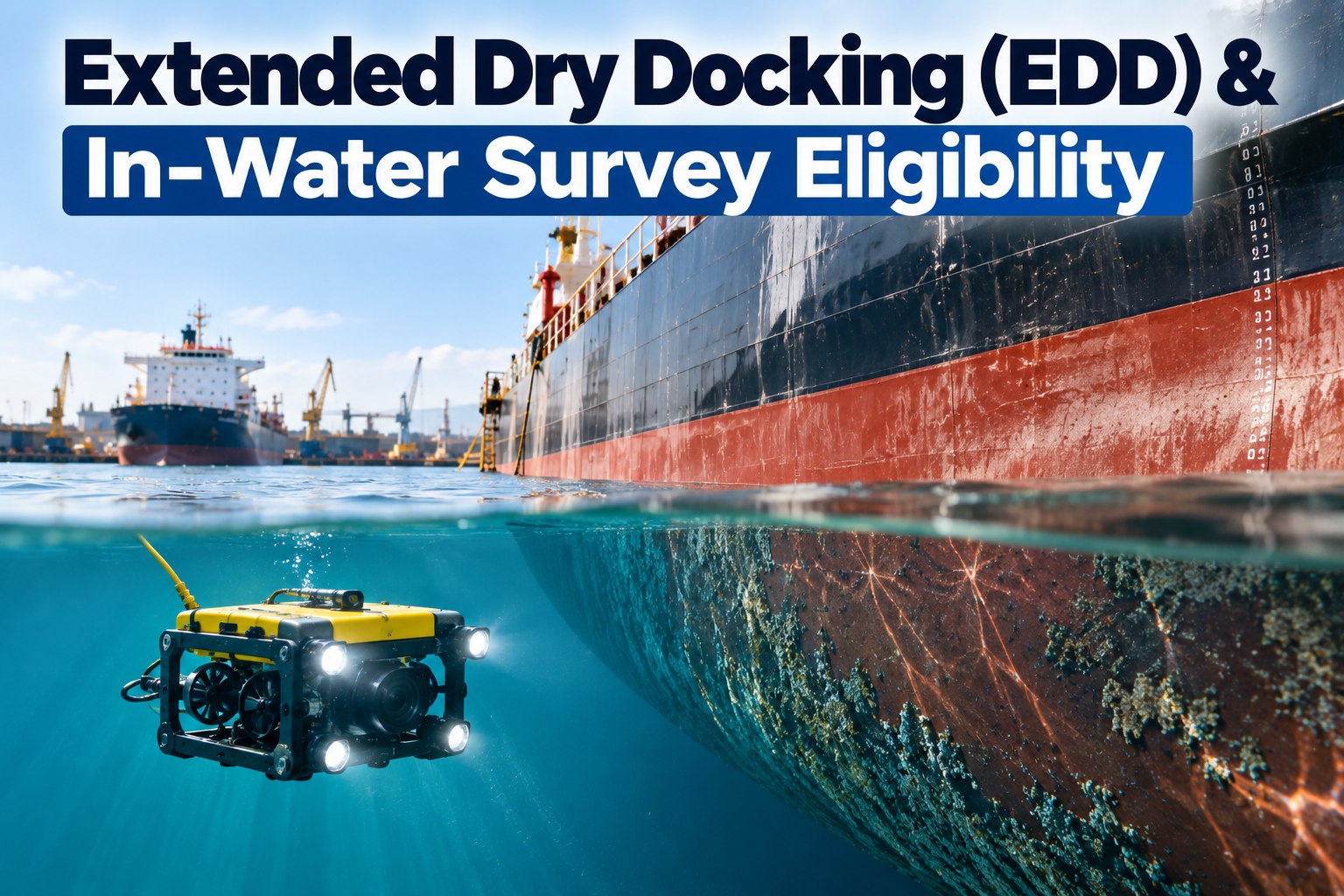
Extended dry docking (EDD) lets a qualifying ship stretch its docking interval from 5 to 7.5 years by replacing selected dockings with in-water surveys. For a Technical Superintendent, that can mean fewer off-hire days and one fewer yard bill, but only for ships that meet the eligibility rules and can prove the condition of their coating and underwater fittings. This guide sets out who qualifies, what class asks for, how an in-water survey works and how to test whether the scheme pays for your ship.
- EDD extends the dry docking interval from 5 to 7.5 years through in-water surveys by approved diving companies.
- In the sources we reviewed, EDD suits container, general cargo and multi-purpose ships, entered by age 10 and ended at 15.
- Passenger ships, tankers, ESP ships, ships with thrusters and keyed taper propellers are excluded.
- Coating, corrosion protection, tank condition and inspection records decide approval, so start building evidence years before applying.
- A change of owner, manager or flag ends the scheme, and a failed in-water survey forces a dry docking.
What Extended Dry Docking Is and What It Is Not
A trade article describes EDD as a way to extend the dry docking period from 5 to 7.5 years by replacing certain dry dockings with in-water surveys carried out by approved diving companies. IACS Recommendation 133, as reproduced by a flag registry, describes the scheme as allowing two consecutive in-water surveys while still requiring a minimum of two bottom inspections in the five-year validity period, with no more than 36 months between any two inspections.
Two points matter in practice. First, EDD is a class scheme. Each society applies its own rules based on the IACS recommendation, so the same ship may be treated differently by different classes. Second, EDD is not the same as a one-off in-water survey. An in-water survey is a bottom inspection done afloat where flag and class rules allow. EDD is the framework that lets a ship use consecutive in-water surveys and so extend the dry docking interval.
How the cycle changes
The hero diagram shows the principle on a 15-year axis. In the standard cycle, a ship docks at renewal survey and carries out the second bottom inspection in the water, where flag and class allow it. Under EDD, two consecutive in-water surveys sit between dockings, so the dock moves from 5 to 7.5 years. Over 15 years the ship saves one mid-life docking but carries out one more in-water survey. The diagram is our own illustration of the principle, not a class survey schedule, so use your class society's survey plan for dates.
EDD Eligibility: Which Vessels Qualify
Eligibility is where the sources agree most and where the details differ. The table below sets out what they say. Trade articles limit EDD to container ships, general cargo ships and multi-purpose dry cargo ships. An Indian Register of Shipping circular excludes bulk carriers and oil tankers by name. The IACS recommendation text excludes ESP ships, which covers most tankers and bulk carriers, among other categories.
| Criterion | What the sources say | Notes |
|---|---|---|
| Ship type | Container ships, general cargo and multi-purpose dry cargo ships (trade articles). Bulk carriers and oil tankers are excluded by one class society circular. | Passenger ships, tankers, ships under the Enhanced Survey Programme and high speed craft are excluded. |
| Age at entry | Up to 10 years from build, ideally 0 to 5 years. | Scheme ends at 15 years and a dry docking is required. |
| Hull rules | Ships subject to IACS UR Z7.1 hull requirements are excluded. | Check your ship's hull class rules. |
| Propulsion | Ships with propulsion thrusters are excluded. Keyed taper propeller connections are excluded. | Rec 133 text as reproduced by a flag registry. |
| Approvals | Flag state approval before application, and class submission. | Class societies run their own EDD rules. |
The age window
Entry is possible until a ship reaches 10 years from build, and trade sources describe 0 to 5 years as the ideal entry range. The IACS text says the scheme ends at 15 years, with a dry docking survey required at that point. The graph below shows the age window.
Technical Requirements: Coating, Anodes and Underwater Fittings
Approval depends on proof that the underwater hull can last the longer interval. The sources point to the following items. Prepare the evidence column well before you apply, because class will want records, not assurances.
| Item | Requirement | Evidence to prepare |
|---|---|---|
| Hull coating | High-quality system with manufacturer's guarantee covering the extended period | Coating specification, DFT records, service history |
| External corrosion protection | Impressed current system, or provision to renew hull anodes while afloat | Anode design life and renewal plan |
| Ballast tanks and void spaces | Protective coating maintained in good condition in double bottom, double side and spaces adjacent to the shell | Tank inspection reports from the last 3 years |
| Sea chests | Thickness measurements and connection surveys | Access plan, thickness records |
| Propeller shaft | Tailshaft condition monitoring survey arrangement | Monitoring records, seal condition |
| Sensors and marks | Maintenance provisions for echo sounder, speed log, draught gauges, draft marks and load line marks | Maintenance plan for items below the waterline |
| Surveys | In-water survey per IACS UR Z3, with hull cleaning and sea chest access planned in advance | Diving company approval, survey plan |
Coating thickness
One trade article gives minimum dry film thickness of 300 microns for new ships and 250 microns for in-service ships, with sacrificial anodes designed for 7.5 years or an impressed current system. We could not find these figures in the IACS text, so treat them as a guide and confirm with class.
A coatings manufacturer's article argues that hard-film systems with a service life of 10 years or more suit EDD, because they tolerate in-water cleaning, while soft silicone systems can tear. That article comes from a coating vendor with a commercial interest and offers no independent test data. Compare coating options on class acceptance and documented service life, not on claims alone.
In-Water Survey Rules: Flag, Class and Diving Requirements
EDD relies on in-water surveys, and those have their own conditions. The table compares what the UK guidance, a German flag summary and class material say.
| Topic | What the guidance says |
|---|---|
| Eligible ships | UK guidance: other ships excluding tankers and bulk carriers over 15 years old. ESP tankers and bulk carriers over 15 years are ineligible. |
| Age | Special consideration is needed for ships over 15 years old (UK guidance). Under SOLAS, a cargo ship under 15 years may carry out one of two required bottom inspections in water (German flag summary). |
| Interval | Two bottom inspections in any 5 years, no more than 36 months apart, one out of water at renewal. |
| Diving team | Experienced, recognised diving company with sufficient relief and safety divers. UK guidance quotes a minimum of 4 divers. |
| Conditions | Sheltered water, weak tides or currents, adequate visibility and hull cleanliness. |
| Supervision | Under the supervision and to the satisfaction of the class surveyor. |
| If damage is found | The surveyor can require a dry docking. One trade article says unsatisfactory results trigger a docking within one month. |
Preparing for the in-water survey
- Plan the cleaning. The hull must be clean enough for a meaningful inspection.
- Prepare sea chest access and chain cable ranging. The IACS text lists both as advance planning items.
- Gather tank records. Internal tank inspections documented from the previous 3 years support the case.
- Choose location and weather. Sheltered water with weak tidal streams and good visibility.
- Book an approved diving company. It must be approved by the class society, with the surveyor supervising.
What Ends an EDD Scheme
EDD is conditional. The IACS text and an IRClass circular list events that end a ship's enrolment, and an owner who is planning a sale or a change of manager should know them before relying on the longer interval.
Is EDD Worth It? Test the Economics
The case rests on the cost of the docking avoided against the extra costs of EDD. The chart below shows our own illustration of off-hire avoided by skipping one 14-day docking at three assumed daily rates. It excludes the avoided yard bill, the survey cost, and any coating or monitoring upgrade, all of which depend on your ship.
Dry dock costs in our own guide run from $500,000 to more than $3 million, and the cost breakdown guide explains how to price a day of off-hire. A coatings vendor article quotes daily opportunity cost of $30,000 to $80,000 and fuel penalties of 10 to 20% for fouled hulls. Both are indicative, and the second is vendor-sourced. Use your own commercial figures.
A simple test
- Add the yard cost and the off-hire of the docking you can avoid.
- Subtract the cost of the extra in-water surveys, cleaning and any hull coating upgrade.
- Subtract the cost of any monitoring or fittings needed for class approval.
- Test the result against the risk of a forced docking if a survey fails.
Common EDD and In-Water Survey Mistakes
Systems for Survey and Hull Condition Tracking
EDD depends on records: dated hull and tank photographs, coating history, thickness readings, survey due dates and the evidence behind each finding. Marine Inspection supports tracking of certificates and surveys, a dated photo repository linked to findings, and observations turned into tasks with owners, deadlines and evidence, which helps build the file class will want. Its dry docking guide covers the dock project itself.