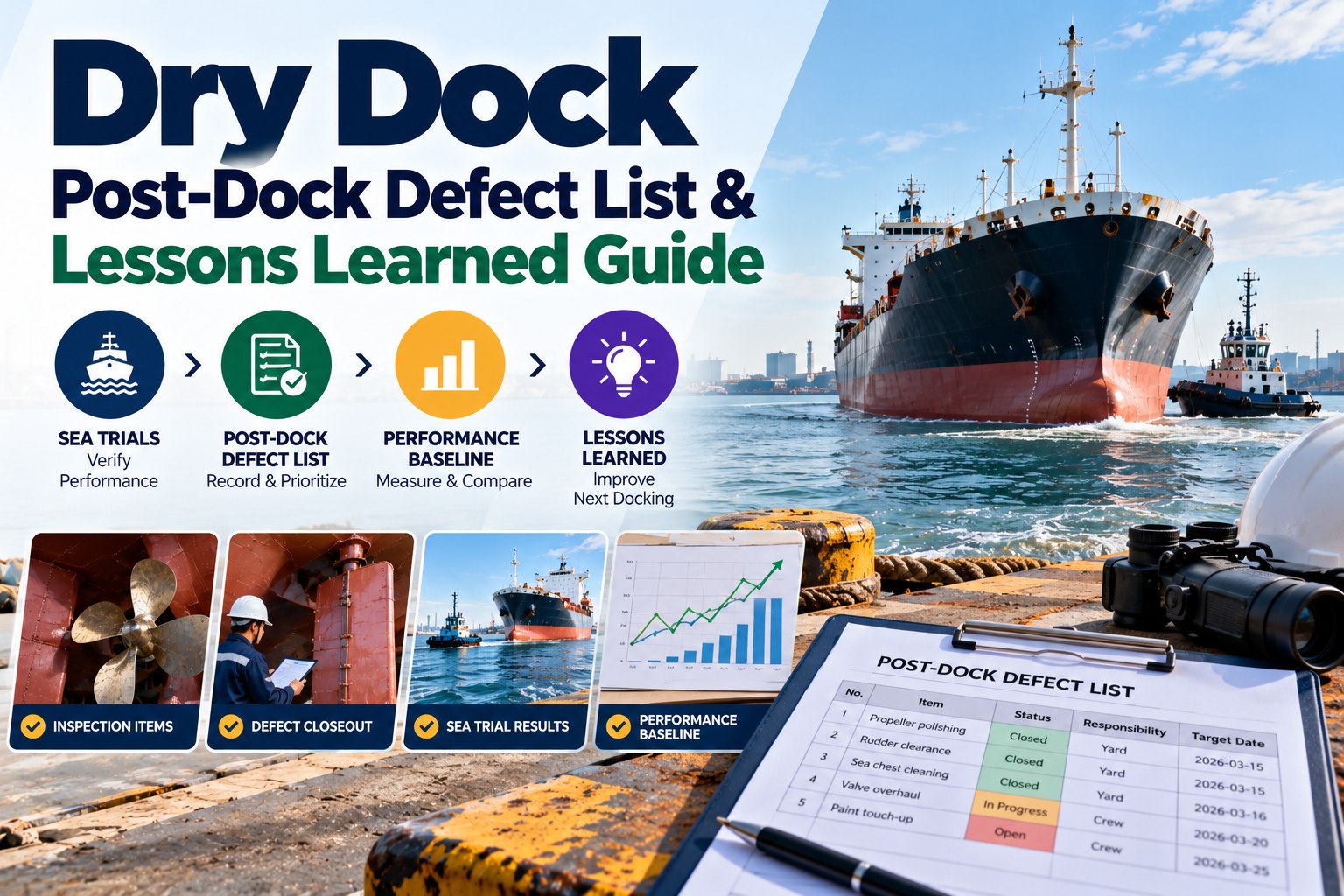
Dry Dock Post-Dock Defect List & Lessons Learned Guide
The dock gate opens, the ship sails, and within about a week everybody involved has moved on to the next vessel. That week is the most valuable one in the whole project, because almost every right the owner holds — to have work finished, to have bad work put right, to prove what the docking actually achieved — depends on evidence gathered while the memory is fresh and the yard still has a reason to care.
Dry dock · close-out and lessons learned
Undocking is a milestone, not the end. Everything you can still recover closes on its own schedule.
Close the docking in the same record it was run from
The trial: proving, not just confirming nothing broke
Most post-dock trials are run as a reassurance exercise. Start everything, run it, nobody reports a problem, sail. That answers the question “is anything obviously wrong” and leaves the far more useful question — “what state is this ship actually in now” — unanswered for the next five years.
Steering, through its full range
Hard over to hard over, both systems, with timings taken, after any rudder work. This is the item most affected by dock work and the one with the clearest pass criteria.
Astern and stopping
Rarely exercised in service and directly affected by propeller and shaft work. If it is not proven now, it is proven in an emergency.
Vibration across the range
Through the speed range rather than at one easy setting, with the critical range confirmed. New vibration after a dock points at the running gear while there is still a yard to discuss it with.
Everything that was opened
Every system touched in the dock, run under load rather than tested in harbour. A pump that runs alongside and a pump that runs in a seaway are not the same proof.
Temperatures and pressures logged
Not observed and forgotten. The first post-dock set of readings is the reference every later reading is judged against, and it exists only if somebody wrote it down.
Anything the yard says is fine
Particularly that. Items signed off on assurance rather than demonstration are the items that become guarantee claims, and claims are much easier with a trial record behind them.
The handover meeting, before the gate opens
Almost everything in the rest of this guide is easier if one meeting happens properly while the ship is still in the yard’s hands. It is the last moment at which both parties have the same information and the owner still has something the yard wants.
Agree the outstanding works list, line by lineNot a general acknowledgement that some items remain, but a numbered list with a description both sides recognise, signed by somebody with authority on each side. This document does more work afterwards than any other, because it is what separates unfinished contract work from a new request.
Settle what is yard scope and what is notEvery item either came from the specification, from an approved addition, or from neither. Categorise each one in the room. Items left uncategorised are categorised later by whoever is more motivated, and that is rarely the owner.
Record the guarantee position in writingWhat is covered, for how long, from what date, and who is notified. For new equipment, capture the maker’s terms at the same time rather than assuming the yard’s guarantee covers it.
Collect the documentation as a deliverableThickness and climatic records, coating logs, test and commissioning certificates, material certificates, welding and examination records. Ask for them at handover, because after departure they belong to a contractor who has no reason to answer.
Walk the ship one more timeWith the list in hand, in the spaces that were worked in, before the staging and the lighting go. Mechanical damage from the work itself is found here or it is found by the next inspection, by which time it is nobody’s.
Leave the final account openSettlement is leverage, and it is the only leverage that outlives undocking. Closing it before the outstanding works are complete converts a contractual position into a request for goodwill.
None of this takes long, and it is routinely compressed because the ship is sailing and everyone is tired. The difference it makes shows up three months later, when a claim either rests on a signed list or on two recollections of the same conversation. Where coating or hull work is involved, the records collected here are also what support a claim against the scheme applied — the condition baselines described in our guide to hull maintenance and inspection.
Building a post-dock defect list that holds up
A defect list is a commercial document that happens to be written by engineers. The ones that work have the same six qualities, and the ones that fail usually fail on the last two.
The first three fields are written naturally by anybody who has just found a problem. The last three require a decision, which is why they are skipped, and why lists made of the first three alone become archives rather than tools. An item with no named owner belongs to nobody, an item with no stated cost position gets argued about later from a weaker position, and an item with no evidence is a recollection by the time anyone disputes it.
Post-dock defect categories: who pays and which clock applies
Sorting the list by this question on day one, rather than by system or severity, is what makes the rest of the process work. Each category has a different route and a different deadline.
Category
Whose cost
Which clock
Evidence it needs
Contract work not finished
The yard, as part of the original price
Before the final account is settled
The signed outstanding-works list agreed at handover
Contract work done badly
The yard, under the guarantee
The guarantee period in the contract
Proof the item was in yard scope and proof of how it has failed
Damage caused in the dock
The yard
Immediately — notify before sailing wherever possible
Photographs and anything that fixes when the damage occurred
New equipment failing early
The maker, under their own warranty
The maker’s period, which rarely matches the yard’s
Commissioning records, running hours and the fault history
Found in dock, outside scope
The owner
Planned for in service or at the next docking
A condition record good enough to plan against later
Performance shortfall
Depends entirely on what the contract says
Tied to the reference run, so effectively immediate
Baseline curves from before and after, in comparable conditions
Owner-supplied material fails
The owner or the supplier
The supplier’s terms
Purchase records and evidence of correct installation
The row that causes most trouble is the fourth. New equipment installed by a yard carries two separate clocks — the yard’s guarantee on the installation and the maker’s warranty on the equipment — and they usually expire at different times. Record both at handover, because the one you need is always the one nobody wrote down.
The performance reference run
Immediately after undocking the ship is in a condition she will not be in again for five years: freshly coated, propeller polished, running gear restored. That state is a measurement opportunity with a short shelf life, because fouling begins at once.
01
Take it early, and in honest conditions
A reference taken in a seaway or in shallow water is worse than none, because it becomes the number everything is compared against. Wait for conditions, but not for weeks.
02
Record the conditions, not just the result
Draught and trim, water depth, sea state, wind, water temperature. A speed and power figure without them cannot be compared with anything later.
03
Pair it with the pre-docking curve
The before and after pair is what demonstrates whether the hull and propeller work delivered. One curve proves the ship’s condition; two prove the money was well spent.
04
Hand it to whoever runs performance
The reference is only useful inside a monitoring regime. The framework it feeds is covered in our guide to vessel performance monitoring.
One list, one owner per line, one place everybody looks
Marine Inspection carries post-dock defects, guarantee items and their deadlines against the vessel alongside the docking record they came from — so nothing expires quietly and the next superintendent inherits the position rather than the folder.
Guarantee claims fail far more often on process than on merit. Four disciplines decide whether a valid claim stays valid.
Notify in writing, earlyAs soon as the defect appears rather than when it becomes inconvenient. Most guarantee terms require prompt notification, and a late report invites the argument that the fault developed from use rather than from the work.
Keep the two clocks separateYard guarantee and maker warranty on the same equipment expire independently. Track both dates per item rather than one date per docking.
Do not repair it away firstWhere safety allows, record the condition before putting it right. A defect repaired by the crew and reported afterwards is a defect that is hard to evidence and easy to decline.
Give it an owner ashoreGuarantee management protects the operating budget for the whole period after the dock, and it is routinely nobody’s actual job. One named person, with the dates in front of them.
The post-dock review: making the next docking cheaper
A lessons-learned session held three months later produces generalities, because everybody has forgotten the specifics and remembers only the mood. Hold it within a few weeks, with the people who were there, around four questions.
What did we add after arrival, and why?
Go through every addition and ask whether it could have been specified beforehand. The honest answers are next docking’s specification, and they are usually a majority of the list.
Where did the schedule actually go?
The chain as it turned out against the chain as planned. Two dockings of that comparison and the next programme stops being an estimate.
What did we fail to measure?
Every reading that would have been easy in the dock and is now impossible for five years. This question alone usually justifies the meeting.
What would we tell the next superintendent?
About this yard, this ship and this scope. Written down, it is handover; left unsaid, it leaves with the person.
The output is not a report. It is a marked-up copy of the specification, a revised duration for the activities that ran long, and a short list of items to measure or prepare earlier next time — all of it attached to the vessel in the planned maintenance system rather than held by whoever happened to run this project.
What goes back into the next specification
The review earns its place only if something physically changes in the next docking package. Six things usually should.
The additions you could have seen coming
Every item added after arrival that could have been scoped beforehand, written into the specification this time. On most dockings this is the majority of the additional work by value.
Durations that were wrong
The activities that ran long, with the duration the ship actually took rather than the one the plan assumed. Two cycles of this and the programme becomes a forecast instead of an aspiration.
Measurements to take earlier
Anything the dock revealed that a planning inspection could have found months before, moved into the pre-docking survey scope where it can still change the tender.
Access that was underestimated
Spaces where staging took longer or reached less than planned. Access is usually the largest cost in tank and structural work and the easiest to get wrong twice.
Rates and clauses that did not hold
Where the agreed rates ran out of categories, where the approval threshold was wrong, and anything that had to be negotiated mid-dock because the contract was silent.
What this yard is good at
Written plainly and kept with the vessel record. Yard capability is the most useful institutional knowledge a technical department holds and the most commonly lost when people move.
The first ninety days after undocking
Dry dock close-out: frequently asked questions
When should the post-dock defect list be issued?
Within the first week, while the trial is fresh and the yard is still engaged. The list is built from the handover outstanding-works list, the trial findings and the first days of normal operation, and every line needs an owner, a cost position and attached evidence before it is sent.
What should the post-dock trial actually prove?
Steering through its full range with timings, astern and stopping performance, vibration across the speed range rather than at one setting, every system that was opened running under load, and a full set of logged temperatures and pressures. Anything the yard signed off on assurance rather than demonstration deserves particular attention.
Why take a performance reference immediately after the dock?
Because the hull and propeller are in a condition they will not return to for five years, and fouling starts immediately. Taken in honest conditions with draught, trim, depth, sea state and wind recorded, and paired with the pre-docking curve, it both proves what the work achieved and anchors the next five years of monitoring.
How are guarantee items tracked?
Per item, with both relevant dates: the yard guarantee on the work and the maker warranty on any new equipment, which expire independently. Notify defects in writing promptly, record the condition before repairing where safety allows, and give the whole guarantee position a named owner ashore.
Who pays for a defect found after undocking?
It depends on the category. Unfinished contract work sits with the yard before the final account is settled; defective contract work sits with the yard under guarantee; damage caused in the dock needs immediate notification; early failure of new equipment goes to the maker; and anything found in dock but outside scope is the owner’s to plan.
When should the lessons-learned review be held?
Within a few weeks, while the people who were there still remember the specifics. Later sessions produce generalities. Four questions carry it: what did we add after arrival and why, where did the schedule actually go, what did we fail to measure, and what would we tell the next superintendent.
What should the review produce?
Not a report. A marked-up specification for next time, revised durations for the activities that ran long, and a short list of things to measure or prepare earlier — all attached to the vessel rather than to the person who ran the project.
What is the most common close-out failure?
Defect records that name what and where but not who owns it, whose cost it is, or what evidence supports it. Those three fields require a decision rather than an observation, so they get left blank, and the list becomes an archive instead of a tool.
Dry dock & planned maintenance
Finish the docking properly, and the next one starts ahead
Marine Inspection keeps the specification, the trial record, post-dock defects with their owners and deadlines, guarantee dates and the performance reference against each vessel — so the value built in the dock is still there at the next one.