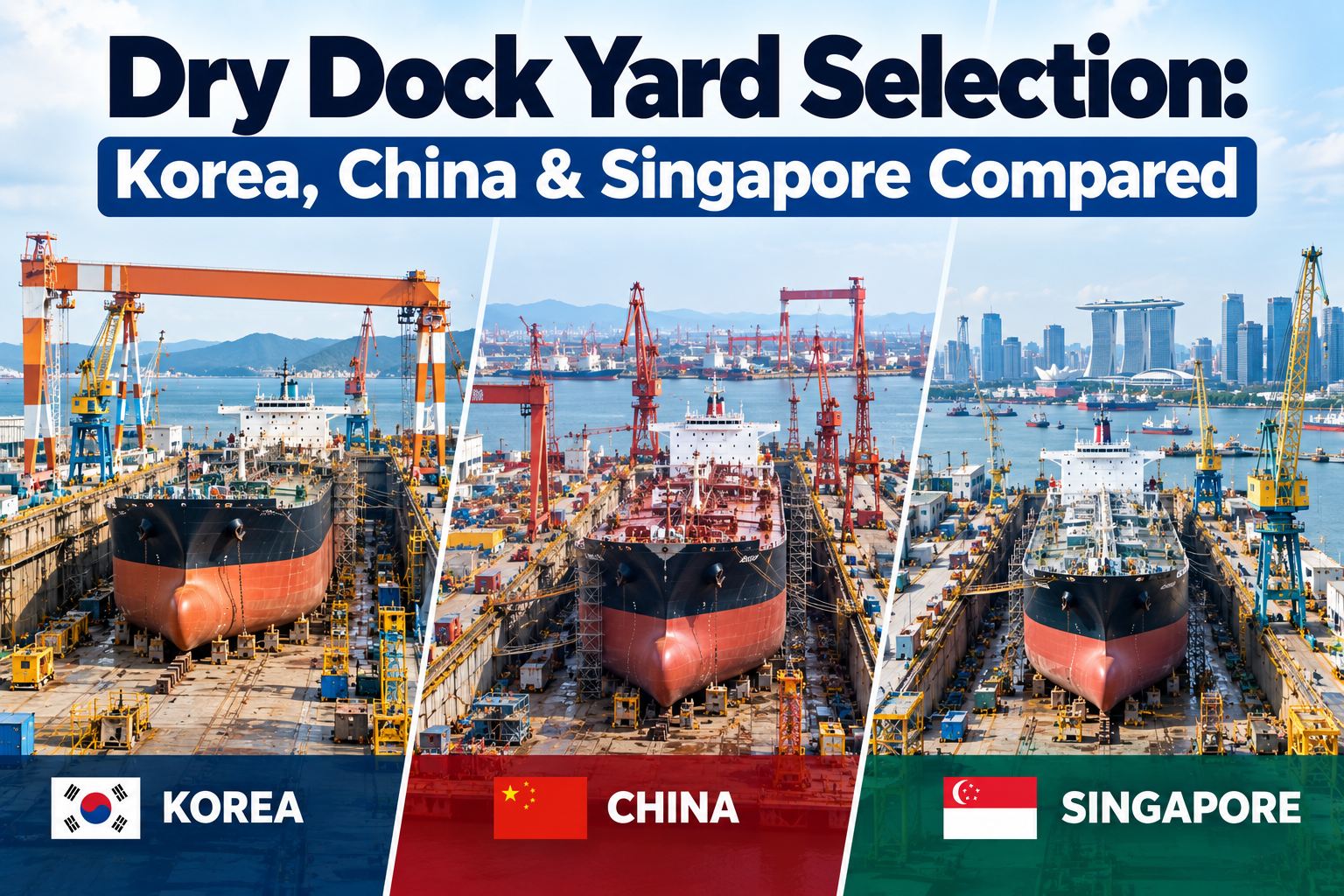
Choosing a dry dock yard by region is a trade-off between price, capacity, quality and whether a berth is free when the ship needs it. A yard that quotes the lowest day rate can still be the most expensive choice once sea days, off-hire and variation orders are counted. For a Fleet Manager shortlisting yards in Korea, China, Singapore and the Middle East, this guide sets out what the published sources say about each region, how to score yards, and how to compare a cheaper yard that is farther away.
- Score yards on price, quality, dock fit, berth availability, voyage cost and communication, not on the daily dock fee.
- China is reported as the lowest-priced region, Korea as the premium end, with Singapore and the Middle East tender-dependent. Most figures come from vendor guides, so tender to confirm.
- Book early: 6 or more months in Korean peak season and up to 12 months for major Chinese yards.
- Add the voyage to every quote before comparing yards in different regions.
- Judge yards on planned against actual days and on variation history, not reputation alone.
How to Choose a Dry Dock Yard: Six Criteria
Price gets the attention, but it is one of six things that decide a yard's real cost and risk. A scorecard keeps the comparison honest, especially when the shortlist spans regions with different strengths. The weights below are our suggestion. Change them to match your ship, your charter exposure and your scope.
| Criterion | Suggested weight | What to check |
|---|---|---|
| Price and rates | 25% | Total by line item, unit rates, daily dock fee, labour rate |
| Quality and class record | 20% | Class approval, ISO certification, references on your ship type |
| Dock fit and capacity | 15% | Dock dimensions, crane and berth, ability to run your scope in parallel |
| Berth and date availability | 15% | Slot in your window, backlog, seasonal shutdowns |
| Voyage deviation cost | 15% | Extra sea days, fuel and off-hire to reach the yard |
| Communication and documentation | 10% | Language, response time, standard quotation format |
Regional Overview: Korea, China, Singapore and the Middle East
The table below pulls together the figures quoted in the sources we reviewed. Several come from Marine Inspection's own regional guides, which are published by a software vendor, and a few come from trade press and yard-promotional material. Treat them as a starting point for tenders, not as quotations.
| Region | Price signal | Figures quoted | Booking and calendar | Watch-outs |
|---|---|---|---|---|
| China | Lowest in the guides we reviewed | Cost index 100 against 120 to 150 for Korea, daily dock fee $5,000 to $8,000 | Tier 1 up to 12 months ahead, Tier 2 3 to 6 months. Avoid Jan to Feb. | Quality variation, language, spares delays |
| South Korea | Premium end | Daily dock fee $6,000 to $10,000, labour $60 to $90 per hour | 6 or more months in peak season | Backlog competes with newbuilds, parts at dock entry |
| Singapore | Above China in one guide | 20 to 40% above China on equivalent work, per one guide | Confirm with yard | Rates and slot, check deviation |
| Middle East | No reliable public figures found | Tender-based | Confirm with yard | Check tanker-trade berth demand |
China: lowest price, widest choice, early booking
Marine Inspection's China guide lists Tier 1 yards in Dalian, Shanghai, Guangzhou, Qingdao and Zhoushan. It puts routine docking at 10 to 15 days, intermediate survey docking at 15 to 20 days and special survey docking at 20 to 30 days, with major repairs at 30 to 60 days or more. It reports a daily dock fee of $5,000 to $8,000 and labour at $40 to $60 per hour, and says China is typically 20 to 40% cheaper than Singapore or Japan for equivalent work. It advises booking Tier 1 yards up to 12 months ahead, avoiding the 2 to 3 week Chinese New Year shutdown in January and February, preparing bilingual specifications and ordering spare parts 8 to 12 weeks before docking.
South Korea: premium capacity, competition for dock time
Marine Inspection's Korea guide describes about 30 dry docks across the main yards, including HD Hyundai Heavy Industries in Ulsan, HD Hyundai Mipo, Hanwha Ocean and Samsung Heavy Industries. It reports a daily dock fee of $6,000 to $10,000 and labour at $60 to $90 per hour. The main constraint is capacity: order backlogs of three to four years mean newbuild production competes with repair for dock time, and peak season needs 6 or more months of advance booking. The same guide says every unplanned dock day can cost $15,000 to $30,000 in occupancy charges alone, and that missing parts at dock entry are a primary cause of schedule overruns.
Singapore: one-stop repair for complex ships
Trade press describes Singapore as a one-stop centre for large repairs and conversions since the 2023 merger of Sembcorp Marine and Keppel into Seatrium. A 2026 yard guide quotes a largest dock of 380 m by 80 m. Seatrium says it has delivered 411 cruise ship projects since 1978 and 989 LNG carrier repair and conversion projects since 1979. These are company claims. A commercial blog describes Singapore as known for accuracy and reliability, with Batam as a lower-cost alternative nearby.
Middle East: tanker trades and offshore units
Drydock Magazine's November 2025 report covers Drydocks World in Dubai and ASRY in Bahrain. Drydocks World reports more than 11,000 ship repairs completed and about 140 projects in the first half of 2025. ASRY specialises in tanker repair, and the report cites a tanker repair finished in 14 days against an expected 18. That is one example, not a yard average. The 2026 yard guide quotes a largest dock of 410 m by 80 m at Drydocks World.
Capacity and Dock Fit
Capacity is more than the size of the biggest dock. The ship has to fit the dock, the scope has to fit the repair berth, and the yard has to staff the work in parallel. The largest docks quoted for each region in a 2026 yard guide are shown below. They are newbuilding-scale docks, so ask the yard which docks are used for repair and when.
| Yard | Largest dock quoted |
|---|---|
| HD Hyundai Heavy Industries, Ulsan (Korea) | 530 m x 131 m |
| Samsung Heavy Industries, Geoje (Korea) | 500 m x 115 m |
| Drydocks World, Dubai (Middle East) | 410 m x 80 m |
| Seatrium, Singapore | 380 m x 80 m |
| Hudong-Zhonghua, Shanghai (China) | 360 m x 92 m |
Berth Availability and Timing
A good yard that cannot take the ship in your window is no use. Availability varies by region and season. Marine Inspection's guides put Korean peak-season booking at 6 or more months and Chinese Tier 1 booking at up to 12 months, with weather favouring September to November in China and a shutdown in January and February. Our dry dock planning timeline guide places yard selection in the tender phase, 3 to 5 months before arrival, which only works if the slot has been discussed earlier.
Verifying Quality Before You Award
Published guides describe regions. You are choosing a yard, and yards vary within a region. Before award, collect evidence on each shortlisted yard.
| Check | What to ask |
|---|---|
| Class approval | Is the yard approved by your class society for the work in scope? |
| Quality system | Does it hold certification such as ISO 9001, as Marine Inspection's China guide notes for major Chinese yards? |
| Similar ships | Ask for references on your ship type and size, and speak to superintendents who docked there. |
| Variation record | How many variation orders, at what rates, on comparable projects? |
| Days against promise | Planned against actual dock days on recent projects. |
| Attendance | What facilities does the yard provide for your superintendent and class surveyor? |
Worked Example: Adding the Voyage to the Quote
This example is our own and uses assumed figures. A yard in another region quotes $150,000 less, but reaching it adds four days of deviation. At an assumed $35,000 of off-hire per day plus $30,000 of extra fuel, the saving disappears.
| Line | Amount |
|---|---|
| Price saving at the cheaper yard | $150,000 |
| Extra deviation days (4 days) | 4 days |
| Off-hire cost at assumed $35,000 per day | $140,000 |
| Extra bunker fuel for deviation (assumed) | $30,000 |
| Total deviation cost | $170,000 |
| Net position of the cheaper yard | $20,000 worse |
Our dry dock cost breakdown guide covers how to price an extra day of off-hire, and our specification guide shows how to ask each yard for comparable line-by-line prices. Use both before comparing across regions.
A Five-Step Yard Shortlisting Process
- 1. Fix the window. Class, charter and weather decide the dates. Check seasonal shutdowns.
- 2. Pick the regions. Use the route and the type of work to choose two or more regions.
- 3. Shortlist three to five yards. Ask about slot, dock fit and references first.
- 4. Send the same package. A line-numbered specification and quotation format, 30 to 60 days before arrival for the full documentation, per Marine Inspection's guide.
- 5. Score and negotiate. Compare line by line, add the voyage, then negotiate per line and agree realistic dock and repair-berth days.
Common Yard Selection Mistakes
Systems for Yard Comparison
Yard selection improves when the last docking is on record. Marine Inspection supports specification development, distribution of the yard documentation package, daily progress and cost tracking and digitisation of the post-dock defect list, as described in its own dry docking guide. Keeping dated photos, observations with owners and deadlines, and planned against actual days for each yard gives you evidence for the next tender, not just an opinion.