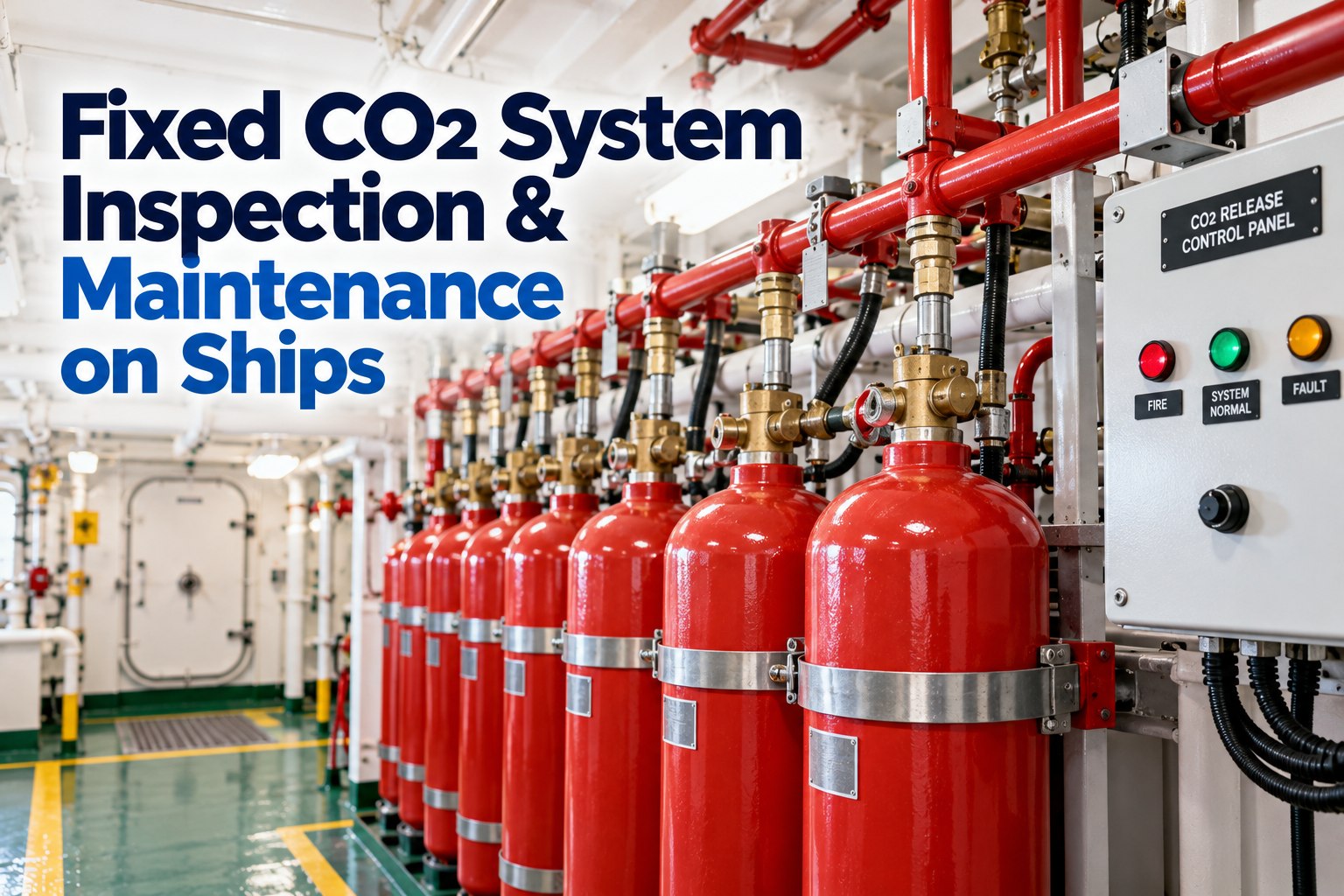
Fixed CO2 system inspection is the routine of checking that a ship’s carbon dioxide fire-extinguishing system will discharge the right amount of gas, into the right space, when the master orders it, and will not discharge when nobody has. It runs from 30-day visual checks by the crew to annual and two-yearly servicing under IMO MSC.1/Circ.1318/Rev.1, with the system itself built to Chapter 5 of the FSS Code. Get it wrong and the cost is a system that fails in a real engine room fire, an accidental release into a manned space, or a servicing record that a surveyor or PSC officer will not accept.
Ready to flood, safe to stand next to: servicing a ship’s fixed CO2 system without gaps
Crew checks, specialist servicing and the records that prove it, so a recent service certificate never hides a system that will not work.
Free sign-up · Offline checklists on board · Signed PDF reports
A fixed CO2 system is one of the few pieces of safety equipment on board that has to work perfectly the first and only time it is used, and is dangerous to people if it works when it should not. It is also one of the easiest to neglect, because most of it sits behind a locked door in the CO2 room and nobody operates it in normal service.
This guide focuses on the maintenance routine and the evidence: what the crew checks, what only a trained service technician should do, how to read a servicing report, the failures investigators keep finding and the records surveyors and port state control ask for. For the wider engine room routine, see engine room maintenance. To put the 30-day check on the crew’s phones, you can start logging CO2 system checks free.
Fixed CO2 system inspection: crew checks and specialist servicing
MSC.1/Circ.1318/Rev.1, dated 25 May 2021, says some tasks can be done by competent crew and others need people specially trained on these systems, and that the ship’s maintenance plan should say which is which. In practice the split looks like this:
- 30-day general visual inspection
- Annual inspection of boundaries, cylinders, piping, hoses, doors and signs
- Keeping the CO2 room locked, dry and clear
- Recording findings and raising defects
- Training and drills on the release procedure
- Testing activating heads and pilot lines
- Cleaning and adjusting pull cables and pulleys
- Checking pilot gas cylinder charge
- Proving time delays and warning devices
- Returning the system to service with stop valves closed
Based on sections 1, 4, 5 and 6.2 of MSC.1/Circ.1318/Rev.1. Steamship Mutual recommends using providers authorised by the system maker and/or certified by a classification society for the specific service.
CO2 system maintenance intervals under MSC.1/Circ.1318
The guidelines set out intervals from 30 days to 20 years. The two-yearly item is the one most often misunderstood: for cargo ships it is due at each intermediate, periodical or renewal survey; for passenger ships, every two years plus or minus three months.
General visual inspection
Stop valves closed, releasing controls in place and accessible, piping and pneumatic tubing intact, cylinders in place and secured, alarms undamaged.
Inspection to the maker’s instructions
Space boundaries for unauthorised openings, cylinders for damage and corrosion, piping and nozzles, flexible hoses tight, doors, signs and release instructions.
Contents, piping and release system
Cylinder contents verified, piping blown through with dry air or nitrogen, activating heads, pilot lines, cables, time delays and alarms tested by trained technicians.
Control valves
Internal inspection of all control valves at least once every five years.
Cylinders and hoses
Cylinder testing at intervals not exceeding 10 years; flexible hoses replaced at the maker’s interval, not exceeding 10 years; all cylinders tested before the 20-year anniversary.
Summary of sections 4 to 7 and the appendix of MSC.1/Circ.1318/Rev.1. Low-pressure systems add tank pressure, liquid level and valve position checks.
Every 30-day check and every service report, filed against the system before the surveyor asks
Crew checks logged offline in the CO2 room, service dates tracked and provider reports attached.
Free to start · Works offline on board · Export to signed PDF
CO2 cylinder weighing and the 10-year cylinder test
Under section 6.1.1, cylinder contents are verified by weighing or another reliable method, and any cylinder holding less than 90% of its nominal charge should be refilled. Many ships now use liquid level indicators, but the rule is the same.
Cylinder contents against the 90% refill limit (illustrative readings)
The amber line marks 90% of nominal charge, the refill limit in MSC.1/Circ.1318/Rev.1 section 6.1.1.
Cylinders removed for testing must be replaced so the quantity of CO2 on board still meets FSS Code Chapter 5, paragraph 2.2.1.
CO2 release alarm test and pilot cylinder checks
The release side is where systems fail without anyone noticing. Section 6.2 of the guidelines puts it in the hands of trained technicians, and investigation findings show why it matters.
Activating heads
Tested at full working pressure through the pilot lines, or blanked off and tested from the release station.
Pilot cylinders
Charge verified; pilot hoses and pneumatic tubing checked for leaks.
Pull cables and pulleys
Manual release cables and corner pulleys checked, cleaned and adjusted.
Time delay and alarms
Pre-discharge alarms and time delays shown to work before release, in every protected space.
Zone valves
Actuating arms secure on their spindles; valves move freely and return to closed.
Return to service
Releasing controls verified, interlocks reset, all stop valves closed and the record signed.
Engine room CO2 system failures investigators keep finding
Two kinds of failure dominate the case studies: systems that do not discharge when needed, and systems that discharge when nobody meant them to.
Nautical Institute, MARS report 201120
Five hours into a machinery space fire, the master ordered CO2 release. No gas reached the space, although the system had recently been serviced by an authorised provider. Investigators found:
- Leaking, badly tightened fittings in the CO2 room
- A zone valve arm that came off its spindle, held by one small screw
- Five other zone valves with loose arms
- Pilot and gang release bottles that did not work, so cylinders were opened by hand
- Fibre yarn on pipe threads and water trapped in undrainable pipe
Steamship Mutual, Risk Alert 61
The Club cites UK MAIB and USCG reports of unintended releases:
- Two MAIB cases where cylinder valves malfunctioned after poor maintenance by approved shore providers
- A crew member triggering a heat actuator instead of a temperature transmitter during a routine test
- A technician activating the pilot system during maintenance
- Loosely clamped cylinders that strained and cracked discharge hoses
CO2 system annual inspection checklist and servicing records
Section 3.4 of the guidelines asks for records of inspection and maintenance, including corrective action, kept in the safety management system. The appendix gives sample service charts where every item is marked carried out, not carried out or not applicable.
| Item | What to record | Who |
|---|---|---|
| 30-day inspection | Date, inspector, each check item, defects found | Crew |
| Annual inspection | Boundaries, cylinders, piping, hoses, doors, signs; corrective action | Crew to maker’s instructions |
| Cylinder contents | Each cylinder’s weight or level against nominal charge | Crew or technician |
| Release system test | Activating heads, pilot charge, cables, time delays, alarms | Trained technician |
| Service report | Service chart items, provider and technician details, inspection tag | Service provider |
| Cylinder test dates | Hydrostatic test date of every cylinder; hose renewal dates | Crew to track, provider to test |
| Defect close-out | Defect, repair, date and who signed it off | Chief engineer |
Read every service report before signing it off: check each item is actually marked carried out, the technician’s authorisation covers your system, and any refills or failed cylinders are listed. For how fire-fighting deficiencies weigh at inspection, see our PSC detention deficiencies guide.
FSS Code Chapter 5 and the CO2 room: what inspectors look at
The system is built to Chapter 5 of the FSS Code. On board, inspectors usually start in the CO2 room and at the release stations.
CO2 room
Locked, dry, ventilated, used only for the system, with cylinders clamped and labelled.
Release stations
Clear operating instructions, controls accessible and protected against accidental use.
Protected spaces
Pre-discharge alarm audible and visible, warning signs at entrances, no unauthorised openings.
Paperwork
Service report, inspection tag, 30-day records and cylinder test dates all current.
For the wider fire-safety picture see SOLAS compliance.
How Marine Inspection supports fixed CO2 system inspection
Marine Inspection keeps the crew checks, the provider’s servicing and every cylinder’s dates in one record for the system.
Offline 30-day checklist
Done in the CO2 room with or without signal, with photos of valves, cylinders and the release cabinet.
Cylinder register
Each cylinder’s weight, hydrostatic test date and hose renewal date, with refills flagged.
Service and survey alerts
Two-yearly servicing, five-yearly valve inspection and 10-year cylinder tests flagged before they fall due.
Provider reports attached
Service charts and technician certificates filed against the system.
Automatic work orders
A defect found on any check raises a job and tracks it to close-out.
Signed PDF reports
Records ready for the surveyor, the auditor and port state control.
Plans scale from one ship to a fleet; see Marine Inspection pricing.
Fixed CO2 system inspection: trust the test, not the certificate
Fixed CO2 system inspection works when the crew do the 30-day and annual checks properly, trained technicians test the release side at the two-yearly service, every cylinder’s contents and test dates are tracked, and every service report is read before it is signed. The incidents show that a recent certificate proves nothing on its own. Keep the checks and reports in a digital logbook so the evidence is complete when you need it.
Know which cylinder is below its refill limit, and when the next service is due, on every ship
Free sign-up · Offline on board · Signed PDF reports