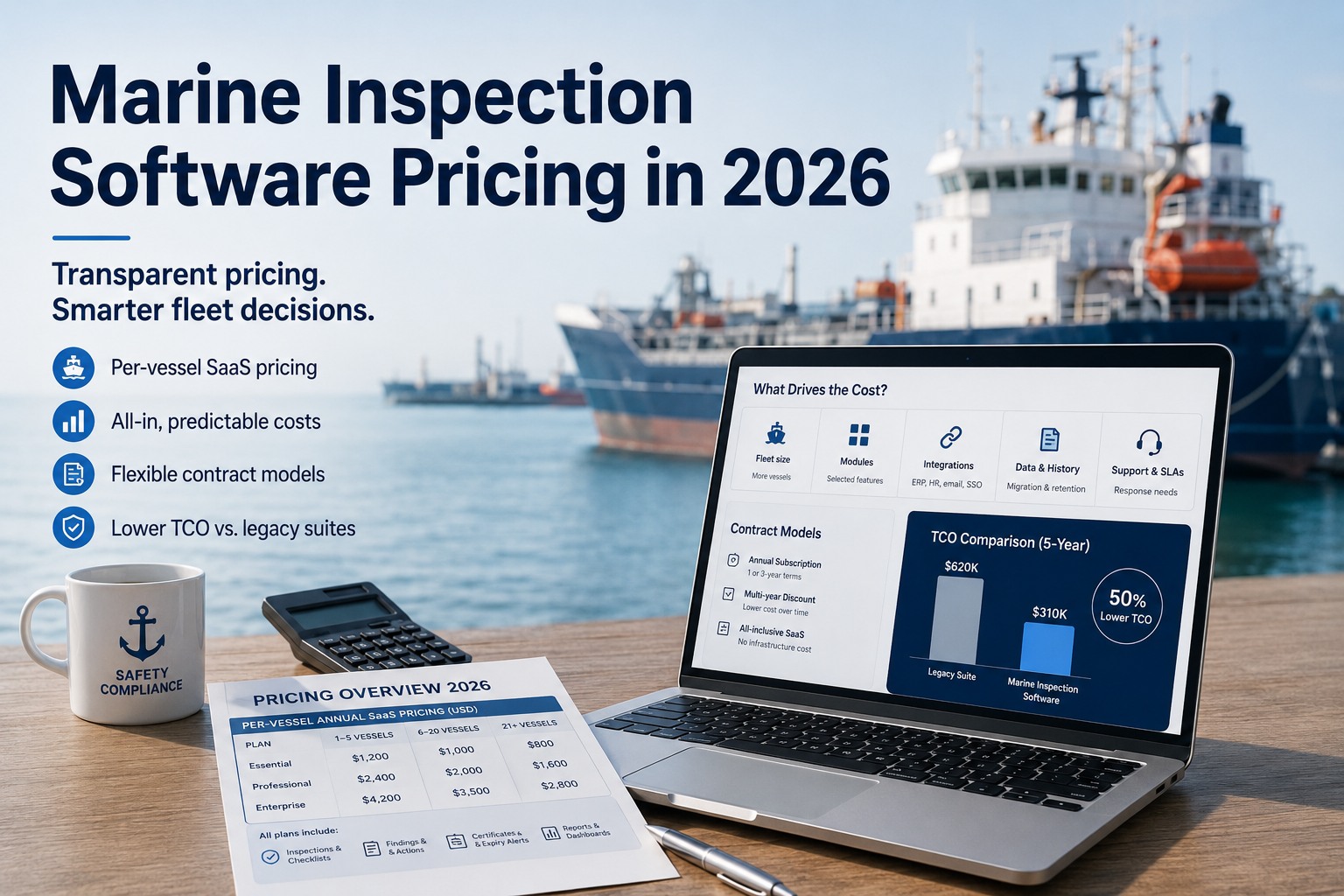
The first question most fleets ask about marine inspection software is also the hardest to get a straight answer to: what does it actually cost? Pricing in this market is famously opaque at the top end, where enterprise suites quote only on application and wrap the real number in multi-year contracts and implementation fees, and much clearer at the modern end, where platforms publish per-vessel bands you can budget against directly. The result is that two fleets can pay wildly different amounts for what looks like the same capability, and the sticker price on a proposal is rarely the number you end up living with once implementation, training and the features you never use are counted. This page cuts through that. It sets out what fleets genuinely pay in 2026 across the three pricing tiers, what actually drives your cost, the hidden lines that separate sticker price from total cost of ownership, and how the modern per-vessel model works — so you can budget realistically and know what to ask before signing anything. Because the exact figure for any fleet depends on its size, users and module mix, the most accurate number is always a fleet-specific one: to get yours, book a demo or start a free trial and price it against your own vessels.
BUYER RESOURCE · PRICING
Marine Inspection Software Pricing: What Fleets Actually Pay in 2026
Pricing runs from opaque enterprise quotes to transparent per-vessel bands. Here is what fleets genuinely pay across the three tiers, what drives your cost, the hidden lines behind total cost of ownership, and how the modern SaaS model works.
The Three Pricing Tiers
Marine inspection and management software divides cleanly into three commercial tiers, and knowing which one a platform sits in tells you most of what you need to know about its price, its contract and its fit. The ranges below reflect what the market reports in 2026.
Enterprise ERP
$50K–$500K+ / year
Custom quotes on application, not published
Typically three-year contracts
Add 20–30% first-year for implementation and services
Six-figure annual minimum common
Best fit: large multi-fleet operators with deep ERP-integration needs and dedicated IT.
Mid-market modular
$10K–$50K / vessel / year
Per-vessel pricing with technical-management depth
Module-based, often annual contracts
Moderate implementation overhead
Strong for maintenance-heavy operations
Best fit: mid-size fleets needing deep technical management within a broader suite.
Modern SaaS
Per-vessel base fee + add-ons
Transparent published bands, not custom quotes
Month-to-month flexibility, free trial available
Pay only for the modules you use
Deploys in 6–12 weeks, not 6–15 months
Best fit: commercial fleets wanting transparent terms, fast deployment and mobile-first adoption.
The gap between the tiers is not only price but predictability. Enterprise pricing is quoted case by case and locked into long contracts, while the modern SaaS tier publishes bands you can budget against and offers month-to-month flexibility with a free trial — so you can validate fit before committing rather than signing a multi-year deal on a custom quote. To price your fleet in the transparent tier, book a demo or start a free trial.
What Actually Drives Your Cost
Within any tier, the figure your fleet pays is shaped by a handful of variables. Understanding them lets you estimate your own position and see where cost can be controlled.
Number of vessels
The primary lever in per-vessel models — cost scales with the fleet, though many platforms taper the rate as vessel count rises.
Users per vessel
How many crew and shore staff need access, since some models price partly on seats alongside the per-vessel base.
Module mix
Which capabilities you enable — inspections, PMS, certificates, predictive AI, sustainability reporting — with modular platforms charging only for what you use.
Integration requirements
Connections to existing PMS, ERP or class portals, which can add cost and are a common source of hidden expense.
Implementation services
Data migration, configuration and training — modest for modern SaaS, but 20–30% of first-year cost for enterprise suites.
Contract term
Month-to-month versus multi-year, and any escalation clauses, which shape both flexibility and the true multi-year cost.
Sticker Price Is Not Total Cost
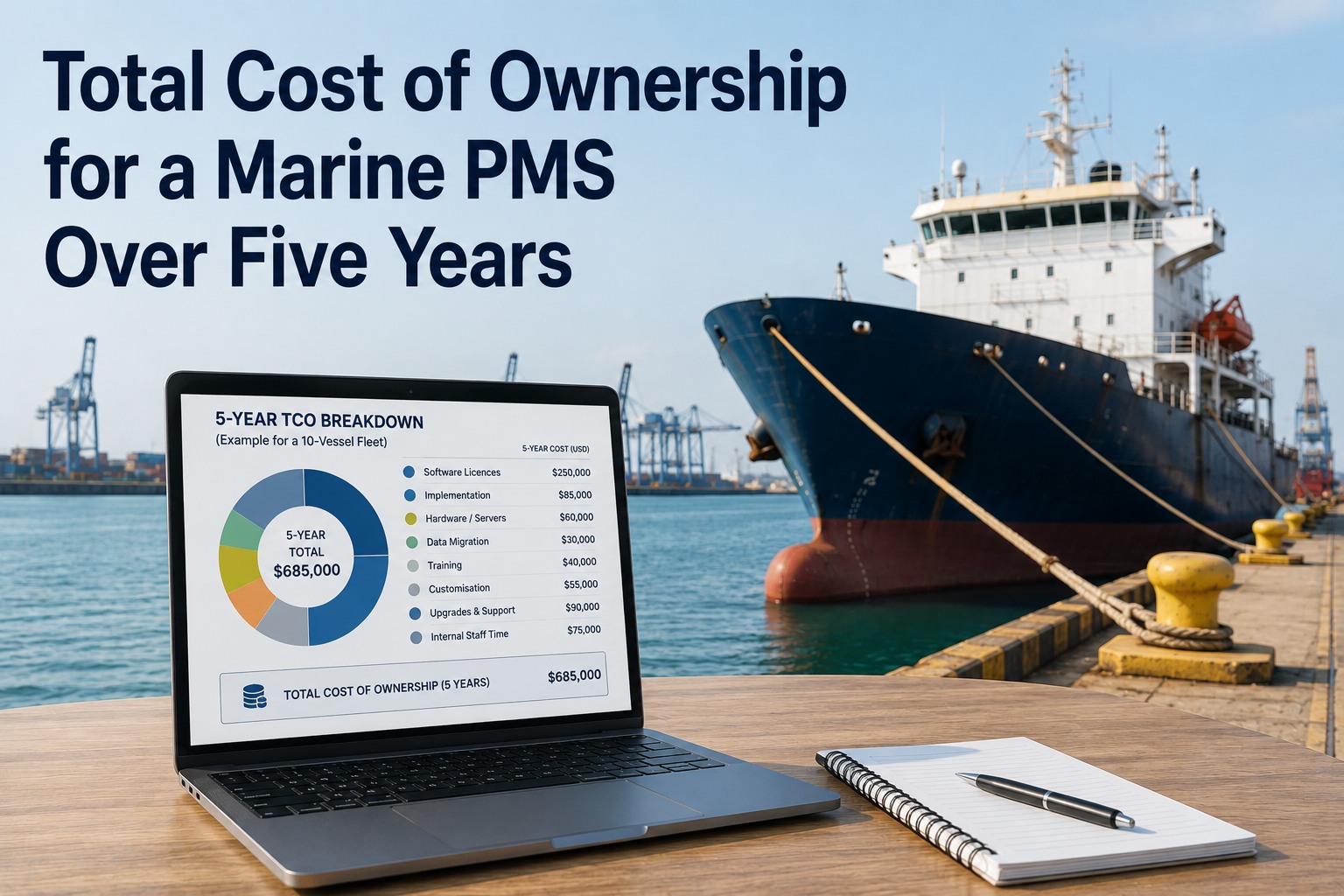
The single most important idea in software budgeting is that the number on the proposal is not the number you pay. Total cost of ownership includes several lines that the headline figure often omits, and the lowest sticker price is frequently not the lowest true cost once they are counted.
Count these before you compare
Implementation and professional services, often a large first-year addition on enterprise deals
Data migration from your existing paper, spreadsheet or legacy system
Training time and the productivity cost of a slow rollout
Integration work to connect PMS, ERP and class portals
Contract escalation clauses that raise the rate over a multi-year term
The cost of paying for modules and complexity you will never use
This is why deployment time belongs in the pricing conversation. A modern platform that reaches operational baseline in six to twelve weeks delivers value almost immediately, while a legacy suite taking six to fifteen months delays every benefit and carries months of parallel-running cost — so two platforms with similar sticker prices can have very different total costs once time-to-value is counted. To build a like-for-like total-cost view for your fleet, book a demo or start a free trial.
How the Modern Per-Vessel Model Works
The modern SaaS approach is built to be transparent and controllable, which is why it has become the default for most commercial fleets. Rather than a bundled six-figure contract, it charges a base per-vessel platform fee with modular add-ons layered on top, so operators pay for the capability they actually need and nothing they do not.
A fleet might run the core inspection and PMS modules across every vessel, add predictive AI on the vessels where it pays off, and enable sustainability reporting only where it is required — paying for each accordingly. The pricing is published in bands rather than negotiated case by case, so budgeting is straightforward, and the commercial terms favour the buyer: a free trial to validate fit with no commitment, and month-to-month flexibility instead of a multi-year lock-in. This model also removes the lock-in risk that makes enterprise contracts so consequential, because a fleet that finds the platform does not suit it is not trapped in a three-year deal. For most fleets, the combination of transparent per-vessel pricing, pay-for-what-you-use modularity, fast deployment and no lock-in is what makes the total cost both lower and far more predictable than the enterprise alternative. To see how the per-vessel model prices for your fleet specifically, book a demo or start a free trial.
Pricing It Against the Cost of Not Having It
A final piece of context makes the pricing conversation easier: the cost of the software should be weighed against the cost of the problems it prevents. Modern ships carry more than three hundred distinct pieces of machinery requiring regular maintenance surveys, and the consequences of missing something — a lapsed certificate, an unplanned failure at sea, a Port State Control detention — dwarf the annual cost of the platform that helps prevent them.
A single detention can cost from tens of thousands to over a million dollars once the full cascade is counted, and an expired certificate discovered on inspection draws fines in the thousands, while a maintenance-led CMMS is widely reported to cut maintenance costs by twenty to thirty per cent by shifting a fleet from fixing failures to preventing them. Against numbers like these, per-vessel software pricing is modest, and the return comes not only from efficiency but from the expensive events avoided. This is why the most useful way to evaluate price is not in isolation but against your fleet's own risk and inefficiency — which is exactly what a fleet-specific pricing conversation is for. To weigh the cost against the return for your own operation, book a demo or start a free trial.
Frequently Asked Questions
QHow much does marine inspection software cost per vessel?
It depends on the tier. Modern SaaS platforms charge a transparent per-vessel base fee with modular add-ons, published in bands you can budget against directly. Mid-market modular platforms typically run from around ten thousand to fifty thousand dollars per vessel per year, offering deeper technical-management functionality. Enterprise ERP suites are quoted differently, often from fifty thousand to over five hundred thousand dollars per year for the whole deal on custom quotes, with a six-figure annual minimum common. The right figure for your fleet depends on the number of vessels, users per vessel, the modules you enable, and your integration needs, so the most accurate number is always a fleet-specific quote. A demo or free trial lets you price it against your own vessels rather than working from tier averages.
QWhy do enterprise platforms not publish their prices?
Enterprise maritime ERP suites quote on application because their pricing is highly customised to each deal — bundling multiple modules, professional services, integration work and multi-year terms into a single negotiated contract, typically with a six-figure annual minimum and an additional twenty to thirty per cent in the first year for implementation. This model suits large multi-fleet operators with dedicated IT teams and deep integration requirements, but it makes budgeting difficult and comparison opaque, and it locks fleets into long contracts. The modern SaaS tier deliberately does the opposite, publishing per-vessel bands and offering month-to-month flexibility with a free trial, so smaller and mid-size fleets can see the price, validate fit without commitment, and avoid the lock-in risk of a multi-year enterprise deal signed on a custom quote.
QWhat hidden costs should I watch for?
The sticker price is rarely the total cost. Watch for implementation and professional-services fees, which can add a large amount in the first year on enterprise deals; data migration from your existing paper, spreadsheet or legacy system; training time and the productivity cost of a slow rollout; integration work to connect your PMS, ERP or class portals; contract escalation clauses that quietly raise the rate over a multi-year term; and the cost of paying for modules and complexity you will never use. Deployment time matters too, because a platform that takes six to fifteen months to go live delays every benefit and carries months of parallel-running cost, whereas a modern platform live in six to twelve weeks starts returning value almost immediately. Always build a total-cost-of-ownership view, not just a sticker comparison.
QIs cheaper software always better value?
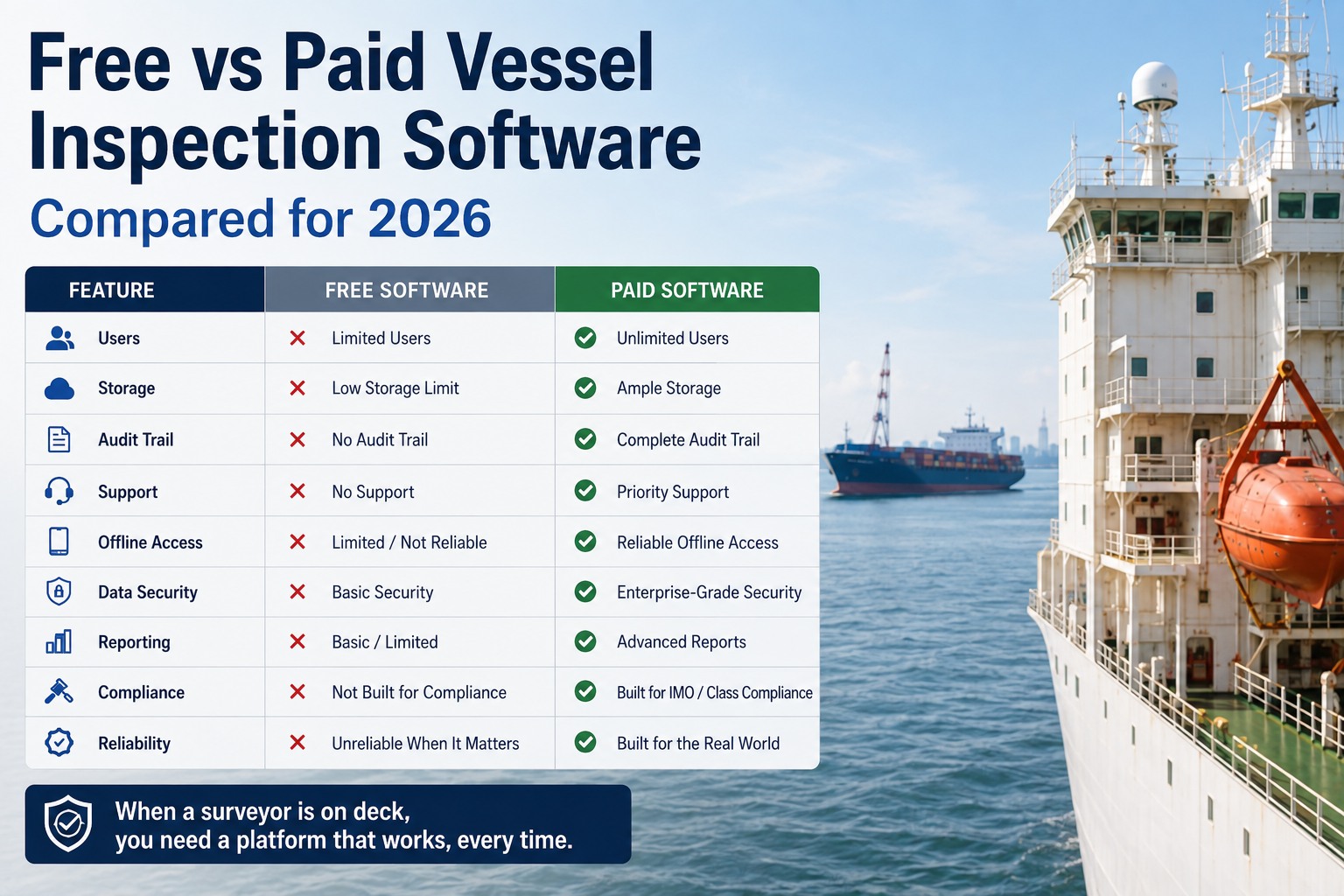
No — the lowest sticker price is frequently not the lowest total cost or the best value. A cheap platform that the crew will not adopt, that lacks genuine offline capability, or that takes many months to deploy can cost far more in lost value and workarounds than a slightly dearer one that is adopted quickly and works in real conditions. Equally, an expensive enterprise suite loaded with modules you never use is poor value regardless of its capability. The right lens is value for your fleet: the total cost of ownership set against the efficiency gained, the detentions and failures avoided, and the speed of return. A per-vessel platform that is transparently priced, fast to deploy and actually used typically delivers the strongest value for most commercial fleets, which is why fit and adoption matter as much as the headline number.
QCan I try the software before committing to a price?
Yes, if you choose a platform in the modern SaaS tier. A defining feature of that tier is a free trial with full functionality and month-to-month flexibility, which lets you validate fit and even run a pilot before any financial commitment — a marked contrast to enterprise suites that require a signed multi-year contract up front. Starting a free trial lets your team explore the platform, often pre-loaded with sample data, and confirm it works for your fleet before you discuss a formal quote. From there, a demo can price the platform precisely against your vessel count, users and module needs. This try-before-you-buy approach removes much of the risk from the decision, which is one of the main reasons the transparent SaaS model has become the default for commercial fleets.
The only price that matters is the one for your fleet — get a figure against your own vessel count, users and modules.